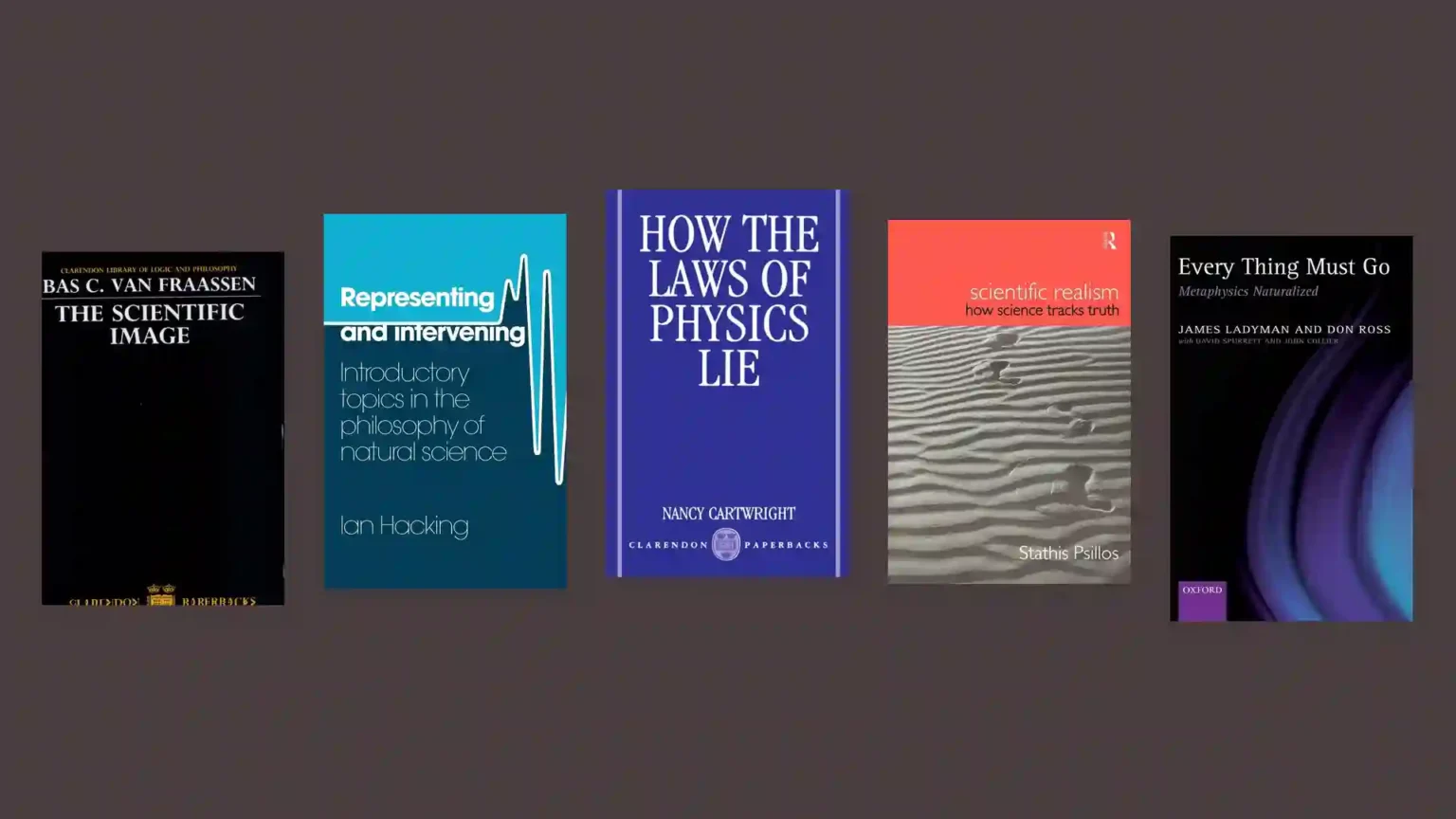
These books on scientific realism treat evidence, unobservable entities, explanation, and scientific change as different philosophical problems.
If your goal is to decide whether scientific realism is “true,” do not begin by buying seven defenses of the same thesis. Begin by deciding which realism problem you actually have. Is it about unobservable entities? The truth of theories? The status of laws? Experimental manipulation? Metaphysical structure? Theory change? Representation? The Stanford Encyclopedia overview is useful precisely because it separates metaphysical, semantic, and epistemic commitments that are too often bundled together. The seven books below are chosen to make those commitments collide rather than repeat one another.
1. Bas van Fraassen — The Scientific Image
The Scientific Image is the book to read first if you want the strongest pressure on realism from empiricism. Van Fraassen’s constructive empiricism asks science to aim at empirical adequacy rather than truth about unobservable structures. That is not the crude instrumentalist claim that theories are merely calculation devices. It is a disciplined refusal to make belief outrun what the observable phenomena require. Any realism that cannot answer this book is not yet a position; it is an intuition.
2. Ian Hacking — Representing and Intervening
Representing and Intervening changes the terrain by moving from theory to experiment. Hacking’s own preface tells readers that the second half, on intervening, can profitably be read first because philosophers had neglected experimental practice. The attraction is comparative: one may be cautious about the truth of a high-level theory while taking manipulated entities seriously. The book shows why “realism” need not rise or fall as one block.
3. Nancy Cartwright — How the Laws of Physics Lie
How the Laws of Physics Lie tests realism at the level of laws and models. Cartwright argues that the most powerful theoretical laws often describe idealized situations rather than the messy world directly. Yet her view is not simple antirealism: causal capacities and experimentally grounded entities may deserve more commitment than elegant universal equations. Put next to Hacking, the book forces a counterexample to the assumption that realism about entities, laws, and theories must travel together.
4. Paul Churchland — Scientific Realism and the Plasticity of Mind
Scientific Realism and the Plasticity of Mind takes the opposite risk. It defends a strong realism and asks what would happen if scientific categories reshaped perception and self-understanding rather than merely described a world already carved into common-sense kinds. The book is especially valuable because it makes realism psychologically ambitious: if science tells us what is there, perhaps learning science should transform what we are capable of noticing.
5. Stathis Psillos — Scientific Realism: How Science Tracks Truth
Scientific Realism: How Science Tracks Truth is the sustained defense to read once the main objections are on the table. Psillos addresses instrumentalism, constructive empiricism, underdetermination, the pessimistic induction from discarded theories, structural realism, reference, and truthlikeness. Read it after van Fraassen and Cartwright so that its arguments have clear adversaries. Otherwise its defense of realism can look like a single large thesis when it is actually a toolkit built against several different skeptical pressures.
6. Anjan Chakravartty — A Metaphysics for Scientific Realism
A Metaphysics for Scientific Realism asks a question many debates postpone: what exactly are realists committing themselves to when they accept the entities and structures posited by science? Realism has a metaphysical bill. Chakravartty’s project is valuable because it makes that bill explicit rather than allowing “approximately true” to do all the work. If Psillos is strongest on epistemic defense, Chakravartty is the better stress test for ontological precision.
7. Ladyman, Ross, Spurrett, and Collier — Every Thing Must Go
Every Thing Must Go is the final book because it radicalizes the metaphysical question. Its naturalized metaphysics rejects a world picture built from self-subsistent little objects and develops versions of structural realism constrained by contemporary science. The gain is boldness; the danger is that “taking science seriously” can itself conceal choices about which sciences, structures, and explanatory levels receive priority.
Two arguments every book must face
The first is the so-called no-miracles argument: the predictive and technological success of mature science would be surprising if its theories were not at least approximately right about important features of the world. Psillos develops that intuition into a defense of realism; van Fraassen replies that empirical success can be accepted without belief in unobservable ontology. The Stanford overview of scientific realism shows why the dispute is not settled by pointing to successful prediction alone: realists must explain what kind of success licenses what kind of belief.
The second is the pessimistic induction from the history of science. Past theories often succeeded and were later abandoned or substantially revised. If success once coexisted with false ontology, why should current success guarantee truth? Structural realism, selective realism, and entity realism are partly attempts to identify what survives historical change. This is why Every Thing Must Go and Representing and Intervening belong in the same reading set even though they defend very different realist commitments. One treats structure as metaphysically central; the other asks what experimental practice entitles us to say exists.
The seventh book is not the seventh vote
A reading list like this fails if it becomes a referendum. Churchland and Psillos do not simply cast two votes for realism while van Fraassen casts one against it. Cartwright can be realist about causal capacities while suspicious of the literal truth of fundamental laws. Hacking can be realist about experimentally manipulated entities without endorsing every theoretical description attached to them. Chakravartty’s metaphysical realism asks a different question again: once belief is granted, what sort of thing is being believed in? The disagreement is multidimensional.
The comparison that matters
| Book | Realism pressure point | Best counterquestion |
|---|---|---|
| The Scientific Image | Observable vs unobservable | Why believe more than empirical adequacy requires? |
| Representing and Intervening | Experiment and entities | Does successful manipulation warrant realism? |
| How the Laws of Physics Lie | Laws and idealization | Can useful laws misdescribe reality? |
| Scientific Realism and the Plasticity of Mind | Scientific categories | Should science revise common sense? |
| Scientific Realism | Truth and theory change | Can realism survive abandoned theories? |
| A Metaphysics for Scientific Realism | Ontological commitment | What exactly must a realist believe exists? |
| Every Thing Must Go | Structure and naturalized metaphysics | Is structure more fundamental than objects? |
One temptation now becomes visible: treating realism and antirealism as two teams. The actual field is more interesting. Van Fraassen can reject belief in unobservables while Hacking accepts some experimental entities; Cartwright can distrust fundamental laws while defending causes; structural realists can abandon traditional object metaphysics while calling themselves realists. Even BookInLight’s discussion of Richard Rorty and pragmatism belongs nearby as a different challenge to representational pictures of knowledge, though Rorty should not be collapsed into constructive empiricism or philosophy-of-science antirealism.
The set is therefore deliberately asymmetrical: some books defend realism, some reject it, and some split the position into local commitments. That asymmetry is the point.
A reading order that keeps the debate open
Start with van Fraassen because he forces the realist to say what exceeds empirical adequacy. Follow with Hacking because experiment disrupts a purely theory-centered argument. Then read Cartwright: her attack on the literal truth of fundamental laws prevents “entity realism” from becoming a blanket endorsement of scientific theory. Only after those pressures are visible should Psillos supply the sustained realist defense. Chakravartty then asks what metaphysical commitments that defense requires, while Churchland tests how radically scientific ontology might revise ordinary categories. Finish with Every Thing Must Go, where realism becomes a proposal about structure and naturalized metaphysics rather than merely belief in electrons or genes.
Peter Godfrey-Smith’s Theory and Reality can serve as a neutral companion if the terminology becomes dense. It is not one of the seven because its job is cartographic rather than partisan: it explains how logical empiricism, Popper, Kuhn, realism, Bayesianism, and later debates fit into one history of philosophy of science. Used between the primary books, it can prevent a disagreement over one dimension of realism from being mistaken for a disagreement over all of them.
For a first pass, read van Fraassen and Hacking as a pair, then Psillos. Add Cartwright if models and explanation are your problem, Chakravartty if metaphysics is your problem, Churchland if you care about the conceptual impact of science, and Every Thing Must Go if structural realism is the destination. The point of seven books is not completeness. It is to stop one word—“realism”—from hiding seven different arguments.
The next question is forced by the comparison: which scientific successes actually deserve realist commitment, and at what level—entities, causal powers, structures, models, laws, or whole theories? A serious realist position begins only after that choice is made.
Cover artwork: credits and source records
- The Scientific Image — Oxford University Press (source record)
- Representing and Intervening — Cambridge University Press (source record)
- How the Laws of Physics Lie — Oxford University Press (source record)
- Scientific Realism: How Science Tracks Truth — Routledge (source record)
- Every Thing Must Go — Oxford University Press (source record)