How to Start Reading Dostoevsky is less a question of finding his shortest book than of entering the right moral and psychological atmosphere. Fyodor Dostoevsky matters because his novels turn guilt, freedom, faith, humiliation, ideology, cruelty, and compassion into dramatic conflicts between unforgettable people. Beginners often struggle because the books are crowded, emotionally extreme, philosophically charged, and translated into English in noticeably different styles. This guide offers a five-book route from the most accessible major novel to the works that demand greater patience. It is a structured entry point, not a definitive ranking.
At Bookinlight, reading paths are designed to help serious readers begin without reducing difficult writers to slogans or shopping lists.
Introduction
Dostoevsky should not be approached as a novelist who hides a tidy philosophical system inside fictional plots. His ideas live through competing voices, reversals, confessions, evasions, jokes, scandals, and acts of violence or mercy. A character may express a brilliant argument and still be self-deceived; another may appear foolish while seeing the moral situation more clearly. How to Start Reading Dostoevsky therefore depends on learning to hear disagreement rather than searching too quickly for the author’s final verdict. The sequence below begins with narrative momentum, moves into the underground psychology beneath it, and then expands toward faith, radical innocence, and political possession.
The shortest honest answer
How to Start Reading Dostoevsky: begin with Crime and Punishment because it combines a gripping plot with the central Dostoevskian problems of pride, guilt, suffering, and moral rebirth. Then read Notes from Underground for the voice of wounded self-consciousness beneath those problems, followed by The Brothers Karamazov for the fullest confrontation between faith, doubt, freedom, and responsibility. Continue with The Idiot to test whether radical goodness can survive social life, and finish this first path with Demons, where private resentment becomes political contagion. The later books deepen and complicate what the first two make immediately visible.
Before you start: how to approach Dostoevsky
The main beginner problem is not insufficient historical knowledge. A practical answer to How to Start Reading Dostoevsky begins by correcting the expectation that every scene will advance the plot cleanly or that every long speech represents Dostoevsky’s own position. Read the novels first as dramas of consciousness. Track what each speaker wants, what humiliation or desire drives the speech, and how another character answers. Dostoevsky’s crowded rooms, interrupted conversations, sudden entrances, and public scandals are part of the thinking. The ideas are not detachable lectures; they acquire meaning through the person who risks, distorts, or suffers them.
You do not need to read chronologically. Beginning with the early fiction can make the author seem slighter than he becomes, while beginning with the late masterpieces can bury a new reader under too many characters and theological disputes. A compact scholarly orientation is useful, but it should remain secondary. Deborah Martinsen’s Oxford introduction to Dostoevsky is a credible guide to his life, major works, and recurring themes if you want context alongside the novels.
The misconception to avoid is that Dostoevsky is simply a preacher of suffering or an early existentialist with fictional illustrations. His work is far more unstable. Belief is tested by doubt, freedom can become self-destruction, compassion can become domination, and intelligence can rationalize cruelty. Read slowly enough to notice changes in tone, but do not stop for every allusion. On a first reading, keep a small character list, note variant names and patronymics, and preserve the emotional momentum of the scenes.
The best first book on Dostoevsky
Start with: Crime and Punishment
Crime and Punishment is the strongest first encounter because it gives a beginner nearly everything essential without requiring prior familiarity with Russian intellectual history. The murder plot creates forward pressure, Raskolnikov’s feverish mind provides psychological intimacy, and the conflict between abstract justification and embodied suffering establishes a pattern that returns throughout the later novels. The book also teaches you how Dostoevsky handles ideas: not as stable propositions, but as forces that possess a person, fracture relationships, and collide with inconvenient human reality.
What it does not give is the full polyphonic scale of The Brothers Karamazov, the political reach of Demons, or the sustained experiment in goodness found in The Idiot. It is best for readers who want narrative urgency while learning Dostoevsky’s moral vocabulary. Immediately afterward, read Notes from Underground. Its shorter, harsher voice reveals the resentful logic and compulsive self-sabotage that help explain not only Raskolnikov but many later Dostoevskian characters. For most readers asking How to Start Reading Dostoevsky, this pairing is more effective than beginning with either the shortest story or the largest masterpiece.
The core reading sequence
Crime and Punishment
Crime and Punishment belongs first because it lets narrative suspense carry the philosophical weight. Raskolnikov is not merely a murderer awaiting detection. He is a young man testing whether intelligence, exceptional status, and a supposedly beneficial purpose can release him from ordinary moral limits. Dostoevsky makes the theory compelling enough to be dangerous, then exposes how quickly it breaks down when translated into blood, bodily fear, chance encounters, and the stubborn existence of other people. The reader should watch the gap between Raskolnikov’s explanations and his behavior. His actions often reveal motives that his theories conceal: wounded pride, isolation, the desire to prove himself, and a longing to cross a boundary simply because it is there.
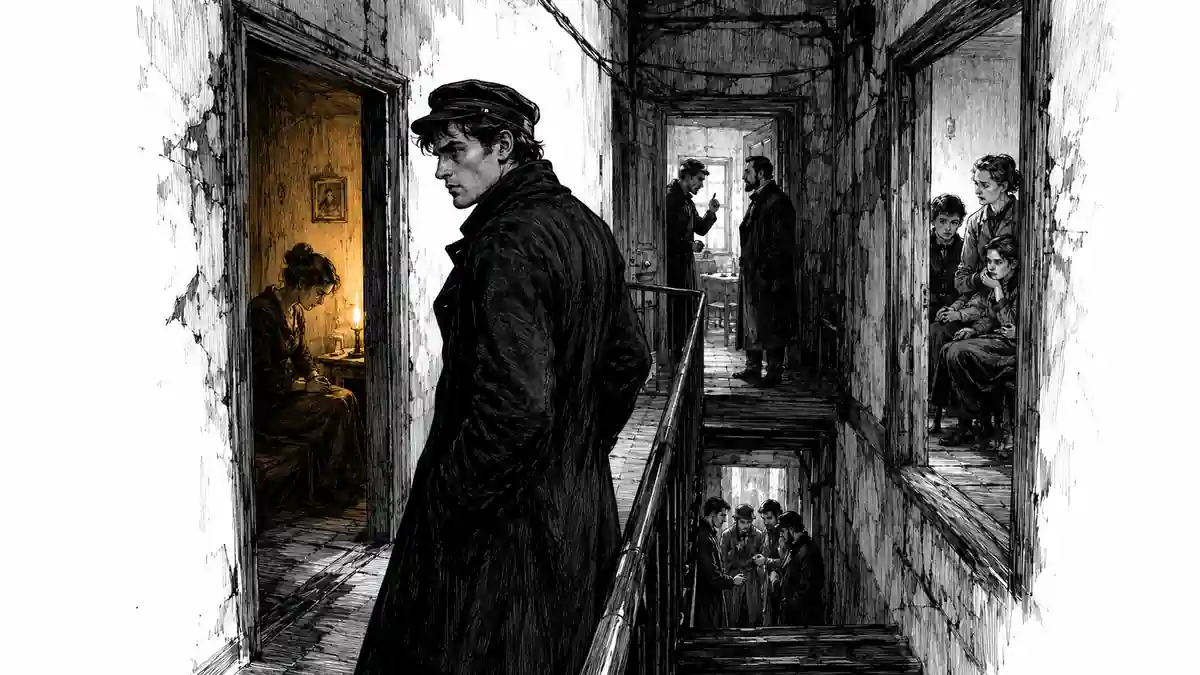
At this stage, pay special attention to the novel’s physical world. Petersburg is crowded, hot, dirty, noisy, and economically brutal. Rooms are cramped; conversations become public; money travels through humiliating exchanges. This material pressure prevents the book from becoming an abstract debate about crime. Sonya, Porfiry, Dunya, Razumikhin, and Svidrigailov each offer a different response to freedom and suffering, and none can be reduced to a simple moral label. Porfiry’s psychological pursuit is especially important because it mirrors the reader’s task: he listens for contradictions, recognizes performance, and waits for a person to become unable to live inside his own explanation.
The novel’s limitation for a beginner is also its advantage. Its structure can make Dostoevsky appear more orderly than he usually is. Later books are looser, more crowded, and more openly argumentative. Do not treat the ending as a neat cancellation of everything that came before. The epilogue announces a possibility rather than completing a simple conversion. Read it as the beginning of a moral problem: whether a person can move from abstract superiority toward responsibility for concrete others. That question opens the rest of the sequence.
Difficulty: Beginner
“I was delighted to discover Oliver Ready’s new translation of Crime and Punishment. It is brimful of a young man’s rage and energy and bullshit.”
— Peter Carey • Penguin Classics: Crime and Punishment
Notes from Underground
Notes from Underground comes second because it strips away the crime plot and places the reader inside a voice that argues, retreats, attacks, revises, anticipates objections, and humiliates itself before anyone else can. The Underground Man is intelligent enough to expose shallow theories of rational self-interest, social engineering, and predictable human behavior. Yet his intelligence does not free him. It becomes an instrument of resentment and paralysis. He values freedom so intensely that he would choose suffering or absurdity merely to prove that no formula can fully determine him. The result is one of literature’s most concentrated studies of consciousness turning against itself.
Read the first part as a performance rather than a philosophical treatise. The narrator wants to dominate the reader, but he also wants recognition. He mocks confidence while craving superiority; he rejects the world while imagining how the world sees him. In the second part, the abstractions acquire social bodies. His encounters with former schoolmates, an officer, a servant, and Liza reveal that humiliation moves in cycles. A person who feels powerless may seek someone more vulnerable to injure. Dostoevsky’s crucial insight is not merely that wounded people wound others, but that self-awareness does not automatically prevent cruelty. The Underground Man can describe his motives with extraordinary precision and still repeat them.
The difficulty lies in the narrator’s deliberate unpleasantness and the density of the polemic. Readers often either identify with him too quickly or dismiss him as a pathological exception. Both reactions miss the book’s force. He exaggerates tendencies that ordinary consciousness prefers to hide: spite disguised as principle, imagined audiences, retrospective revenge, and the desire to preserve grievance because grievance gives the self a shape. After Crime and Punishment, the novella teaches you to distrust eloquent self-explanation. It also prepares you for Ivan Karamazov, Ippolit, Stavrogin, and the ideological talkers of Demons, all of whom inhabit more complex versions of the underground.
Difficulty: Moderate
“I began to see connections between Dostoevsky’s work and the literary, philosophical and sociocultural situation in Russia at the time he was writing.”
— Joseph Frank • Stanford Magazine
The Brothers Karamazov
The Brothers Karamazov belongs at the center of the route, not at the beginning, because it gathers nearly every major Dostoevskian problem into a vast family drama. The conflict among Fyodor Pavlovich and his sons is at once domestic, legal, erotic, theological, and philosophical. Dmitri lives through appetite and honor, Ivan through intellectual rebellion, Alyosha through active love, and Smerdyakov through grievance, servitude, and insinuation. These are not fixed allegorical positions. Each voice changes under pressure, borrows from the others, and reveals contradictions that no summary can settle.
The reader should resist treating “Rebellion” and “The Grand Inquisitor” as detachable philosophical essays. Their power depends on Ivan’s relation to Alyosha, the family’s history of neglect, and the approaching crime. Ivan’s protest against innocent suffering is not a classroom puzzle; it emerges from a person who longs for moral order yet refuses any harmony purchased with a child’s pain. Alyosha’s response is likewise not a counterargument in the conventional sense. Dostoevsky stages thought as relationship: speech, silence, gesture, memory, and responsibility. The novel’s famous multiplicity of voices becomes a moral form because no person is understood from only one perspective.
This is the first demanding book in the sequence. The opening monastery sections can feel slow, names multiply, and the novel’s architecture becomes clear only gradually. Keep reading through the early accumulation. The murder investigation and trial eventually concentrate the dispersed tensions, but the deepest question is broader than legal guilt. Who is responsible for an act when several people desired it, enabled it, imagined it, or withdrew at the decisive moment? The book expands guilt from private conscience into shared moral implication. Its limitation is deliberate incompletion: Dostoevsky planned further development for Alyosha, and the surviving novel leaves important futures open. Still, it offers the fullest experience of his art before you turn to the more unstable experiments of The Idiot and Demons.
Difficulty: Demanding
“Although Fyodor Dostoyevsky wrote with wildness and urgency, he patiently insisted on asking an essential question: What are we living for?”
— Karl Ove Knausgaard • The New Yorker
The Idiot
The Idiot should follow The Brothers Karamazov because it is easier to appreciate once you have learned not to demand perfect structural control from Dostoevsky. Prince Myshkin returns to Russia with openness, compassion, and an almost radical inability to participate in ordinary social calculation. The novel asks what happens when a “positively beautiful” person enters a world organized by money, erotic rivalry, wounded pride, spectacle, and possession. Myshkin sees pain that others overlook, but perception does not give him the power to save anyone. His compassion may comfort, expose, confuse, or unintentionally intensify the crises around him.
Focus on the triangular relations among Myshkin, Nastasya Filippovna, Rogozhin, and Aglaya. Nastasya is not simply a fallen woman awaiting rescue. She has internalized the judgment imposed on her, turns shame into theatrical power, and repeatedly tests whether anyone can love her without owning, pitying, or idealizing her. Rogozhin’s desire reduces love to possession, while Myshkin’s compassion risks failing to recognize the difference between loving a person and responding to suffering. Aglaya, meanwhile, wants nobility without humiliation and struggles with the public role assigned to Myshkin. The novel’s emotional intelligence lies in showing that good intentions do not escape the complexity of other people’s freedom.
Its difficulty is formal. The plot can feel episodic, conversations stretch, and characters change direction with startling speed. Rather than forcing the book into a clean moral diagram, follow recurring images: illness, beauty, execution, the Holbein painting of the dead Christ, money thrown into the fire, and faces interpreted by other faces. These motifs ask whether beauty saves, wounds, deceives, or reveals. The novel adds a crucial correction to any reading of Dostoevsky as a writer who simply opposes evil with Christian goodness. Goodness itself becomes vulnerable, socially unintelligible, and perhaps insufficient when it lacks practical judgment. That failure is what makes the book tragic rather than reassuring.
Difficulty: Demanding
“The Idiot is Dostoevsky’s book about a good man. Interestingly enough, Prince Myshkin’s goodness represents itself not in virtue but in innocence.”
— John Rosenthal • The Sun Magazine
Demons
Demons comes last because it assumes that the reader can already tolerate Dostoevsky’s crowded cast, unstable narration, ideological argument, grotesque comedy, and sudden violence. Inspired partly by a real political murder, the novel examines how ideas move through vanity, generational resentment, boredom, ambition, and group pressure. It is not a neutral anatomy of all politics, nor is it reducible to a conservative warning against revolution. Dostoevsky is interested in the conditions under which human beings begin to treat other people as material for a project, a test, or a future abstraction.
Watch the contrast between intellectual prestige and actual character. Stepan Trofimovich performs the role of an old liberal intellectual; Pyotr Verkhovensky turns organization, gossip, secrecy, and manipulation into political technique; Stavrogin becomes a vacant center onto which others project greatness, transgression, or leadership. Shatov and Kirillov pursue opposed responses to spiritual crisis, yet both remain entangled in the same network. The group’s ideology matters, but so do embarrassment, rivalry, sexual history, status anxiety, and the desire to belong to something decisive. Political possession works because it recruits private weaknesses rather than replacing them.
The beginning is intentionally slow and comic. Do not abandon the novel before its social map forms. The early provincial absurdity establishes the habits that later make catastrophe possible: people speak in roles, reputations outrun reality, and small manipulations accumulate. Depending on the translation, the suppressed chapter commonly called “At Tikhon’s” may appear in an appendix or restored position. Read it, but note that its publication history and placement affect how Stavrogin is interpreted. The book’s limitation is its polemical pressure; some figures are caricatured, and its political judgments require historical caution. Yet after the previous four works, Demons becomes the necessary culmination of a beginner’s route. It shows the underground escaping the solitary room, becoming a circle, and finally entering public life as organized irresponsibility.
Difficulty: Advanced
“What makes the novel prophetic, however, is not so much how closely Dostoevsky’s ideas approximate their twentieth-century counterparts as how deadly he makes any idea.”
— Michael Henry Heim • Los Angeles Times
How these books fit together
How to Start Reading Dostoevsky becomes clearer when the sequence is understood as an expanding scale of responsibility. Crime and Punishment begins with an individual theory tested through a crime. Notes from Underground moves backward into the resentful consciousness capable of producing such theories. The Brothers Karamazov enlarges the problem into family, faith, law, and shared guilt. The Idiot asks whether compassion and innocence can interrupt destructive desire. Demons then carries self-deception into political organization, where private wounds become collective methods.
The path also moves from relative narrative orientation toward increasingly unstable form. That progression matters. By the time you reach the later books, you will recognize that Dostoevsky’s disorder is often purposeful: a world of competing voices cannot be presented as a calm lecture. His relation to existential thought is useful but should remain historically careful; the Stanford Encyclopedia of Philosophy’s account of existentialism places Dostoevsky among literary precursors without pretending that he belongs neatly to a later philosophical school.
Common beginner mistakes
Mistaking a character for the author. Ivan, the Underground Man, Kirillov, and other powerful speakers articulate positions the novels dramatize rather than simply endorse.
Reading only for philosophical quotations. Detached passages lose the shame, desire, irony, and relationship that give them meaning.
Panicking over Russian names. Keep a brief list of first names, patronymics, surnames, and nicknames; recognition becomes easier after the first hundred pages.
Expecting polished realism. Repetition, interruption, melodrama, and abrupt tonal shifts are often structural features, not accidental defects.
Turning How to Start Reading Dostoevsky into a completion challenge. A slower reading of three books is more valuable than racing through the canon without hearing the voices.
Optional paths depending on your interest
If you are interested in psychological suspense and moral guilt, read Crime and Punishment.
If you are interested in alienation, free will, and self-sabotage, read Notes from Underground.
If you are interested in faith, doubt, family, and ethical responsibility, read The Brothers Karamazov.
If you want a more advanced path through ideology and political violence, read Demons.
FAQ
Which English translation of Dostoevsky should a beginner choose?
Choose a complete modern edition with notes and a character list, then sample a page before committing. Oliver Ready is especially lively for Crime and Punishment; Pevear and Volokhonsky preserve verbal roughness and recurring terms; David McDuff is clear and well annotated. Consistency and readability matter more than finding a universally “best” translator.
Should I read introductions before the novels?
Read the translator’s note and basic historical chronology first, but save interpretive introductions until afterward when they reveal major plot developments. Dostoevsky’s surprises are not merely mechanical; discovering how an argument grows from a relationship is part of the reading experience.
How much Russian history do I need to understand the novels?
A basic grasp of serf emancipation, the intelligentsia, Orthodox Christianity, censorship, radical movements, and nineteenth-century Petersburg is enough for a first reading. Use endnotes when a specific debate matters; do not postpone the fiction until you have mastered imperial Russian history.
How is this Dostoevsky reading order different from a university syllabus?
A syllabus may begin chronologically, assign criticism, and emphasize historical coverage. This guide to How to Start Reading Dostoevsky prioritizes momentum and conceptual preparation: each book trains you to hear the more difficult voices and structures of the next one.
Illustration credit: Bookinlight