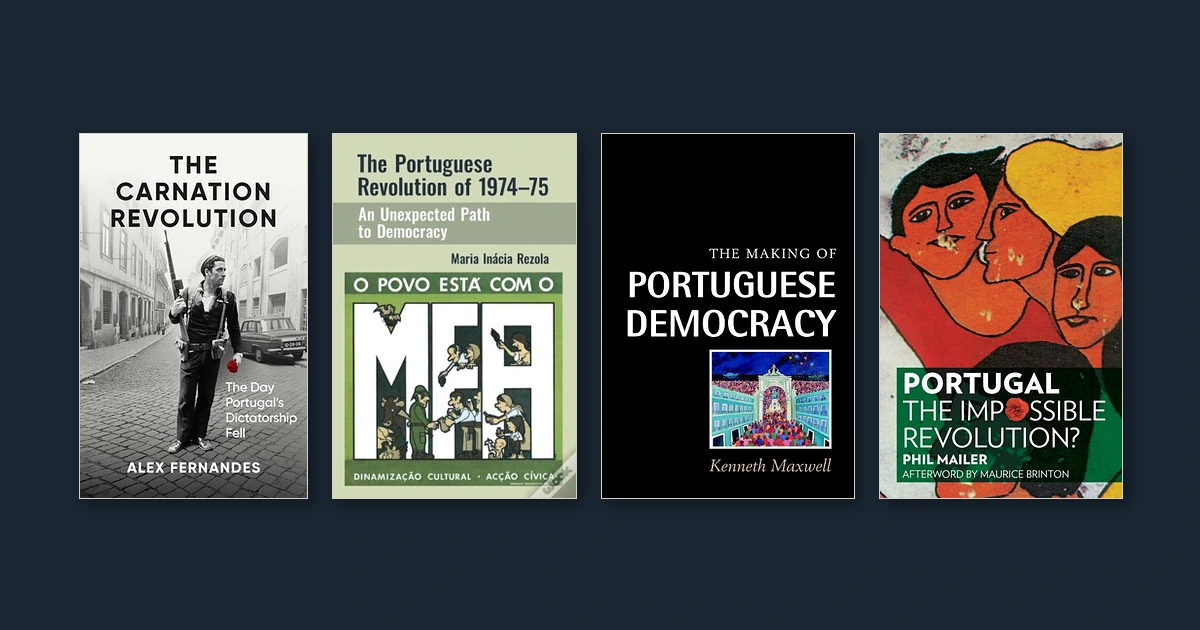
The best books on the Carnation Revolution resist the postcard image of flowers in rifle barrels. They reconstruct a military rupture, an anti-colonial reckoning, a struggle over popular power, and the difficult conversion of revolutionary possibility into democratic institutions. Read together, these five books make 25 April 1974 a beginning rather than a self-contained miracle.
The Short Answer
The best books on the Carnation Revolution begin with Alex Fernandes for narrative orientation, then move to Maria Inácia Rezola for the political machinery of 1974–75. Kenneth Maxwell supplies the imperial and international frame; Raquel Varela restores workers and neighborhood movements; Phil Mailer closes the sequence with a partisan eyewitness account of revolutionary possibility.
This is an argumentative route rather than a simple chronology. Fernandes shows how the dictatorship fell. Rezola asks how a coup became an open-ended revolution. Maxwell explains why decolonization, Western strategy, and European realignment shaped the settlement. Varela and Mailer then contest any history that ends with elite bargains alone. The strongest first scholarly book is Rezola; the most inviting first book is Fernandes.
Why the best books on the Carnation Revolution must move beyond one day
The familiar image—soldiers, crowds, carnations—captures the ethical beauty of 25 April while risking historical compression. The Armed Forces Movement overthrew the Estado Novo, but the unresolved colonial wars had already fractured military authority. In the following nineteen months, governments rose and fell, parties competed with military factions, workplaces formed commissions, land was occupied, banks and industries were nationalized, and decolonization transformed both Portugal and Africa.
The central dispute is therefore definitional. Was this principally a democratic transition initiated by officers, a social revolution redirected into parliamentary government, an imperial collapse, or several processes colliding? No single book can answer without privileging a scale of analysis. These five belong together because they move between street, barracks, ministry, colony, workplace, and diplomatic arena—and because their disagreements expose what smooth commemorative narratives leave out.
From military rupture to contested democracy
Read the revolution as a contest over political authorship. Officers opened the breach, but they did not control every force released by it. Parties sought electoral legitimacy; workers and residents built local organs of action; anti-colonial movements destroyed the imperial horizon; foreign governments watched Portugal as a strategic test. The question is not simply who “won,” but which institutions converted uncertainty into durable authority—and which emancipatory possibilities were narrowed, absorbed, or defeated along the way.
1 · Narrative entry
The Carnation Revolution: The Day Portugal’s Dictatorship Fell
Author: Alex Fernandes
Recommended edition: Oneworld Publications hardcover, 2024, ISBN 9780861547548
Best for: A vivid reconstruction of the coup and its human actors
Difficulty: General
Intellectual role: Narrative orientation before interpretation
BookInLight Rating: ★★★★★
Fernandes writes close to the clock, the street, and the individual decision. Coded radio signals, hesitant officers, disobedient soldiers, political prisoners, and civilians entering spaces they had been told to avoid give the overthrow its contingency. This is the book most likely to make a newcomer understand why the day felt miraculous without reducing it to myth. Its concentration on the coup is also its limit: the social revolution and institutional struggle that followed require Rezola, Varela, and Maxwell.
BookInLight note: Read for sequence and atmosphere; mark every point at which a military plan depends on civilian action.
2 · Archival synthesis
The Portuguese Revolution of 1974–1975: An Unexpected Path to Democracy
Author: Maria Inácia Rezola
Recommended edition: Liverpool University Press paperback, 2023, ISBN 9781789761832
Best for: The strongest single scholarly overview in English
Difficulty: Intermediate
Intellectual role: Explains the passage from coup to revolution to constitutional order
BookInLight Rating: ★★★★★
Rezola organizes the period around three protagonists: the armed forces, political parties, and mass social organizations. That triangular method prevents the military from becoming a single actor and the public from becoming a cheering background. Archival documents, government records, and oral testimony reveal competing centers of authority inside the revolutionary process. Begin here when the question is not merely what happened, but why democratic normalization emerged from a field that contained several rival futures.
BookInLight note: Rezola is the hinge of the list: every other book enlarges, dramatizes, or disputes one part of her institutional map.
3 · International frame
The Making of Portuguese Democracy
Author: Kenneth Maxwell
Recommended edition: Cambridge University Press paperback, 1997, ISBN 9780521585965
Best for: Decolonization, European orientation, and foreign pressure
Difficulty: Intermediate
Intellectual role: Connects domestic revolution to empire and the Cold War
BookInLight Rating: ★★★★★
Maxwell refuses the comforting fiction that Portugal’s revolution unfolded inside national borders. The colonial wars helped produce the officers’ revolt; African independence transformed Portugal’s geopolitical position; European governments and the United States treated Lisbon’s instability as a Cold War problem. His long perspective also explains why democratic consolidation meant a new European orientation after centuries of imperial projection. Read after Rezola: the institutional contest then appears inside a wider collapse of empire and redistribution of power in southern Africa.
BookInLight note: Maxwell’s scale corrects both romantic localism and narrow transition theory.
4 · Revolution from below
A People’s History of the Portuguese Revolution
Author: Raquel Varela
Editor: Peter Robinson; Translator: Sean Purdy
Recommended edition: Pluto Press paperback, 2019, ISBN 9780745338576
Best for: Workers, women, residents’ commissions, strikes, and agrarian reform
Difficulty: Intermediate
Intellectual role: Re-centers popular agency and social conflict
BookInLight Rating: ★★★★★
Varela asks what the revolution looks like when cabinet changes cease to be the only rhythm. Strikes, workers’ commissions, neighborhood organizing, women’s struggles, housing occupations, self-management, and land reform become institutions of political thought in action. Her Marxist interpretation is explicit, and some readers will resist its definition of “the people” or its judgment of party mediation. That is precisely why the book belongs here: it makes visible the social revolution that transition narratives can domesticate into background pressure.
BookInLight note: Pair Varela with Rezola whenever “popular mobilization” sounds too abstract; Varela supplies the workplaces, neighborhoods, and demands.
5 · Eyewitness dissent
Portugal: The Impossible Revolution?
Author: Phil Mailer
Afterword: Maurice Brinton
Recommended edition: PM Press paperback, 2012, ISBN 9781604863369
Best for: Revolutionary mood, committees, factions, and libertarian socialist critique
Difficulty: Intermediate
Intellectual role: Participant testimony that resists retrospective inevitability
BookInLight Rating: ★★★★★
Mailer’s account is openly partisan, sometimes impatient with organizations, and invaluable for exactly those reasons. Written from inside the libertarian left, it follows worker, tenant, soldier, peasant, and student committees as living alternatives to both capitalist restoration and party command. It cannot substitute for Rezola’s archival balance or Maxwell’s geopolitical range. Read last, however, it restores uncertainty: participants did not yet know that later historians would call one outcome consolidation and another impossibility.
BookInLight note: Treat the polemic as evidence—not only about events, but about what radical participants believed the revolution could become.
How These Books Speak to One Another
Fernandes and Mailer occupy opposite ends of historical time. Fernandes reconstructs the precision required to topple a regime; Mailer records the disorder released once precision ceased to govern events. Rezola stands between them, showing how military pluralism, party strategy, and mass action repeatedly altered one another. Her account makes clear why neither “officers delivered democracy” nor “the people made the revolution” is adequate alone.
Maxwell and Varela quarrel productively over scale. Maxwell tracks empire, diplomacy, Europe, and the architecture of democratic consolidation. Varela follows social reproduction, labor, housing, and workplace control. Each reveals the other’s blind spot: international history can make popular politics look reactive; history from below can understate the constraints imposed by decolonization and foreign power. The best books on the Carnation Revolution work as a set because the event changes meaning when the lens changes.
The Reading Map
| Book | Difficulty | Rating | Why It Matters |
|---|---|---|---|
| The Carnation Revolution | General | ★★★★★ | Makes the coup legible. |
| The Portuguese Revolution | Intermediate | ★★★★★ | Maps competing authorities. |
| Making Democracy | Intermediate | ★★★★★ | Adds empire and diplomacy. |
| A People’s History | Intermediate | ★★★★★ | Restores popular power. |
| Impossible Revolution? | Intermediate | ★★★★★ | Preserves lived uncertainty. |
Where to Begin
- Entry point: Read Fernandes over a weekend for the coup’s people, geography, and pace.
- Historical structure: Give Rezola several focused sessions; it supplies the indispensable map of armed forces, parties, and social organizations.
- Imperial and international correction: Move to Maxwell before treating the outcome as a purely domestic choice.
- Social depth: Read Varela for labor, housing, gender, rural conflict, and the institutions of popular power.
- Advanced reflection: Finish with Mailer, allowing his eyewitness polemic to test every retrospective claim of inevitability.
What the Carnations Cannot Settle
For accessibility, Fernandes is the best first book; for the strongest balance of evidence and interpretation, Rezola is the essential center. The full sequence reveals something neither commemorative memory nor transition theory can contain alone: Portugal’s democracy emerged from an anti-authoritarian victory, imperial collapse, social insurgency, institutional bargaining, and the defeat of other possible orders.
That is the final value of the best books on the Carnation Revolution. They preserve the flowers without allowing them to conceal conflict. They show democracy not as a gift deposited intact on 25 April, but as the contingent result of people and institutions struggling to decide who could act, who could govern, and what freedom would materially require.
Related BookInLight Reading Guides
Best Books on the Glorious Revolution: Five Serious Histories of 1688 — useful for comparing how violent rupture becomes a remembered constitutional settlement.
Seven Best Books on the Meiji Restoration — another route through regime collapse, state reconstruction, and the tension between restoration and revolution.
Editorial Note
Research and preparation were undertaken within the BookInLight Department of History and Historiography. The article received bibliographical review, source verification, edition checking, and factual scrutiny. Factual corrections, overlooked scholarship, interpretive suggestions, and constructive ideas are welcomed through BookInLight’s editorial channels.
The BookInLight Art Department directed the editorial composition, exact-edition cover selection, and image presentation. Rights in the displayed covers remain with their publishers, designers, artists, and other rights holders. Complete republication, reproduction, translation, or reuse of this article requires prior written permission from BookInLight.
Sources and Further Reading
Primary Texts and Editions
Alex Fernandes, The Carnation Revolution, Oneworld Publications, 2024. The official distributor record supports the edition details and the book’s narrative scope.
Maria Inácia Rezola, The Portuguese Revolution of 1974–1975, Liverpool University Press, 2023. The Oxford Academic record documents its sources, structure, and analysis of the armed forces, parties, and mass organizations.
Kenneth Maxwell, The Making of Portuguese Democracy, Cambridge University Press. The Cambridge Core edition supports the international, imperial, and European framing.
Raquel Varela, edited by Peter Robinson and translated by Sean Purdy, A People’s History of the Portuguese Revolution, Pluto Press, 2019. The exact-edition record supports the editor, translator, publication date, and history-from-below emphasis.
Phil Mailer, Portugal: The Impossible Revolution?, PM Press, 2012. The PM Press edition page supports bibliographical details and the participant perspective.
Historical and Institutional Context
The University of Coimbra’s 25th of April Documentation Centre provides archival collections in text, photography, sound, video, and political iconography.
The Portuguese Parliament’s account of the construction of democracy, 1974–1976, supports the constitutional chronology.
The Portuguese Parliament’s page on the first Assembly of the Republic election in 1976 clarifies the institutional endpoint of the sequence.
The Guardian’s April 1974 archive report preserves contemporary international reporting on the coup and its immediate interpretation.
Scholarly Studies and Critical Reception
The JSTOR edition record for Rezola was consulted for bibliographical cross-checking and scholarly accessibility.
The International Review of Social History assessment informs the discussion of Varela’s activist historiography and definition of popular agency.
The Financial Times review of Fernandes was consulted for contemporary critical reception.
Stewart Lloyd-Jones, “An End or a Beginning for Portugal?”, supports the article’s distinction between commemorative memory and critical reassessment.
Image Credits
The Carnation Revolution, Oneworld Publications hardcover, 2024; cover asset supplied through Simon & Schuster’s official edition page, authoritative record. The same verified asset appears in the hero shelf and book module.
The Portuguese Revolution of 1974–1975, Liverpool University Press paperback, 2023; cover asset delivered by Wook and matched to the Oxford Academic edition record. The same verified asset appears in the hero shelf and book module.
The Making of Portuguese Democracy, Cambridge University Press paperback, 1997; cover asset supplied through the Cambridge Core edition page. The same verified asset appears in the hero shelf and book module.
A People’s History of the Portuguese Revolution, Pluto Press paperback, 2019; cover asset delivered through the TGJones/WHSmith bookseller image server and matched to the exact paperback edition page. The same verified asset appears in the hero shelf and book module.
Portugal: The Impossible Revolution?, PM Press paperback, 2012; cover asset supplied through the PM Press edition page. The same verified asset appears in the hero shelf and book module.