This Leviathan interpretation begins from a feature that the famous monster can make us overlook: Hobbes’s commonwealth is not a naturally existing body waiting to be ruled. It is an artificial person, produced when a multitude authorizes someone to speak and act in its name. Read from that premise, the book’s argument changes shape. Fear of violent death still matters, and Hobbes’s sovereign remains formidable, but the deepest political problem is prior to obedience: how can many private judgments become one public act without pretending that the many have literally become one mind?
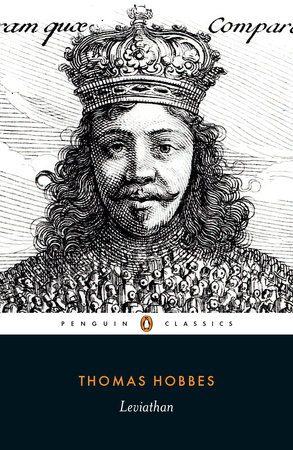
Recommended display edition: Penguin Classics paperback, 2017; introduction and notes by Christopher Brooke; ISBN 9780141395098.
Leviathan interpretation: Begin with the Person, Not the Monster
The conventional shorthand is efficient: without government, human beings fall into a war of all against all; to escape it, they covenant to submit to an absolute sovereign. Nothing in that summary is simply false. It is also insufficient. It moves so quickly from fear to command that it hides the conceptual machinery by which Hobbes turns a crowd of individuals into a commonwealth. The decisive machinery appears in Chapter XVI, on persons, authors, actors, and authority, immediately before the chapter in which the commonwealth is generated. That sequence is not accidental. As Quentin Skinner has emphasized in his study of persons, authors, and representatives, Hobbes made representation structurally central to the 1651 argument in a way his earlier political works had not.
That matters because Hobbes’s title can misdirect a modern reader. The biblical Leviathan evokes overwhelming power, and Hobbes knowingly exploits that resonance. Yet the book’s famous visual rhetoric gives the monster an unexpected anatomy. The giant sovereign rising over the landscape is composed of tiny human figures. His body is literally made of subjects. The picture does not say that the ruler has swallowed society. It stages a more unsettling proposition: political unity is representational. A people appears as one body only because its plurality is organized through an office that can speak, decide, command, punish, legislate, and make war in a name treated as public.
The full public-domain text makes the architecture easy to inspect in the Project Gutenberg edition: the notorious state-of-nature discussion in Chapter XIII is followed by the laws of nature, the theory of persons, and then the institution of a commonwealth. The progression is from private judgment to norms of peace to representation. Hobbes’s political achievement is therefore not merely the discovery of a reason to obey. It is a theory of how actions acquire public authorship.
This reading does not soften Hobbes into a liberal constitutionalist. His sovereign is not designed to be hemmed in by rival final authorities, and his hostility to divided sovereignty is relentless. But it does distinguish three things often collapsed into one: the multitude of subjects, the sovereign who represents them, and the commonwealth that exists as a person through representation. Once those distinctions are kept in view, absolutism becomes a conclusion inside a theory of political attribution rather than the book’s entire meaning.
Central proposition: Leviathan is most revealing when read as a theory of manufactured public personhood. Hobbes’s sovereign is terrifying because it possesses undivided final authority, but the deeper innovation lies in explaining how authorization makes the acts of a representative count as the acts of a multitude. The unresolved problem is that this artificial unity never abolishes the embodied individuals whose fear, judgment, and right of self-preservation made it necessary.
Civil War and the Crisis of Public Voice
Hobbes’s indispensable historical context is not generic disorder but the political disintegration of the British kingdoms in the 1640s. Civil war confronted him with competing institutions and doctrines that each claimed legitimate authority: king and Parliament, civil and ecclesiastical jurisdictions, rival churches, armies, local powers, and consciences instructed to judge obedience by competing standards of religious truth. Hobbes had left England for Paris in 1640. By the time Leviathan appeared in 1651, Charles I had been executed, monarchy abolished in England, and the political vocabulary of sovereignty, representation, allegiance, church government, and resistance had been violently tested.
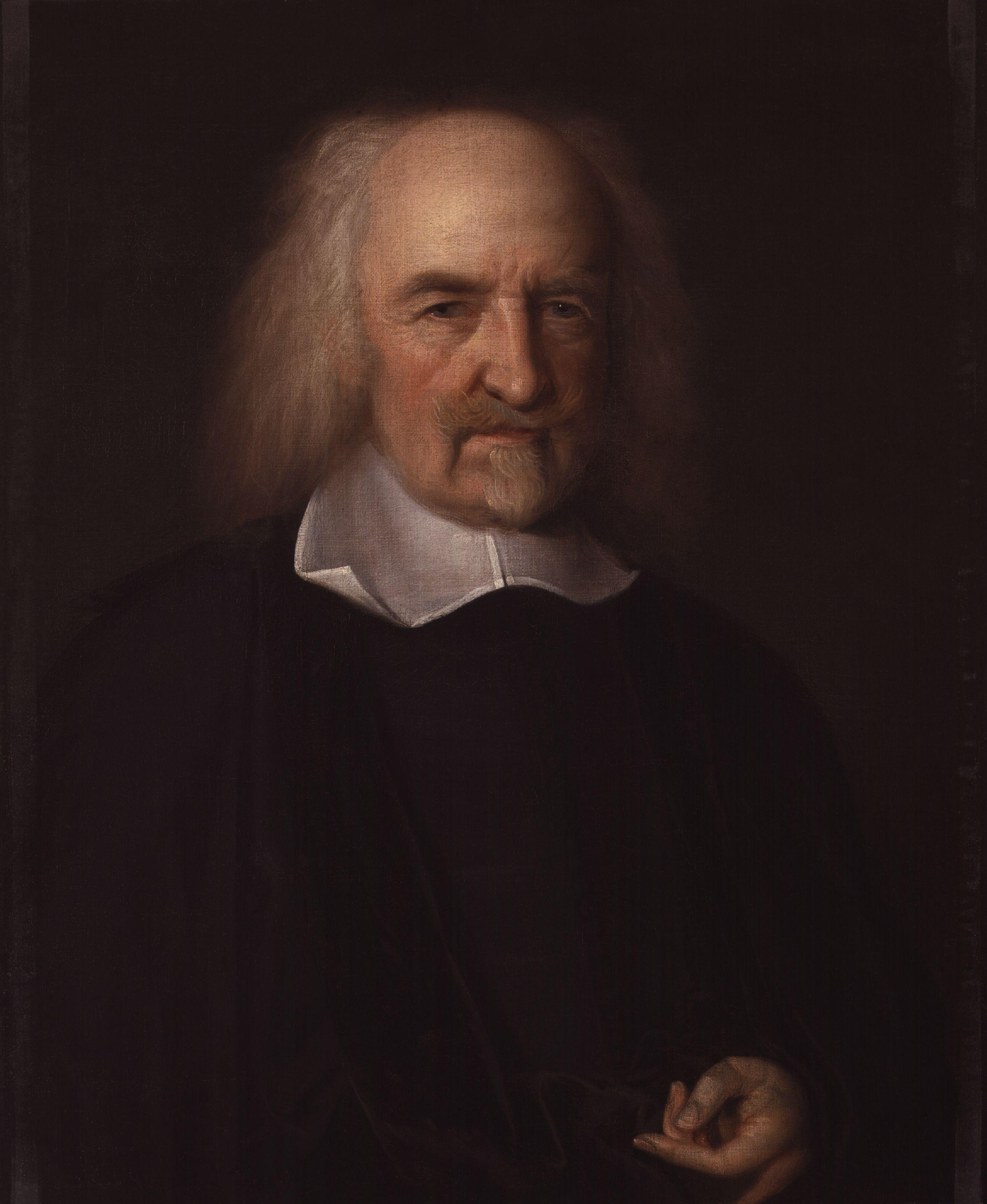
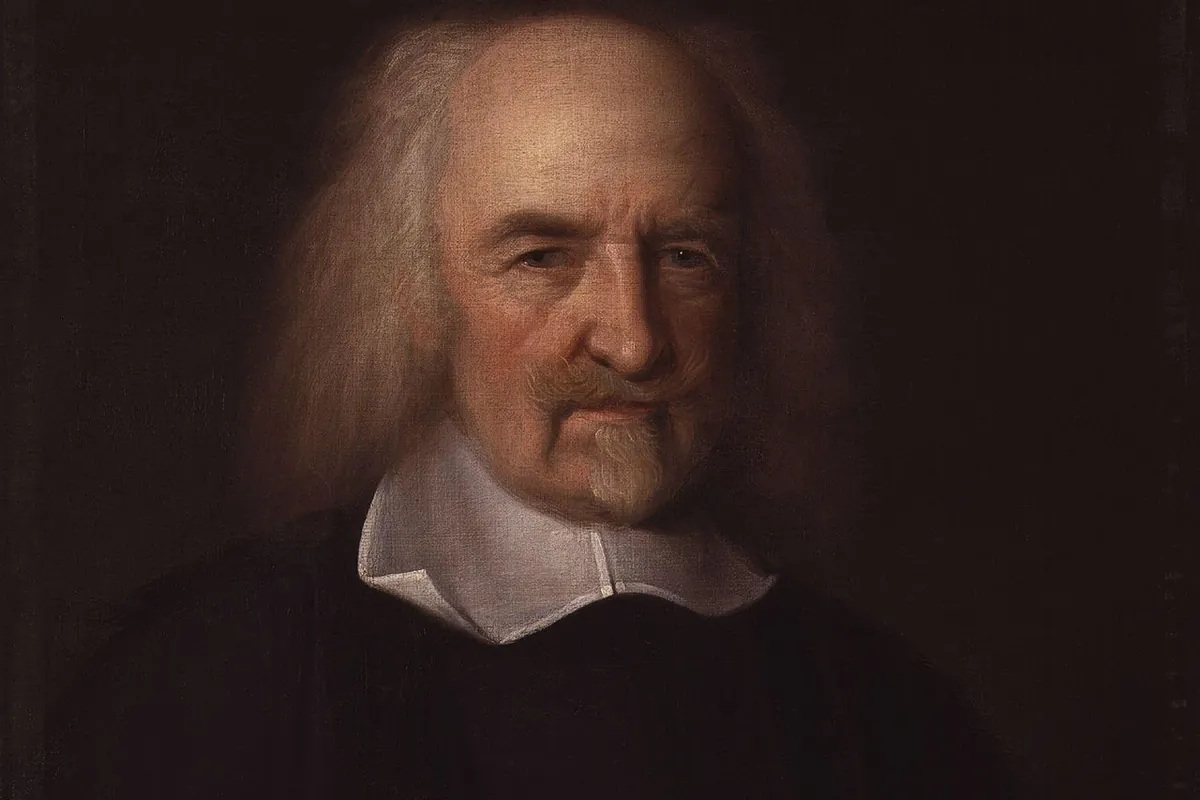
Thomas Hobbes in later life. The severity commonly associated with his politics can obscure how much of his project was driven by the problem of political disintegration.
The familiar story treats this experience mainly as psychological cause: Hobbes feared civil war, therefore he wanted a powerful ruler. The connection is real, but too thin. Civil war also posed a problem of attribution. Who speaks for England when institutions issue incompatible commands? When Parliament claims to represent the realm and the king claims an authority not reducible to Parliament, whose acts are public acts? When religious teachers insist that conscience may release subjects from civil obedience, who determines which teaching binds politically? Hobbes’s solution is to deny that a commonwealth can remain one person while final judgment is dispersed among rival claimants.
This is why the Stanford Encyclopedia of Philosophy is right to stress the reciprocal relation Hobbes constructs between peace and political obedience, while also noting that the older picture of him as a simple psychological egoist is now widely rejected. The state of nature is not generated by a claim that every person is constantly malicious. It is generated by a condition in which each remains judge, jury, and enforcer in his or her own cause. The fatal defect is not wickedness alone. It is the absence of an acknowledged public standpoint.
The religious half of the title therefore matters. Leviathan, or The Matter, Forme, & Power of a Common-Wealth Ecclesiasticall and Civill announces that the book is about more than secular police power. Parts III and IV examine Christian commonwealth and what Hobbes calls the kingdom of darkness because rival spiritual claims can generate rival obligations. A reader who stops after the chapters on sovereignty misses the scale of the project. Hobbes is trying to prevent an alternate jurisdiction from acquiring enough public authority to split the commonwealth’s personhood.
The Grammar of Person, Author, and Actor
Chapter XVI can look like a technical detour. In fact, it supplies the grammar of the state. Hobbes defines a person through the ownership or attribution of words and actions. A natural person speaks and acts in his or her own name. An artificial person represents words or actions belonging to another. The person who performs is the actor; the person whose action is represented is the author; the right to act for another is authority. These are theatrical and legal categories before they are metaphysical ones. Hobbes is asking what must be true for an act performed by one body to count as the act of somebody else.
That vocabulary transforms covenant. Political agreement does not merely promise future obedience to a powerful third party. Each covenanting individual authorizes a representative and agrees to own the representative’s public acts under the terms of institution. The sovereign is therefore not simply the strongest individual standing above society. The sovereign occupies a representative office. The commonwealth, meanwhile, is a person only because it can be represented as one. Skinner’s later account of the “purely artificial person” of the state is especially illuminating here: the state has no natural voice or body of its own and can act only through a representative.
The distinction is easy to lose because in a monarchy the natural body of one ruler and the representative role of sovereign coincide. Hobbes nevertheless needs us to keep them conceptually apart. The king can sleep, age, become ill, or die as a natural person; the political office is defined by the authorized capacity to speak for the commonwealth. This helps explain why Hobbes can treat monarchy, aristocracy, and democracy as forms of sovereignty while insisting that sovereignty itself must be undivided. The number of natural persons bearing the office can vary. What cannot be divided, on his account, is the location of final public judgment.

A manuscript design for the frontispiece makes the theory visible: the sovereign’s body is assembled from the persons whose political unity he represents.
The word author also prevents us from translating authorization into democratic consent too quickly. To authorize is to make another’s public action count as one’s own within the political relation; it is not to approve each decision psychologically or morally. David Runciman has shown why Hobbes’s theory can look both anti-democratic and unexpectedly generative for later theories of representation: it releases political representation from the requirement that representative and represented share the same immediate will. The representative creates an actionable unity that did not previously exist as a single political agent.
That achievement contains the book’s hardest contradiction. The subject is treated as author of sovereign acts, yet the subject cannot covenant away the basic impulse and right to resist immediate destruction. The political person says, in effect, “this public act is mine,” while the natural person may still say, “I cannot be obliged to kill myself.” Hobbes never fully dissolves the friction because he cannot. The artificial person depends on bodies that remain natural, vulnerable, fearful, and capable of private judgment. Public unity is therefore powerful but never ontologically complete.
The State of Nature Is a Crisis of Judgment
The state of nature is often remembered through a single adjective-laden sentence: life without common power is “solitary, poor, nasty, brutish, and short.” The quotation is genuine; its afterlife has been distorting. Hobbes is not simply describing primitive humanity, nor does the argument require the thesis that every human act is selfish. What makes the condition intolerable is the conjunction of relative equality, vulnerability, uncertain intentions, competition, concern for reputation, and above all the absence of an authoritative judge whose decisions can settle disputes.
Equality is especially important. People are equal enough in their capacity to threaten one another that no one can permanently guarantee security by private strength. Because intentions are opaque, defensive preparation can look aggressive to others. Rational anticipation amplifies danger. “War” therefore names a known disposition toward conflict during a period in which there is no assurance to the contrary, not an uninterrupted sequence of battles. The problem has an epistemic form: each person must interpret danger without an authoritative common interpreter.
The laws of nature direct rational agents toward peace, covenant keeping, gratitude, accommodation, and other conditions of sociability. Yet rules discovered by reason are insufficient while individuals remain exposed to unilateral defection. Hobbes’s famous insistence that covenants need coercive power is thus not contempt for morality so much as a claim about assurance. Peace requires a structure capable of stabilizing expectations. The sovereign solves that problem by transforming uncertain private judgments into publicly enforceable determinations.
This makes Hobbes less a theorist of wicked human nature than a theorist of political conditions under which even moderately prudent people can become dangerous to one another. It also makes the transition to representation intelligible. If the problem were simply evil appetites, coercion might be enough. If the problem is that there is no common authority competent to make binding judgments, then the crucial institution is one that can generate a public decision and make it attributable to a commonwealth.
Sovereignty as a Technology of Attribution
Calling sovereignty a technology is not to modernize Hobbes into a theorist of digital systems. It names a technique for making decisions count as public. The sovereign legislates, judges controversies, appoints officers, decides war and peace, and regulates doctrines with political consequences because these functions require a final locus of attribution. For Hobbes, to divide final authority among independent institutions is to recreate the possibility that subjects will receive incompatible commands from bodies each claiming to speak for the whole.

The published frontispiece joins sword and crozier above a territory whose inhabitants compose the sovereign: civil and ecclesiastical power are gathered into a single representative figure.
The frontispiece is therefore argumentative rather than decorative. Sword and crozier are held by one crowned figure. Beneath them appear paired emblems of temporal and spiritual institutions. Above the landscape, the sovereign’s body is formed from many small figures whose faces turn toward him. Quentin Skinner’s work on Hobbes’s humanist frontispieces and rhetorical formation helps recover what later abstractions of “the state” can conceal: Hobbes deliberately thinks politics through personation, theatrical representation, visual embodiment, and authorized speech.
This also clarifies the relation between sovereign and state. The sovereign represents the person of the commonwealth; the sovereign is not simply the whole commonwealth in natural flesh. When commentators say “Hobbes’s Leviathan” to mean an omnipotent ruler, they compress the representational relationship into its bearer. The compression captures the experience of sovereign power but loses the theory that makes it legitimate. Hobbes’s ruler does not claim authority merely because he is stronger. In an instituted commonwealth, he is authorized as the bearer of a public person.
The price is severe. If every rival institution can appeal to an authority outside the sovereign’s settlement, the unity Hobbes has constructed can unravel. That is why he resists constitutional arrangements in which separate bodies possess independent final claims. Modern readers who value checks and balances will find this conclusion rightly alarming. But it should be criticized on its strongest ground. Hobbes does not simply dislike institutional plurality; he thinks it produces a logical and practical problem about who gets the last word when public authorities conflict.
Freedom Inside the Artificial Body
The absolutist caricature becomes most misleading when it implies that subjects cease to possess liberty. Hobbes defines liberty primarily as the absence of external impediments to motion. Law therefore restricts liberty, but political life still contains vast spaces in which law does not command. More importantly, some rights cannot be made obligatory by covenant because the point of covenant is preservation. A person commanded directly to kill or wound himself, refrain from self-defense, or in some circumstances incriminate himself confronts a limit built into Hobbes’s account of obligation.
Susanne Sreedhar’s work on Hobbes and resistance has made this tension difficult to ignore. The point is not that Hobbes secretly endorses a constitutional right of revolution. He does not. It is that his subjects remain agents whose natural right of self-preservation cannot be fully converted into a duty of passive self-destruction. The theory of authorization has edges.
Protection is equally important. Political obligation is linked to the sovereign’s capacity to protect. When that capacity disappears in the relevant sense, the basis of obedience changes. This dependence does not yield a modern doctrine of accountable government, but it prevents sovereignty from becoming metaphysically self-sufficient. The artificial person exists for the peace and defense that natural persons cannot securely provide for themselves.
Here the title becomes almost ironic. Leviathan looks larger than life, yet its political existence is radically dependent. It needs authorization to become a person, officials to act, subjects to obey, institutions to transmit commands, and material power to protect. Hobbes grants the sovereign enormous legal competence because he believes divided final authority risks civil war. He does not thereby turn the commonwealth into an organism whose members have no claims apart from the whole. The body is artificial all the way down.
Representation Without Representation-as-Mirroring
Modern representative politics often evaluates representatives by resemblance, responsiveness, electoral authorization, deliberative quality, or accountability. Hobbes’s concept is both narrower and stranger. A representative need not mirror the represented, and the represented need not already constitute a unified political subject with a settled will. The act of representation helps constitute the unity it represents. A multitude becomes one person, Hobbes says, when it is represented by one person in the relevant sense.
That formulation has a radical implication. “The people” is not simply a political agent existing before representation and then choosing a mouthpiece. Before a representative unity is instituted, there is a multitude. The public person is made by a structure of authorization. Al P. Martinich’s discussion of authorization and representation usefully cautions against treating authorization as a simple alienation of every underlying right. The relation is juridical: it specifies whose action may count as whose.
The insight survives even if we reject Hobbes’s institutional conclusion. Modern states continually depend on conventions of attribution. A signature by a minister, judgment by a court, vote by a legislature, order by a public officer, or treaty executed by authorized officials can become an act of the state even though millions of citizens never performed or approved it personally. Political systems differ enormously over who may perform such acts and under what constraints. Hobbes supplies an unusually stark account of the prior problem: how can an action performed by particular humans acquire the status of an act of an impersonal political entity?
Three Hobbeses—and Why None Is Enough Alone
One influential Hobbes is the theorist of absolute sovereignty. This Hobbes is real. The book insists on undivided final authority, rejects a right to depose the sovereign on ordinary grounds of injustice, and grants the sovereign powers that later constitutional thought treats with suspicion. Any reading that turns him into a premature liberal falsifies the institutional conclusion.
A second Hobbes is the founder of contractarian political philosophy: individuals imagined as naturally free and equal authorize political authority because peace is rationally preferable to a condition of insecurity. This too is indispensable. It explains why legitimacy is not derived straightforwardly from divine right, inherited hierarchy, or a naturally political human essence. Yet “social contract” can become another shortcut if it treats the covenant simply as a transaction: surrender liberty, receive security.
The third Hobbes, recovered most powerfully by Skinner, is the theorist of personation, rhetoric, and the artificial state. For understanding the title and the architecture of Chapters XVI and XVII, this interpretation is the most persuasive. Skinner’s historical method also corrects the temptation to imagine that Hobbes invented political representation in a vacuum. His arguments intervened in older legal, theatrical, humanist, and revolutionary vocabularies of persons and representatives. His achievement was a reconstruction, not an ex nihilo discovery.
Even that reading can be overextended if it makes representation swallow the rest of the book. Materialist psychology, fear, rational calculation, religious controversy, the laws of nature, and the technology of coercion are not decorative supports. Representation explains how a commonwealth becomes one agent; it does not by itself explain why people need one, why they obey it, or what makes its commands effective. Runciman’s question about whether Hobbes is anti-democratic or proto-democratic is fruitful precisely because the theory exceeds our present categories. It furnishes a conceptual tool later representative politics can use while defending a sovereign structure many democrats reject.
Sreedhar supplies a further corrective. If we see only the authorizing subject, we may forget the resisting natural person who cannot make himself obligated to embrace immediate destruction. The best Leviathan interpretation therefore combines the artificial person with the limits exposed by embodiment. Hobbes wants a public unity strong enough to terminate civil conflict, but he constructs it from agents whose basic drive to preserve themselves cannot be completely absorbed into that unity.
What the Absolutist Slogan Misses
A reductive Leviathan interpretation says that people are selfish, so they need an all-powerful ruler; that shortcut loses almost everything that makes the book intellectually difficult. It mistakes a condition of insecure private judgment for a fixed anthropology of greed. It treats coercion as the creation of order when Hobbes also needs covenant, authorization, office, law, and representation. It confuses the sovereign representative with the artificial person of the commonwealth. It makes the religious books seem like an appendix even though rival claims of spiritual authority are central to Hobbes’s fear of divided allegiance.
The slogan also obscures why Hobbes’s absolutism is conceptually interesting rather than merely objectionable. He is not content to say that concentrated power works better. He argues that the very possibility of a final public act requires a determinable authorizing structure. The conclusion that this structure must be institutionally undivided is where readers should press him. Is finality really incompatible with constitutional division of functions? Can multiple institutions be mutually constraining while a legal order still specifies procedures for resolving conflict? Later constitutional practice suggests yes. Hobbes’s inference from public unity to undivided sovereignty is powerful, but not compulsory.
His theory also underestimates the political value of organized dissent and independent institutions. A system can be endangered by rival claims to final authority; it can also be endangered when no institution can effectively contest a ruler’s attribution of private interest to public necessity. Hobbes’s model is strongest as a diagnosis of fragmentation and weaker as an account of domination from the center. That limitation should not be repaired by pretending it is absent. It is one of the reasons Leviathan remains productive rather than simply correct.
Why Rereading Leviathan Now Matters
A serious contemporary Leviathan interpretation does not need to claim that Hobbes predicted modern bureaucracy, mass democracy, constitutional courts, corporations, social media, or artificial intelligence. The more durable relevance is conceptual. Modern public life still depends on acts of representation and attribution that transform the actions of particular people into actions performed in the name of an institution, a government, a court, a corporation, or a state. The disputes that follow are often disputes about authorization: who was entitled to speak, whose act it was, which office had competence, and when an institution exceeded the authority entrusted to it.
Hobbes is especially useful when political language treats “the people” as if it possessed a single natural voice prior to institutions. His account is a warning against that metaphysics. A multitude has many voices. Political unity is achieved through rules that make some decisions count as public decisions. Democracies answer the authorization problem differently from Hobbes: elections, constitutions, separated institutions, judicial review, federalism, rights, parties, public contestation, and procedures of accountability alter who may represent whom and how that representation may be challenged. Yet those systems do not escape the underlying question of public personhood. They give it different institutional answers.
This is where Richard Tuck’s reflections on the relation between sovereignty and government are suggestive. In the preface to The Sleeping Sovereign, Hobbes becomes part of a longer history in which sovereignty can be distinguished from the ordinary machinery of government. Whether or not one accepts Tuck’s broader genealogy, the distinction makes clear why “who governs?” and “in whose name is government authorized?” need not be the same question.
Hobbes also sharpens the problem of institutional trust. The commonwealth cannot operate if every command is treated merely as the private utterance of whichever natural person currently holds office. Public institutions require conventions that allow officeholders’ acts to be attributed to entities that persist beyond them. But the same convention can become dangerous when it shields officials from responsibility. Hobbes emphasizes the first problem and gives insufficient resources for the second. Contemporary readers should preserve both insights: political order needs attribution, and attribution must not become impunity.
The book’s theological politics deserves renewed attention for a similar reason. Hobbes understood that conflicts become explosive when institutions make incompatible claims not merely about interests but about ultimate obedience. His answer—subordinating public religious authority to the sovereign—is too drastic for modern commitments to religious liberty and institutional pluralism. Still, the underlying problem remains recognizable: a political order must specify how claims of conscience, law, institutional autonomy, and public security interact without allowing every disagreement to become a contest over final jurisdiction.
What must be resisted is the temptation to convert Hobbes into a contemporary partisan. He does not provide a ready-made argument for emergency government, technocracy, populism, or the modern security state. Nor does the existence of artificial public persons vindicate every institution that claims to act in a public name. Hobbes is valuable because he forces a prior question: by what authorization does a collection of human beings acquire an agent capable of binding action? His answer is historically specific and institutionally extreme. The question is not.
Final Verdict
The strongest reason to reread Leviathan is not that Hobbes has the last word on political authority. He plainly does not. It is that he sees with unusual clarity that a state cannot act unless human actions can be converted into public actions through rules of representation and authorization. The giant of the title is therefore more than an emblem of overwhelming power. It is a picture of a political fiction made operational: a multitude represented as one artificial person.
That interpretation reveals both Hobbes’s achievement and his danger. He explains why public order cannot rest indefinitely on private judgment, but he pushes the need for a final public voice toward an undivided sovereignty that gives too little institutional protection against domination by the center. At the same time, the natural person never disappears. Self-preservation, resistance to immediate destruction, and the sovereign’s dependence on protection leave a fissure inside the artificial body. Authorization is immense, not magical.
Readers should therefore resist two reductions: Hobbes is neither merely the prophet of authoritarian power nor a disguised theorist of modern liberal representation. He is more unsettling than either. For a reliable, readable text, the 2017 Penguin Classics edition with Christopher Brooke’s introduction and notes is an excellent entry; readers undertaking specialized textual work should also consult a scholarly edition such as Richard Tuck’s Cambridge text or Noel Malcolm’s comparative English-Latin edition. Leviathan still deserves serious attention because its unresolved question remains fundamental: how can political unity be real enough to act without pretending that plurality has ceased to exist?
Three Books to Read Beside This Book


This article was researched and written by the BookInLight Department of Political Thought and Intellectual History. The editorial process included bibliographical review, comparison of primary-text and edition records, source verification, and fact-checking of historical, conceptual, and publication details. Readers are invited to send factual corrections, overlooked scholarly sources, interpretive suggestions, and constructive ideas that could improve a future revision.
Editorial art direction, visual composition, image selection, and presentation were developed by the BookInLight Art Department. Third-party book covers remain the property of their respective publishers, artists, designers, and rights holders and are displayed for identification and editorial discussion. Complete republication, reproduction, translation, or reuse of this BookInLight article requires prior written authorization from BookInLight.
Sources and Further Reading
Primary Text and Editions
Thomas Hobbes, Leviathan (1651), Project Gutenberg. Public-domain English text used to check chapter sequence, terminology, and the relations among the state of nature, authorization, persons, and sovereignty.
Thomas Hobbes, Leviathan, introduction and notes by Christopher Brooke, Penguin Classics, 2017, ISBN 9780141395098, publisher record. Used for the recommended display edition and edition verification.
Thomas Hobbes, Leviathan, revised student edition, edited by Richard Tuck, Cambridge Texts in the History of Political Thought, Cambridge University Press, 1996, ISBN 9780521567978, Cambridge edition page. Consulted as a scholarly reading edition and for editorial apparatus.
Historical and Conceptual Context
Sharon A. Lloyd and Susanne Sreedhar, “Hobbes’s Moral and Political Philosophy,” Stanford Encyclopedia of Philosophy. Used for chronology, state-of-nature interpretation, absolutism, political obligation, religion, and the rejection of the older psychological-egoist simplification.
Quentin Skinner, From Humanism to Hobbes: Studies in Rhetoric and Politics, Cambridge University Press, 2018, book record. Used for Hobbes’s humanist education, rhetoric, visual political argument, personation, and the genealogy of representation.
Quentin Skinner, “Hobbes on Political Representation,” in From Humanism to Hobbes, Cambridge Core. Used to situate Hobbes within, and against, earlier English arguments about political representation.
Quentin Skinner, “Hobbes and the Concept of the State,” in From Humanism to Hobbes, Cambridge Core. Used for the distinction among sovereign, subjects, and the artificial person of the state.
Major Interpretations
Quentin Skinner, “Hobbes on Persons, Authors and Representatives,” in Patricia Springborg, ed., The Cambridge Companion to Hobbes’s Leviathan, Cambridge Core. Central secondary source for Chapter XVI and the representational architecture of institution.
Quentin Skinner, “Hobbes and the Purely Artificial Person of the State,” in Visions of Politics, Cambridge Core. Used for the claim that the state lacks a natural voice and acts only through representation.
Al P. Martinich, “Authorization and Representation in Hobbes’s Leviathan,” in The Oxford Handbook of Hobbes, Oxford Academic. Used to distinguish authorization from a simple wholesale alienation of individual rights.
David Runciman, “Hobbes’s Theory of Representation: Anti-democratic or Proto-democratic?” in Political Representation, Cambridge Core. Used to frame the theory’s uneasy relation to later representative democracy.
Susanne Sreedhar, Hobbes on Resistance: Defying the Leviathan, Cambridge University Press, 2010, Cambridge Core. Used for the scope of self-preservation, resistance, and the limits of political obligation.
Patricia Springborg, ed., The Cambridge Companion to Hobbes’s Leviathan, Cambridge University Press, 2007, Cambridge Core. Used as a multi-author reference for the book’s theological, political, and conceptual architecture.
Richard Tuck, The Sleeping Sovereign: The Invention of Modern Democracy, Cambridge University Press, 2016, Cambridge Core preface. Used for the later distinction between sovereignty and ordinary government and Hobbes’s place in that genealogy.
Companion Editions for the Recommendation Strip
Plato, The Republic, translated by Desmond Lee, introduction by Melissa Lane, Penguin Classics, 2007, ISBN 9780140455113, publisher record. Verified recommendation edition.
John Locke, Two Treatises of Government, edited by Peter Laslett, Cambridge Texts in the History of Political Thought, 1988 paperback, ISBN 9780521357302, Cambridge edition page. Verified recommendation edition.
Jean-Jacques Rousseau, The Social Contract and Other Later Political Writings, second edition, edited and translated by Victor Gourevitch, Cambridge Texts in the History of Political Thought, Cambridge University Press, 2019, paperback ISBN 9781316605448, Cambridge edition page. Verified recommendation edition.
Image Credits
1. Target-book cover: Thomas Hobbes, Leviathan, Penguin Classics, 2017 paperback, introduction and notes by Christopher Brooke, ISBN 9780141395098. Cover asset delivered from Penguin Random House’s image server and checked against the official publisher record. Cover rights remain with the publisher, designer, artist, and other applicable rights holders; used here for editorial identification.
2. Thomas Hobbes portrait: John Michael Wright, portrait of Thomas Hobbes, circa 1669–1670, National Portrait Gallery, London. The underlying artwork is public domain; the Commons record carries public-domain status information. Wikimedia Commons source page. Institutional reproduction-right assertions may vary by jurisdiction.
3. Manuscript frontispiece design: ink drawing on manuscript offered by Thomas Hobbes to Charles II, 1651; attributed to Wenceslas Hollar or, more likely, Abraham Bosse; British Library, MS Egerton 1910 f.1. Public-domain work; Commons file identified as free of known copyright restrictions. Wikimedia Commons source page.
4. Published Leviathan frontispiece: frontispiece designed by Abraham Bosse for Thomas Hobbes’s Leviathan, 1651; British Museum collection record 1858,0417.283. Public-domain historical artwork. Wikimedia Commons source page, with provenance to the British Museum.
5. Recommendation cover: Plato, The Republic, translated by Desmond Lee, introduction by Melissa Lane, Penguin Classics, 2007, ISBN 9780140455113. Exact-edition cover asset delivered through Amazon Media and cross-checked against the Penguin Random House edition record. Cover rights remain with applicable rights holders.
6. Recommendation cover: John Locke, Two Treatises of Government, edited by Peter Laslett, Cambridge Texts in the History of Political Thought, 1988 paperback, ISBN 9780521357302. Exact-edition cover asset delivered through Amazon Media and cross-checked against the Cambridge University Press edition record. Cover rights remain with applicable rights holders.
7. Recommendation cover: Jean-Jacques Rousseau, The Social Contract and Other Later Political Writings, second edition, edited and translated by Victor Gourevitch, Cambridge Texts in the History of Political Thought, paperback ISBN 9781316605448. Exact-edition cover asset delivered through Amazon Media and cross-checked against the Cambridge University Press edition record. Cover rights remain with applicable rights holders.
Artwork credit: John Michael Wright, c. 1669–1670 — Source:
Wikimedia Commons