The best World War II books are not simply the loudest sellers or the most familiar classroom titles. This ranking brings military history into conversation with Holocaust testimony, the Pacific war, the Eastern Front, civilian memory, and the atomic age—while separating documented circulation from publishing folklore and treating translation history as part of a book’s historical afterlife.
Any serious list of the best World War II books has to decide what counts as both “World War II” and “best-selling.” The conflict cannot be reduced to Normandy and Nazi Germany: it also means China, Poland, the Soviet-German war, the Holocaust, the Pacific, occupation, captivity, bombing, and the atomic ending. Nor does bestseller status mean accepting the largest number repeated online. Older classics often predate centralized tracking, translation records are uneven, and publishers sometimes report a milestone without separating language or territory.
This ranking therefore combines documented circulation with intellectual reputation, historical influence, original-language publishing history, and international translation. When a reliable total cannot be established, the absence is stated rather than converted into an estimate. The result is a reading history of the war as well as a recommendation list.
From campaign history to a global history of violence
World War II publishing has changed with the historiography. Early mass-market histories often privileged leaders, battles, Allied victory, and the European campaign. Later scholarship moved the Holocaust toward the center, reopened the Eastern Front after Soviet archives became more accessible, and gave greater weight to China, Japanese imperialism, occupation, forced labor, racial ideology, famine, civilian bombing, and imperial collapse. The strongest books below do not all perform the same task: some reconstruct systems of killing, some recover combat experience, and some show how an individual witness can permanently alter public memory.
Commercial success and scholarly prestige also diverge. A memoir can circulate in tens of millions while a field-changing monograph has no public lifetime sales figure. Translation adds another asymmetry: a book may be globally canonical without publishers releasing language-by-language consumer data. Those gaps are not editorial inconveniences; they are evidence about how twentieth-century publishing was measured.
What should a World War II book explain?
The war changes meaning as the scale changes. Headquarters, a police battalion, a camp barracks, a Pacific foxhole, a hidden annex, and an atomic laboratory produce different kinds of truth. The ranking rewards books that make one scale unusually clear while remaining connected to the larger conflict.
- Central Question
- How did a global war become a system of conquest, mass killing, mobilization, survival, and memory?
- Historical Pressure
- Empire, racial ideology, industrial warfare, state capacity, and civilian vulnerability.
- Why These Books
- Together they connect strategy and structure to testimony, experience, and the war’s publishing afterlife.
First published: 2021 · Allen Lane
Original language: English
Recommended edition: Penguin Books paperback, 2023 · ISBN 9780143132936
Best for: Global framing beyond a 1939–45 European chronology
Difficulty: Advanced
Intellectual role: Recasts the conflict as an imperial war spanning China, Europe, and the Pacific.
Overy changes the frame rather than merely updating facts. Beginning with imperial expansion in Asia and connecting conquest, resources, race, and state power, he resists the habit of separating Europe from the Sino-Japanese war. Its position reflects its shorter reception history and thin public sales data, not weak scholarship. Few recent syntheses more forcefully demonstrate why the war has to be read as an interconnected crisis of rival empires.
First published: 1992 · HarperCollins
Original language: English
Recommended edition: Harper Perennial paperback, 2017 · ISBN 9780062303028
Best for: Perpetrator behavior and Holocaust killing operations
Difficulty: Intermediate–Advanced
Intellectual role: Microhistory of conformity, choice, and participation in mass murder.
Browning moved explanation away from the comforting category of ideological monsters and toward the social mechanisms by which policemen became killers. He tests antisemitism, obedience, peer pressure, careerism, habituation, and opportunities for refusal against testimony. Public sales totals are opaque, but its scholarly and teaching afterlife is exceptional. Its rank therefore demonstrates one principle of this list: documentary and intellectual importance can outweigh the absence of a bestseller number.
Worldwide sales: No reliable cumulative figure verified.
As of: September 2026
Evidence type: Long-running scholarly/trade circulation
Original-language sales: No reliable cumulative figure verified.
Translated into: Multiple languages; no complete rights-holder count.
Principal languages: German, French, Dutch and others.
First published: 1984 · Pantheon Books
Original language: English
Recommended edition: The New Press paperback, 2004 · ISBN 9781565843431
Best for: Veteran, civilian and home-front memory
Difficulty: Accessible
Intellectual role: Polyphonic challenge to the phrase “good war.”
Terkel places admirals beside workers, veterans beside Japanese Americans, celebrants beside people who remained wounded or doubtful. Memory is not decorative testimony here; it becomes historical evidence. The Pulitzer confirmed the book’s stature and decades of classroom use extended its reach. Public cumulative sales and translation-market figures remain difficult to establish, so its position rests more heavily on methodological influence, literary quality, and the extraordinary breadth of voices it preserved.
Worldwide sales: No reliable cumulative figure verified.
As of: September 2026
Evidence type: Pulitzer-winning long-tail trade title
Original-language sales: No reliable cumulative figure verified.
Translated into: Current rights material documents selected rights, not a complete published-language count.
Principal rights markets documented: Simplified Chinese, Korean, Spanish.
First published: 1997 · Basic Books
Original language: English
Recommended edition: Basic Books paperback, 2012 · ISBN 9780465068364
Best for: Nanjing, Japanese wartime violence, and memory politics
Difficulty: Intermediate
Intellectual role: Mass-market intervention in the international memory of Nanjing.
Chang’s public impact exceeded the book’s academic consensus. It forced a large English-language readership to confront Nanjing, survivor testimony, Japanese wartime violence, and postwar denial, while generating serious disputes over evidence and framing. Taiwanese government records report more than 500,000 copies sold and ten weeks on the New York Times nonfiction list. That documented reach makes it an unusually consequential work of transnational war memory even where later scholarship requires qualification.
Worldwide sales: More than 500,000 copies reported.
As of: 2015 reporting
Evidence type: Government-recorded publishing milestone
Original-language sales: Reported total not split by English-language territory.
Translated into: Multiple languages; no authoritative cumulative count verified.
Principal languages: Chinese and several European languages.
Original language: English
Recommended edition: Modern Library paperback, 2003 · ISBN 9780812968583
Best for: Japanese decision-making and the Pacific War
Difficulty: Intermediate
Intellectual role: A Japanese-centered narrative of imperial defeat.
Toland’s Pulitzer-winning narrative gives sustained attention to Japanese decision-makers and witnesses rather than treating Japan only as the object of Allied operations. Later scholarship has revised parts of its interpretation, but the book helped normalize multi-perspectival Pacific history for general readers. Its commercial reputation is substantial, yet a responsible cumulative sales figure and complete translation-language count remain unavailable publicly, limiting a higher ranking.
Worldwide sales: No reliable cumulative book-level figure verified.
As of: September 2026
Evidence type: Award-winning long-running trade title
Original-language sales: No reliable cumulative English figure.
Translated into: Foreign editions documented; no complete count.
Principal languages: Chinese and other translated editions are catalogued.
Original language: English
Recommended edition: Basic Books paperback, 2022 · ISBN 9781541600065
Best for: Mass killing in Eastern Europe
Difficulty: Advanced
Intellectual role: Geographic reframing of Nazi and Soviet killing regimes.
Snyder’s intervention is geographic rather than merely comparative. He places Nazi and Soviet projects of mass killing in the same East European space while insisting on distinctions between their purposes and mechanisms. Basic Books reports translation into more than thirty languages and bestseller status in six countries. Its unusually international scholarly debate gives it greater reach than most academic histories, although no cumulative consumer-sales total is publicly available.
Worldwide sales: No reliable numerical total; bestseller in six countries.
As of: Publisher record checked September 2026
Evidence type: Publisher-reported international reach
Original-language sales: No reliable cumulative English figure.
Translated into: More than 30 languages.
Principal languages: German, Polish, Ukrainian, Russian, French, Spanish and others.
Original language: English
Recommended edition: Presidio Press paperback, 2007 · ISBN 9780891419068
Best for: Marine combat at Peleliu and Okinawa
Difficulty: Accessible–Intermediate
Intellectual role: Ground-level anatomy of Pacific combat.
Sledge writes from notes made close to combat but with the discipline of a later memoirist. Peleliu and Okinawa appear not as map arrows but as fatigue, terror, filth, discipline, dehumanization, and loyalty. Its later bestseller revival and adaptation in The Pacific widened readership, although public sources provide neither a defensible lifetime total nor a complete translation count. Experiential authority and literary control keep it high in the ranking.
Worldwide sales: No reliable cumulative figure verified.
As of: September 2026
Evidence type: Publisher-recognized bestseller; cumulative figure unavailable
Original-language sales: No reliable cumulative English figure.
Translated into: Multiple foreign editions; complete count unavailable.
Principal languages: European and Asian editions are bibliographically attested.
Original language: English
Recommended edition: Classic Edition hardcover, Simon & Schuster, 2001 · ISBN 9780743216388
Best for: American airborne unit history
Difficulty: Accessible
Intellectual role: Human-scale European campaign narrative.
Ambrose’s focus on Easy Company gives the European campaign an unusually legible human scale. The book’s cultural afterlife, especially through television, expanded unit history far beyond specialist military readership. Simon & Schuster identifies it as a New York Times bestseller but provides no audited lifetime total. Its narrow American perspective and later controversies over Ambrose’s research practices keep it below the strongest synthetic histories despite its enormous popular influence.
Worldwide sales: No reliable cumulative book-level total verified.
As of: September 2026
Evidence type: Publisher-designated New York Times bestseller
Original-language sales: No cumulative English figure verified.
Translated into: Numerous foreign editions; no authoritative current count.
Principal languages: German, French, Dutch, Spanish and others.
Original language: English
Recommended edition: 25th Anniversary paperback, 2012 · ISBN 9781451677614
Best for: Manhattan Project, physics, and wartime mobilization
Difficulty: Intermediate–Advanced
Intellectual role: Connects science, institutions, industry, and atomic warfare.
Rhodes makes the bomb neither a detached scientific triumph nor a last-chapter wartime epilogue. He reconstructs the chain from modern physics to industrial mobilization, Los Alamos, Trinity, Hiroshima, and Nagasaki. The Pulitzer Prize, National Book Award, and National Book Critics Circle Award mark unusual cross-field authority. Public cumulative sales and translation totals remain opaque, so the rank rests primarily on intellectual range, research quality, and durable reputation.
Worldwide sales: No reliable cumulative figure verified.
As of: September 2026
Evidence type: Award-winning long-tail trade history
Original-language sales: No cumulative English figure verified.
Translated into: Foreign editions well documented; no authoritative complete count.
Principal languages: Multiple European and Asian languages.
Original language: English
Recommended edition: Random House Trade Paperbacks, 2014 · ISBN 9780812974492
Best for: Pacific captivity and survival
Difficulty: Accessible
Intellectual role: Biography linking sport, air war, captivity, trauma, and postwar survival.
Hillenbrand’s biography of Louis Zamperini is narrower than a theater history but commercially exceptional. Random House reported nearly four million copies by April 2014, and translation reached 29 languages by late that year. The book moves between prewar ambition, bomber operations, survival at sea, Japanese POW camps, and postwar trauma. Its combination of archival narrative and mass readership makes it one of the clearest examples here of serious war writing crossing into blockbuster circulation.
Worldwide sales: Nearly 4 million copies by April 2014; later publisher reporting says film-linked editions sold millions, not added here to avoid overlap.
Evidence type: Publisher-reported milestone
Original-language sales: No clean English-only split published.
Translated into: 29 languages by late 2014.
Principal languages: Major European and Asian languages.
Original language: English
Recommended edition: Simon & Schuster paperback, 1994 · ISBN 9780671890919
Best for: D-Day as simultaneous human experience
Difficulty: Accessible
Intellectual role: Foundational multi-perspective narrative military history.
Ryan’s D-Day narrative was a publishing phenomenon as well as a model for later popular military history. Its intercut Allied, German, and civilian viewpoints create simultaneity across the invasion zone rather than a headquarters-only account. A Columbia Journalism Review history reports sales reaching tens of millions and publication in eighteen languages. Later scholarship is deeper and more archival, but few campaign histories have matched its combination of circulation, narrative method, and durable influence.
Worldwide sales: Tens of millions reported within the book’s early publishing history.
Evidence type: Responsible publishing-history reporting
Original-language sales: No reliable English-only cumulative split.
Translated into: 18 languages reported.
Principal languages: Numerous European and international editions.
Original language: English
Recommended edition: Vintage paperback, 2020 · ISBN 9780593082362
Best for: Civilian experience of atomic bombing
Difficulty: Accessible
Intellectual role: Documentary reconstruction that personalized nuclear war.
Hersey’s six-person account changed the scale through which many readers understood Hiroshima: an event described strategically became bodily and civic catastrophe. A New Yorker retrospective reported roughly 3.5 million book copies sold by 1993. Its economy, documentary discipline, and extraordinary classroom afterlife make its influence much larger than its size. Translation history is extensive, although no reliable cumulative language count or comparable market-by-market sales record is public.
Worldwide sales: About 3.5 million copies by 1993.
Evidence type: Documented retrospective figure
Original-language sales: No reliable cumulative English split.
Translated into: Many languages; no authoritative complete count verified.
Principal languages: Japanese, French, German and others.
Original language: English
Recommended edition: Penguin paperback, 1999 · ISBN 9780140284584
Best for: Eastern Front operational and human history
Difficulty: Intermediate
Intellectual role: Brought post-Soviet Eastern Front history to a mass readership.
Beevor’s Stalingrad moved a central Eastern Front battle into global popular history as post-Soviet archival access altered the evidentiary landscape. Command decisions sit beside starvation, coercion, German collapse, civilian suffering, and the brutal conditions of both armies. Penguin describes the book as an international million-copy bestseller. That commercial achievement, combined with the timing of its scholarship and extensive foreign publication, gives it exceptional weight among modern campaign histories.
Worldwide sales: More than one million copies internationally, according to publisher description.
Evidence type: Publisher-reported bestseller milestone
Original-language sales: No reliable cumulative English split.
Translated into: Extensive international editions; no single current authoritative total verified.
Principal languages: German, French, Spanish, Italian, Dutch, Polish, Russian and others.
Original language: English
Recommended edition: Pantheon hardcover · ISBN 9780679406419
Best for: Holocaust memory, family testimony, and representation
Difficulty: Accessible–Intermediate
Intellectual role: Recast the graphic narrative as a vehicle for historical testimony.
Spiegelman’s achievement is not simply that a comic addresses the Holocaust. Form, memory, family conflict, testimony, and historical reconstruction become inseparable. Maus received a special Pulitzer citation and changed what literary institutions considered possible for comics. Responsible reporting describes sales in the millions, while Spiegelman estimated publication in about thirty languages by 2011. Edition-specific sales for The Complete Maus cannot responsibly be separated from circulation of the wider work.
Worldwide sales: Millions for Maus as a work; no reliable Complete-edition total.
Evidence type: Responsible secondary reporting
Original-language sales: No reliable English-only split.
Translated into: About 30 languages by 2011.
Principal languages: French, German, Polish, Italian, Spanish, Japanese, Farsi and others.
First published: 1947 · De Silva, Turin
Original language: Italian
Recommended edition: Simon & Schuster paperback, 1995 · ISBN 9780684826806 · translated by Stuart Woolf
Best for: Auschwitz testimony and camp social order
Difficulty: Intermediate
Intellectual role: Analytical survivor testimony of exceptional literary restraint.
Levi’s first edition was commercially modest—2,500 printed and 1,500 sold—but the work’s afterlife became international. That reversal matters: translation and reputation transformed a difficult first launch into a canonical testimony. Levi’s close analysis of language, hierarchy, hunger, moral compromise, and survival makes the camp a social world without normalizing it. The Primo Levi Center documents extensive translation; its Hebrew edition alone passed 30,000 sales.
Worldwide sales: No credible global lifetime total; 1,500 copies of the 2,500-copy 1947 first edition were sold.
Evidence type: Primo Levi Center publishing history
Original-language sales: 1,500 first-edition Italian copies; later Italian cumulative total unavailable.
Translated into: Dozens of languages.
Principal languages: English, German, French, Hebrew, Dutch, Polish, Russian and others.
1. Hebrew
Am Oved edition · more than 30,000 copies sold · Israel · after the 1988 publication.
First published: 1958 · Les Éditions de Minuit
Original language: French, following the Yiddish precursor
Recommended edition: Hill and Wang paperback, 2006 · ISBN 9780374500016 · translated by Marion Wiesel
Best for: Holocaust witness and moral memory
Difficulty: Accessible
Intellectual role: Compact testimony that became a global educational text.
Night enters the top five because its international reach is unusually well documented. Boston University’s Elie Wiesel Center reports more than ten million copies sold and translation into thirty languages. Its compressed first-person form made Wiesel’s adolescent experience central to Holocaust education internationally. It remains below the broader histories because its power is testimonial rather than explanatory across the war as a whole, and its Yiddish–French–English textual history requires careful bibliographic distinction.
Worldwide sales: More than 10 million copies.
Evidence type: University institutional retrospective
Original-language sales: No reliable cumulative French-language total verified.
Translated into: 30 languages.
Principal languages: English and major European, Asian and other languages.
First published: 1946 · Verlag für Jugend und Volk, Vienna
Original language: German
Recommended edition: Beacon Press paperback, 2006 · ISBN 9780807014271
Best for: Camp testimony, psychology, and meaning
Difficulty: Accessible
Intellectual role: Transforms survivor experience into an existential and therapeutic argument.
Frankl has the strongest publisher-verified commercial figure in this upper group after Anne Frank: Beacon Press reports more than sixteen million copies in more than fifty languages. The first portion belongs directly to camp testimony; the second develops logotherapy and a theory of meaning. That dual structure explains its extraordinary interdisciplinary reach. It ranks fourth rather than higher because its governing purpose extends beyond World War II history into psychology and existential reflection.
Worldwide sales: More than 16 million copies.
As of: Current Beacon Press publisher record checked September 2026
Evidence type: Publisher-reported figure
Original-language sales: No reliable cumulative German-language split verified.
Translated into: More than 50 languages.
Principal languages: Extensive worldwide publication across Europe, Asia, the Middle East, and the Americas.
First published: 1947 · Contact, Amsterdam
Original language: Dutch
Recommended edition: Vintage paperback, ISBN 9780385480338 · edited by Otto H. Frank and Mirjam Pressler; translated by Susan Massotty
Best for: Occupation, persecution, adolescence, and Holocaust memory
Difficulty: Accessible
Intellectual role: The war’s most internationally circulated intimate civilian witness.
Anne Frank’s diary combines exceptional readership with documentary intimacy. The Anne Frank House records a first Dutch printing of 3,036 copies and reports translation into more than seventy languages; responsible reporting placed worldwide circulation above thirty-five million by 2014. Its narrow physical setting is its strength: persecution and genocide enter daily life through confinement, argument, fear, hope, and adolescence. It ranks third because its witness reach is extraordinary while military and geopolitical explanation necessarily remains outside its scope.
Worldwide sales: More than 35 million copies reported by 2014.
Evidence type: Widely reported cumulative milestone supported by institutional publication history
Original-language sales: No reliable Dutch lifetime total; the first 3,036 figure denotes copies printed, not copies sold.
Translated into: More than 70 languages by 2022.
Principal languages: English, German, French, Spanish, Japanese, Chinese, Hebrew and many others.
1. German
1955 pocket edition · about 30,000 copies sold in roughly one month following an initial 50,000-copy printing · West German market.
First published: 1960 · Simon & Schuster
Original language: English
Recommended edition: Simon & Schuster hardcover, 2011 · ISBN 9781451642599 · introduction by Ron Rosenbaum
Best for: Nazi Germany as political and wartime system
Difficulty: Advanced
Intellectual role: The monumental postwar popular history of Hitler’s regime.
Shirer’s scale, access to captured German records, and experience as a correspondent produced one of the twentieth century’s defining popular histories. A scholarly reception study documents approximately 2.8 million U.S. hardcover-and-paperback sales by 1975; the often-repeated ten-million claim is substantially harder to verify. The same scholarship documents at least nine translation languages. Its limitation at number two is historiographical age: later research has revised important interpretations, while the geographical frame remains centered on Nazi Germany.
Best-supported sales: About 2.8 million U.S. hardcover and paperback copies by 1975; larger ten-million claims are less securely documented.
Evidence type: Scholarly reception history drawing on publishing records
Original-language sales: The 2.8-million figure covers the U.S. market, not worldwide English-language circulation.
Translated into: At least nine specifically documented languages.
Principal languages: German, French, Hebrew, Italian, Spanish, Portuguese, Greek, Persian, Chinese.
First published: 2012 · Weidenfeld & Nicolson
Original language: English
Recommended edition: Little, Brown paperback, 2013 · ISBN 9780316023757
Best for: A modern one-volume global synthesis
Difficulty: Intermediate–Advanced
Intellectual role: Integrates theaters, civilians, genocide, strategy, and imperial collapse within one narrative.
Beevor’s single volume takes first place because it offers the strongest overall balance rather than the largest sales number. China and Manchuria, Europe, the Eastern Front, the Holocaust, the Pacific, occupation, resistance, and imperial collapse are treated as parts of an interconnected conflict. Beevor’s official biography records number-one bestseller status in Britain and four other countries and bestseller status in another five; Five Books reports twenty-one languages. No reliable cumulative book-level total is public, but scope, modern scholarship, international circulation, readability, and subject relevance align more completely here than in any other finalist.
Worldwide sales: No reliable numerical cumulative total; No. 1 bestseller in Britain and four other countries, bestseller in another five.
Evidence type: Official author publishing history
Original-language sales: No reliable cumulative English-language total verified.
Translated into: 21 languages according to the documented edition record.
Principal languages: French, German, Spanish, Portuguese, Italian, Dutch, Polish, Swedish, Japanese, Chinese, Korean and others.
The Reading Map
- #20 Blood and Ruins — Advanced · global framing · imperial-war synthesis; modern reception, limited sales data.
- #19 Ordinary Men — Intermediate–Advanced · perpetrator behavior · field-changing microhistory without a public lifetime total.
- #18 The Good War — Accessible · wartime memory · Pulitzer oral history; stronger rights than sales evidence.
- #17 The Rape of Nanking — Intermediate · Nanjing and memory politics · more than 500,000 copies documented.
- #16 The Rising Sun — Intermediate · Japanese wartime perspective · Pulitzer synthesis with limited sales transparency.
- #15 Bloodlands — Advanced · Eastern European mass killing · more than 30 languages; bestseller in six countries.
- #14 With the Old Breed — Accessible–Intermediate · Pacific combat · canonical memoir without a defensible cumulative total.
- #13 Band of Brothers — Accessible · American airborne war · mass cultural afterlife; no audited lifetime figure.
- #12 The Making of the Atomic Bomb — Intermediate–Advanced · Manhattan Project · triple major-award authority.
- #11 Unbroken — Accessible · captivity and survival · nearly four million by 2014; 29 languages.
- #10 The Longest Day — Accessible · D-Day · tens of millions reported; 18 languages.
- #9 Hiroshima — Accessible · atomic civilian experience · about 3.5 million by 1993.
- #8 Stalingrad — Intermediate · Eastern Front · international million-copy bestseller.
- #7 The Complete Maus — Accessible–Intermediate · Holocaust memory and form · millions sold; about 30 languages.
- #6 If This Is a Man — Intermediate · Auschwitz testimony · from 1,500 first-edition sales to global canon.
- #5 Night — Accessible · Holocaust testimony · more than 10 million; 30 languages.
- #4 Man’s Search for Meaning — Accessible · testimony and psychology · more than 16 million; more than 50 languages.
- #3 The Diary of a Young Girl — Accessible · occupation and persecution · more than 35 million reported; more than 70 languages.
- #2 The Rise and Fall of the Third Reich — Advanced · Nazi Germany · about 2.8 million U.S. copies by 1975; at least nine documented translation languages.
- #1 The Second World War — Intermediate–Advanced · global synthesis · 21 languages and multiple No. 1 national markets.
What the war looks like after twenty books
Read together, these best World War II books make commercial success look less like a single ladder than a history of reception. Some works crossed borders because testimony traveled faster than scholarship; others reshaped a field while leaving almost no public sales trail. Original-language success is often measurable only in fragments, while translation may be documented by language count without consumer totals. The larger pattern is clearer: the literature has moved from victory narrative toward a wider map of empire, genocide, occupation, Asian theaters, civilian suffering, scientific mobilization, and memory. Sales reveal reach, but they cannot substitute for explanatory power. The strongest reading therefore comes from placing mass-circulation witnesses beside histories capable of reconnecting those experiences to the global conflict that produced them.
Related Book in Light Reading Guides
Professional Editorial Note
Prepared for the Book in Light History desk through bibliographic review, publishing-history research, sales verification, translation research, edition verification, source checking, and fact-checking. Where public evidence does not support a cumulative figure, the article says so. Book in Light’s Art Department is responsible only for the editorial presentation of the cover units; third-party cover artwork remains the property of the relevant rights holders and is not licensed here for independent republication. Corrections supported by stronger publisher, rights, library, or trade evidence are welcome.
Sources and Further Reading
Publishing, Sales & Rights Records
- Penguin Random House — Blood and Ruins — displayed edition and bibliographic record.
- Open Library — Ordinary Men — exact 2017 ISBN and first-edition history.
- The New Press — The Good War — displayed edition and publisher record.
- Office of the President, Republic of China (Taiwan) — sales and bestseller evidence for The Rape of Nanking.
- The Pulitzer Prizes — John Toland — award verification for The Rising Sun.
- Basic Books — Bloodlands — displayed edition and publisher record.
- Basic Books / Hachette — Bloodlands — translation and international-bestseller evidence.
- Penguin Random House — With the Old Breed — edition and bestseller record.
- Simon & Schuster — Band of Brothers — exact edition and cover provenance.
- Simon & Schuster — The Making of the Atomic Bomb — edition and major-award record.
- Random House / Children’s Book Council — Unbroken — nearly four-million-copy milestone.
- Los Angeles Times — Unbroken — 29-language publication evidence.
- Columbia Journalism Review — Cornelius Ryan — circulation and language evidence for The Longest Day.
- The New Yorker — John Hersey — approximately 3.5 million Hiroshima copies by 1993.
- Penguin UK — Stalingrad — international million-copy bestseller description.
- TIME — Art Spiegelman — work-level reporting that Maus sold millions.
- NPR / North Country Public Radio — Art Spiegelman — approximately 30 languages.
- Primo Levi Center — Se questo è un uomo — first-edition printing and sales.
- Primo Levi Center — translations — international editions and Hebrew sales.
- Boston University Elie Wiesel Center — Night — more than ten million copies and 30 languages.
- Macmillan — Night — exact Hill and Wang edition.
- Beacon Press — Man’s Search for Meaning — more than 16 million copies and more than 50 languages.
- Anne Frank House — first edition of Het Achterhuis — Dutch print-run history.
- Anne Frank House — 75th anniversary — more than 70 languages and translation chronology.
- Anne Frank House — international reception — German pocket-edition printing and sales.
- Alvin H. Rosenfeld, Journal of Contemporary History — reception, sales, and translation history for Shirer.
- Simon & Schuster — The Rise and Fall of the Third Reich — exact displayed edition.
- Antony Beevor — official biography — national bestseller-market history for The Second World War.
- Five Books — The Second World War — 21-language publication figure.
- Weidenfeld & Nicolson — The Second World War — original UK publisher record.
Image Credits
- #20. Blood and Ruins, paperback, Penguin Books, 2023. Authentic published cover sourced from Penguin Random House.
- #19. Ordinary Men, paperback, Harper Perennial, 2017. Exact-ISBN cover asset cross-checked against Open Library edition records.
- #18. The Good War, paperback, The New Press, 2004. Exact-ISBN cover asset cross-checked against The New Press.
- #17. The Rape of Nanking, paperback, Basic Books, 2012. Authentic published cover sourced from Hachette.
- #16. The Rising Sun, paperback, Modern Library, 2003. Authentic published cover sourced from Penguin Random House.
- #15. Bloodlands, paperback, Basic Books, 2022. Authentic published cover sourced from Basic Books / Hachette.
- #14. With the Old Breed, paperback, Presidio Press, 2007. Authentic published cover sourced from Penguin Random House.
- #13. Band of Brothers, Classic Edition hardcover, Simon & Schuster, 2001. Cover identity verified through Simon & Schuster.
- #12. The Making of the Atomic Bomb, 25th Anniversary paperback, Simon & Schuster, 2012. Cover identity verified through Simon & Schuster.
- #11. Unbroken, paperback, Random House Trade Paperbacks, 2014. Authentic published cover sourced from Penguin Random House.
- #10. The Longest Day, paperback, Simon & Schuster, 1994. Cover identity verified through Simon & Schuster.
- #9. Hiroshima, paperback, Vintage, 2020. Authentic published cover sourced from Penguin Random House.
- #8. Stalingrad, paperback, Penguin, 1999. Authentic published cover sourced from Penguin Random House.
- #7. The Complete Maus, hardcover, Pantheon. Authentic published cover sourced from Penguin Random House
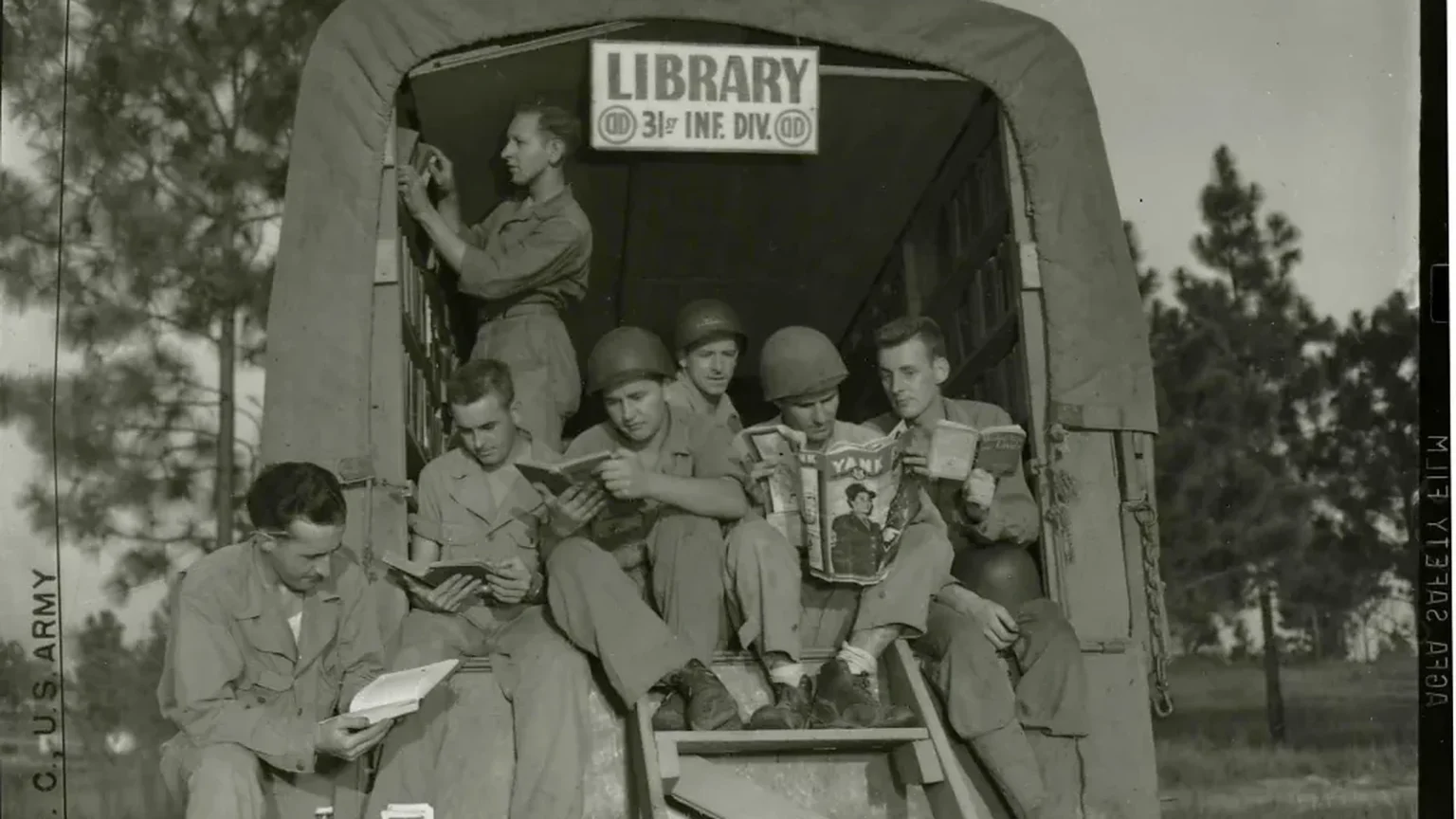
Image credit: U.S. Army Signal Corps — Source: National Archives and Records Administration — License: Public domain (U.S. federal government work) — Photo: 111-SC-180622