Bookinlight · Untranslated Books
Published by Planeta in Buenos Aires in 2008, José Pablo Feinmann’s monumental history of philosophy returns Descartes, Hegel, Marx, Heidegger, Sartre and Foucault to the political worlds that produced them. The La filosofía y el barro de la historia English Translation question remains open: no complete English edition, or officially announced forthcoming one, was located in the catalogues and publisher records checked on 12 September 2026. Its absence leaves one of Argentina’s most ambitious works of public philosophy largely inaccessible to Anglophone readers.
Book at a Glance
Book at a glance
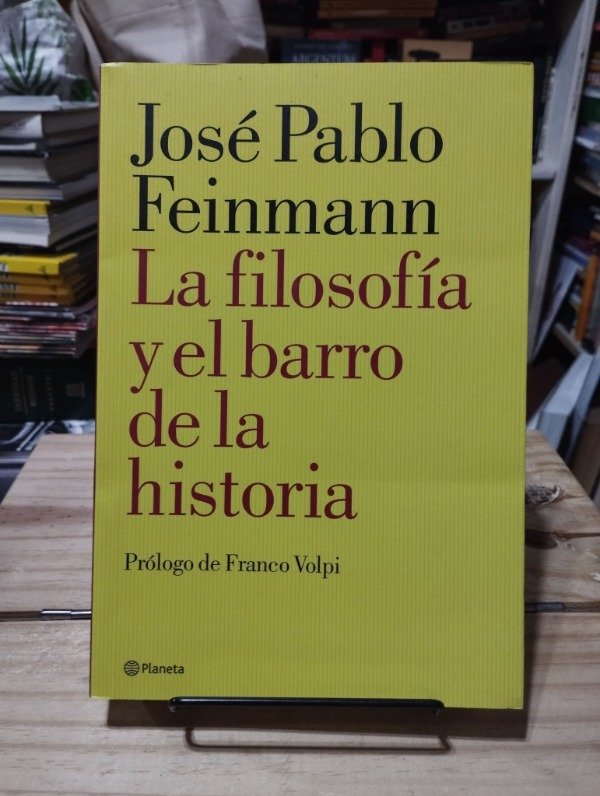
Original title: La filosofía y el barro de la historia: del sujeto cartesiano al sujeto absoluto comunicacional
Author: José Pablo Feinmann
Original language: Spanish
Country: Argentina
Original publisher: Planeta
First published: 2008
Current edition: Planeta paperback, ISBN 978-950-49-1969-8; 2008–2010 printings are traceable, but no in-stock new copy was verified.
Format and length: Paperback; 816 pages in the Sophos listing and 814 in WorldCat/Google Books. Contemporary reviews vary between 804 and 809 pages.
Current price: Current retail price not reliably located (checked 12 September 2026).
Introducing the Book
Feinmann did not conceive this as a detached survey of “great thinkers.” Its premise is that philosophy becomes intelligible when ideas are put back into the historical conflicts that made them urgent. The project grew from a large public course, then reached mass readers through twenty illustrated Página/12 supplements beginning in May 2006, before Planeta issued the full book in 2008 with a preface by Italian philosopher Franco Volpi.
The intended reader is serious but not necessarily academic. Feinmann writes as a teacher, essayist and polemicist: he explains difficult systems, dramatizes their stakes, moves between philosophy, politics, cinema and biography, and then tells the reader where he thinks an argument succeeds or fails. That combination makes the book unusually accessible for a work of its scale, but it also makes clear that this is a committed interpretation rather than a neutral textbook.
What the Book Is About
The arc begins with the modern subject: Descartes and the claim that certainty can be rebuilt from a thinking “I.” Kant and Hegel then enlarge the problem until reason, history and subjectivity become inseparable. Marx reverses Hegel’s idealism into material conflict; Nietzsche attacks inherited metaphysics and morality; Freud unsettles the sovereignty of consciousness. From there Feinmann turns to Heidegger, Nazism, the Frankfurt School and Auschwitz, before making Sartre and Foucault central antagonists in a longer dispute over human agency.
That dispute is the book’s real engine. Feinmann resists versions of structuralism and post-structuralism that, in his reading, dissolve the subject into language, systems or dispersed power. He repeatedly returns to Marx and Sartre because they preserve the possibility of historical action. Foucault is treated with admiration and combativeness; Heidegger is both philosophically unavoidable and politically compromised. By the later sections, the problem has shifted toward postmodernity and media power: the “absolute communicational subject” of the subtitle names a world in which subjectivity is increasingly produced and governed through communication itself.
Feinmann’s wager is not that history explains philosophy away, but that philosophy becomes legible when concepts are returned to the conflicts, institutions and powers that made them urgent.
About the Author

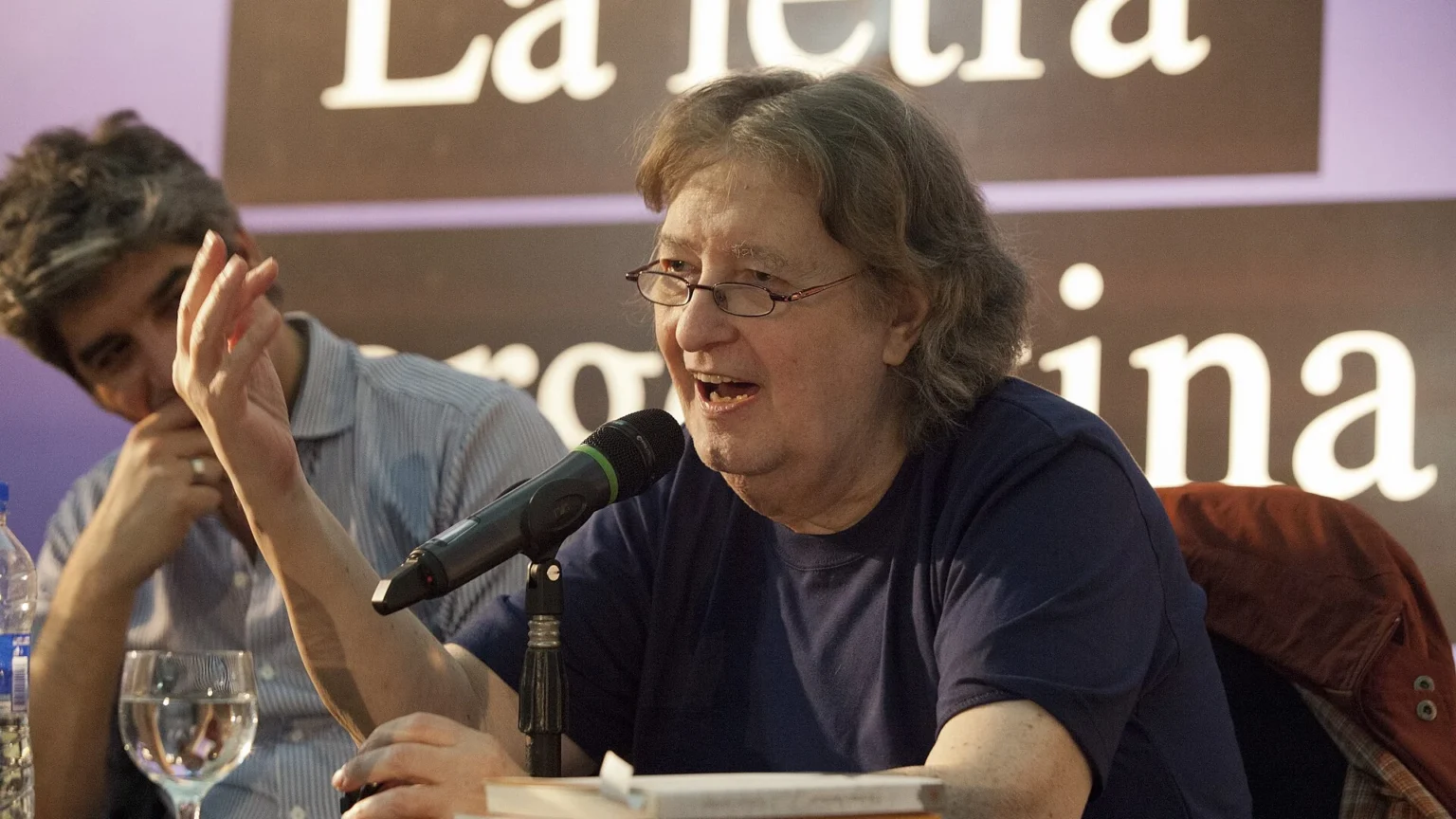
José Pablo Feinmann (1943–2021) was an Argentine philosopher, novelist, screenwriter and public intellectual trained at the University of Buenos Aires, where he also taught philosophy. His writing repeatedly joined philosophical argument to Argentine political history, film, literature and debates about power.
Across more than thirty books—from Filosofía y nación and La sangre derramada to the two-volume Peronismo—he cultivated an essayistic mode deliberately wider than specialist academic philosophy. His television series Filosofía, aquí y ahora extended that public-pedagogical project to a mass audience.
La filosofía y el barro de la historia is perhaps the fullest expression of that method: philosophy narrated as intellectual history, argued in public, and constantly returned to questions of subjectivity, political action and historical responsibility.
Why the Book Matters
The book matters first because of scale and address. Feinmann attempted something uncommon in contemporary Spanish-language philosophy: an 800-page account of modern thought written not for a narrow subfield but for a broad public, without surrendering argument. Its earlier life as a newspaper supplement and its later connection to Feinmann’s television work placed philosophical history inside popular media rather than behind university walls.
It also matters because its organizing problem is distinctive. This is not simply a Latin American retelling of a European canon. Feinmann reads that canon from an Argentine political-intellectual position shaped by Marxism, Peronism, dependency, dictatorship, mass media and the problem of historical agency. His strongest claim is methodological: concepts do political work, and their histories cannot be separated from wars, class formations, institutions and technologies of power.
That makes the book especially useful even when one disagrees with it. Its partiality is visible. Feinmann’s Sartrean and dialectical sympathies generate forceful readings, but they also produce sharp judgments about Heidegger, Foucault and postmodernism. The result is less a reference manual than an invitation to contest the history of philosophy as one reads it.
How the Book Was Received
The accessible critical record is smaller than the book’s cultural footprint, so the five discussions below are limited to verifiable original-language sources. Across them, a pattern emerges: admirers value Feinmann’s clarity, narrative energy and anti-academic public address; critics question the historical balance of his readings, his moral and political framing, and his treatment of post-1960s French philosophy.
LA NACIÓN
Reviewer: Not credited · 29 November 2008
Assessment: Praises the book as polemical, fertile and strongly didactic, while warning that Feinmann’s historical interpretation can be ideologically slanted and less rigorous than its philosophical exposition.
PÁGINA/12 · RADAR
Reviewer: Gabriel Lerman · 12 October 2008
Assessment: Treats the volume as one of Feinmann’s fundamental books and emphasizes his “narrated philosophy”: a hybrid of philosophical explanation, fiction, cinema, history, biography and politics shaped by the voice of the classroom.
LETRAS URUGUAY
Reviewer: Germán Cáceres
Assessment: Values Feinmann’s ability to clarify difficult thinkers without reducing them to slogans, especially Hegel and Marx, and stresses the reciprocal relation the book establishes between philosophical ideas and historical events.
FILOSOFIA.MX
Reviewer: Not credited · 12 March 2009
Assessment: Reads the book as a philosophical thriller organized around the modern subject—its construction, dismantling and possible recovery—and praises Feinmann for reconnecting theory with praxis, historical agency and power.
INFOBAE
Reviewer: Eduardo Porretti · 20 December 2021
Assessment: In a retrospective on Feinmann’s work, Porretti singles out the book as a model of deep popularization: public-facing philosophy that preserves conceptual ambition while tracing modernity, bourgeois power and the history of ideas.
Why It Should Be Translated into English
A complete La filosofía y el barro de la historia English Translation would fill a real gap. English readers can already encounter enormous libraries on Descartes, Hegel, Marx, Heidegger and Foucault; what they cannot easily access is Feinmann’s Argentine reconstruction of that same tradition as a history of political agency, defeat, ideology and media power. The value lies not in adding another introductory survey, but in moving the geographical position from which the canon is narrated.
That perspective would make the book useful in Latin American philosophy, intellectual history, political theory, media studies and courses on continental philosophy. It also has crossover potential because its voice was designed for readers outside the academy. Translation would need a strong editorial apparatus—an introduction situating Feinmann in Argentine intellectual history and selective notes for local political references—without domesticating the lecture-like energy that gives the book its character.
There is precedent for Feinmann in English: his novel Timote, translated by David William Foster, was published by Texas Tech University Press in 2012. But no complete English version of this philosophical work was located as of the latest check.
The strongest case for a La filosofía y el barro de la historia English Translation is not completeness but perspective: it would let Anglophone readers encounter the European philosophical canon as argued from Argentina, through the pressures of political history rather than as an autonomous succession of ideas.
English-Language Publishers That Should Consider It
These are editorial-fit recommendations only. They do not imply publisher interest or confirmed rights availability.

Candidate 1
Duke University Press · United States
Why it fits: Duke has a deep list in Latin American critical thought and translation.
Relevant catalogue comparison: Enrique Dussel’s 752-page Ethics of Liberation, translated into English in 2013.
Best edition type: Scholarly trade paperback with contextual introduction and notes.
Likely readership: Philosophy, Latin American studies, political theory.
Possible limitation: Feinmann’s expansive, lecture-driven style is more public-facing than much of Duke’s theory list.

Candidate 2
Verso Books · United Kingdom / United States
Why it fits: Verso publishes translated continental philosophy and politically engaged public theory.
Relevant catalogue comparison: Marina Garcés’s New Radical Enlightenment, translated by Julie Wark.
Best edition type: Serious-trade paperback with a substantial translator’s introduction.
Likely readership: General intellectual readers, Marxist theory, philosophy and politics.
Possible limitation: An 800-page translation would be expensive and unusually long for a crossover title.

Candidate 3
Fordham University Press · United States
Why it fits: Fordham combines continental philosophy with work on the Americas and translated theory.
Relevant catalogue comparison: Philosophizing the Americas (2024), an inter-American philosophy collection.
Best edition type: Academic-trade translation with introduction, chronology and selective notes.
Likely readership: Continental philosophy, intellectual history and Latin American studies.
Possible limitation: The book is longer and more essayistic than a conventional monograph and would need careful editorial framing.
Sources
Bibliographic and publisher sources
- UCSE Bibliographic Catalogue: José Pablo Feinmann, Universidad Católica de Santiago del Estero — verifies the 2008 first edition, Planeta and ISBN.
- WorldCat record for the 2008 Planeta edition, OCLC — verifies language, publisher, ISBN and 814-page catalogue description.
- “La filosofía y el barro de la historia” announcement/interview, Página/12 — documents the course origins and twenty-supplement serialization.
Price and edition sources
- La Filosofía y el Barro de la Historia, Librería Sophos — lists the Planeta 2008 paperback, ISBN, 816 pages and Q790, but marks it unavailable.
- La filosofía y el barro de la historia — used copy, Libros de Ninguna Parte — exact-cover source; lists ARS 28,000 but marks the copy out of stock.
Author sources
- José Pablo Feinmann, PlanetadeLibros — publisher biography and bibliography.
- “José Pablo Feinmann: el autor que popularizó la filosofía en la Argentina”, Argentina.gob.ar — career, public-philosophy context and portrait source.
Reviews and critical reception
- “Sacar la filosofía a la calle”, La Nación, 29 November 2008.
- “Pienso, luego existo”, Gabriel Lerman, Página/12 · Radar, 12 October 2008.
- “La filosofía y el barro de la historia”, Germán Cáceres, Letras Uruguay.
- “La Filosofía, según José Pablo Feinmann”, Filosofia.mx, 12 March 2009 — extended critical reading of the book’s subject, praxis and power argument.
- “José Pablo Feinmann: La máquina de escribir”, Eduardo Porretti, Infobae, 20 December 2021.
English-translation verification sources
- José Pablo Feinmann author record, Open Library — lists the target in Spanish editions and was checked for English-version evidence.
- Google Books record — verifies the Spanish Planeta edition and ISBN; no English edition is identified.
- Timote: A Novel, Open British National Bibliography — verifies Feinmann’s separate 2012 English translation by David William Foster.
Amazon edition sources
No exact Amazon product page matching ISBN 978-950-49-1969-8 was verified; search-results pages were therefore not used or linked.
Publisher-comparison sources
- Ethics of Liberation, Duke University Press — comparable long-form translated Latin American philosophy.
- New Radical Enlightenment, Verso Books — comparable translated public philosophy.
- Philosophizing the Americas, Fordham University Press — demonstrates an inter-American philosophy list alongside Fordham’s continental-theory series.
Image Credits
- Main cover, Planeta edition: Libros de Ninguna Parte, exact-title listing.
- José Pablo Feinmann portrait: Argentina.gob.ar — source page credits the photograph as courtesy of La Voz.
- Duke University Press logo: Wikimedia Commons file page — logo sourced there to Duke University Press materials.
- Verso Books logo: Wikimedia Commons file page — verified wordmark derived from the Verso website header.
- Fordham University Press logo: Fordham University Press Graphic Resources, official press asset page.
Image credit: Margarita Solé / Ministerio de Cultura de la Nación — Source: Wikimedia Commons — License: CC BY-SA 2.0