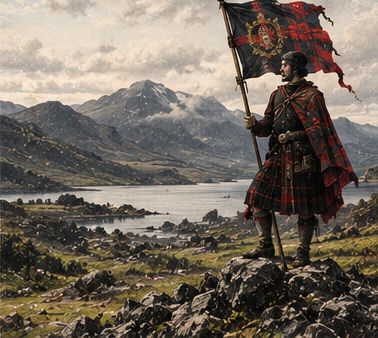
On 6 December 1745, the Jacobite army turned back at Derby. London lay farther south. The army had advanced with astonishing speed, won at Prestonpans, crossed into England and reached the deepest point of invasion any Jacobite force would achieve. Yet the expected English rising had not materialized, French troops had not appeared in sufficient force, and government armies were converging. The retreat did not make defeat inevitable, but it exposed the central weakness of the ’45: a campaign that could move faster than the political coalition behind it could grow.
To explain Jacobite failure only through Culloden is therefore to begin too late. The risings of 1715 and 1745 failed for different immediate reasons, but both reveal the same structural problem. The Stuart cause could mobilize intense loyalty and exploit moments of crisis. It struggled to turn that loyalty into a coalition broad enough, supplied enough and internationally supported enough to overthrow a state whose military, fiscal and administrative capacity was becoming stronger.
The failure is easier to see as a chain
A causal ledger is more useful than a single-cause verdict:
Political coalition: Jacobite sympathy was real but uneven across Scotland, England and Ireland; sympathy did not automatically become armed support.
Foreign assistance: France and Spain could use Jacobitism strategically, but their support was constrained by wider European wars and their own priorities.
Command and strategy: The risings depended on fast decisions by leaders operating with incomplete information and sometimes conflicting goals.
Logistics and supply: An invading army had to feed, equip, pay and reinforce itself while moving through contested territory.
State capacity: The post-1688 British state could raise revenue, move troops, use naval power, collect intelligence and punish rebellion more effectively than earlier regimes.
Time: Every delay favored the government: militia mobilized, regular regiments returned, routes were secured, and foreign intervention became harder.
1715: a large rising without a decisive political center
The 1715 rising followed the Hanoverian succession and deep political resentment after the Union of 1707. In Scotland, John Erskine, Earl of Mar, raised the Jacobite standard at Braemar. The rebellion gathered substantial manpower, but numbers did not solve the problem of direction. At Sheriffmuir on 13 November, the battle was tactically confused and strategically inconclusive. The Jacobite advance stalled. James Francis Edward Stuart arrived only later, when momentum had already drained from the campaign. For an external check on the chronology and interpretation, The National Archives — Jacobite Rising of 1745.
The National Archives’ research guide is useful here because its categories — administration, finance, military campaigns, trials, forfeitures — remind us that rebellion was not merely a battlefield event. The government response operated through records, money, law and confiscation as well as troops. The rising had to defeat not simply an army but an increasingly coordinated governing system.
The contrast between the two risings is useful. In 1715, a large mobilization failed to convert manpower into coherent strategic momentum. In 1745, the movement solved more of the operational problem — it won battles, captured Edinburgh and invaded England — but still failed to trigger the political and foreign-policy cascade on which final success depended. The recurring weakness was therefore not identical battlefield performance; it was the gap between rebellion and a coalition capable of replacing the state.
Derby, not Culloden, is the strategic hinge
Charles Edward Stuart’s rising began under less promising conditions and initially performed far better. The Jacobites captured Edinburgh, defeated government forces at Prestonpans and invaded England. The National Library of Scotland’s timeline records the critical sequence: Carlisle fell; the army moved through Lancaster, Preston and Manchester; it reached Derby; then it retreated when large English reinforcements and the promised French support failed to appear.
This is the point at which romantic accounts often become counterfactual: what if the army had continued to London? The question is legitimate, but it should not erase the information available to the commanders. The deeper the army moved into England, the longer its supply line became and the more dangerous encirclement looked. A march on London was not merely a matter of nerve. It required confidence that political support, reinforcements and strategic distraction would grow faster than government resistance. That confidence was missing.
COUNTERFACTUAL CHECK: A continued march on London changes the military question. It does not automatically solve English recruitment, French intervention, finance, supply, or the legitimacy of a restored Stuart government.
The Hanoverian state had learned
Between 1715 and 1745 the government improved the infrastructure of coercion in Scotland. George Wade’s road and fortification program is the obvious symbol, but the larger change was institutional. Britain’s fiscal-military state could finance war on a scale the Jacobite movement could not match. Naval power limited external reinforcement. Intelligence and political networks identified threats. After 1745, the state combined military victory with legal and social measures intended to prevent another rising from rebuilding the same base.
This does not mean the Hanoverian state was omnipotent. Prestonpans and Falkirk Muir exposed serious weaknesses. It means that the government could survive local failure and generate replacements. The Jacobites had a much smaller margin for error. Their victories had to create a political cascade. Government defeats could be absorbed.
A popular cause is not yet a governing coalition
Jacobitism survived because the post-1688 settlement was not universally accepted. It drew on dynastic loyalty, Episcopalian and Catholic identities, anti-Union feeling, Tory opposition and a European diplomatic environment in which rival powers had reasons to destabilize Britain. Yet these motives were not identical. A Scottish opponent of Union, an English Tory, a French strategist and a Highland chief did not necessarily want the same political future.
Coalitions can fight together without sharing the same endpoint. That ambiguity became fatal when the campaign required risky decisions. Restoration of the Stuarts, dissolution of the Union, defense of local power, religious settlement and European strategy could overlap, but they did not fuse into one universally compelling program.
Culloden closes the story; it does not explain it
The Battle of Culloden on 16 April 1746 destroyed the field army and ended the final rising. A contemporary map preserved by The National Archives notes that many Jacobites were short of pay and provisions and had endured an exhausting march with little food or sleep immediately before the battle. The government force, by contrast, fought after months in which the strategic initiative had shifted decisively. But if we ask why the Jacobite rebellions failed, Culloden should be treated as the final military expression of earlier political and logistical problems.
The Jacobites could threaten the state because legitimacy remained contested. They could not replace the state because threat was not the same as governing capacity. Their history is therefore best understood not as a simple contest between romantic rebels and modern government, but as a collision between rival claims to rule in an age when the ability to tax, borrow, supply, communicate and survive defeat was becoming as important as the right to wear the crown. For the historiography behind these military and political explanations, BookInLight’s Jacobite rebellions reading list provides a structured route through the major studies.
What the archival and scholarly record changes
The historical record is more useful when chronology, primary evidence, and later interpretation are kept separate. First, Oxford Bibliographies — Jacobite Risings provides a more specialized scholarly treatment and makes the interpretive stakes visible. Second, The National Archives — Jacobite Risings 1715 and 1745 anchors the discussion in documentary or archival material. Finally, The National Archives — Jacobite Rebellion of 1715 anchors the discussion in documentary or archival material. Taken together, these sources help distinguish what is documented from the causal weight later historians assign to it—a crucial difference in subjects that are easily compressed into one dramatic story.
That source-led method changes the kind of claim this article makes. It separates the surviving record from later historical explanation, and it distinguishes chronology from causation. Where historians assign different weight to state capacity, ideology, institutions, leadership, or contingency, the disagreement remains visible instead of being collapsed into a single verdict. The article’s own synthesis is therefore presented as a reading of the evidence, not as a substitute for the evidence.
Related BookInLight histories
Best Books on the Glorious Revolution: Five Serious Histories of 1688
A Crown Divided: Five Histories of the Spanish Succession War
Archives and historical reading
The National Archives — Jacobite Risings 1715 and 1745 — Archival guide to policy, finance, military operations, trials and forfeitures.
The National Archives — Jacobite Rebellion of 1715 — Documents and introduction by historian Daniel Szechi.
The National Archives — Jacobite Rising of 1745 — Primary-source teaching set and historical introduction.
National Library of Scotland — Jacobites: A timeline — Chronology from the Stuart claim through the 1745 rising.
National Museums Scotland — The Jacobite challenge — Material-culture and political overview.
Royal Scots Dragoon Guards — Jacobite Rebellions — Military context including Sheriffmuir, Glenshiel and Wade’s infrastructure program.