Seven books on Galileo and the Church reveal disagreements about evidence, authority, patronage, trial records, and the history of science.
A useful reading list on Galileo and the Church should begin by refusing a familiar convenience: there is no single ‘Galileo affair’ waiting to be narrated once the facts are collected. There is a sequence of events, texts, warnings, institutional decisions, scientific claims, political pressures, biblical arguments, and later reinterpretations. The Stanford Encyclopedia of Philosophy’s Galileo entry summarizes the core proceedings while also showing how much interpretive controversy attaches to their causes and significance. The seven books below are worth reading together because they disagree about what deserves explanatory priority.
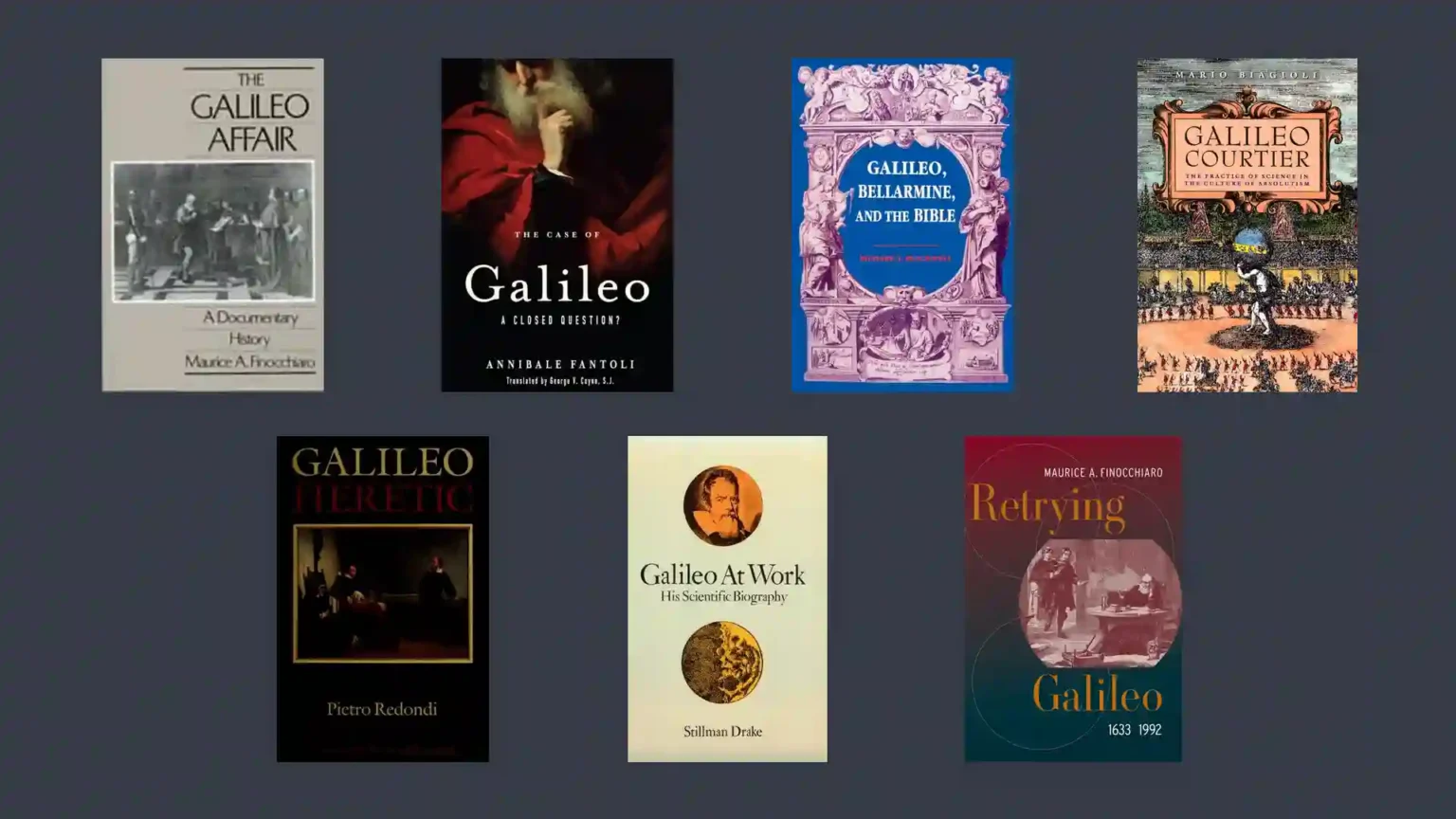
1. Maurice A. Finocchiaro — The Galileo Affair: A Documentary History
The Galileo Affair is the correct first book because it limits the temptation to inherit somebody else’s plot before encountering the documents. Finocchiaro assembles material from the 1613–16 controversy through the 1633 proceedings, including letters, reports, depositions, the sentence, and the abjuration. Its value is methodological as much as archival. The documents make visible the difference between what an institution recorded, what Galileo claimed, what advisers recommended, and what later historians infer. No documentary collection is neutral—selection and translation remain editorial acts—but this one gives the reader enough primary material to test subsequent narratives.
Read it with three columns in mind even if no table is written: evidence, inference, judgment. A 1616 record may establish that a warning occurred; it does not by itself settle every later question about the exact legal force of that warning. A letter about Scripture may reveal Galileo’s hermeneutic strategy; it does not alone prove how representative that strategy was among Catholic theologians. This discipline of separating levels of claim should govern the six books that follow.
2. Annibale Fantoli — The Case of Galileo: A Closed Question?
The Case of Galileo condenses decades of specialist work into a narrative that takes both scientific and ecclesiastical arguments seriously. Fantoli is particularly useful for readers who have inherited either of two symmetrical myths: heroic science facing pure obscurantism, or a merely unfortunate misunderstanding between equally reasonable parties. His account keeps institutional responsibility, theological constraints, scientific uncertainty, and personal decisions in the same frame. The question mark in the subtitle matters. ‘Closed’ can mean factually settled, morally resolved, institutionally acknowledged, or historiographically exhausted; those are not the same thing.
3. Richard J. Blackwell — Galileo, Bellarmine, and the Bible
Galileo, Bellarmine, and the Bible shifts the center of gravity from astronomy to biblical interpretation and ecclesiastical authority. Blackwell reconstructs the theological world in which Cardinal Bellarmine, Jesuit thinkers, Galileo, and figures such as Paolo Antonio Foscarini argued about what Scripture could mean once natural-philosophical claims appeared to challenge a literal reading. The book is indispensable because ‘the Church rejected science’ is too coarse to describe the actual dispute. Questions of proof, interpretation, magisterial authority, Counter-Reformation discipline, and the status of hypothetical astronomy were entangled.
Blackwell’s emphasis also supplies a warning. If the affair is told only as a contest between an empirical scientist and a biblical institution, then the internal Catholic debates disappear. If it is told only as an exegetical dispute, Galileo’s changing evidential case for Copernicanism disappears. The explanatory gain comes from keeping both in view.
4. Mario Biagioli — Galileo, Courtier
Galileo, Courtier changes the question again. Biagioli treats patronage, court culture, credibility, etiquette, and self-fashioning as constitutive of scientific practice rather than as social scenery around an autonomous method. Galileo’s move into Medici service, the naming and presentation of discoveries, the management of disputes, and the politics of reputation become part of how knowledge acquired authority. Readers trained to separate ‘the science’ from ‘the politics’ may find the book deliberately unsettling.
This approach does not show that telescopic observations were merely rhetorical constructions. It shows that observations had to circulate through institutions and audiences whose judgments determined credibility, access, and protection. Biagioli’s account therefore complicates both heroic biography and institutional morality play. Galileo possessed unusual mathematical and polemical capacities, but he also operated inside systems of patronage that could amplify success and magnify conflict.
5. Pietro Redondi — Galileo Heretic
Galileo Heretic is the list’s necessary provocation. Redondi argued that atomistic implications in Galileo’s physics posed a deeper theological threat—especially in relation to Eucharistic doctrine—and that the 1633 Copernican charge may have functioned as a safer route through a more dangerous conflict. The hypothesis generated intense debate and has not become the consensus explanation. That is exactly why the book belongs here. It demonstrates how a striking archival clue can reorganize an entire narrative, and how historical scholarship then tests whether the reconstruction explains more evidence than it strains.
Read Redondi after the documentary baseline, not before it. The value is not that the reader must accept a hidden-case thesis. The value is learning what revisionist history looks like when it proposes a new causal center. Compare every major inference with Finocchiaro, Fantoli, and the broader scholarly synthesis. Historiography advances through arguments strong enough to be challenged.
6. Stillman Drake — Galileo at Work
Galileo at Work restores a danger created by affair-centered reading lists: Galileo can become famous only for being tried. Drake’s scientific biography follows problems in motion, mechanics, instruments, telescopic observation, mathematical reasoning, and the development of a research program across decades. The University of Chicago Press’s Stillman Drake author page records the book among his major Galileo studies. It belongs on a Church-focused list because one cannot judge the epistemic conflict well without understanding what kind of scientific achievement and argumentative practice Galileo actually brought into it.
Drake also exposes chronological distortion. The 1633 trial is a climax in one story but not the endpoint of Galileo’s science. Reading the scientific biography beside the judicial history prevents condemnation from swallowing the intellectual life that preceded and followed it.
7. Maurice A. Finocchiaro — Retrying Galileo, 1633–1992
Retrying Galileo, 1633–1992 begins where many histories stop. Finocchiaro follows the affair’s afterlife through arguments about censorship, science, secularism, Catholic thought, historical memory, and the twentieth-century attempts to reassess the case. This is crucial because ‘Galileo versus the Church’ is partly a later cultural object built from the seventeenth-century proceedings. The meaning of 1633 has been repeatedly retried by philosophers, scientists, dramatists, churchmen, historians, and public polemicists.
The book therefore changes the unit of analysis. Instead of asking only why Galileo was condemned, it asks why the condemnation continued to matter, and how different eras used it to define their own relation to authority and knowledge. What looks like a settled historical symbol is shown to have a history of its own.
How the seven arguments fit
These books should not be forced into a synthetic verdict too quickly. Finocchiaro’s documentary collection disciplines claims with sources. Fantoli reconstructs the case as an institutional and intellectual conflict. Blackwell foregrounds Scripture and ecclesiology. Biagioli foregrounds patronage and credibility. Redondi tests a revisionist hidden-cause hypothesis. Drake restores the long scientific career. Finocchiaro’s later volume reconstructs the centuries of interpretation after the sentence. Each changes what counts as the event.
That plurality is not a sign that ‘anything goes.’ Some claims are better evidenced than others. The current Stanford Encyclopedia treatment of Galileo explicitly notes both the clouded legal status of Copernicanism and the limited support received by the atomism-cover-up hypothesis. Historiographical disagreement becomes productive when it is tied to records that can be compared, not when every narrative is treated as equally plausible.
A second reason to preserve disagreement is that the familiar category ‘science versus religion’ is itself too large for the evidence. The conflict involved astronomy, natural philosophy, biblical exegesis, canon law, institutional obedience, papal politics, patronage, standards of demonstration, and the credibility of new instruments. Different books enlarge different parts of that field. The result is not a softer story in which nobody was responsible; Galileo was condemned, forced to abjure, and confined. It is a more exact story in which explaining the condemnation requires distinguishing scientific evidence from juridical procedure, theological interpretation from ecclesiastical authority, and seventeenth-century decisions from the symbolic uses later generations made of them. Those distinctions also explain why a single biography or a single institutional history cannot carry the full burden of the subject.
For a first route, read Finocchiaro’s documentary history, Fantoli, and Blackwell. Then choose Biagioli if the politics of credibility interests you, Drake if scientific practice is your priority, and Redondi if you want to see how a revisionist thesis tests the archive. Finish with Retrying Galileo. The final book turns the reader back on the reading list itself: every generation inherits Galileo through earlier arguments about Galileo. The affair is historical, but the desire to make it symbolize the relation between knowledge and authority is part of its continuing history.
Cover artwork: credits and source records
- The Galileo Affair: A Documentary History — University of California Press (source record)
- The Case of Galileo: A Closed Question? — University of Notre Dame Press (source record)
- Galileo, Bellarmine, and the Bible — University of Notre Dame Press (source record)
- Galileo, Courtier — University of Chicago Press (source record)
- Galileo Heretic — Princeton University Press (source record)
- Galileo at Work — Dover Publications (source record)
- Retrying Galileo, 1633–1992 — University of California Press (source record)