Print culture research asks who produces, distributes, preserves, and interprets texts, not just what authors wrote.
Put two objects on a desk: a fifteenth-century printed book and a twenty-first-century scholarly paperback about that book. They are both “books,” but they invite different questions. One asks how reproduction altered knowledge; the other asks who printed, sold, trusted, handled, preserved, and interpreted printed objects. A beginner in print culture needs both questions before choosing a theory.
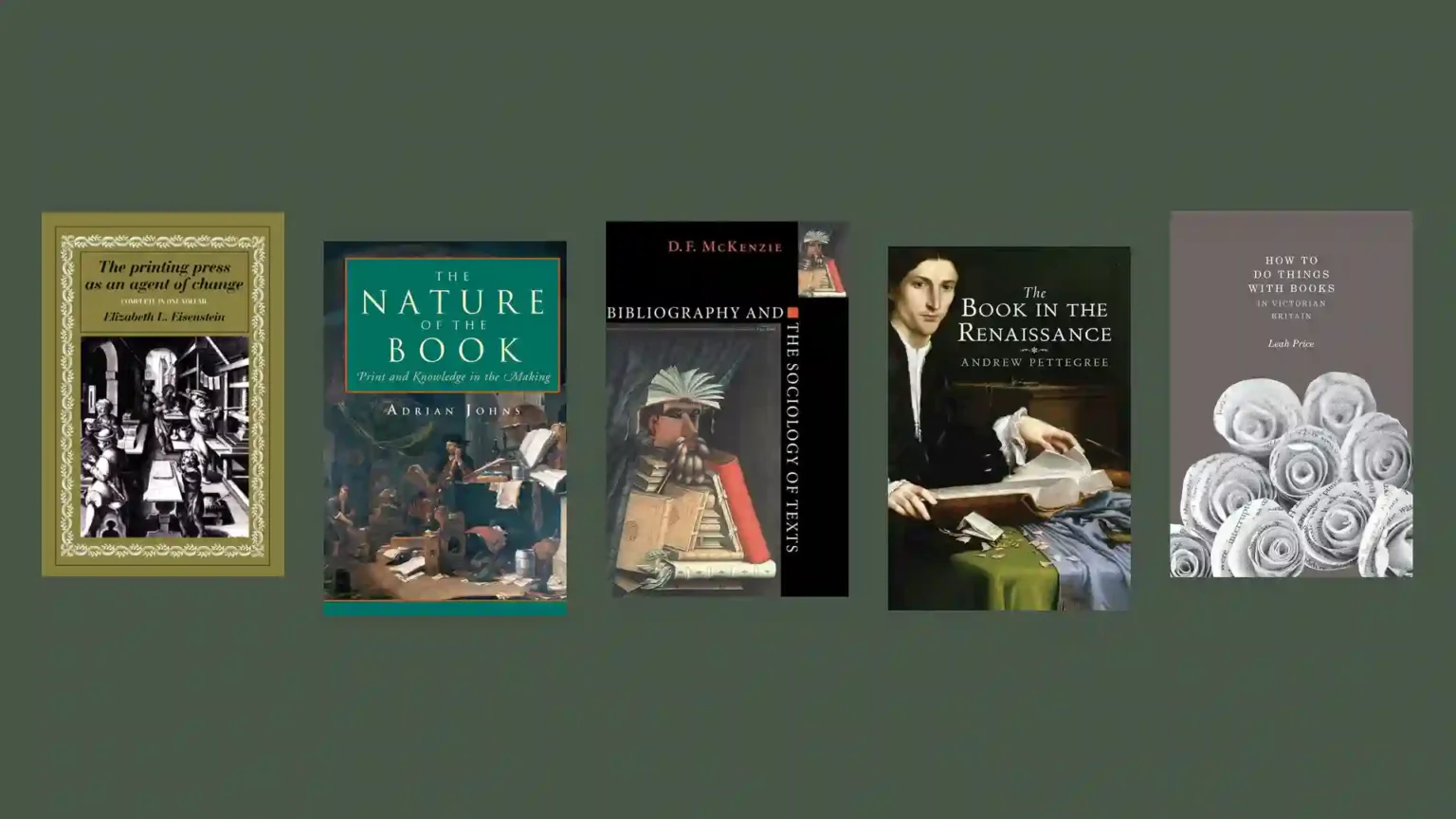
First object: technological change. Elizabeth Eisenstein’s The Printing Press as an Agent of Change is the large-scale starting point.
Eisenstein asks what follows when written material moves from manuscript copying into print reproduction: greater fixity, accumulation, comparison, wider dissemination, and new conditions for Renaissance, Reformation, and science. The book is deliberately ambitious. Read enough to understand the thesis before reading its critics; otherwise later book-history scholarship can sound like a collection of local corrections with no large claim to correct.
Second object: credibility. Adrian Johns’s The Nature of the Book makes printed knowledge look less automatic.
Johns follows authors, printers, booksellers, readers, piracy, reputation, and practical efforts to make print trustworthy. The contrast with Eisenstein is foundational for a beginner. Printing does not simply produce stable knowledge by technical force; communities must manufacture credibility. Read the two books against each other, not as an old thesis replaced by a new one.
From “the press” to the material text
D. F. McKenzie’s Bibliography and the Sociology of Texts changes the unit of analysis again. Material form is not packaging added to a separable message. Format, typography, edition, production, circulation, and use participate in meaning. If your real interest is literary interpretation, this is often the book that turns “book history” from background into method: the text is encountered through historically specific forms.
A useful practical detour is the Rare Book School. Its teaching model treats bibliography as something learned from objects, technologies, bindings, type, paper, provenance, and description rather than from abstract media theory alone. The school’s Presswork program makes the point physically: setting type and operating period presses reveals constraints that disappear when print is treated as a metaphor.
Markets, readers, and uses
Andrew Pettegree’s The Book in the Renaissance gives the beginner a market. It covers the first great age of European print, but resists a smooth story of inevitable success. Printers faced demand, risk, patronage, piracy, religious conflict, and the problem of selling enough copies. Read it when “print revolution” begins to sound as though technologies distribute themselves.
Leah Price’s How to Do Things with Books in Victorian Britain then gives the book a body and a social life. Her distinction among reading, handling, and circulating printed matter is especially useful after early-modern histories because it breaks the assumption that a book’s only meaningful use is to have its words read. The Harvard publication record is also a concise bibliographic route to the study.
A five-book route that answers five different questions
Eisenstein — What changed when reproduction moved from script to print?
Johns — How did printed matter acquire credibility and authority?
McKenzie — How does the material form of a text help produce meaning?
Pettegree — What economic and institutional conditions made print sustainable?
Price — What do people do with books besides extract verbal content?
Do not read all five as competing answers to one question. They operate at different scales. A seminar paper on a particular edition may need McKenzie much more than Eisenstein; a project on Reformation pamphlets may reverse that priority; a study of collecting, gifting, display, or non-reading may begin with Price.
The next reading decision should therefore follow the object you have. If it is an early printed book embedded in a market, continue with Pettegree and Johns. If it is a literary work whose editions change its presentation, move deeper into bibliography after McKenzie. If the puzzle is why books matter as possessions, gifts, props, or waste paper, follow Price. Print culture becomes manageable when “the book” stops being one thing.
Before theory, inspect one printed object
An evidence-first route starts with a book in hand. Record the title page, publisher, date, format, pagination, illustrations, signs of ownership, marginalia, advertisements, and anything that identifies an edition or printing. Then ask what the object permits that another form would not. A facsimile, a cheap reprint, a deluxe binding, and a circulating-library copy may carry the same verbal work while participating in different histories.
This is where McKenzie becomes practical rather than abstract. If material form participates in meaning, then a change in page design, paratext, sequence, or apparatus can become evidence for interpretation. Johns adds a second discipline: authority has to be produced. Printer reputation, correction practices, piracy, licensing, and reader trust can matter as much as the mechanical capacity to multiply copies.
Do not confuse print culture with the history of ideas
Print historians certainly follow ideas, but the field asks how ideas become material, reproducible, saleable, credible, collectible, censorable, and reusable. Pettegree is useful because printers can fail; Price is useful because readers can refuse to “read” in the idealized sense; Eisenstein is useful because technical shifts can reorganize intellectual possibilities at very large scale. The field becomes distinctive when all three levels—technology, institution, and use—remain visible.
A beginner who only wants a conceptual overview can stop after the five-book route. A student moving into primary research should add catalogues, bibliographies, provenance records, and physical description. The Rare Book School course ecosystem shows how quickly “print culture” branches into descriptive bibliography, provenance, scholarly editing, typography, binding, manuscripts, and digital materials. The next step is therefore a method choice, not another general survey.
Cover artwork: credits and source records
- The Printing Press as an Agent of Change — Cambridge University Press (source record)
- The Nature of the Book — University of Chicago Press (source record)
- Bibliography and the Sociology of Texts — Cambridge University Press (source record)
- The Book in the Renaissance — Yale University Press (source record)
- How to Do Things with Books in Victorian Britain — Princeton University Press (source record)