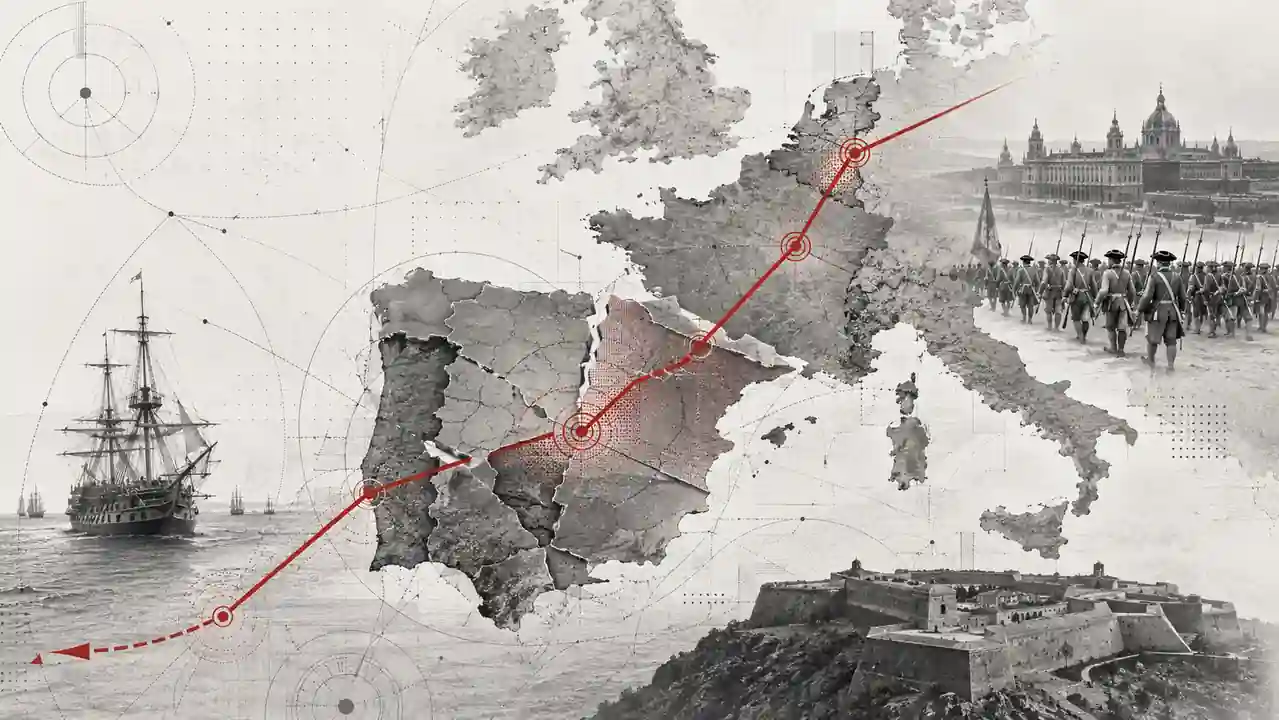
Illustration by Bookinlight Art Desk
A Bookinlight Reading Dossier
Readers searching for the best War of the Spanish Succession books need more than a sequence of battles. They need a way to connect dynastic legitimacy, coalition warfare, fiscal endurance, maritime commerce, Spanish political division, and the diplomatic reconstruction of Europe.
The conflict began as a dispute over who would inherit the composite Spanish monarchy after Charles II died without an heir. It became something larger: a test of whether Bourbon power could unite the French and Spanish crowns, whether alliances could restrain a dominant monarchy, and whether victory on land could be converted into durable political settlement. The five books below are arranged as an intellectual progression—from narrative orientation to Spanish experience, French war-making, Atlantic strategy, and revisionist scholarship.
By Bookinlight
The Reading Lens
A succession crisis that reorganized the meaning of power
The war is most revealing when read neither as a Marlborough epic nor as a simple Anglo-French duel. It joined court politics to provincial loyalties, dynastic law to military logistics, and European campaigns to Atlantic extraction. Its central paradox is that no coalition achieved everything it sought, yet the settlements of 1713–1714 changed the rules of diplomatic expectation. These books belong together because each isolates a different mechanism—narrative, monarchy, strategy, commerce, or historiography—through which a dynastic quarrel became an early modern world war.
Central Question
How could Europe prevent one dynasty from converting inheritance into hegemony?
Historical Pressure
A vacant throne, imperial overstretch, confessional memory, and the cost of coalition war.
Why These Books
Together they restore Spain, France, Britain, the Atlantic, and historical method to one frame.
How to Read the Best War of the Spanish Succession Books
Begin with the war’s chronology, then complicate it. Falkner supplies the map; Kamen recenters the Iberian struggle; Lynn explains the French military system; Satsuma opens the Atlantic and commercial dimensions; Pohlig and Schaich show how contemporary scholarship has moved beyond older national narratives. Read in this order, the conflict changes from a chain of campaigns into a struggle over how composite monarchies, fiscal states, and imperial markets could coexist.
James Falkner
Best for: A first complete overview
Difficulty: General
Intellectual role: Narrative foundation
Bookinlight Rating: ★★★★½
Falkner’s study is the most practical entrance into a conflict whose geography can overwhelm newcomers. It moves across Flanders, the German lands, Italy, Iberia, the Mediterranean, the Atlantic, and North America without losing the central question of succession. The book’s chief contribution is organizational: it shows how campaigns that are often remembered separately—Blenheim, Ramillies, Turin, Almansa, Oudenarde, Malplaquet—belonged to a single coalition struggle in which military success repeatedly failed to produce immediate political decision.
That clarity makes the book especially useful for readers who know Marlborough’s name but not the structure of the Grand Alliance. Falkner explains commanders, sieges, marches, and battlefield choices in accessible language, while keeping diplomacy and war aims visible. His narrative also corrects a common misconception: the anti-Bourbon coalition did not simply advance toward inevitable victory. It depended on fragile coordination among states with different priorities, and it could be weakened by exhaustion, ministerial change, or disagreement over peace terms.
The book belongs first in this sequence because later interpretations require chronological confidence. Once the reader understands where armies moved and why fronts rose or collapsed, questions of finance, legitimacy, commerce, and state formation become easier to see. Falkner changes the war from a famous battle surrounded by obscurity into a prolonged system of interlocking theaters. Specialists will want denser archival analysis, but general readers gain the indispensable architecture on which every more demanding account rests.
Bookinlight Note
Read this with a map nearby. The book’s real achievement is not simplification, but the controlled restoration of simultaneity.
Henry Kamen
Best for: Spain’s internal war
Difficulty: Intermediate
Intellectual role: Iberian recentering
Bookinlight Rating: ★★★★½
Kamen’s classic study performs a necessary act of correction: it treats Spain not as the inert prize of foreign powers but as a political arena with institutions, territories, elites, grievances, and competing visions of monarchy. The succession crisis divided the Spanish composite monarchy unevenly. Support for Philip V and the Bourbon cause was strong in some regions, while the Habsburg claimant attracted decisive backing elsewhere, especially within the Crown of Aragon. Kamen therefore reveals a civil conflict nested inside an international war.
This perspective is essential because the language of “balance of power” can make the war appear to have been designed exclusively in London, Vienna, Versailles, and The Hague. Kamen asks what succession meant within Spain: who recognized legitimate authority, how war altered local alignments, and why the eventual Bourbon victory enabled a far-reaching reconfiguration of relations between crown and territories. The reader sees that dynastic change was not a ceremonial substitution at the top. It could transform administrative practice, provincial privilege, military obligation, and the political future of Catalonia and Valencia.
The book benefits readers willing to move beyond campaign narrative into institutional and regional history. Its age should be kept in mind; later scholarship has revised many emphases and widened the imperial frame. Yet its intellectual intervention remains powerful. It changes the reader’s understanding by restoring agency to the society whose throne supposedly caused the conflict. After Kamen, “Spanish succession” no longer names only a European diplomatic problem. It names a contested remaking of Spain itself, produced through occupation, allegiance, resistance, and victory.
Bookinlight Note
The book is most valuable when it makes “Spain” plural: a monarchy of territories whose political choices could not be reduced to foreign invasion.
John A. Lynn
Best for: Strategy and military systems
Difficulty: Intermediate
Intellectual role: French strategic context
Bookinlight Rating: ★★★★★
Lynn places the succession conflict inside the longer military history of Louis XIV’s reign. That wider frame matters. France entered the war not as an abstract embodiment of absolutism but as a state shaped by decades of campaigning, territorial acquisition, fortress construction, logistical innovation, and mounting fiscal strain. By tracing the wars from 1667 to 1714, Lynn shows how the strategic advantages of the Bourbon monarchy were inseparable from the burdens accumulated through repeated mobilization.
The book’s central contribution is to integrate operations with institutions. Armies do not appear merely when battles begin; they must be recruited, supplied, commanded, moved, and sustained across campaigning seasons. Fortresses and sieges matter as much as dramatic field engagements. Geography constrains ambition. Commanders operate within political instructions and imperfect information. This approach helps explain why spectacular coalition victories did not automatically destroy France, and why French resilience after years of pressure deserves as much analysis as Allied success.
Readers interested in the “military revolution,” state formation, or the practical limits of royal power will benefit most. Lynn also prevents the war from becoming an English national story centered on Marlborough. The French monarchy, its generals, defensive systems, and resource problems regain explanatory weight. The result changes our understanding of the conflict’s end: peace came not because one side achieved total mastery, but because strategic endurance, political fatigue, and revised calculations narrowed what victory could plausibly mean. Read after Falkner and Kamen, Lynn turns chronology and regional politics into a deeper study of the machinery—and limits—of early modern power.
Bookinlight Note
The decisive subject is endurance: not who could win once, but which political system could keep converting money, grain, manpower, and command into another campaign.
Shinsuke Satsuma
Best for: Atlantic and maritime strategy
Difficulty: Advanced
Intellectual role: Global and commercial expansion
Bookinlight Rating: ★★★★½
Satsuma’s study shifts attention from continental battlefields to an argument circulating within early eighteenth-century Britain: that maritime war against Spanish America could enrich Britain, weaken its enemies, and achieve strategic results at comparatively low cost. Rather than treating this claim as self-evident, he reconstructs its political and intellectual life. Pamphleteers, merchants, ministers, colonial interests, and naval planners imagined “war at sea” differently, and their preferred policies did not always survive contact with administration, diplomacy, or operational reality.
This is where the War of the Spanish Succession becomes recognizably global. Access to Spanish American trade, the circulation of silver, colonial expeditions, private interests, and the future South Sea Company were not secondary decorations around a European core. They influenced how British actors defined the value of war and the rewards of peace. Satsuma also exposes the gap between strategic rhetoric and state capacity. Maritime advocates promised gain, but naval operations faced logistical limits, conflicting constituencies, and the danger that commercial ambitions might undermine alliance diplomacy.
The book is best for readers interested in empire, political economy, naval policy, or the genealogy of British global power. It changes the theme by showing that “balance of power” operated alongside a struggle over markets and imperial access. Utrecht therefore appears not merely as a European territorial settlement but as a redistribution of commercial opportunity. Satsuma’s focused monograph is more specialized than the preceding books, yet it supplies a dimension they cannot: the language through which oceanic violence was represented as economical, patriotic, and politically rational.
Bookinlight Note
The Atlantic was not a distant theater. It was a field in which British elites debated what kind of war could convert violence into commercial advantage.
Edited by Matthias Pohlig and Michael Schaich
Best for: Current scholarly debates
Difficulty: Advanced
Intellectual role: Historiographical synthesis
Bookinlight Rating: ★★★★★
This edited volume is the best destination after the reader has mastered the war’s basic chronology. Its essays dismantle the assumption that the conflict can be adequately understood through great commanders, cabinet diplomacy, and decisive battles alone. Instead, contributors examine the war through multiple scales and methods: finance, communication, political culture, international relations, military organization, regional experience, and the global reach of imperial competition. The result is not one replacement narrative but a demonstration of why the old narrative has become insufficient.
The volume’s central intellectual contribution lies in comparison and connection. It treats the war as a European and global event while remaining attentive to the specific institutions that made coalition action possible or difficult. States appear less as unitary actors than as assemblages of courts, ministers, creditors, military contractors, provincial authorities, and information networks. Peace likewise becomes a process rather than a final scene: negotiation had to reconcile incompatible claims, battlefield outcomes, dynastic honor, and the exhaustion of political communities.
Advanced readers, graduate students, and researchers will benefit most, though individual chapters can guide ambitious general readers. The book changes one’s understanding by making the conflict a laboratory for early modern history itself. It reveals how scholars now ask not only who won, but how war was financed, justified, experienced, reported, and remembered. Placed last, it also teaches a methodological lesson: synthesis is strongest after narrative certainty has been disturbed. The War of the Spanish Succession emerges as an event whose apparent familiarity has concealed unresolved questions about scale, agency, and globalization.
Bookinlight Note
Use the collection selectively, then return to it. Its value increases as the reader acquires enough context to see where the essays genuinely revise inherited explanations.
The Reading Map
Five routes through the same war
| Book | Difficulty | Rating | Why It Matters |
|---|---|---|---|
| Spanish Succession 1701–1714 | General | ★★★★½ | Establishes chronology, theaters, alliances, and campaigns. |
| Succession in Spain | Intermediate | ★★★★½ | Restores regional politics and civil conflict within Spain. |
| Wars of Louis XIV | Intermediate | ★★★★★ | Explains strategy, logistics, fortresses, and French endurance. |
| Colonial Maritime War | Advanced | ★★★★½ | Connects naval strategy, silver, trade, and empire. |
| New Perspectives | Advanced | ★★★★★ | Introduces revisionist, comparative, and global scholarship. |
Questions for the Shelf
FAQ
Which book should a beginner read first?
James Falkner offers the clearest single-volume entry. It gives readers enough chronology and geography to approach the more specialized books without becoming lost among fronts, commanders, and alliances.
Why is the War of the Spanish Succession considered a global conflict?
Because the Spanish monarchy possessed territories and commercial systems extending beyond Iberia. Fighting, naval operations, and strategic competition reached the Mediterranean, Atlantic, and colonial worlds, while access to trade and silver shaped British and allied calculations.
Was the war mainly about Marlborough?
No. Marlborough was a major coalition commander, but an exclusive focus on him obscures Spain’s internal conflict, French resilience, Dutch and imperial interests, Italian campaigns, maritime strategy, and the diplomacy that ultimately limited Allied ambitions.
Did the Peace of Utrecht end the entire war?
The Utrecht treaties in 1713 ended much of the conflict and redistributed territories and commercial privileges, but the imperial-French settlement continued through Rastatt and Baden in 1714. The peace was a sequence of agreements, not one universal treaty.