“`copy
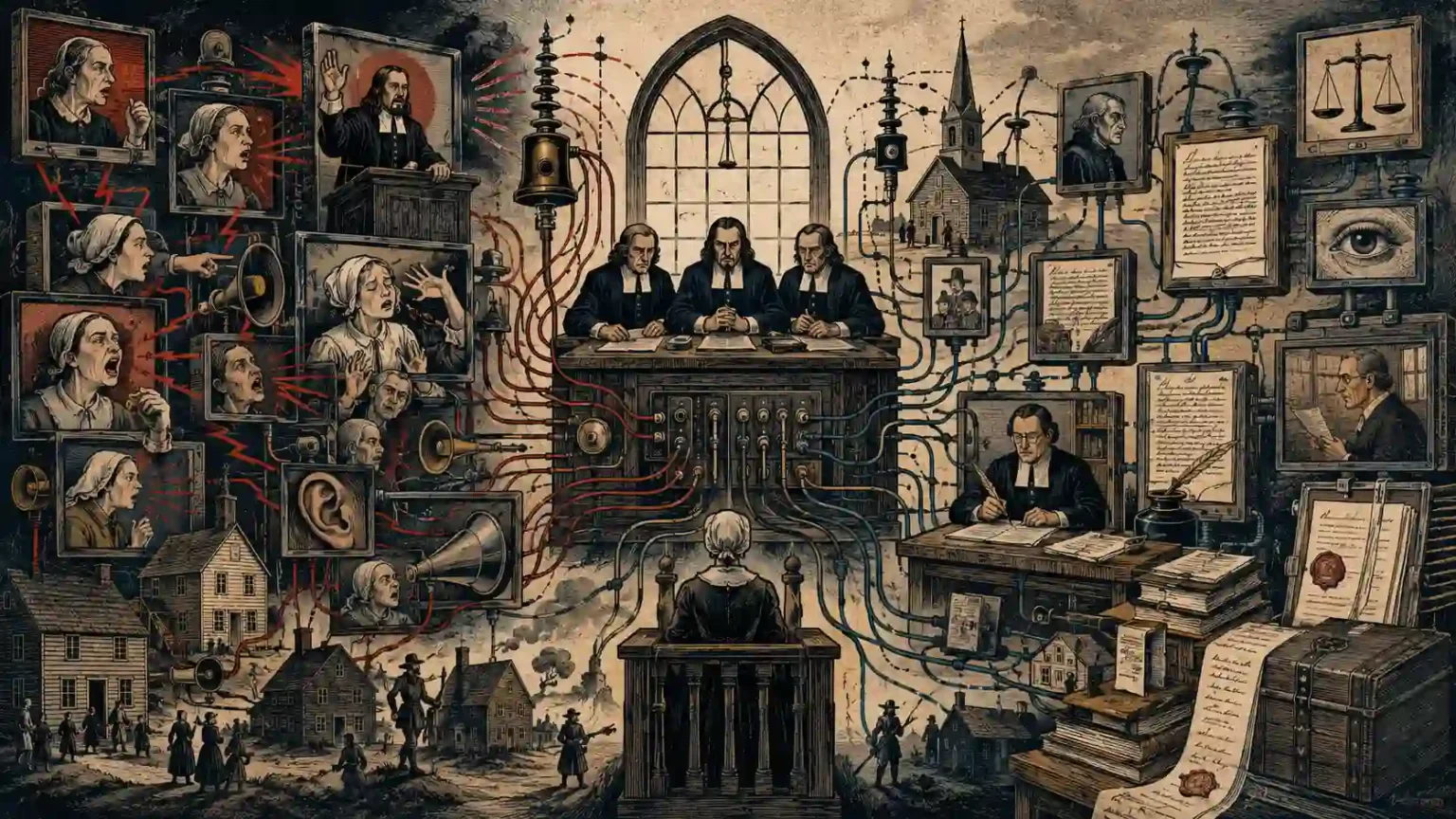
Illustration by Bookinlight Art Desk
The best books on Salem witch trials do not treat 1692 as an isolated eruption of superstition. Read together, they show a society under pressure: frontier war, contested authority, Puritan cosmology, local faction, gendered suspicion, legal improvisation, and the terrifying speed with which testimony can become machinery.
By Bookinlight
The Reading Lens
How to Read the Best Books on Salem Witch Trials
Salem is most intelligible when read across scale. The intimate village quarrel matters, but so do imperial war, legal procedure, gender hierarchy, print culture, and the theological grammar through which New Englanders understood invisible harm. These books belong together because no single method can contain Salem: the archive, the day-by-day chronicle, social history, military history, feminist analysis, and literary narrative each reveal a different layer of the same crisis.
Central Question
How did fear become public evidence?
Historical Pressure
War, faction, theology, gender, law, and colonial insecurity.
Why These Books
They move from documents to interpretation without flattening the event.
The Reading Map
The Reading Map
| Book | Difficulty | Rating | Why It Matters |
|---|---|---|---|
| Records of the Salem Witch-Hunt | Advanced | ★★★★★ | The legal archive behind every serious interpretation. |
| The Salem Witch Trials | Intermediate | ★★★★★ | Restores sequence, pace, and cumulative panic. |
| Salem Possessed | Intermediate | ★★★★½ | Turns Salem into a problem of social structure. |
| In the Devil’s Snare | Intermediate | ★★★★★ | Places Salem inside war and colonial government. |
| The Devil in the Shape of a Woman | Intermediate | ★★★★½ | Makes gender central, not incidental. |
| A Storm of Witchcraft | General to Intermediate | ★★★★½ | Synthesizes many causes without reducing the crisis. |
| The Witches | General | ★★★★ | A vivid narrative entrance into the human drama. |
1
Records of the Salem Witch-Hunt
Edited by Bernard Rosenthal
Best for: Readers who want the legal record before the legend.
Difficulty: Advanced
Intellectual role: The archive that tests every later interpretation.
Bookinlight Rating: ★★★★★
This is not the easiest starting point, but it is the most sobering one. Records of the Salem Witch-Hunt gathers the legal documents of the crisis into chronological order, giving readers the texture of accusation, deposition, warrant, examination, confession, denial, petition, and aftershock. Its importance lies in the way it interrupts inherited narratives. Salem often arrives to modern readers as metaphor: mass panic, irrationality, scapegoating, misogyny, religious terror. The documents do not cancel those terms, but they make them harder, stranger, and more exact. They show procedure as well as frenzy, handwriting as well as fear, formula as well as pain.
For historians, legal scholars, and deeply committed general readers, this volume changes the scale of inquiry. The trials become not one event but a documentary sequence, full of repetitions, silences, clerical habits, local names, and unstable evidentiary categories. It belongs in this article because every interpretation of Salem must finally answer to the surviving record. Readers who approach it patiently will begin to see how fragile “evidence” becomes when a culture gives spectral accusation official weight. The book also teaches an ethical discipline: before turning Salem into a lesson for the present, one must hear the forms in which seventeenth-century people accused, defended, confessed, and begged to be believed.
Critical Reception
“the most comprehensive, most carefully and consistently transcribed record ever produced”
John M. Murrin, Princeton University
Bookinlight Note: Use this volume as a reference companion, not as a cover-to-cover obligation. It is the ground beneath the rest of the reading list.
2
The Salem Witch Trials: A Day-by-Day Chronicle of a Community Under Siege
Marilynne K. Roach
Best for: Readers who need chronology, sequence, and narrative control.
Difficulty: Intermediate
Intellectual role: The temporal map of the crisis.
Bookinlight Rating: ★★★★★
Marilynne K. Roach’s great contribution is discipline of sequence. The Salem crisis is easy to compress into a simplified pattern: girls suffer, accusations spread, courts condemn, executions follow, authorities repent. Roach slows that pattern down. By arranging events day by day, she restores the bewildering simultaneity of 1692: family disputes, jail transfers, examinations, sermons, rumors, executions, changes in court procedure, and the wider unease of colonial life. The result is not a simple narrative arc but an unfolding civic emergency.
This book belongs here because Salem cannot be understood only by theme. It must be understood by pace. Panic worked through accumulation, not abstraction. Readers see how one accusation gave permission to another, how uncertainty hardened into procedure, how distant communities were drawn into the orbit of Salem Village, and how the meaning of confession changed as the crisis moved forward. Roach’s method especially helps readers who feel lost among the large cast of ministers, magistrates, afflicted persons, accused women and men, kin networks, and neighboring towns. It also modifies the reader’s moral imagination: the disaster was not inevitable from the first fit. It was made through decisions, delays, credulities, and institutional choices. For anyone building a serious foundation, this is one of the most useful books about the Salem witch trials because it teaches the event as lived time.
Bookinlight Note: Read Roach beside the primary records. The chronicle gives the archive narrative motion without turning it into melodrama.
3
Salem Possessed: The Social Origins of Witchcraft
Paul Boyer and Stephen Nissenbaum
Best for: Readers interested in social history, local conflict, and village structure.
Difficulty: Intermediate
Intellectual role: The classic local-social interpretation.
Bookinlight Rating: ★★★★½
Salem Possessed remains one of the indispensable interpretive works because it asks a deceptively concrete question: what was Salem Village before it became “Salem”? Boyer and Nissenbaum reconstruct the village as a divided social world, shaped by family alignments, economic change, disputes over ministry, landholding patterns, and the uneasy relation between village and town. Their argument does not reduce witchcraft belief to economics. Rather, it shows how accusation could travel along existing lines of tension. Salem’s invisible war, in their telling, had a visible geography.
The book belongs in this article because it changed how modern readers ask historical questions about the trials. Instead of beginning with “Why did people believe in witches?” it begins with social placement: who accused whom, who supported Reverend Samuel Parris, who stood outside local power, and how older conflicts could acquire theological force. Readers who benefit most are those interested in method. The book demonstrates how tax records, church records, maps, family networks, and village politics can become evidence for mental and social history. Later scholars have revised parts of its interpretation, but that is part of its value. It teaches Salem as a field of debate rather than a finished morality tale. After reading it, the trials appear less like an inexplicable fever and more like a crisis in which community fracture, religious language, and social fear converged.
Critical Reception
“reinterprets a world-famous episode so completely and convincingly”
Robin Briggs, The Times Literary Supplement
Bookinlight Note: Treat this as a classic model of social history: powerful, generative, and best read with later correctives nearby.
4
In the Devil’s Snare: The Salem Witchcraft Crisis of 1692
Mary Beth Norton
Best for: Readers seeking the wider colonial and wartime context.
Difficulty: Intermediate
Intellectual role: The frontier-war and governance interpretation.
Bookinlight Rating: ★★★★★
Mary Beth Norton’s central move is to enlarge Salem without dissolving it. In the Devil’s Snare argues that the crisis must be read against the trauma of warfare on New England’s northern frontier, especially the violence, displacement, and fear generated by conflicts involving English colonists, French power, and Indigenous communities. Norton does not simply add “war” as background. She shows how refugees, stories of attack, military insecurity, and colonial politics shaped the mental world in which the afflicted and the authorities understood invisible assault.
This book is essential because it challenges the habit of treating Salem as a sealed village drama. It shifts attention to the Massachusetts government, the judges, Governor William Phips, the military situation, and the broader geography of fear. It also makes the afflicted girls more historically legible: not as timeless symbols of adolescent instability, but as persons living in a community saturated by stories of bodily violence and spiritual siege. Readers interested in political history, war, colonial administration, and historical psychology will benefit most. Norton changes the reader’s understanding of Salem by showing that “the Devil” was not merely a theological abstraction. In 1692, for many New Englanders, diabolical conspiracy, military threat, and political vulnerability could appear as one crisis. The trials become a distorted response to a colony that felt itself surrounded, exposed, and poorly governed.
Bookinlight Note: Norton is especially valuable after Boyer and Nissenbaum: one book tightens the village lens, the other widens the colonial field.
5
The Devil in the Shape of a Woman: Witchcraft in Colonial New England
Carol F. Karlsen
Best for: Readers interested in gender, property, inheritance, and social suspicion.
Difficulty: Intermediate
Intellectual role: The feminist historical analysis that broadens Salem.
Bookinlight Rating: ★★★★½
Carol F. Karlsen’s book is not confined to Salem, and that is precisely why it belongs here. The Devil in the Shape of a Woman studies witchcraft accusation in colonial New England with sustained attention to gender, social power, inheritance, reputation, household authority, and the vulnerability of women who did not fit expected patterns of dependence. Karlsen’s argument makes it impossible to discuss Salem as though accused women happened merely by chance to stand at the center of the crisis. Gender was not decorative context; it structured suspicion.
The book benefits readers who want a more analytical understanding of why certain bodies, voices, and social positions became legible as dangerous. It is especially important for readers dissatisfied with explanations that reduce Salem to irrational panic or local quarrel alone. Karlsen’s work shows how a patriarchal society could identify spiritual threat in women who seemed economically, sexually, or socially difficult to contain. She also helps readers avoid a crude inversion in which accused women become simply proto-modern heroines. The point is subtler: the categories of witchcraft emerged from a deeply ordered world in which theology and gender hierarchy reinforced one another. After reading Karlsen, Salem appears as part of a broader New England pattern. The crisis remains historically specific, but its social grammar becomes clearer: accusation was a way of policing the boundaries of acceptable womanhood, household order, and communal authority.
Critical Reception
“A pioneer work in…the sexual structuring of society.”
Edmund S. Morgan, Yale University
Bookinlight Note: Read Karlsen when the question becomes not only why Salem happened, but why gender made some accusations believable.
6
A Storm of Witchcraft: The Salem Trials and the American Experience
Emerson W. Baker
Best for: Readers wanting a broad, readable synthesis of multiple causes.
Difficulty: General to Intermediate
Intellectual role: The integrative modern overview.
Bookinlight Rating: ★★★★½
Emerson W. Baker’s A Storm of Witchcraft is valuable because it resists the temptation of a single-cause Salem. Baker presents the trials as a convergence: Puritan belief, frontier violence, political instability after the loss and restoration of colonial charter structures, local quarrels, judicial failure, print controversy, and the peculiar authority granted to afflicted testimony. The metaphor of a storm is apt not because it excuses responsibility, but because it captures the collision of pressures that made 1692 unusually destructive.
This book belongs in a serious reading sequence as a bridge between specialist scholarship and accessible historical understanding. Readers who are new to Salem but want more than a popular retelling will find it especially useful. Baker organizes the many moving parts without erasing debate, and he is attentive to the way Salem later became an American symbol. That afterlife matters. The trials did not end only in court records and compensation petitions; they entered political language as a warning about fear, accusation, and the abuse of power. Baker changes the reader’s understanding by showing Salem as an American event without making it anachronistically modern. The seventeenth century remains strange, theological, and legally distinct, yet the crisis reveals recurring dangers in public life: frightened institutions, opportunistic authority, communal grievance, and the human desire to make suffering legible by naming enemies.
Bookinlight Note: This is one of the best middle paths: broad enough for orientation, serious enough to remain useful after further study.
7
The Witches: Salem, 1692
Stacy Schiff
Best for: Readers who want a vivid narrative entrance into Salem.
Difficulty: General
Intellectual role: The literary historical narrative.
Bookinlight Rating: ★★★★
Stacy Schiff brings to Salem the gifts of narrative compression, atmosphere, character, and moral unease. The Witches is not the most archival book in this list, nor the most methodologically explicit, but it performs a different service: it returns the event to readers as a terrifying human drama. Schiff is especially strong at making the crowded cast feel alive without allowing the story to become easy. Ministers, magistrates, children, accused women, husbands, neighbors, and political figures move through a world where invisible agencies were not literary devices but explanatory realities.
The book belongs here because every serious reading packet needs an account that reminds us why Salem still grips the cultural imagination. Academic explanation can sometimes cool the event too quickly; Schiff restores dread, confusion, and momentum. Readers who are beginning the subject may find this the most inviting first book, especially if they prefer narrative history to scholarly apparatus. More advanced readers will want to pair it with the records, Roach, Norton, Karlsen, and Boyer and Nissenbaum, because Schiff’s literary power is best balanced by documentary and analytical works. Its interpretive value lies in the way it refuses to make Salem emotionally manageable. The trials remain a story of social pressure and institutional violence, but also of household terror, young voices, clerical authority, broken trust, and the lethal charisma of accusation once a community has accepted the unseen as public fact.
Critical Reception
“the fullest and finest story ever told about Salem in 1692”
Joseph J. Ellis
Bookinlight Note: Schiff is best read as narrative reanimation: compelling, unsettling, and strongest when placed after the interpretive scaffolding is visible.
Questions Readers Ask Before Starting
What is the best first book on the Salem witch trials?
For a readable beginning, choose Stacy Schiff or Emerson W. Baker. For a serious chronological foundation, choose Marilynne K. Roach.
Which book is best for primary documents?
Records of the Salem Witch-Hunt is the strongest archival resource, especially for readers studying law, testimony, and chronology.
Why do scholars disagree about Salem?
Because Salem involved overlapping causes: theology, gender, local conflict, war, legal procedure, political authority, and the instability of evidence.
Are the Salem witch trials only a story of superstition?
No. Belief in witchcraft mattered, but the crisis also involved institutions, trauma, power, gender, village politics, and colonial governance.
The Last Margin
The best books on Salem witch trials leave the reader with a difficult lesson: the past becomes most useful when it remains historically strange. Salem was not simply “mass hysteria,” nor merely Puritan darkness, nor only patriarchy, nor only war trauma, nor only village faction. It was a crisis in which many structures made one another more dangerous. To read these seven books together is to watch evidence being made, authority being tested, fear being translated into procedure, and a community discovering too late that certainty can become a form of violence.