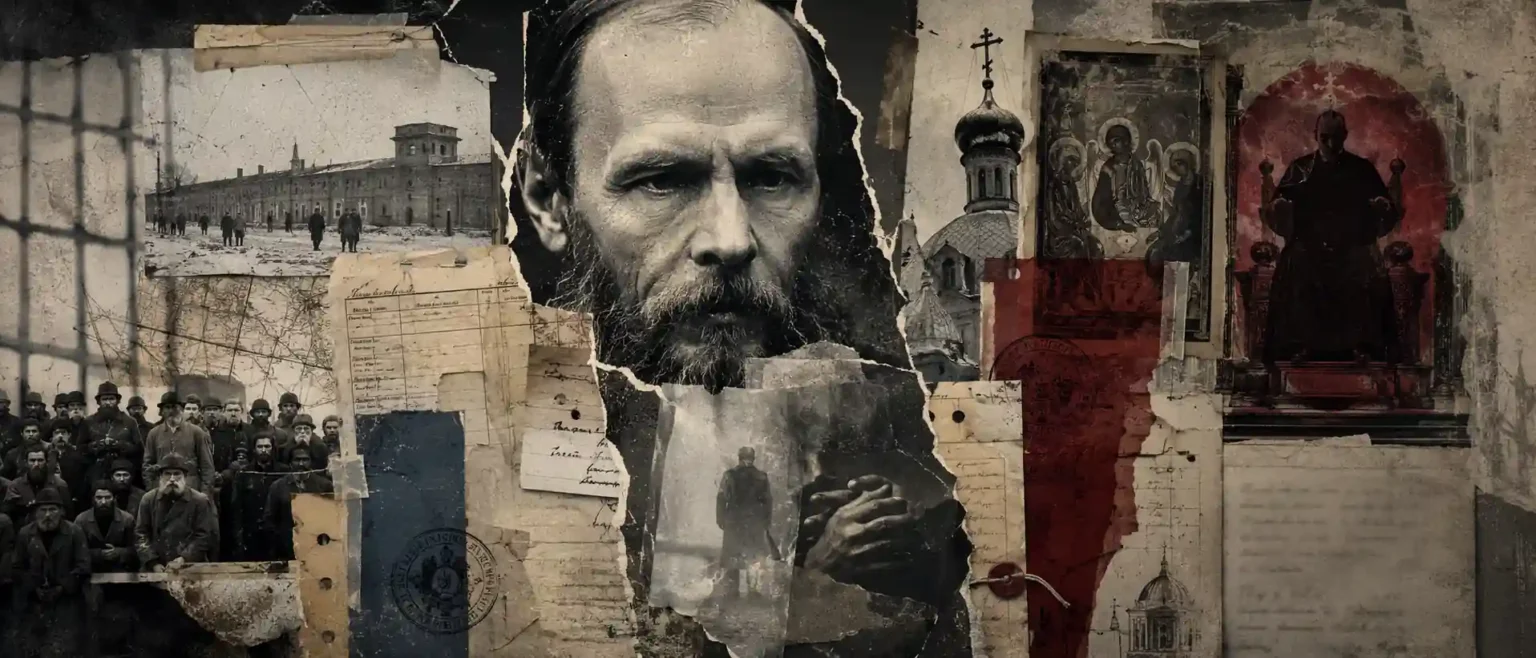
Illustration by Bookinlight Art Desk
Curated by Bookinlight
The best books on Dostoevsky political theology do not treat him merely as a religious novelist with political opinions. They read him as a dramatist of sovereignty, conscience, temptation, ecclesial power, revolutionary faith, and the perilous human desire to escape freedom.
Dostoevsky matters to political theology because his fiction repeatedly asks whether human beings can bear liberty without turning either to coercive authority or to ideological salvation. In the Grand Inquisitor, in the prison-house, in Russian Orthodoxy, in Catholic polemic, and in the revolutionary underground, theology becomes a question of rule: who may command, who may forgive, who may suffer, and whether love can become political without becoming tyranny.
Faith, freedom, and the politics of spiritual authority
These books should be read as a sequence rather than as isolated commentaries. Williams clarifies how Dostoevsky’s fiction thinks theologically through language and form; Pattison and Thompson place that theology within Christian traditions; Ruttenburg relocates his politics in exile and democratism; Avramenko and Trepanier gather the explicit political-theological arguments; Blake shows why Catholicism becomes Dostoevsky’s charged image of spiritual empire.
Author: Rowan Williams
Best for: Readers seeking the deepest theological entry into Dostoevsky’s major novels
Difficulty: Intermediate
Intellectual role: Establishes how Dostoevsky’s fiction thinks through speech, freedom, repentance, and grace
Bookinlight Rating: ★★★★★
Rowan Williams’s study is the best starting point for readers who want Dostoevsky’s theology without reducing the novels to doctrinal illustrations. Williams reads the major fiction as a drama of language: people speak, conceal, accuse, confess, bless, and mishear one another, and the spiritual condition of a world becomes visible through those exchanges. This is crucial for political theology because Dostoevsky’s most dangerous authorities rarely rule only by force. They rule by explaining suffering, arranging salvation, promising order, and turning human weakness into an argument for obedience.
The book belongs here because Williams shows why theological meaning in Dostoevsky cannot be separated from form. The Grand Inquisitor is not a detachable parable about church and state; it is embedded in a novel of brothers, wounds, memory, failed responsibility, and contested testimony. That structure matters. It prevents political theology from becoming abstract and keeps the question of sovereignty tied to persons who are capable of both cruelty and transfiguration.
Readers interested in Christian imagination, narrative ethics, or the theological critique of modernity will benefit most. Williams makes Dostoevsky more difficult, not less: he shows that freedom is not simply a liberal possession, nor is faith a political program. Faith appears as a risk within speech, an exposure to others, and a refusal of the closed system. After reading Williams, Dostoevsky’s politics looks less like a set of positions and more like a sustained test of whether human beings can live without idols of certainty.
Critical Reception
“An outstanding event in the fields of theology and literary studies.”
Slavic Review
Bookinlight Note: Read this first if the phrase “Dostoevsky and political theology” feels too narrow; Williams shows why it is actually a question about fictional form, moral speech, and the meaning of freedom.
Author: George Pattison and Diane Oenning Thompson, editors
Best for: Readers who want Dostoevsky placed inside Christian theology, liturgy, icons, law, grace, and kenosis
Difficulty: Intermediate to Advanced
Intellectual role: Gives the theological grammar behind Dostoevsky’s political imagination
Bookinlight Rating: ★★★★½
This collection is indispensable because it resists the temptation to extract from Dostoevsky a neat religious doctrine. Its essays instead examine the interaction between Christian tradition and literary practice: gospel allusion, hagiography, icons, law and grace, Trinitarian patterns, kenotic humility, and the difficult question of how Orthodoxy shapes fictional experience. For political theology, that matters because Dostoevsky’s politics cannot be understood merely through ideology. His imagination is saturated with inherited Christian forms that determine how authority, sacrifice, communal responsibility, and spiritual charisma appear.
The strongest value of the book is its range. It helps readers see that Dostoevsky’s theology is not a private inwardness opposed to politics. It carries institutional, ritual, and historical force. The elder, the saint, the penitent criminal, the icon, the scriptural word, and the sacrificial sufferer all have political implications, because each offers a model of how human beings may be ordered together. Yet the collection also keeps Dostoevsky from becoming a simple propagandist for religious authority. His Christian world is unstable, dramatic, and often tested by scandal.
Readers already familiar with the novels will gain the most from it. The book changes the theme by showing that Dostoevsky’s political theology is not only the Grand Inquisitor or anti-Catholic polemic. It is also the deeper Christian symbolic economy through which freedom, obedience, suffering, and community become thinkable.
Critical Reception
“Timely and welcome.”
Modern Language Review
Bookinlight Note: Use this book as the theological archive behind the more explicitly political works in this list.
Author: Nancy Ruttenburg
Best for: Readers interested in exile, the people, peasant emancipation, and Dostoevsky’s democratic imagination
Difficulty: Advanced
Intellectual role: Reframes Dostoevsky’s post-Siberian politics through democratism rather than simple reaction
Bookinlight Rating: ★★★★½
Nancy Ruttenburg’s book is essential because it unsettles a familiar shortcut: the idea that Dostoevsky moved from youthful socialism through prison into uncomplicated Orthodox conservatism. Her argument returns to the Siberian decade and especially to Notes from the House of the Dead, where Dostoevsky’s encounter with common Russians becomes an artistic and political crisis. The result is not liberal democracy in the ordinary institutional sense, but what he called Russian “democratism”: an experience of the people that is traumatic, mystical, humiliating, and generative.
For political theology, Ruttenburg matters because she shifts attention from doctrine to the demos. Dostoevsky’s religious politics cannot be understood without the body of the people: convicts, peasants, sinners, and those who refuse to fit educated ideological categories. The prison camp becomes a strange theological-political school. It breaks abstract humanitarianism, but it also makes possible a new, unstable sense of communion. Authority, in this reading, cannot simply be imposed from above; it is tested by the humiliating opacity of the people.
This is a demanding work for readers who want Dostoevsky placed within modernity, sovereignty, and the politics of popular life. It changes the whole theme by making political theology less clerical. The problem is not only church power or revolutionary atheism; it is whether any spiritual politics can speak of “the people” without using them as a myth.
Critical Reception
“Brims with surprising insights.”
Slavic Review
Bookinlight Note: Pair this with the prison and peasant materials before returning to the Grand Inquisitor; the political stakes become far sharper.
Author: Richard Avramenko and Lee Trepanier, editors
Best for: Readers who want an explicit political-theory treatment of Dostoevsky
Difficulty: Intermediate to Advanced
Intellectual role: Makes the political theology explicit through essays on freedom, humility, justice, ideology, and the Grand Inquisitor
Bookinlight Rating: ★★★★★
This edited volume earns its place because it directly addresses the gap many readers feel after finishing Dostoevsky: the novels seem politically explosive, but their political teaching is dispersed through narrative, confession, satire, murder, saintliness, and metaphysical argument. Avramenko and Trepanier gather scholars of political science, philosophy, history, and Russian studies to treat Dostoevsky not only as a novelist but as a thinker of modern political life. Its organization is especially useful for this article because it includes a section explicitly devoted to political theology.
The book shows that Dostoevsky’s political thought is inseparable from anthropology. What is the human being? A rational chooser, a sinner, a sufferer, a creature of love, a rebel against God, a subject who wants freedom but fears it? Every answer produces a politics. The Grand Inquisitor becomes central because he offers not merely a critique of Catholicism, but a theory of rule: people want bread, miracle, and authority more than the burden of freedom. Revolutionary ideology is read in similar terms, as a secular religion that promises salvation while narrowing the soul.
Readers trained in political theory will find this the most direct bridge. It changes Dostoevsky from a writer “with political opinions” into an interlocutor for debates about liberalism, nihilism, authority, humility, and metaphysical liberty. The result is not a single doctrine but a field of tensions: Christian love against coercive benevolence, freedom against security, and humility against ideological mastery.
Critical Reception
“The volume’s invitation to explore the political dimension of Dostoevskii’s thought deserves to be taken seriously.”
Slavic Review
Bookinlight Note: This is the central academic bridge between Dostoevsky studies and political theology as a field.
Author: Elizabeth A. Blake
Best for: Readers interested in Catholicism, the Grand Inquisitor, revolutionary Europe, and religious polemic
Difficulty: Advanced
Intellectual role: Explains why Catholicism becomes Dostoevsky’s charged image of spiritual and political power
Bookinlight Rating: ★★★★½
Elizabeth A. Blake’s book gives the list its sharpest institutional edge. Dostoevsky’s anti-Catholicism is often mentioned, but Blake treats it with the historical and textual seriousness it requires. She shows that Catholicism is not a simple target in Dostoevsky’s imagination. It appears as a political force, an ideological system, a cultural archive, a revolutionary presence, and a source of fascination as well as hostility. That complexity matters because the Grand Inquisitor cannot be understood as a cartoon of Rome. It is a meditation on what happens when spiritual care becomes organized domination.
The book belongs in any serious account of Dostoevsky and political theology because it reveals how confessional difference becomes political symbolism. For Dostoevsky, Catholicism can represent the temptation to relieve humanity of freedom by offering authority, miracle, and a managed salvation. Yet Blake’s close readings also show that Dostoevsky’s Catholic imagination is historically entangled with European revolutionary movements, Polish Catholic identity, underground networks, and nineteenth-century debates about power. Theology here is never only theology; it is mapped onto empire, rebellion, intellectual life, and cultural production.
This is best for readers ready to move beyond general remarks about Orthodoxy versus Catholicism. Blake changes the theme by making Dostoevsky’s polemic historically dense. Political theology becomes a contested field of institutions and imaginations, where the church can appear as sacrament, empire, conspiracy, consolation, or coercive machine.
Critical Reception
“Blake’s detailed monograph represents a welcome contribution to Dostoevsky studies.”
Slavic and East European Journal
Bookinlight Note: This is the book that makes the Grand Inquisitor historically concrete rather than merely symbolic.
How to read these books on Dostoevsky political theology
| Book | Difficulty | Rating | Why It Matters |
|---|---|---|---|
| Dostoevsky: Language, Faith, and Fiction | Intermediate | ★★★★★ | Shows how theology works through narrative speech. |
| Dostoevsky and the Christian Tradition | Intermediate to Advanced | ★★★★½ | Places the novels inside Christian tradition. |
| Dostoevsky’s Democracy | Advanced | ★★★★½ | Recasts exile and the people as political sources. |
| Dostoevsky’s Political Thought | Intermediate to Advanced | ★★★★★ | Makes the political-theological argument explicit. |
| Dostoevsky and the Catholic Underground | Advanced | ★★★★½ | Historicizes Catholicism, authority, and the Inquisitor. |
FAQ
What is the best first book on Dostoevsky and political theology?
Rowan Williams is the best first choice because he explains how Dostoevsky’s theology is inseparable from fictional form, speech, and moral freedom.
Which book is most directly about Dostoevsky’s political thought?
Dostoevsky’s Political Thought is the most direct academic bridge between Dostoevsky studies and political theory, including explicit treatment of political theology.
Why is the Grand Inquisitor central to this theme?
The Grand Inquisitor stages the core political-theological temptation: to remove the burden of freedom by giving humanity bread, miracle, authority, and managed salvation.
Is Dostoevsky simply a conservative religious writer?
No. These books show a more unstable thinker: Orthodox, anti-radical, often polemical, but also radically concerned with freedom, suffering, conscience, and the people.
The Last Margin
The lasting force of Dostoevsky’s political theology is that it refuses easy consolation. He distrusts secular utopias that promise redemption through systems, but he also dramatizes the dangers of religious authority when it becomes a substitute for freedom. His fiction asks whether love can have public meaning without turning into rule, and whether faith can resist the desire to dominate the weak for their own good.
These books on Dostoevsky political theology belong together because each illuminates a different pressure point: language, tradition, the people, political doctrine, and Catholic power. Read in sequence, they reveal a writer for whom the deepest political question is also spiritual: what kind of authority can honor the human soul without possessing it?