Illustration by Bookinlight Art Desk
Modern History
Six Books on the Taiping Rebellion
A reading path through visions of sacred kingship, late Qing state crisis, foreign entanglement, local militarization, and the intimate afterlives of one of the nineteenth century’s most devastating civil wars.
By Bookinlight



A Civil War Read Through Belief, Statecraft, and Survival
The best books on the Taiping Rebellion do more than narrate battles between Qing armies and a millenarian insurgent kingdom. They ask how a private religious vision became a revolutionary state, how imperial institutions responded to breakdown, how foreign observers misread a Chinese civil war through their own missionary and commercial expectations, and how survivors lived with ruins that could not be made whole by victory. The Taiping catastrophe was at once a war of doctrine, a crisis of sovereignty, a regional military transformation, and a social trauma whose consequences extended far beyond Nanjing.
These six books belong together because each refuses a simple category. The Taiping Rebellion was not merely a rebellion, a civil war, a Christian heresy, an ethnic conflict, or a late imperial administrative crisis. It was all of these at once. Reading across biography, religious history, military history, social history, and memory studies reveals a nineteenth-century China under unbearable pressure, where visions of heavenly order and mechanisms of local coercion became part of the same violent world.
Why the best books on the Taiping Rebellion are not only battlefield histories
A battlefield account can show why cities fell, armies maneuvered, and commanders succeeded or failed. Yet the Taiping Rebellion requires a wider intellectual frame. Its leader Hong Xiuquan transformed fragments of Christian teaching into an apocalyptic claim to divine sonship. Its state claimed moral purification while organizing coercive rule. Its enemies, especially local gentry and regional commanders, defended the Qing order by reshaping the instruments of power. Its aftermath demanded forms of burial, commemoration, forgetting, and literary reconstruction.
That is why a serious reading list must move from Hong’s inner world to Taiping theology, from diplomatic crisis to the Qing counterinsurgency, from regional disorder to the mourning practices of survivors. Together, these books turn the rebellion into a problem in historical interpretation: how should historians write an event whose scale exceeds both official archives and conventional moral vocabulary?
The Reading Lens
When sacred revolution becomes social catastrophe
The Taiping Rebellion should be read as a collision between imagined purity and historical damage. Its dream of heavenly renewal produced institutions, armies, gender rules, fiscal demands, and a capital city; its defeat produced new regional power, devastated communities, and unresolved memory. The books below are strongest when read as parts of one argument: civil wars are not only decided by ideology or arms, but by the fragile social worlds that must continue after armies pass through them.
Central Question
How does a movement promising heavenly order become a force that remakes state power, local society, and historical memory?
Historical Pressure
Late Qing China faced fiscal strain, military weakness, foreign intrusion, religious experimentation, and regional social disorder at the same time.
Why These Books
They place charismatic belief, imperial crisis, local violence, Western involvement, and postwar remembrance into one disciplined reading sequence.
Six Books for Reading the Taiping World
God’s Chinese Son: The Taiping Heavenly Kingdom of Hong Xiuquan
Jonathan D. Spence
Best for: Readers who want Hong Xiuquan’s inner world before turning to armies and institutions.
Difficulty: General to Intermediate
Intellectual role: The indispensable biographical and narrative gateway.
Bookinlight Rating: ★★★★★
Spence’s great achievement is to make Hong Xiuquan intelligible without reducing him to madness, fraud, or political ambition. The book follows the failed examination candidate whose encounter with Christian tracts and dream-visions produced a new sacred identity: younger brother of Jesus, enemy of demons, ruler of a Heavenly Kingdom. It is especially valuable because it treats religious imagination as historical force. The Taiping project appears here not as a decorative ideology attached to rebellion, but as the grammar through which power, gender, moral discipline, and violence were organized.
Critical Reception
“A magnificent tapestry…a story that reaches beyond China into our world and time.“
Bookinlight Note: Read this beside a history of nineteenth-century missionary printing. The key question is not whether Hong misunderstood Christianity, but how printed fragments became an architecture of rule.
The Taiping Heavenly Kingdom: Rebellion and the Blasphemy of Empire
Thomas H. Reilly
Best for: Readers interested in religion, legitimacy, and the sacred language of rebellion.
Difficulty: Intermediate
Intellectual role: The theological and ideological deepening of the Taiping problem.
Bookinlight Rating: ★★★★★★
Reilly’s book presses on one of the most difficult questions in Taiping studies: what kind of political theology did the Heavenly Kingdom produce? Rather than treating Taiping Christianity as a curiosity, Reilly examines how biblical language, iconoclasm, ritual, and anti-demonic warfare challenged imperial legitimacy. The title’s phrase “blasphemy of empire” is important. It suggests that the rebellion attacked more than a dynasty; it attacked the sacred ordering through which empire presented itself as moral and cosmic authority.
Critical Reception
“An important book that should not be overlooked by anyone working on Chinese religious history.“
Bookinlight Note: Pair Reilly with Spence to see how a single visionary biography becomes a corporate theology of sovereignty, discipline, and enemies.
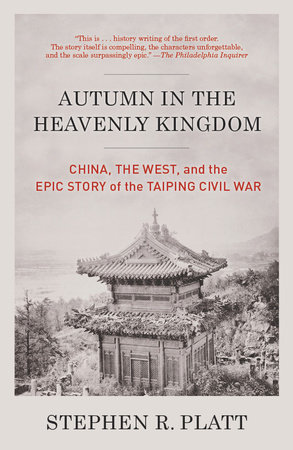
Autumn in the Heavenly Kingdom: China, the West, and the Epic Story of the Taiping Civil War
Stephen R. Platt
Best for: Readers who want a dramatic, politically wide, narrative account of the war’s final phase.
Difficulty: General to Intermediate
Intellectual role: The bridge between Chinese civil war and global nineteenth-century politics.
Bookinlight Rating: ★★★★★
Platt restores contingency to the Taiping Civil War. The reader sees not only Chinese commanders and Taiping leaders, but also British diplomats, American adventurers, missionaries, traders, and military entrepreneurs who tried to interpret the conflict through imperial interests and religious hopes. The book is especially compelling on the late war: the struggle over Nanjing, the rise of Zeng Guofan, and the uncertain place of Western power in deciding whether the Heavenly Kingdom would be tolerated, opposed, or exploited.
Critical Reception
“The story it tells is powerful, dramatic, and unforgettable.“
Bookinlight Note: Use Platt to ask how foreign intervention changes the moral shape of a civil war without making outsiders the true center of the story.
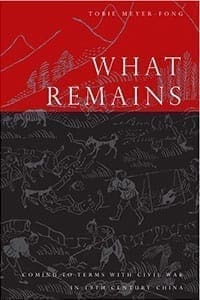
What Remains: Coming to Terms with Civil War in 19th Century China
Tobie Meyer-Fong
Best for: Readers interested in trauma, mourning, material loss, and the social afterlife of war.
Difficulty: Intermediate
Intellectual role: The essential book on memory, survival, and postwar reconstruction.
Bookinlight Rating: ★★★★★★
Meyer-Fong shifts attention from rebellion as event to rebellion as remainder. Bodies, homes, temples, archives, family lines, and moral narratives had to be reconstructed after devastation. This book is crucial because it refuses the triumphalist assumption that suppression restored order. Instead, it asks what kinds of practices allowed people to live amid absence: burial, commemoration, writing, compensation, and the naming of loss. It is one of the richest works for readers who want the Taiping Rebellion to be understood as lived catastrophe.
Critical Reception
“This book transforms our understanding of China’s 19th century.“
Bookinlight Note: The strongest discussion question is simple: what does a society need to remember when remembrance itself threatens to reopen the wound?
Rebellion and Its Enemies in Late Imperial China: Militarization and Social Structure, 1796–1864
Philip A. Kuhn
Best for: Readers who want structural explanation rather than heroic narrative.
Difficulty: Advanced
Intellectual role: The classic analysis of militarization and elite power.
Bookinlight Rating: ★★★★★★
Kuhn’s study is not limited to the Taiping Rebellion, but it is indispensable for understanding how late imperial China fought rebellion by transforming local society. His central concern is militarization: the growth of local defense organizations, gentry leadership, militia structures, and regional military power. Read after Spence and Reilly, Kuhn changes the scale. The focus moves away from the Heavenly Kingdom’s vision toward the social and institutional mechanisms that made counterrebellion possible. The book helps explain why suppression also altered the Qing state.
Bookinlight Note: Kuhn is best read with a pencil. Track every shift from imperial command to local capacity; that shift is one of the rebellion’s deepest political consequences.
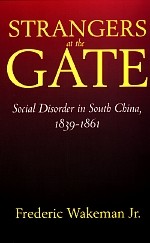
Strangers at the Gate: Social Disorder in South China, 1839–1861
Frederic Wakeman Jr.
Best for: Readers seeking the social disorder and regional world surrounding the Taiping upheaval.
Difficulty: Advanced
Intellectual role: The southern China context that keeps rebellion from becoming an isolated event.
Bookinlight Rating: ★★★★★
Wakeman’s study of South China places the Taiping era within a wider field of social disorder, migration, secret societies, local violence, and imperial weakness. It is especially useful for readers who want to understand why rebellion became possible in particular regions and why the boundary between banditry, protest, community defense, and insurgency could be unstable. The book widens the lens from Taiping leaders and Qing officials to the troubled social ecology out of which nineteenth-century disorder emerged.
Critical Reception
“This pioneering work examines one of the most controversial periods in Chinese history.“
Bookinlight Note: Read Wakeman before assuming that the Taiping Rebellion erupted from a single cause. His world is messy, local, unstable, and historically clarifying.
How These Books Speak to One Another
The sequence matters. Spence begins with charisma and sacred selfhood; Reilly shows how that charisma became theological rebellion; Platt places the war inside the diplomatic and military world of the nineteenth century; Meyer-Fong asks what remained after victory and defeat; Kuhn explains the militarized social structures that made suppression possible; Wakeman reconstructs the regional disorder without which rebellion becomes too tidy.
Together, they prevent two simplifications. The first is to treat the Taiping Rebellion as an exotic religious episode detached from material politics. The second is to treat it as a conventional civil war with a strange religious surface. The deeper reading is harder: the rebellion was a world-making project whose defeat strengthened some forms of order while leaving moral, social, and institutional damage in its wake.
The Reading Map
| Book | Difficulty | Rating | Why It Matters |
|---|---|---|---|
| God’s Chinese Son | General to Intermediate | ★★★★★ | Best entry into Hong’s visionary world. |
| The Taiping Heavenly Kingdom | Intermediate | ★★★★★★ | Explains theology as political power. |
| Autumn in the Heavenly Kingdom | General to Intermediate | ★★★★★ | Narrates war through China and the West. |
| What Remains | Intermediate | ★★★★★★ | Turns attention to mourning and aftermath. |
| Rebellion and Its Enemies | Advanced | ★★★★★★ | Shows counterrebellion as social change. |
| Strangers at the Gate | Advanced | ★★★★★ | Provides the wider southern context. |
Where to Begin
- Entry point: Begin with Spence for narrative clarity and a humane account of Hong Xiuquan.
- Historical background: Move to Wakeman to understand the unstable social world of South China.
- Conceptual foundation: Read Reilly to grasp the religious logic of the Heavenly Kingdom.
- Critical perspective: Use Kuhn to see how suppression changed military and social structures.
- Contemporary relevance: Read Meyer-Fong for memory, mourning, and the politics of postwar recovery.
- Advanced reflection: End with Platt to integrate Chinese crisis, foreign power, and global narrative drama.
External Sources for Further Reading
Encyclopaedia Britannica on the Taiping Rebellion
The Last Margin
The best books on the Taiping Rebellion make the event harder to simplify, which is precisely their value. They show a civil war born from sacred imagination, intensified by imperial weakness, refracted through foreign presence, answered by local militarization, and remembered through damaged communities. To read them together is to see that modern Chinese history cannot be divided neatly between belief and power, violence and order, catastrophe and recovery. The Taiping Rebellion remains unsettling because it forces one final question: when a society survives a war of this magnitude, what kind of order has actually survived with it?