Illustration by Bookinlight Art Desk
By Bookinlight
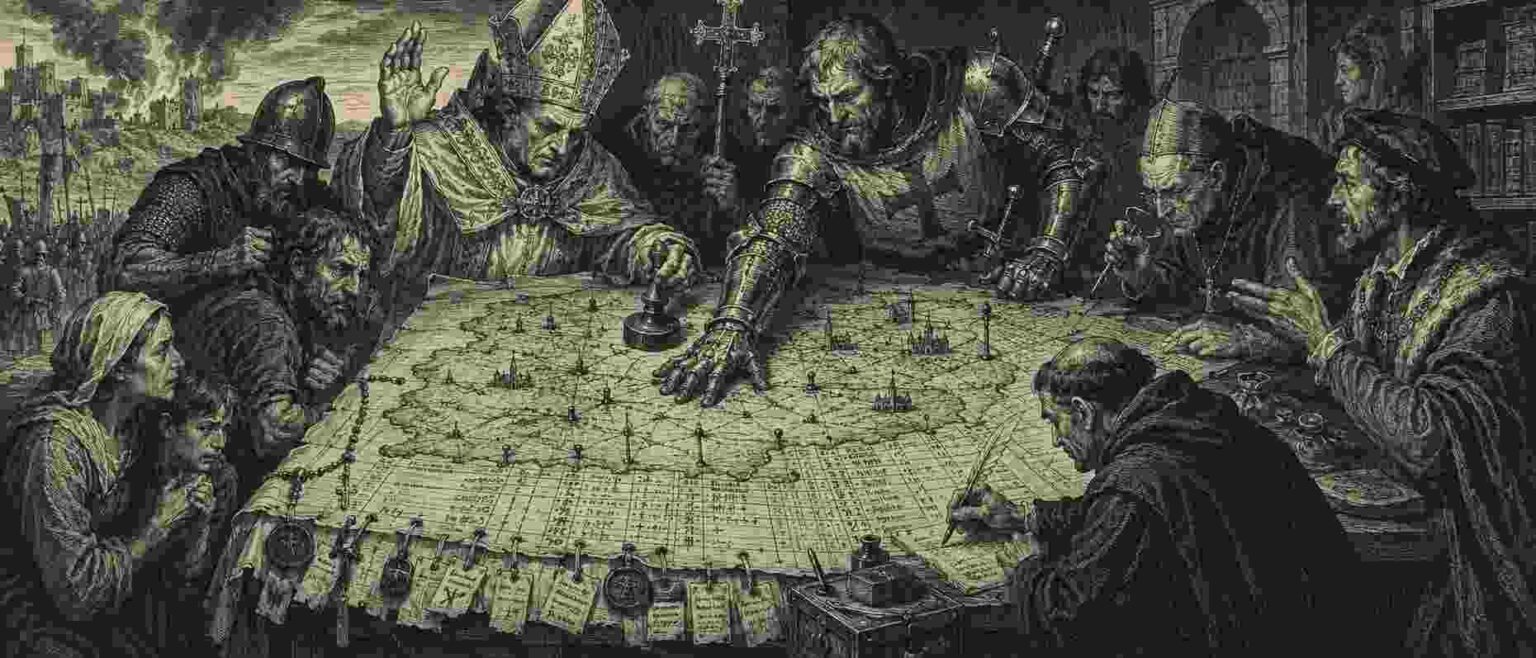
The best books on the Albigensian Crusade must do more than recount sieges, papal decrees, and the destruction of Cathar communities in Languedoc. They must explain how a campaign preached as a holy war became a test case for medieval sovereignty, ecclesiastical discipline, written investigation, and the violent definition of orthodoxy.
The Albigensian Crusade is often approached as a dramatic episode: Béziers, Carcassonne, Simon de Montfort, Toulouse, Montségur. Yet the deeper historical problem is less theatrical and more unsettling. The crusade shows how religious language, feudal ambition, papal law, northern French expansion, and local social worlds converged into a machinery of coercion. The six books below are arranged as an intellectual sequence: first the Cathar problem, then narrative war, then military structure, then revisionist interpretation, then the broader making of persecution, and finally the inquisitorial order that followed.
The Reading Lens
Heresy, Conquest, and the Medieval State of Suspicion
Read together, these books treat the Albigensian Crusade not as a remote religious anomaly, but as a decisive laboratory in which medieval Europe learned to name internal enemies, mobilize sacred violence, and translate suspicion into institutions. Their shared question is not simply whether the Cathars existed or what they believed. It is how a society became capable of making belief, loyalty, memory, and speech into matters of prosecution.
Central Question
How did medieval Christendom turn dissent into an object of war?
Historical Pressure
Papal reform, aristocratic rivalry, southern autonomy, and documentary power.
Why These Books
They move from belief to battle, and from battle to institutions.
The Reading Map: Best Books on the Albigensian Crusade
| Book | Difficulty | Rating | Why It Matters |
|---|---|---|---|
| The Cathars | Intermediate | ★★★★½ | Best foundation for Cathar belief and society. |
| The Albigensian Crusade | General to Intermediate | ★★★★★ | The classic narrative of the war. |
| The Occitan War | Advanced | ★★★★½ | Essential for campaigns, logistics, and politics. |
| A Most Holy War | Intermediate | ★★★★½ | A provocative narrative of sacred violence. |
| The War on Heresy | Advanced | ★★★★★ | Reframes heresy as power and construction. |
| Inquisition and Medieval Society | Advanced | ★★★★½ | Shows how conquest became administration. |
The Cathars: Dualist Heretics in Languedoc in the High Middle Ages
Author: Malcolm Barber
Best for: Readers who need a reliable foundation before entering the war narratives.
Difficulty: Intermediate
Intellectual role: Establishes the religious and social world that made the crusade imaginable.
Bookinlight Rating: ★★★★½
Malcolm Barber’s study is the most useful opening volume because it resists the temptation to turn the Cathars into either romantic rebels or theological abstractions. Its strength lies in reconstruction: belief, preaching, household networks, noble protection, clerical weakness, and the regional conditions that allowed dissent to survive in Languedoc. Barber is careful about sources, especially because much of what later readers know about Catharism comes through hostile ecclesiastical testimony. That caution is precisely why the book belongs here. Before the Albigensian Crusade can be understood as a military or political event, the reader has to understand why a religious movement could become visible enough, protected enough, and disturbing enough to attract papal intervention. Barber also gives the reader a sense of the complexity of dualism without reducing it to a simple doctrine of good spirit and evil matter. The result is a disciplined entry into a world where theology, kinship, local lordship, and anticlerical feeling overlap. Readers who benefit most are those who want context rather than spectacle. The book changes one’s understanding of the crusade by showing that violence did not descend upon an empty label called heresy; it entered a dense social landscape where belief had patrons, customs, and everyday forms of credibility.
Bookinlight Note
Start here if you want the word “Cathar” to become historically difficult rather than merely atmospheric.
The Albigensian Crusade
Author: Jonathan Sumption
Best for: Readers seeking a lucid narrative of the conflict from crisis to conquest.
Difficulty: General to Intermediate
Intellectual role: Provides the classic synthetic account of the crusade as political tragedy.
Bookinlight Rating: ★★★★★
Jonathan Sumption’s book remains indispensable because it offers what many more specialized studies cannot: a continuous, morally alert narrative of the Albigensian Crusade as a human and political catastrophe. Sumption is especially strong on the interplay between papal authority, French aristocratic ambition, local lordship, and the culture of Languedoc. He writes with enough narrative force to make events intelligible without flattening them into simple villainy. Simon de Montfort is not merely a fanatic; Innocent III is not merely a bureaucratic pope; Raymond VI of Toulouse is not merely a weak southern lord. The book’s real contribution is its capacity to hold incompatible pressures together. The crusade was religiously justified, politically useful, legally contested, and socially devastating at the same time. For readers new to the subject, this is the book that gives the war chronological shape. For more advanced readers, it remains valuable because its interpretive balance prevents the subject from collapsing into either anti-clerical melodrama or dry institutional history. It changes the reader’s understanding of the Albigensian Crusade by showing that the violence was not an accidental excess of medieval faith. It was the product of decisions, incentives, ambitions, scruples, and failures that accumulated into a war against a Christian society from within Latin Christendom itself.
Bookinlight Note
This is the best single narrative for readers who want the crusade to unfold as history rather than as legend.
The Occitan War: A Military and Political History of the Albigensian Crusade, 1209–1218
Author: Laurence W. Marvin
Best for: Readers who want campaigns, sieges, command decisions, and political mechanics.
Difficulty: Advanced
Intellectual role: Restores the crusade’s military and strategic anatomy.
Bookinlight Rating: ★★★★½
Laurence W. Marvin’s study is crucial because the Albigensian Crusade is often discussed as theology, persecution, or cultural destruction while its military structure remains underexamined. This book corrects that imbalance. Marvin focuses on the years from 1209 to 1218, the phase dominated by Simon de Montfort, and treats the conflict as a sequence of campaigns shaped by logistics, fortifications, alliances, feudal obligation, tactical opportunity, and the difficulty of holding conquered territory. The result is not a narrow military chronicle. It shows that war-making itself transformed the meaning of the crusade. Cities, castles, hostages, oaths, ravaged lands, and negotiated submissions became the material grammar through which religious policy was enacted. The book belongs in this list because it makes clear that sacred authorization did not automatically produce victory; crusading required supply, leadership, intimidation, and political incorporation. It is best for readers who already know the basic narrative and now want to understand why some operations succeeded, why resistance endured, and why conquest in Languedoc was never a simple march from north to south. Marvin changes the reader’s understanding by making the crusade less abstract. The destruction of Cathar protection networks depended on roads, walls, seasons, money, and the fragile ability of armed men to turn temporary victories into durable rule.
Bookinlight Note
Read after Sumption, when you are ready to see how holy war worked through siegecraft and territorial pressure.
A Most Holy War: The Albigensian Crusade and the Battle for Christendom
Author: Mark Gregory Pegg
Best for: Readers interested in narrative intensity and interpretive provocation.
Difficulty: Intermediate
Intellectual role: Recasts the crusade as a struggle over the moral boundaries of Christendom.
Bookinlight Rating: ★★★★½
Mark Gregory Pegg’s account is valuable because it makes the Albigensian Crusade feel intellectually dangerous again. Rather than treating the war as a familiar episode in the history of Catharism, Pegg foregrounds the shock of Christians being offered crusading privileges for violence against other Christians in southern France. His writing is vivid, but the book’s importance is not merely stylistic. It insists that the crusade altered the internal imagination of Latin Christendom. The enemy was not a distant Muslim polity, nor a pagan frontier, but a landscape of villages, lords, women, priests, memories, and suspected affiliations inside the Christian world. Pegg is especially attentive to how later inquisitorial testimony preserves fractured recollections of the conflict, allowing ordinary people to enter a story often dominated by popes and nobles. This book belongs in the article because it gives the crusade emotional and theological immediacy. It is ideal for readers who want a serious but gripping account that emphasizes violence, memory, and religious identity. It changes the reader’s understanding by making the Albigensian Crusade less like a medieval sideshow and more like a decisive moment in the formation of an inward-facing Christendom, one capable of turning the language of salvation against its own communities.
Bookinlight Note
Pegg is especially good when the question becomes not only what happened, but what kind of Christian world became possible afterward.
The War on Heresy
Author: R. I. Moore
Best for: Readers ready for historiographical argument rather than simple reconstruction.
Difficulty: Advanced
Intellectual role: Challenges inherited assumptions about heresy, evidence, and persecution.
Bookinlight Rating: ★★★★★
R. I. Moore’s book is not a straightforward history of the Albigensian Crusade, and that is exactly why it belongs in any serious reading sequence. Moore asks how western Europe came to imagine, identify, and pursue heresy with such intensity after the first millennium. His argument pushes readers to examine the archive itself: who described heretics, under what institutional pressure, in what polemical language, and for what purpose? For the Albigensian Crusade, this matters enormously. If the category of heresy was shaped by clerical anxiety, reformist ambition, legal procedure, and the needs of authority, then the crusade cannot be read only as a reaction to an obvious religious threat. It must also be read as part of the making of a persecuting order. Moore is demanding because he destabilizes the comfort of narrative certainty. He does not simply replace one story with another; he forces readers to ask how stories of heresy were produced. The book is best for readers who want historiography, not just events. It changes the understanding of the Albigensian Crusade by shifting attention from the supposed essence of Cathar doctrine to the processes by which medieval power recognized enemies, organized fear, and converted accusations into a public program of repression.
Bookinlight Note
This is the book that turns the reader from “what did heretics believe?” toward “how did authority learn to see heresy?”
Inquisition and Medieval Society: Power, Discipline, and Resistance in Languedoc
Author: James B. Given
Best for: Readers interested in what happened after conquest became administration.
Difficulty: Advanced
Intellectual role: Connects the crusade’s violence to the disciplinary procedures of the inquisition.
Bookinlight Rating: ★★★★½
James B. Given’s book is the necessary closing volume because the Albigensian Crusade did not end with battlefields alone. Its aftermath was institutional. In Languedoc, inquisitorial tribunals used investigation, testimony, confession, punishment, and written records to govern religious suspicion. Given examines this world as a sociology of power, asking how a relatively small number of inquisitors could operate across a large region and make their authority felt in village life. This shifts the reader from spectacular violence to administrative discipline. The persecuting energy that had once appeared in crusading armies reappears here as procedure: names entered into records, memories extracted under pressure, networks mapped through testimony, penalties calibrated to produce obedience. The book belongs in this article because it shows the long shadow of the crusade. Military victory could break noble protection and alter political sovereignty, but the elimination of heresy required a different instrument: bureaucratic knowledge. Given is best for readers interested in power, social control, and the history of institutions. It changes the understanding of the Albigensian Crusade by revealing that conquest was only the first act. The deeper transformation came when Languedoc became a space where ordinary speech, family memory, and local association could be reorganized by a documentary regime of suspicion.
Bookinlight Note
Read this last to see how the crusade’s violence hardened into files, interviews, punishments, and social discipline.
Frequently Asked Questions
What is the best first book on the Albigensian Crusade?
Jonathan Sumption’s The Albigensian Crusade is the best first narrative. Malcolm Barber’s The Cathars is the stronger first choice if you need religious and social context before the war.
Were the Cathars the main cause of the crusade?
Cathar heresy was the formal religious cause, but the crusade also involved papal authority, regional lordship, northern French ambition, legal reform, and the problem of enforcing obedience in Languedoc.
Which book is best for military history?
Laurence W. Marvin’s The Occitan War is the most focused military and political study, especially for readers interested in campaigns, sieges, leadership, and territorial control.
Which book best explains the inquisition after the crusade?
James B. Given’s Inquisition and Medieval Society is the best choice for understanding how post-crusade Languedoc was governed through testimony, documentation, punishment, and social discipline.
What Reading Still Keeps Open
The best books on the Albigensian Crusade do not leave the reader with a single moral or institutional answer. They leave a harder problem: how a civilization defines danger inside itself, and how quickly pastoral correction can become armed conquest, then legal procedure, then social memory. To read these six books together is to watch medieval Europe build a language of purity and threat that could sanctify war, reorganize territory, and make ordinary lives legible to power.