Edward W. Said’s Orientalism made representation inseparable from imperial power: the “Orient” was not merely described but produced as an object of knowledge, administration, fantasy, and rule. This guide to scholarly articles on Orientalism introduces ten carefully selected journal studies that test the book across globalization, media, policy, gender, Palestine, philosophy, Islam, war, pedagogy, and international relations. Each entry identifies the article’s question, argument, method, evidence, access status, and precise relation to Said’s text, while the edition note recommends one reliable reading copy.
The Book and the Recommended Edition

Recommended reading edition
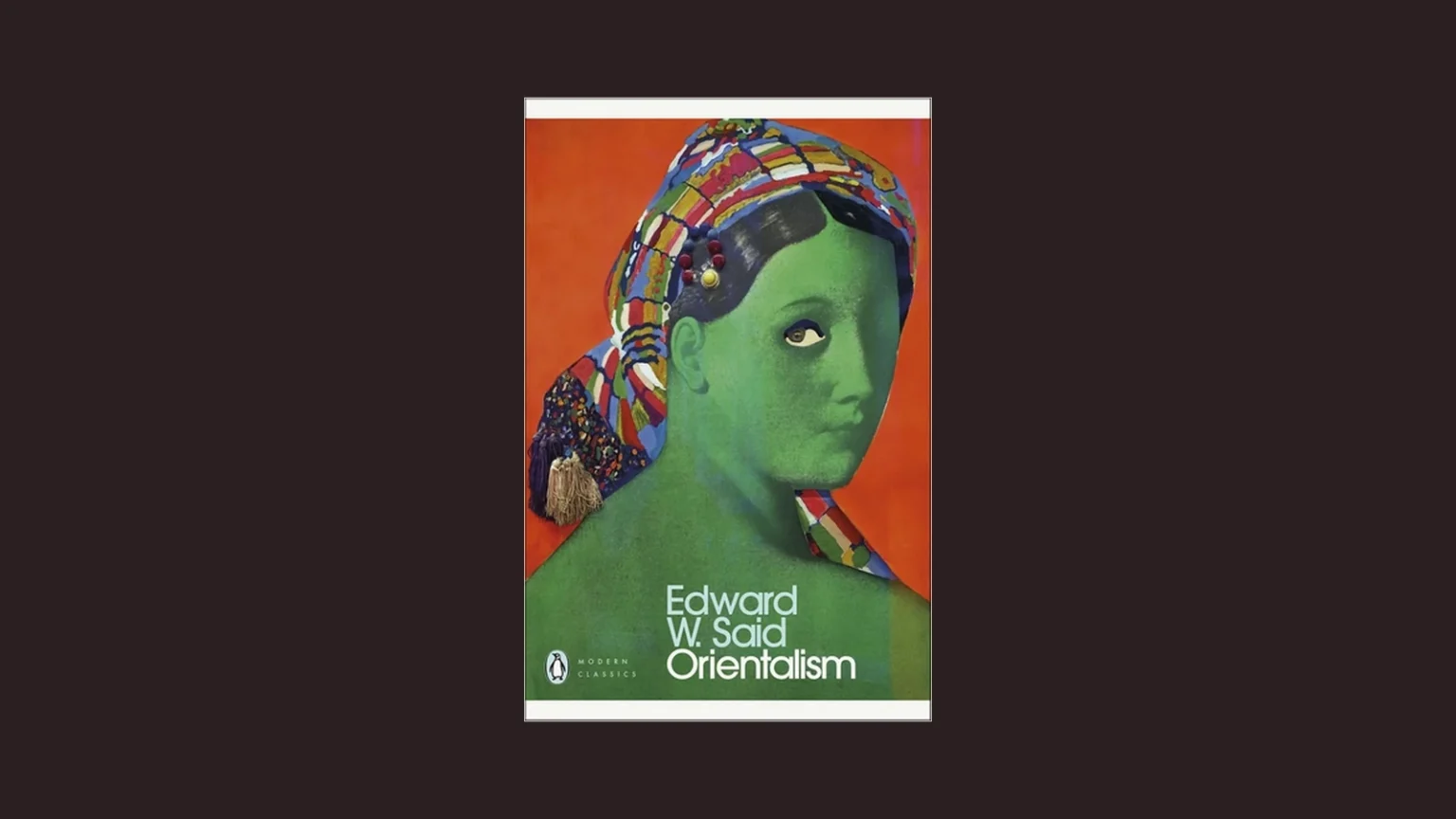
Orientalism by Edward W. Said
Original publication: New York: Pantheon Books, 1978; written and first published in English.
Edition: Penguin Modern Classics paperback, Penguin Classics imprint.
Current publisher record: 5 December 2019.
Contents: Main text, 1995 Afterword, and 2003 Preface.
Format and extent: Paperback, 432 pages.
ISBN-13: 978-0-14-118742-6.
ISBN-10: 0-14-118742-5.
This is the most practical single-volume choice for readers moving between Said’s 1978 argument and its later reception. The text is not a new critical edition, but it preserves the book alongside Said’s substantial 1995 Afterword and the Preface written after the attacks of 11 September 2001 and the ensuing wars. Those additions matter for several articles below because they clarify Said’s resistance to civilizational essentialism and his insistence that Orientalism was a study of representation and authority, not a declaration that every European statement about Asia or the Middle East is false.
The official Penguin edition record confirms the pagination, ISBN, format, and cover shown here. Readers citing the book should still record the edition they actually use, since pagination varies across the 1978 Pantheon first edition and later reissues.
Representation, Empire, and the Trouble with a Usable Classic
Edward W. Said (1935–2003), a Palestinian-American literary critic and longtime Columbia University professor, wrote Orientalism at the intersection of comparative literature, intellectual history, anti-colonial politics, and the modern history of the Middle East. Its most durable claim is not simply that Western writers misrepresented an Eastern reality. Said argued that descriptions, classifications, literary conventions, philological expertise, travel writing, administrative reports, and strategic policy formed a discourse: a patterned system that helped make “the Orient” available to European knowledge and power.
The book deliberately moves among three meanings of Orientalism: an academic field; a habit of thought organized by an East–West distinction; and an institutional practice through which European powers managed, spoke for, and acted upon peoples cast as Oriental. Michel Foucault’s account of discourse helped Said connect statements to institutions, while Antonio Gramsci’s concept of hegemony helped him explain why cultural authority can operate without simple command. Yet Said’s archive remains his own: literary works, philology, colonial scholarship, travel narratives, and political prose concerning chiefly British and French power in the Arab-Islamic Middle East, followed by the rise of American authority.
That archive produced both the book’s force and its recurrent difficulties. Historians and area specialists have questioned its geographic concentration, its treatment of chronology, its tendency to make a heterogeneous scholarly tradition appear too coherent, and its limited attention to German, Russian, Ottoman, female, and indigenous forms of knowledge. Feminist and queer critics have pressed the gendered and sexual assumptions of the argument. Political theorists have asked whether the book leaves enough room for the agency of colonized peoples or for representations that resist imperial utility. Said himself answered some misreadings in the Afterword and Preface included in the expanded Penguin text.
The result is a classic that is easy to invoke and difficult to use responsibly. “Orientalist” now often functions as a loose synonym for stereotype, prejudice, or factual error; Said’s sharper question concerned how representation acquires institutional authority and political consequence. The scholarly articles on Orientalism selected here therefore do more than affirm or reject the book. They specify mechanisms, revise its exclusions, carry its concepts into new disciplines, and test whether its account of knowledge and power can explain changed historical settings.
Ten Essential Studies: scholarly articles on Orientalism
The sequence below is chronological by formal publication record, with online-first and issue dates distinguished where they differ. These scholarly articles on Orientalism retain their separate questions and methods rather than being compressed into a single thematic verdict.
- “Orientalism in a globalised world: Said in the twenty-first century” — Ahmad H. Sa’di
- “Traces of orientalism in media studies” — Banafsheh Ranji
- “From discourse to practice: Orientalism, western policy and the Arab uprisings” — Jasmine K. Gani
- “Gender as the UnSaid: Exploring the Interstices in Edward Said’s Orientalism” — Chantal Zabus
- “In the Name of the Father: Orientalism, Zionism and Edward Said’s Foundational Status in Postcolonial Studies” — Sneharika Roy
- “Edward Said and Philosophy” — Zeyad el Nabolsy
- “Imprints of Islam on Edward Said’s Orientalism” — Nicolás Roser Nebot and Rachida Boubrit
- “Orientalism, Liberal Empire, and the 2003 Iraq War” — Joseph Stieb
- “Epistemologies of Domination: Colonial Encounters, Heterology, and Postcolonial Pedagogy” — Alina Sajed
- “Cold War Orientalism and the Making of Islam in International Relations” — Turan Kayaoglu
Article 1 of 10
“Orientalism in a globalised world: Said in the twenty-first century”
Ahmad H. Sa’di
Journal: Third World Quarterly, 42.11 (2021), 2505–2520; published online 22 July 2020.
Publisher: Routledge / Taylor & Francis.
DOI: 10.1080/01436597.2020.1788935.
Access: Summary based on the verified publisher abstract and official bibliographic record; full text was not independently examined.
Argument and Scope
Sa’di asks whether Said’s diagnosis survives neoliberal globalization, digital communication, intensified migration, and the securitization of Muslim populations. His answer is neither simple continuity nor disappearance. Older forms of exoticism and civilizational hierarchy persist, but they coexist with a more adaptable neo-Orientalism that can speak the languages of security, integration, gender equality, and liberal tolerance while continuing to mark populations as deficient or dangerous.
Method and Evidence
The official abstract presents a broad conceptual diagnosis spanning public opinion, media, political elites, and scholarly thought. Its framework joins Said’s discourse analysis to debates over Islamophobia, migration, new racism, and globalized governance. Because the full text was unavailable for independent examination, narrower claims about its corpus are not made here.
Relation to the Book
The article treats Orientalism as a living diagnostic rather than a closed history of nineteenth-century European scholarship. It asks what changes when the object of representation is no longer only a distant colony but also the migrant, citizen, refugee, or security subject within Western states.
About the Author
Ahmad H. Sa’di is an associate professor in the Department of Politics and Government at Ben-Gurion University of the Negev. His work addresses citizenship, surveillance, Palestinian society, and the political production of knowledge.
Editorial Note
The article was formally published online in 2020 and assigned to volume 42, issue 11, in 2021. Both dates are retained because they explain why different databases may cite it differently.
Article 2 of 10
“Traces of orientalism in media studies”
Banafsheh Ranji
Journal: Media, Culture & Society, 43.6 (2021), 1136–1146.
Publisher: SAGE.
DOI: 10.1177/01634437211022692.
Access: Open-access publisher full text examined; Creative Commons Attribution 4.0.
Argument and Scope
Ranji turns the critique back upon media studies. De-Westernization has challenged the field’s geographical concentration, she argues, yet its language can reproduce the binary it seeks to overcome: “Western” media remain the unmarked norm, while “non-Western” media are generalized through politics, religion, authoritarianism, or cultural difference. The Iranian case exposes how apparently comparative research can preserve an asymmetrical gaze.
Method and Evidence
This is a reflexive disciplinary essay rather than a quantitative survey. Ranji reads recurring categories and formulations in media-research literature, relates them to her work on Iranian journalism, and draws on the institutional experience of conducting and evaluating scholarship across the West/non-West divide.
Relation to the Book
Said’s method becomes a test of the field’s own positionality. The article is especially useful for readers who want to understand Orientalism not as a catalogue of insulting images but as a structure of comparison in which one location possesses theory and another supplies culturally overdetermined data.
About the Author
Banafsheh Ranji is a postdoctoral fellow in sociology and political science at the Norwegian University of Science and Technology. Her research concerns journalism, media sociology, exile, and the politics of knowledge; the article arose from doctoral work conducted at the University of Oslo.
Article 3 of 10
“From discourse to practice: Orientalism, western policy and the Arab uprisings”
Jasmine K. Gani
Journal: International Affairs, 98.1 (2022), 45–65; published 10 January 2022.
Publisher: Oxford University Press for Chatham House.
DOI: 10.1093/ia/iiab229.
Access: Open-access publisher and institutional-repository full text examined; Creative Commons Attribution-NonCommercial 4.0.
Argument and Scope
Gani traces a movement from latent assumptions to manifest policy during the Arab uprisings. Early Western enthusiasm for democratic protest gave way, in many venues, to a narrative of an “Islamist winter.” The shift did not merely describe events: it narrowed the range of imaginable political actors, encouraged selective recognition, and helped shape the uneven support or restraint of British and American policy.
Method and Evidence
Combining discourse analysis with intellectual and policy history, Gani studies commentary from the first year of the uprisings and places it in a longer history of Western representation. A comparison of Chatham House and the Council on Foreign Relations shows how different epistemic communities, sources of regional input, and institutional agendas mediated discourse into policy.
Relation to the Book
This is one of the clearest recent demonstrations of Said’s power/knowledge thesis at work. Rather than stopping at biased language, it identifies the institutional passage between representation and foreign-policy practice—and shows how policy can then return as fresh “evidence” for inherited Orientalist claims.
About the Author
Jasmine K. Gani is assistant professor of international relations theory at the London School of Economics. At the article’s publication she was based at the University of St Andrews. Her research includes race and empire in international relations, Syria, the Middle East, and the politics of knowledge production.
Article 4 of 10
“Gender as the UnSaid: Exploring the Interstices in Edward Said’s Orientalism”
Chantal Zabus
Journal: Acta Neophilologica, 55.1–2 (2022), 209–222.
Publisher: University of Ljubljana Press, Faculty of Arts.
DOI: 10.4312/an.55.1-2.209-222.
Access: Open-access full text examined; Creative Commons Attribution-ShareAlike 4.0.
Argument and Scope
Zabus reads gender as an “UnSaid” within Said: a constitutive absence rather than a detachable missing topic. Women, sexual dissidents, and gender outlaws occupy textual and geographic interstices that disturb the apparent stability of East and West. The article therefore asks how the book’s binaries change when bodies and desires excluded from its principal analytical field are restored to view.
Method and Evidence
The approach is feminist, queer, and postcolonial close reading. Zabus works through Said’s language and later post-Orientalist debates, attending to marginal figures and spaces that escape straightforward placement within a masculine imperial encounter. “Interstice” functions both as a textual method and a political geography.
Relation to the Book
The essay neither excuses Said’s limited treatment of gender nor treats the omission as grounds for discarding his framework. Instead, it makes the absence analytically productive: gendered and queer subjects disclose where the architecture of Orientalism becomes porous and where its account of representational power requires revision.
About the Author
Chantal Zabus is a scholar of comparative and postcolonial literature associated with Université Sorbonne Paris Nord. Her research includes African literatures, language, gender, sexuality, and queer postcolonial studies.
Article 5 of 10
“In the Name of the Father: Orientalism, Zionism and Edward Said’s Foundational Status in Postcolonial Studies”
Sneharika Roy
Journal: Postcolonial Literatures and Arts, 1 (2023), “Name of a Discipline”; online 5 April 2024.
Publisher: Société des Études Postcoloniales / OpenEdition Journals.
DOI: 10.4000/11oaw.
Access: Legal open access is available; this account was checked against the official article record, abstract, and issue materials.
Argument and Scope
Roy repositions Said’s foundational status by returning Orientalism to his sustained writing on Palestine. The book’s canonization in postcolonial-studies anthologies, she argues, can detach its analysis from the political struggle that gave it urgency. Said’s critique of Zionism, American liberal consensus, and Arab nationalism is not an optional supplement but part of the intellectual field in which his study of nineteenth-century Orientalism intervened.
Method and Evidence
The essay combines intellectual history, close reading across Said’s oeuvre, and reception analysis. Its attention to anthologization and disciplinary “founding fathers” asks how excerpts become canonical and what political commitments disappear when a text is converted into a portable theoretical origin.
Relation to the Book
For readers approaching scholarly articles on Orientalism through classroom theory, Roy supplies an essential correction: the book is foundational, but not self-sufficient. “Zionism from the Standpoint of Its Victims” and Said’s Palestinian political essays make explicit the dispossession, representation, and struggle over narrative that abbreviated disciplinary histories can obscure.
About the Author
Sneharika Roy is associate professor at the American University of Paris. She works in comparative literature, postcolonial studies, epic, and creative writing, with particular attention to the forms through which political and literary traditions are transmitted.
Editorial Note
The journal issue carries a 2023 designation, while OpenEdition records the article as online from 5 April 2024. The article qualifies by its formal online publication record.
Article 6 of 10
“Edward Said and Philosophy”
Zeyad el Nabolsy
Journal: Cambridge Journal of Postcolonial Literary Inquiry, 11.1 (2024), 103–109; published online 23 November 2023.
Publisher: Cambridge University Press.
Article type: Peer-reviewed Book Forum contribution.
DOI: 10.1017/pli.2023.35.
Access: Open-access publisher full text examined; Creative Commons Attribution 4.0.
Argument and Scope
El Nabolsy reconstructs Said’s philosophical commitments through Timothy Brennan’s biography. Said rejects naïve realism—the idea that representations simply mirror an unmediated world—without abandoning truth. His position combines representational mediation with a correspondence account of truth and a non-deterministic standpoint epistemology: social location shapes what can be seen, but does not mechanically guarantee correct knowledge.
Method and Evidence
The piece is a compact exercise in conceptual reconstruction. It reads Brennan alongside Said, compares the resulting position with early-modern epistemology, classical Marxist ideology critique, and contemporary work on epistemologies of ignorance, and distinguishes claims that are often blurred in discussions of discourse.
Relation to the Book
Its value lies in explaining a central puzzle of Orientalism: how can representations be false, socially durable, and causally productive at once? El Nabolsy shows that Said need not choose between a world independent of discourse and the claim that authorized representations reorganize the reality they purport merely to describe.
About the Author
Zeyad el Nabolsy is a scholar of modern African intellectual history with formal training in philosophy and Africana studies. The article lists York University in Toronto as his affiliation; Cornell’s Africana Studies profile records his doctoral work and research on African philosophy and intellectual history.
Article 7 of 10
“Imprints of Islam on Edward Said’s Orientalism”
Nicolás Roser Nebot and Rachida Boubrit
Journal: Anthropology of the Middle East, 19.2 (Winter 2024), 36–52.
Publisher: Berghahn Journals.
DOI: 10.3167/ame.2024.190203.
Access: Legal open access is available through Open Anthropology; discussion is limited to claims confirmed by the publisher record and abstract.
Argument and Scope
Roser Nebot and Boubrit isolate the religious history within Said’s archive. They accept the persistence of anti-Islamic patterns in European representation, but resist treating Western writing as a single hostile block. The article’s scope is chiefly the Arab Muslim Middle East and North Africa, where Christian polemic, philology, literature, and modern expertise produced durable images of Islam.
Method and Evidence
The publisher description indicates a comparative close reading of the writers and traditions that structure Said’s account, including figures such as Dante, Barthélemy d’Herbelot, Ernest Renan, and Bernard Lewis, alongside counterexamples of more equitable engagement. The method tests a historical pattern against variation within the archive.
Relation to the Book
The article sharpens the difference between identifying a recurring representational inheritance and declaring every European account identical. It is useful for readers who want to preserve Said’s critique of religious stereotyping while asking how exceptions, translations, and intellectual crossings complicate the unity of “the West.”
About the Authors
Nicolás Roser Nebot is affiliated with the University of Málaga’s Department of Translation and Interpreting and works on Arabic, translation, and Arab-Islamic intellectual history. Rachida Boubrit’s work is likewise connected to translation and Arabic studies at Málaga.
Article 8 of 10
“Orientalism, Liberal Empire, and the 2003 Iraq War”
Joseph Stieb
Journal: Journal of American Studies, 58.3 (2024), 390–420; published online 5 December 2024.
Publisher: Cambridge University Press for the British Association for American Studies.
DOI: 10.1017/S0021875824000380.
Access: Full text unavailable for independent examination; summary is limited to the verified abstract and official bibliographic record.
Argument and Scope
Stieb agrees that essentialized difference helped justify the 2003 invasion of Iraq, but argues that this Saidian explanation is incomplete. Liberal universalism—the assertion that supposedly universal values authorized transformative intervention—also supplied an imperial rationale. More provocatively, opponents of the war could deploy Orientalist binaries and stereotypes in arguments for restraint.
Method and Evidence
The official abstract describes a historical analysis of the war’s intellectual and cultural origins within the longer history of liberal empire. It treats cultural ideas as politically multidirectional: the same representational repertoire can support invasion, pessimism about democratization, or non-intervention. Detailed archival claims are omitted here because the full text was not independently reviewed.
Relation to the Book
The article revises a one-way application of Orientalism. Said clarifies how difference can license domination; Stieb adds that sameness, universalism, and civilizational uplift can do imperial work too, while Orientalist difference may occasionally be mobilized against intervention. Context, not vocabulary alone, determines political effect.
About the Author
Joseph Stieb is a historian of United States foreign relations and national-security thought. The article lists the Department of National Security Affairs at the U.S. Naval War College as his institutional affiliation.
Editorial Note
The article is included because the official abstract establishes a distinctive, substantive intervention. Claims beyond that record have deliberately not been reconstructed.
Article 9 of 10
“Epistemologies of Domination: Colonial Encounters, Heterology, and Postcolonial Pedagogy”
Alina Sajed
Journal: International Studies Review, 26.3 (September 2024), viae035; published 2 September 2024.
Publisher: Oxford University Press for the International Studies Association.
DOI: 10.1093/isr/viae035.
Access: Open-access publisher full text examined.
Argument and Scope
Sajed develops the “epistemology of domination”: the patterned ways an oppressor knows, classifies, and narrates the oppressed. Reverse-gaze accounts of colonial encounters reveal three recurrent problems—the politics of representation, the denial of coevalness that makes colonized societies appear belated, and an overemphasis on Western agency that can inadvertently reproduce the dominance under criticism.
Method and Evidence
The article joins comparative political theory, intellectual history, and critical pedagogy. Through readings of Ibrahim Abu-Lughod, Ashis Nandy, Zeynep Çelik, Michel de Certeau, Maxime Rodinson, and Ottoman and Arab counter-gazes, it develops “heterology”—knowledge of the other that remains alert to reciprocity, temporal coexistence, and asymmetrical power.
Relation to the Book
Sajed retains Said’s central problem while criticizing the linearity and geographical restriction of his narrative. Orientalism can overstate Western authorship of the colonial encounter and underrepresent the intellectual agency of those observed. Her pedagogical alternative asks scholars to study domination without making Europe the sole source of historical movement.
About the Author
Alina Sajed is associate professor of political science at McMaster University. Her work spans international-relations theory, colonialism and decolonization, the Global South, comparative political theory, and North Africa and the Middle East.
Article 10 of 10
“Cold War Orientalism and the Making of Islam in International Relations”
Turan Kayaoglu
Journal: Global Studies Quarterly, 6.1 (January 2026), ksaf113; published 29 January 2026.
Publisher: Oxford University Press for the International Studies Association.
DOI: 10.1093/isagsq/ksaf113.
Access: Open-access publisher full text examined; Creative Commons Attribution-NonCommercial-NoDerivatives 4.0.
Argument and Scope
Kayaoglu names a specific formation: “Cold War Orientalism,” the fusion of inherited Orientalist assumptions with strategic anxiety about religion, communism, and geopolitical alignment. The article shows how reductive accounts of Islamic political thought entered international relations not only as prejudice from outside the discipline but as part of its conceptual and professional formation.
Method and Evidence
Using contextual intellectual history associated with the Cambridge School, Kayaoglu reconstructs the work and setting of Majid Khadduri, while comparing figures such as Bernard Lewis and currents including Realpolitik and the Islamization of Knowledge. The evidence links scholarly authority, disciplinary canonization, and Cold War strategic usefulness.
Relation to the Book
Said treated Lewis at length but gave Khadduri only brief attention. Kayaoglu supplies the disciplinary genealogy that Orientalism left undeveloped: how “Islam” became a static, strategically legible object within international relations. The result extends Said’s power/knowledge critique into the construction of a modern academic field and argues for epistemic plurality rather than a replacement canon with a single center.
About the Author
Turan Kayaoglu is associate vice chancellor for faculty affairs and professor of political science at the University of Colorado Denver. His scholarship addresses international relations, religion, human rights, international organizations, and the political history of knowledge about Islam.
Related BookInLight Reading Guides
BookInLight’s guide to scholarly articles on Frantz Fanon’s The Wretched of the Earth extends the postcolonial reading path from representation to colonial violence, national consciousness, and liberation.
Six books on the Algerian War of Independence supplies historical grounding for the French colonial world that shadows Said’s archive and many later debates over decolonization.
Scholarly articles on Michel Foucault’s Discipline and Punish offers a companion route into discourse, institutions, surveillance, and the forms of power that informed Said’s critical vocabulary.
This article was researched and written by the BookInLight Department of Political Thought and Intellectual History. The editorial process included bibliographical review, article-title and DOI verification, publisher and repository checks, access-status distinctions, source verification, and factual review of edition and scholar-profile information. Readers are invited to send factual corrections, overlooked sources, interpretive suggestions, and constructive ideas that could improve a future revision.
The BookInLight Art Department is credited for editorial art direction, visual composition, cover selection, and image presentation. Rights in the third-party book cover and any linked publisher materials remain with their respective rights holders. Complete republication, reproduction, translation, or reuse of this article requires prior written permission from BookInLight.
Sources and Further Reading
Recommended Edition and Publication History
Penguin, Orientalism, ISBN 9780141187426 — official source for the recommended edition’s imprint, format, publication record, pagination, ISBN, and cover.
WorldCat record for the 1978 Pantheon edition — bibliographic support for the first American publication.
WorldCat record for the expanded Penguin edition — support for the edition incorporating Said’s later Preface.
Ten Selected Articles
Sa’di, “Orientalism in a globalised world” — official abstract, dates, pagination, and DOI metadata.
Ranji, “Traces of orientalism in media studies” — publisher full text, bibliographic record, and license.
Gani, “From discourse to practice” — publisher full text, issue metadata, argument, and DOI.
Zabus, “Gender as the UnSaid” — official article record, open full text, pagination, and license.
Roy, “In the Name of the Father” — official article page, issue designation, online date, DOI, and open-access terms.
El Nabolsy, “Edward Said and Philosophy” — publisher full text, article type, publication dates, and license.
Roser Nebot and Boubrit, “Imprints of Islam” — publisher record, abstract, volume, pages, DOI, and access status.
Stieb, “Orientalism, Liberal Empire, and the 2003 Iraq War” — official abstract, pagination, date, access status, and DOI.
Sajed, “Epistemologies of Domination” — publisher full text, article number, date, and DOI.
Kayaoglu, “Cold War Orientalism” — publisher full text, 2026 issue record, article number, DOI, and license.
Scholar Profiles and Repository Records
Ben-Gurion University profile for Ahmad H. Sa’di — institutional position and research context.
NTNU profile for Banafsheh Ranji — current affiliation and research areas.
LSE profile for Jasmine K. Gani — current position and disciplinary specialization.
University of St Andrews repository record for Gani’s article — lawful full-text route and publication-time metadata.
American University of Paris profile for Sneharika Roy — position and research fields.
McMaster University profile for Alina Sajed — institutional position and research areas.
University of Colorado Denver profile for Turan Kayaoglu — current appointment and scholarly background.
Image Credits
Cover of Edward W. Said, Orientalism, Penguin Modern Classics / Penguin Classics, current product record 2019, ISBN 9780141187426. Image supplied on the official Penguin edition page; cover rights remain with Penguin and the relevant rights holders.