The best new books in Modern History for August 2026 range from Central Europe’s prolonged Great War and Ottoman experiments in sovereignty to Soviet-bloc revolt, Islamic constitutionalism, environmental segregation, historical memory, and the media culture of 1968. These ten first editions were selected after publication-date, subject-relevance, bibliographic, edition, and cover-source checks.
Eligible titles were first published from through , inclusive; coordinated print and digital formats released within thirty days were treated as one first-edition program where publisher metadata supported that treatment.
Selection combined publisher and bibliographic date verification, negative edition checks, disciplinary relevance testing, critical research, exact-edition link checking, and cover-source validation.
Affiliate note: Book in Light may earn a small commission if a purchase is made through some links on this page, at no extra cost to the reader. Commercial availability never determines editorial selection.
The 10 best new books in Modern History for August 2026
The ranking gives greatest weight to disciplinary centrality, then originality, evidence, method, authorial expertise, independent critical engagement, and the contribution each book makes to the month as a whole. Lower placement usually reflects narrower scope rather than weak scholarship.

1. The Blood-Dimmed Tide: Central Europe’s Long Great War, 1905–1921
Jesse Kauffman
Harvard University Press ·
ISBN-13: 9780674972353
Page count: 304
Primary field: Modern History
Specific subfield: Central European war, empire, and state formation
Why It Was Selected
Kauffman takes first place because he challenges the habit of treating the First World War’s Eastern Front as a secondary theatre whose political consequences can be understood by importing a Western Front chronology. His wider frame, beginning before 1914 and extending through the violent dissolution of empires after the armistice, makes the emergence of new Central European states part of a prolonged military and political crisis. Among August’s books, it has the greatest combination of geographical scale, explanatory ambition, and disciplinary centrality. Readers interested in nationalism, imperial collapse, borderlands, military occupation, and state formation will find a history in which 1918 is a turning point rather than a clean ending.
Short Book Summary
The book reconstructs Central Europe’s era of war from the tensions of the pre-1914 borderlands through the imperial war, revolution, civil conflict, occupation, and postwar struggles that followed. Its principal intervention is chronological: violence on the eastern side of Europe did not obey the neat 1914–1918 periodization commonly associated with the Great War. German, Habsburg, Russian, Polish, Ukrainian, and other political projects operated in territories where sovereignty remained unstable long after old regimes began to break apart. Kauffman therefore links battlefield experience to occupation, population politics, national mobilization, and the creation of successor states. The resulting account treats the First World War less as an isolated international collision than as the central phase of a longer struggle over political order in the lands between Germany and Russia.
Author Profile
Jesse Kauffman is a historian of modern Central and Eastern Europe whose research focuses on war, nationalism, empire, and political transformation. His scholarship has repeatedly examined how military conflict altered ideas of nation and state in the German-Polish borderlands and across east-central Europe. That background matters here because the book requires fluency in several overlapping imperial and national archives rather than the perspective of a single belligerent. The Harvard University Press edition page situates the new volume within his continuing work on war and state-making.
Publisher & Print Editions
Who Should Read It
Best for graduate students, researchers, and serious general readers of the First World War, Central Europe, nationalism, borderlands, and imperial collapse. It is particularly useful for courses that need to move beyond a Western Front-centered narrative or explain why the violence associated with the Great War continued after formal armistices. Familiarity with the basic political geography of the Habsburg, German, and Russian empires will help.

2. Empire by Law: The Ottoman Origins of the Mandate System in the Middle East
Aimee M. Genell
Columbia University Press ·
ISBN-13: 9780231203357
Page count: 432
Primary field: Modern History
Specific subfield: Ottoman, legal, imperial, and international history
Why It Was Selected
Genell ranks second because she alters the genealogy of one of the twentieth-century Middle East’s defining institutions. Instead of treating League of Nations mandates as a European solution imposed on the ruins of the Ottoman Empire, she reconstructs an Ottoman history of negotiated autonomy, sovereignty, and international law that preceded the mandates by decades. This is modern history at its strongest: archival work changes the conceptual map of a major transition from empire to postwar international order. It falls just below Kauffman because its institutional problem is more specialized, but its implications reach far beyond Ottoman studies into histories of international law, colonial governance, sovereignty, and the political settlement created after the First World War.
Short Book Summary
The book traces the development of the Ottoman Empire’s “privileged provinces,” including Egypt and Mount Lebanon, from the nineteenth century into the settlement that followed the First World War. Genell argues that autonomy was not simply evidence of imperial weakness. It became a legal technology through which Ottoman officials, lawyers, European powers, and provincial actors negotiated layered forms of authority. By following debates over Egypt, the Gulf, treaties, provincial status, and Woodrow Wilson’s language of self-determination, she shows how older Ottoman experiments supplied precedents for later mandate arrangements. The study therefore complicates the familiar sequence of Ottoman collapse followed by a fundamentally new international system. Legal categories survived political rupture. Practices developed to preserve a flexible empire could be reformulated to organize post-Ottoman rule.
Author Profile
Aimee M. Genell is Assistant Professor of International History at Boston University’s Frederick S. Pardee School of Global Studies. Her research brings together Ottoman political history, international law, imperial governance, and the emergence of the modern Middle Eastern state system. The project developed from long-term work on Ottoman sovereignty and the British occupation of Egypt, giving the book an unusually deep institutional foundation. Columbia’s author and edition record places it in the Columbia Studies in International and Global History series.
Critical Reception
One of the first substantial independent assessments, Daniel Neep’s review for Engelsberg Ideas, stresses the book’s reconstruction of Ottoman legal argument as an active political practice rather than an imitation of European norms. Neep treats Genell’s archival work as part of the revisionist scholarship that has displaced older narratives of inevitable Ottoman decline. The review’s most important point is methodological: actors living through imperial crisis did not know which political future would prevail. Genell’s recovery of abandoned alternatives therefore changes how the mandate system itself appears—not as an obvious endpoint, but as one branch among several possible constitutional and imperial arrangements.
Empire by Law is a welcome addition to the revisionist scholarship on the late Ottoman Empire
The judgment captures the book’s strongest historiographical contribution: replacing a terminal-decline framework with a history of institutional experimentation.
Reviews & Criticism
Publisher & Print Editions
Who Should Read It
Especially strong for graduate courses and researchers in Ottoman history, modern Middle Eastern history, international law, imperial history, and the history of sovereignty. Readers familiar with the nineteenth-century Eastern Question will get the most from its legal detail, but its argument also matters to political historians studying how international institutions recycle older imperial practices under new names.

3. The Age of Hobsbawm: The Life of a Revolutionary Historian
Emile Chabal
Belknap Press of Harvard University Press ·
ISBN-13: 9780674737761
Page count: 496
Primary field: Modern History
Specific subfield: Historiography and twentieth-century intellectual history
Why It Was Selected
Third place goes to a biography that is simultaneously a history of historical writing. Eric Hobsbawm’s career intersected with communism, Marxist scholarship, labor history, global intellectual networks, the rise of social history, and the extraordinary international readership of his synthetic histories. Chabal’s subject therefore offers something larger than an academic life. The book asks how ideological commitment, archival scholarship, journalism, political friendship, and institutional prestige coexisted in one of the twentieth century’s most consequential historians. It ranks below the first two because its object is a historian rather than a historical transformation in itself, yet no other August title speaks as directly to the production and public authority of modern history as a discipline.
Short Book Summary
Chabal follows Hobsbawm from his multilingual Central European childhood through Cambridge, communist politics, British academic life, global travel, journalism, and the writing of books that reached audiences far beyond the university. The biography pays close attention to the intellectual networks behind the finished texts: Marxist colleagues, historians of labor and revolution, politicians, writers, and contacts across Europe, Latin America, India, and elsewhere. It also confronts the tension that defined Hobsbawm’s reputation—an ability to explain long-term transformations in capitalism and nationalism alongside a political loyalty to communism that remained controversial after the evidence of Stalinism became impossible to ignore. Chabal thereby turns biography into a study of how historical interpretation is made within institutions, political commitments, friendships, and changing public cultures.
Author Profile
Emile Chabal is Professor of Contemporary History at the University of Edinburgh. His scholarship has ranged across modern France, political culture, postwar Europe, identity, and the historiography of contemporary politics. That combination makes him unusually well positioned to treat Hobsbawm as both a historian and a political intellectual embedded in several national and scholarly worlds. His earlier work on France and postwar political categories also informs the biography’s attention to how large interpretive labels acquire historical authority. The Harvard edition record provides the authoritative publication details.
Critical Reception
Publishers Weekly emphasizes the biography’s success in using Hobsbawm’s life to illuminate a much larger intellectual and political landscape, especially his influence on labor history and wide-angle interpretations of capitalism. Later commentary has been less comfortable with the political legacy. A review in The Indian Express foregrounds Hobsbawm’s contradictions: extraordinary explanatory range, international prestige, and commitment to writing history for broad audiences existed beside an enduring defense of communism and major blind spots in his treatment of twentieth-century violence. The emerging reception therefore treats Chabal’s book less as commemoration than as an opportunity to reassess how scholarship and ideology shaped one another.
It’s a remarkably illuminating portrait of the man, his times, and his discipline.
The phrase points to the biography’s three simultaneous scales: person, twentieth-century politics, and the institutional history of historical scholarship.
Reviews & Criticism
Publisher & Print Editions
Digital & Audio Editions
Who Should Read It
Ideal for historians interested in historiography, Marxism, twentieth-century Europe, intellectual biography, social history, and the politics of scholarship. It should work particularly well in graduate seminars on historical method because it allows students to ask how a historian’s political commitments affect topic selection, explanatory scale, archival interpretation, and public reputation without reducing scholarship to ideology alone.

4. All the Seas Were Ink: Islamic Constitutionalism in Motion
Iza R. Hussin
Cambridge University Press ·
ISBN-13: 9781009727945
Page count: 266
Primary field: Modern History
Specific subfield: Global legal, Islamic, and oceanic history
Why It Was Selected
Hussin earns fourth place for making movement itself an analytical method. By following Sultan Abu Bakar of Johor through maritime and imperial networks, she reconstructs constitutionalism as something produced through travel, translation, diplomatic encounter, and comparison rather than simply imported from a European metropolitan center. The book is co-primary history and legal thought, but modern history is indispensable to its argument: nineteenth-century empire, oceanic mobility, Asian sovereignty, Islam, and international law organize the story. Its geographical reach is unusually wide without becoming a loose global survey. The result is one of August’s strongest examples of connected history, especially for readers interested in how political concepts change as they cross jurisdictions.
Short Book Summary
The book follows Abu Bakar, Sultan of Johor, across a nineteenth-century world that connected Southeast Asia with Japan, India, the Ottoman Empire, Egypt, Britain, and even Hawaii. Hussin asks what happens to legal concepts when rulers, advisers, texts, and diplomatic practices travel. Abu Bakar’s itineraries exposed him to competing imperial arrangements and different ways of describing sovereignty; these encounters helped produce Johor’s constitutional order and an enduring experiment in modern Islamic constitutionalism. Rather than narrating constitutional development as a one-way transfer from Europe to Asia, Hussin reconstructs a field of translation in which Asian rulers strategically compared political forms, Islamic authority, maritime power, and international recognition. The sea becomes an archive of legal motion, not an empty space between national histories.
Author Profile
Iza R. Hussin is based at the University of Cambridge and works across comparative politics, legal history, Islamic law, Southeast Asian studies, and the historical circulation of political ideas. Her scholarship has long questioned models in which law radiates outward from European imperial centers toward passive colonial recipients. This book extends that concern by tracing legal forms through mobile rulers and oceanic connections. Cambridge places the volume in its Cambridge Oceanic Histories series, an appropriate setting for its mobile geography.
Publisher & Print Editions
Who Should Read It
Best suited to readers of global history, Southeast Asian history, imperial legal history, Islamic constitutionalism, and international political thought. Graduate students will gain most from its conceptual language, but the itinerary-based structure also makes it useful for courses on connected and oceanic history. It is especially valuable for anyone trying to move beyond simple diffusion models of modernization.

5. Excavating Empire: Russian Archeology in the Nineteenth Century
Louise McReynolds
Oxford University Press · online ; print August 31, 2026
ISBN-13: 9780197901694
Page count: 240
Primary field: Modern History
Specific subfield: Imperial Russian history and history of archaeology
Why It Was Selected
McReynolds places fifth because she shows how the supposedly remote practice of digging burial mounds became a modern imperial project of classification, professionalization, and historical imagination. Oxford explicitly places the volume in Modern History, alongside historical archaeology and world history. Its strongest contribution is to make knowledge production itself part of imperial politics: antiquarians, museums, archaeological congresses, learned societies, and field practices helped define what counted as Russia’s past. The scale is narrower than the books above it, but the methodological payoff is substantial. Material remains become evidence for how empires turn territory into history and how emerging academic disciplines acquire authority.
Short Book Summary
The book follows the generations of nineteenth-century Russian antiquarians and archaeologists who excavated kurgans and other material remains while trying to construct a tangible past for an enormous and diverse empire. McReynolds charts the shift from aristocratic collecting and antiquarian curiosity toward societies, congresses, professional standards, and claims to scientific expertise. Questions that appear technical—how to classify an artifact, date a burial site, distinguish peoples, or organize a congress—were inseparable from arguments about Russian identity and imperial space. The study also traces the destructive rupture of war, revolution, and civil conflict after 1917, when institutions and individual scholarly careers were transformed or destroyed. Archaeology thus becomes an especially concrete form of modern historical politics.
Author Profile
Louise McReynolds is Cary C. Boshamer Distinguished Professor Emerita at the University of North Carolina at Chapel Hill. Her work has made major contributions to modern Russian social and cultural history, including studies of journalism, celebrity, leisure, mass culture, and the changing public sphere. Those interests are highly relevant to this book’s attention to how expertise becomes public and institutionalized. Oxford Academic’s book record identifies the subjects as Modern History, Historical Archaeology, Archaeology by Region, and World History.
Publisher & Print Editions
Who Should Read It
Particularly useful for scholars and graduate students in Russian history, imperial history, archaeology, museum studies, history of science, nationalism, and intellectual history. It can also support courses examining how nineteenth-century states institutionalized knowledge about territory and population. Readers do not need archaeological training; the central problem is historical authority rather than excavation technique.

6. The Hungarian Revolution of 1956: Tremors in the Soviet Bloc
Johanna C. Granville
Oxford University Press · online ; print September 3, 2026
ISBN-13: 9780198815907
Page count: 288
Primary field: Modern History
Specific subfield: Cold War, Soviet bloc, revolution, and dissent
Why It Was Selected
Granville ranks sixth because she deliberately moves the history of 1956 beyond Budapest. The Hungarian uprising remains the central event, but its significance is tested through reactions across East Germany, Austria, Romania, Soviet Ukraine, and Soviet Russia. That transnational architecture distinguishes the book from histories that end with the Soviet military suppression of the revolution. It asks how news, fear, student activism, migration, and political calculation crossed the boundaries of the socialist bloc. Although Oxford formally classifies it under Cold War and Contemporary History, its treatment of communist empire, revolution, and the political order created after 1945 makes it directly relevant to the broader modern-history field examined here.
Short Book Summary
Rather than retelling only the familiar sequence from October protest to Soviet intervention in Hungary, Granville follows the revolution’s political aftershocks across neighboring and Soviet societies. She examines how regimes interpreted Hungarian events, how students and dissenters drew lessons from them, and how authorities responded to the possibility of imitation. East Germany, Romania, Soviet Ukraine, and Russia reveal different combinations of repression, anxiety, ideological policing, and limited reform. Austria adds the international and refugee dimension. The book consequently treats 1956 as an event that changed expectations throughout the bloc. Its west-to-east movement makes the revolution a regional test of Soviet authority and exposes the uneven political consequences of de-Stalinization.
Author Profile
Johanna C. Granville is a historian of the Soviet Union and Eastern Europe whose research has concentrated on Cold War crises, international relations, communist politics, and archival evidence from across the former Soviet bloc. Her earlier scholarship on the Hungarian Revolution established a long engagement with the diplomatic and political dimensions of 1956. The new book broadens the problem geographically and places cross-border effects at the center. The authoritative Oxford Academic record confirms the August 7 online publication date and September 3 coordinated print release.
Publisher & Print Editions
Digital & Audio Editions
Who Should Read It
Recommended for students and researchers of the Cold War, communist Eastern Europe, Soviet nationality politics, revolutions, migration, and dissent. Its comparative structure should be especially useful in seminars that want to ask why the same international shock produced different political responses across superficially similar socialist regimes.

7. China’s Date Debate: How Manchurian Scholars Rewrote World War II
Emily Matson
University of Michigan Press ·
ISBN-13: 9780472058112
Page count: 194
Primary field: Modern History
Specific subfield: Chinese war memory and historiography
Why It Was Selected
Matson’s compact study ranks seventh because it transforms what could appear to be a dispute over dates into a history of historical authority. The question is when China’s war against Japan should be said to have begun: 1937, with the Marco Polo Bridge Incident, or 1931, with the Japanese seizure of Manchuria. Matson shows that the eventual official adoption of a fourteen-year chronology was not simply dictated from the top. Regional scholars from Manchuria had argued for it for decades. The book therefore connects professional historical writing to nationalism, regional identity, party legitimacy, and international memory. Its narrower scope places it below the larger imperial histories, but its historiographical precision is excellent.
Short Book Summary
For decades, the standard Chinese chronology described the war with Japan as an eight-year conflict beginning in 1937. Scholars based in Manchuria argued that this excluded six years of occupation and resistance following the 1931 Mukden Incident. Matson reconstructs how their regional claim developed, how other historians contested it, and how the debate interacted with changing political priorities inside the People’s Republic of China. By the time the fourteen-year chronology received official educational recognition in 2017, it represented more than a revised date. It altered the position of Manchuria within national history and expanded the usable wartime past through which the Chinese Communist Party could narrate resistance, victimization, and legitimacy. The book is therefore about who acquires the power to define national historical time.
Author Profile
Emily Matson is Adjunct Professor of History at Georgetown University, a Stephen M. Kellen Term Member at the Council on Foreign Relations, and a recent fellow with the University of Pennsylvania’s Penn Project on the Future of U.S.-China Relations. Her research connects modern Chinese history, Manchuria, historical memory, and contemporary political narratives. The University of Michigan Press author profile confirms these affiliations and positions the book within her work on Chinese historical identity.
Publisher & Print Editions
Digital & Audio Editions
Who Should Read It
A strong choice for students of modern China, Sino-Japanese war history, Manchuria, nationalism, public memory, historiography, and contemporary Chinese politics. Because the central dispute is clearly defined, the book should also work well in advanced undergraduate courses exploring how states and scholars convert chronology into political meaning.

8. The Greenlining of Staten Island: Environmental Preservation and Racial Segregation, 1945–1995
Patrick D. Nugent
University of Chicago Press ·
ISBN-13: 9780226849478
Page count: 336
Primary field: Modern History
Specific subfield: Postwar urban and environmental history
Why It Was Selected
Nugent ranks eighth for turning an apparent urban-environmental success story inside out. Staten Island’s parks, greenbelts, low-density zoning, and conservation arrangements can be read as environmental achievements; his concept of “greenlining” asks how those same policies helped preserve racially exclusive residential landscapes after overtly discriminatory housing tools became less defensible. The argument brings environmental history, metropolitan history, race, planning, and postwar politics into a single frame. Its geographic concentration is much tighter than the higher-ranked books, but the case has broad explanatory value because it reveals how environmental amenities themselves—not only environmental harms—can become instruments in the unequal distribution of urban space.
Short Book Summary
The Greenlining of Staten Island follows the borough from the mid-twentieth century through the environmental and planning battles that produced greenbelts, ecological zoning, conservation easements, parkland, and low-density residential districts. Nugent connects these policies to fights over urban renewal, highways, national parks, community planning, the Fresh Kills landfill, environmental justice, and Staten Island’s political relationship with New York City. His central claim is that preservation cannot be understood separately from housing and racial geography. White communities could support environmental protection while also using protected landscapes and development restrictions to defend exclusionary patterns of residence. The book thus expands environmental-justice history by examining the unequal distribution of valued environmental amenities as well as pollution and degradation.
Author Profile
Patrick D. Nugent is a historian whose research crosses modern United States history, metropolitan development, environmental politics, planning, and racial geography. The book’s location in the University of Chicago Press series Historical Studies of Urban America places it in a distinguished tradition of scholarship on metropolitan institutions and inequality. The official edition page classifies it under American, Environmental, and Urban History as well as Urban Politics.
Publisher & Print Editions
Digital & Audio Editions
Who Should Read It
Excellent for readers of environmental history, urban history, race and housing, metropolitan planning, environmental justice, and postwar United States history. The Staten Island case is specific enough for detailed seminar discussion yet broad enough to illuminate recurring conflicts over zoning, conservation, exclusion, and urban growth elsewhere in the United States.

9. I Did It for My Country: Sirhan Sirhan, Palestine, and the Assassination of Robert F. Kennedy
Michael R. Fischbach
Columbia University Press ·
ISBN-13: 9780231222112
Page count: 392
Primary field: Modern History
Specific subfield: 1960s United States, Palestine, and political violence
Why It Was Selected
Fischbach enters at ninth because he revisits a famous episode of American political violence through a context frequently pushed to the margins of its public memory: Sirhan Sirhan’s Palestinian background and anger over U.S. support for Israel. The book’s value lies less in reopening the mechanics of Robert F. Kennedy’s assassination than in restoring political and transnational context to the historical record. By examining displacement, 1948, Arab American politics, U.S. electoral politics, the Six-Day War, legal strategy, and the responses of governments and community organizations, Fischbach connects a Los Angeles assassination to the larger history of Palestine and American involvement in the Middle East.
Short Book Summary
The book reconstructs Sirhan’s life before the assassination, including his Palestinian childhood, displacement, migration to the United States, and the political world in which he interpreted Kennedy’s support for Israel. Fischbach then examines the killing, trial, public debate, and the efforts of different actors to explain—or depoliticize—the crime. The central historical question is how an assassination committed during the tumultuous American year of 1968 came to be remembered largely within a domestic narrative of national tragedy while its Middle Eastern dimension receded. By placing U.S., Palestinian, Arab American, Israeli, and diplomatic contexts beside one another, the book shows how political memory can narrow a transnational event into a nationally legible story.
Author Profile
Michael R. Fischbach is Professor of History at Randolph-Macon College and a specialist in modern Middle Eastern history, Palestine, Palestinian dispossession, and the relationship between Arab politics and U.S. social movements. His previous books include studies of records of Palestinian property loss, Black Power’s engagement with Palestine, and American movement politics in the Middle East. That archive of work gives this book a foundation extending far beyond the assassination itself. Columbia University Press provides the authoritative edition and author record.
Publisher & Print Editions
Who Should Read It
Best for readers of 1960s United States history, Palestine, U.S.–Middle East relations, political violence, assassination history, Arab American history, and historical memory. The book should be especially useful for courses on 1968 because it places an iconic American event inside international developments that conventional domestic narratives often separate from it.

10. Out of Line: Reading and Writing Protest in West Germany, 1968
Peter Schweppe
University of Michigan Press ·
ISBN-13: 9780472058174
Page count: 270
Primary field: Modern History
Specific subfield: West German protest, print, and media history
Why It Was Selected
Schweppe closes the ranking with a tightly focused but methodologically inventive history of West Germany’s 1968 protest culture. Rather than treating pamphlets, underground newspapers, marginalia, graffiti, and experimental books merely as containers for radical messages, he asks how their physical and visual forms helped constitute protest itself. The book therefore joins political history to literary and media history. Its narrower disciplinary reach explains the tenth-place position, not a lack of originality. Among August’s titles it is one of the clearest demonstrations that historians can recover political action by studying the material practices through which people read, wrote, circulated, altered, and publicly displayed texts.
Short Book Summary
Out of Line reconstructs the politics of reading and writing around West Germany’s 1968 protest movement. Schweppe follows unconventional books, radical periodicals, annotations, flyers, and writing on walls to show that political communication depended on form as well as content. A marginal note, improvised publication, or piece of graffiti could alter who controlled a text, where it circulated, how readers participated in it, and whether the distinction between author and audience remained stable. The study therefore treats literary materiality as part of protest organization. By combining the history of the Global Sixties with German studies and theories of media and material form, Schweppe broadens the archive through which political mobilization can be understood.
Author Profile
Peter Schweppe is Associate Professor of German Studies at Montana State University. His scholarship works at the intersection of modern German cultural history, literary form, media, and protest. That interdisciplinary position is essential to a book whose archive consists not only of political organizations and ideas but also of the material forms through which dissenters communicated. The University of Michigan Press author profile confirms his current position and the book’s placement in the series Social History, Popular Culture, and Politics in Germany.
Publisher & Print Editions
Digital & Audio Editions
Who Should Read It
Most useful for readers of postwar Germany, the Global Sixties, student protest, media history, material culture, literary studies, and social movements. Its conceptual vocabulary makes it particularly suitable for graduate seminars, although historians interested in alternative archives of political action will also find its method transferable well beyond Germany.
What August Reveals About Modern History
The best new books in Modern History for August 2026 share a striking suspicion of clean historical boundaries. Kauffman stretches the Great War beyond the dates printed in standard chronologies. Genell finds the institutional ancestry of the mandate system inside the empire it supposedly replaced. Hussin follows constitutional thought across seas rather than national containers. Granville treats the Hungarian Revolution as a shock transmitted through a regional political system. Matson demonstrates that even the starting date of a war is a historical product rather than a neutral fact.
A second pattern is the return of institutions and material practices without a retreat into old-fashioned administrative history. Law, archaeological societies, urban zoning, newspapers, graffiti, books, borders, and scholarly chronologies matter because people use them to organize political possibility. McReynolds’s archaeologists create authoritative versions of Russia’s past through objects and institutions. Nugent’s planners turn environmental protection into a mechanism that can also preserve racial exclusion. Schweppe’s activists make the physical form of writing part of protest itself. These studies ask not simply what historical actors believed, but how beliefs acquired durable form.
The geographical range is also notable. Central and Eastern Europe remain prominent, yet the month extends through the Ottoman and post-Ottoman Middle East, maritime Southeast Asia, China and Manchuria, and metropolitan New York. Several books are explicitly transnational. Even Fischbach’s study of Robert F. Kennedy’s assassination becomes intelligible only when Los Angeles, Palestine, U.S. electoral politics, and the Arab-Israeli conflict are read together.
There are gaps. Africa and Latin America are largely absent from this final ten, and economic history is less prominent than political, legal, intellectual, and cultural history. The selection also leans heavily toward university-press monographs rather than serious trade history. Still, the month’s strongest scholarship suggests a field moving away from self-contained national narratives and toward histories of connection, institutional inheritance, contested chronology, and political memory. That is the principal reason these ten books rise above a simple list of August releases.
Research Scope
Research prioritized originating publishers, exact-edition bibliographic records, scholarly platforms, independent criticism, authorized retailers, and edition-specific cover sources. Search and verification work also included candidates ultimately excluded because of earlier editions, earlier regional releases, non-August publication dates, weak disciplinary relevance, or insufficient exact-edition evidence.
Publishers, presses, and institutional catalogs
- Harvard University Press / Belknap Press
- Columbia University Press
- Oxford University Press / Oxford Academic
- Cambridge University Press / Cambridge Core
- University of Chicago Press
- University of Michigan Press
- Harvard Book Store bibliographic records
- Columbia Fall 2026 catalog material
- Cambridge Oceanic Histories series records
- Historical Studies of Urban America series records
Newspapers, magazines, and literary reviews
- Publishers Weekly
- Engelsberg Ideas
- The Indian Express
- New Books Network discovery records
Academic journals and specialist review outlets
- JSTOR book and open-access chapter records
- Oxford Scholarship Online subject and chapter metadata
- Fulcrum / University of Michigan open-access records
Libraries, ISBN systems, and bibliographic databases
- Google Books exact-edition records
- BiblioVault
- JSTOR bibliographic records
- WorldCat-linked publisher records
- Open Library ISBN records
- VitalSource ISBN records
Retailers and authorized digital platforms
- Amazon exact-product records
- Indigo exact-ISBN records
- Harvard Book Store
- iMusic exact-ISBN records
- VitalSource
- Google Play Books
- De Gruyter / Brill authorized digital records
Cover-image sources
- Harvard / exact Amazon edition image delivery
- Columbia / exact-ISBN iMusic cover delivery
- Oxford / exact Amazon and exact-ISBN iMusic cover delivery
- Cambridge / exact Amazon edition delivery
- University of Chicago Press jacket server
- University of Michigan / exact-ISBN iMusic cover delivery
Sources and Verification
Consequential Research Sources
- Harvard Book Store — The Blood-Dimmed Tide: exact publication date, publisher, ISBN, page count, and edition availability.
- Harvard University Press — The Blood-Dimmed Tide: originating-publisher edition identity.
- Columbia University Press — Empire by Law: publication program, formats, ISBNs, page count, author biography, subjects, and contents.
- JSTOR — Empire by Law: independent book and series record.
- Engelsberg Ideas: independent critical assessment of Genell’s argument and archival intervention.
- Publishers Weekly — The Age of Hobsbawm: independent prepublication review and bibliographic details.
- Harvard University Press — The Age of Hobsbawm: official exact-edition record.
- Cambridge University Press — All the Seas Were Ink: publication date, ISBN, pages, series, subjects, and author identity.
- Oxford Academic — Excavating Empire: August 5 online publication, August 31 print availability, ISBNs, author affiliation, and explicit Modern History classification.
- Oxford Academic — The Hungarian Revolution of 1956: August 7 online publication, print coordination, ISBNs, and subject classification.
- University of Michigan Press — China’s Date Debate: edition formats, ISBNs, page count, table of contents, author profile, and subject placement.
- University of Chicago Press — The Greenlining of Staten Island: page count, series, subject classifications, table of contents, cover, and book description.
- BiblioVault — The Greenlining of Staten Island: cloth, paper, and electronic ISBN verification and Library of Congress classification.
- Columbia University Press — I Did It for My Country: publication program, ISBNs, pages, author credentials, and contents.
- University of Michigan Press — Out of Line: edition formats, page count, series, contents, subject classification, and author identity.
- BiblioVault — Out of Line: exact-ISBN and bibliographic verification.
Related BookInLight Editorial Guides
Editorial Research, Art Direction, and Rights
This article was researched and written by the Book in Light History Department for the Modern History section. Editorial preparation included bibliographic review, first-edition and publication-date checking, disciplinary-relevance assessment, source verification, edition checking, external-link checking, and editorial fact-checking. Readers are welcome to send factual corrections, overlooked scholarly sources, interpretive suggestions, or constructive ideas that can improve future updates.
Editorial art direction, cover selection, and image presentation were prepared for Book in Light by the BookInLight Art Department. Copyright and other rights in individual book covers remain with their respective publishers, artists, designers, photographers, and other rights holders. Complete republication, reproduction, translation, or reuse of this Book in Light article requires prior written authorization from BookInLight.
Image Credits
- The Blood-Dimmed Tide: Central Europe’s Long Great War, 1905–1921 — hardcover, Harvard University Press, 2026. Exact-edition cover delivered through Amazon media infrastructure; authoritative edition: Harvard University Press.
- Empire by Law: The Ottoman Origins of the Mandate System in the Middle East — paperback, Columbia University Press, 2026. Exact-ISBN cover delivered through iMusic CDN; authoritative edition: Columbia University Press.
- The Age of Hobsbawm: The Life of a Revolutionary Historian — hardcover, Belknap Press of Harvard University Press, 2026. Exact-edition cover delivered through Amazon media infrastructure; authoritative edition: Harvard University Press.
- All the Seas Were Ink: Islamic Constitutionalism in Motion — hardback, Cambridge University Press, 2026. Exact-edition cover delivered through Amazon media infrastructure; authoritative edition: Cambridge University Press.
- Excavating Empire: Russian Archeology in the Nineteenth Century — hardcover, Oxford University Press, 2026. Exact-edition cover delivered through Amazon media infrastructure; authoritative edition: Oxford Academic.
- The Hungarian Revolution of 1956: Tremors in the Soviet Bloc — hardcover, Oxford University Press, 2026. Exact-ISBN cover delivered through iMusic CDN; authoritative edition: Oxford Academic.
- China’s Date Debate: How Manchurian Scholars Rewrote World War II — paperback, University of Michigan Press, 2026. Exact-ISBN cover delivered through iMusic; authoritative edition: University of Michigan Press.
- The Greenlining of Staten Island: Environmental Preservation and Racial Segregation, 1945–1995 — paperback, University of Chicago Press, 2026. Cover delivered from the University of Chicago Press jacket server; authoritative edition: University of Chicago Press.
- I Did It for My Country: Sirhan Sirhan, Palestine, and the Assassination of Robert F. Kennedy — paperback, Columbia University Press, 2026. Exact-edition cover delivered through Amazon media infrastructure; authoritative edition: Columbia University Press.
- Out of Line: Reading and Writing Protest in West Germany, 1968 — paperback, University of Michigan Press, 2026. Exact-ISBN cover delivered through iMusic CDN; authoritative edition: University of Michigan Press.
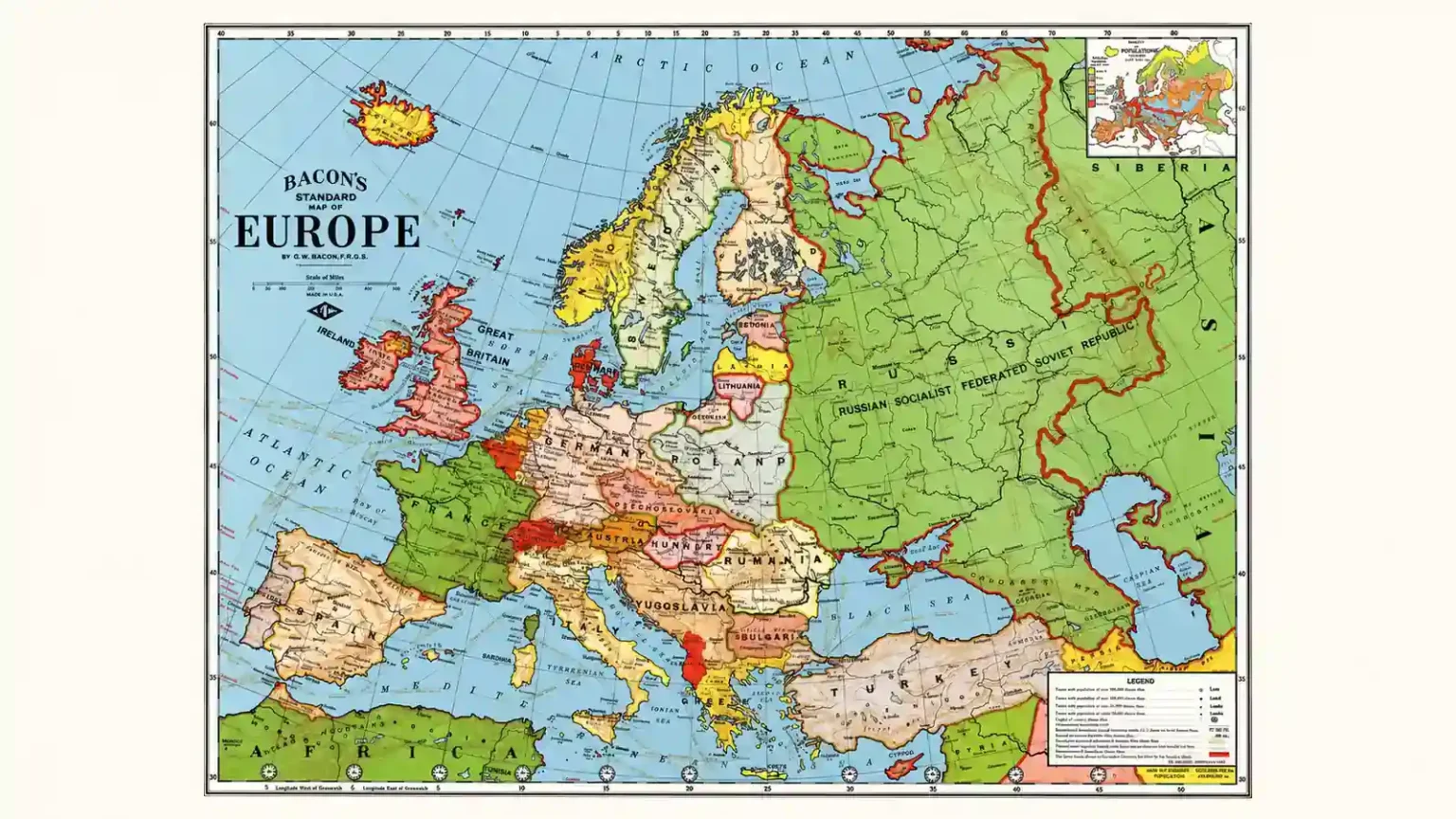
Image credit: George Washington Bacon — Source: Wikimedia Commons / Library of Congress Geography & Map Division — License: Public Domain