Yes—Should You Read Crime and Punishment on Kindle has a clear answer: a publisher-identified modern ebook is the strongest main format for most first-time readers, and Penguin’s Oliver Ready translation is the safest all-purpose choice. Kindle strengthens momentum, name-searching, portability, and adjustable typography; an annotated print edition remains the best companion for notes and passage comparison. The main caution is textual provenance: a cheap file named Crime and Punishment may conceal an older translation, weak navigation, or no editorial apparatus at all.
Best overall format
Modern Kindle or ebook, because search, adjustable type, and constant portability support the novel’s pressure and pace.
Best source inside that format
Penguin’s 2014 Oliver Ready ebook, because publisher metadata identifies the translator, date, and ISBN rather than leaving the English text anonymous.
Best companion format
Norton Critical Edition in print, because Michael R. Katz’s translation comes with notes, documents, a map, and substantial criticism.
Use caution with
Unidentified bargain ebooks, because title, cover, and low price do not establish translation, completeness, notes, or file quality.
Best Overall Format: Should You Read Crime and Punishment on Kindle?
For this particular novel, the ebook is not merely a convenient substitute for print. It fits the work. Dostoevsky’s narrative advances through feverish interior monologue, sudden encounters, interrogations, reversals, and relatively short chapter units. A device that is always nearby helps preserve continuity, while search makes Russian names, patronymics, and earlier conversations easier to recover without building a separate index.
The strongest digital advantages are practical rather than glamorous: adjustable type for a long reading project, instant dictionary access, searchable names and phrases, synchronized highlights, and the ability to read during small intervals that would not justify carrying a substantial paperback. These benefits matter because Crime and Punishment often loses force when read in widely separated bursts. Kindle can keep the reader inside its tightening psychological weather.
Digital reading does weaken spatial memory. A reflowable location is less memorable than a marked page, and comparing a late confession with an earlier theory is slower when both passages live behind menus. Introductions, explanatory notes, maps, and critical documents may also be clumsier in an ebook than in a well-designed print volume. That is why the strongest arrangement is not Kindle alone but Kindle as the main text, with an annotated print or library copy available when the novel demands comparison.
Translation is decisive. The Russian novel, Преступление и наказание, appeared in monthly installments in The Russian Messenger during 1866 and as a separate edition in 1867. Frederick Whishaw produced the first English translation in 1886; Constance Garnett’s 1914 version later became the basis of many public-domain files. Modern translations by David McDuff, Richard Pevear and Larissa Volokhonsky, Oliver Ready, Nicolas Pasternak Slater, and Michael R. Katz do not sound interchangeable. The Kindle listing must therefore identify the translator before the store platform deserves trust. This is why Should You Read Crime and Punishment on Kindle is ultimately a translation question as much as a device question.
Verification warning: do not assume that Amazon’s “Kindle Edition” label identifies the text. Open the product details and confirm the named translator, publisher, publication date, and—where supplied—ISBN or ASIN. An edition with no translator is not a safe first recommendation.
Format verdict: Print is the strongest companion and the best main format for students because stable pagination, visible notes, and quick return to earlier passages support close reading. It is weaker for portability and continuity, especially when the apparatus turns a tense novel into a physically larger study object.

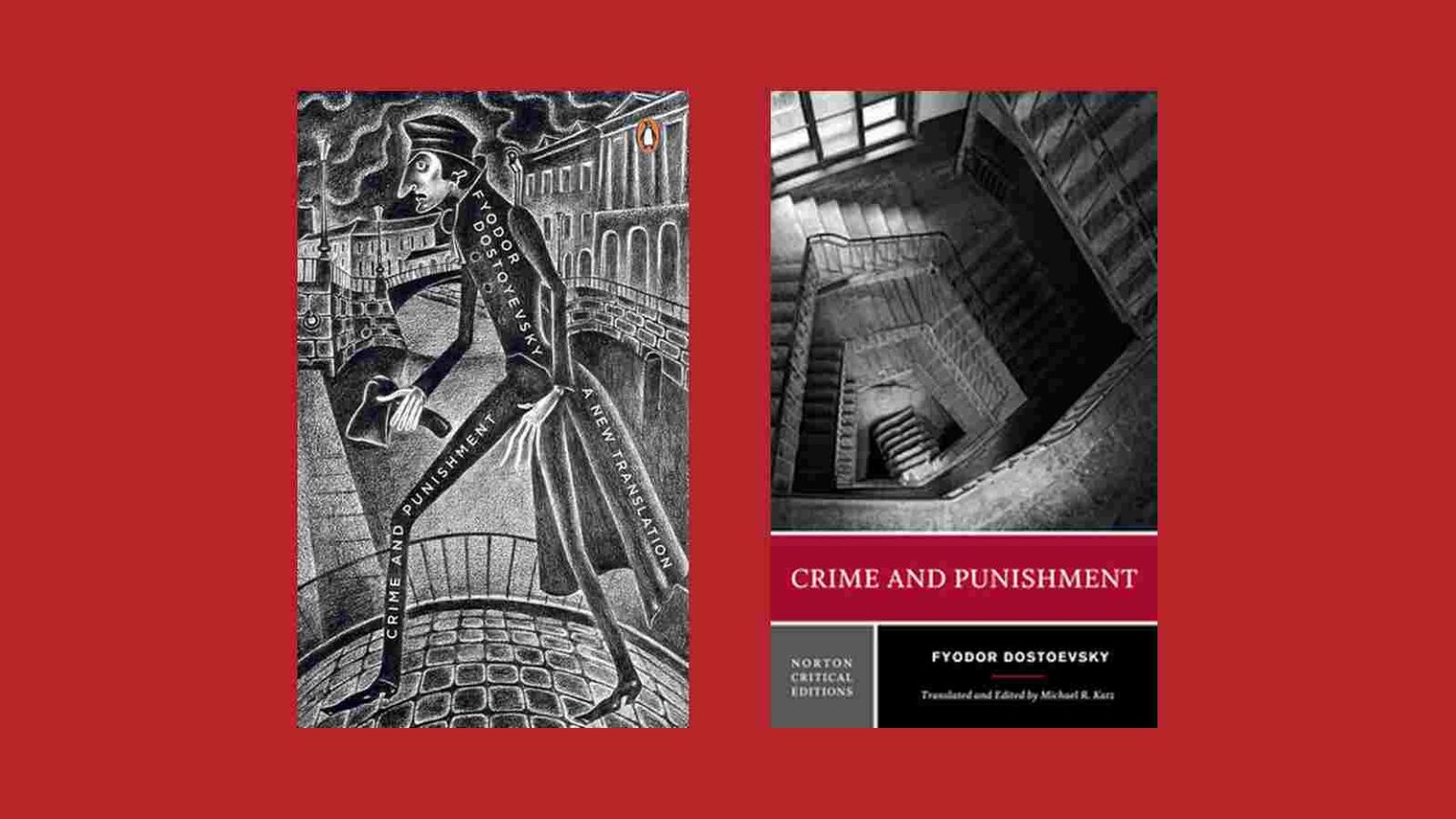
Penguin Classics / Oliver Ready

Norton Critical Edition / Michael R. Katz
Penguin Classics — Oliver Ready
Edition: 2014 paperback, ISBN 9780141192802; translated by Oliver Ready.
Best for: First-time readers who want a modern, vigorous English text without a large research apparatus.
Why this over alternatives: Ready’s version preserves abruptness, comic pressure, and colloquial friction while remaining easy to carry through long sessions. The Penguin volume is a reading edition rather than a classroom anthology, which protects narrative speed.
Main trade-off: Its support material is lighter than Norton or Oxford. Read the introduction after the novel when avoiding interpretive framing matters.
Norton Critical Edition — Michael R. Katz
Edition: 2019 paperback, ISBN 9780393264272; translated and edited by Michael R. Katz.
Best for: Students, teachers, book clubs with a research emphasis, and serious rereaders.
Why this over alternatives: The volume combines detailed explanatory footnotes with a character list, a note on names, a map of St Petersburg, material from Dostoevsky’s notebooks and drafts, and twenty-six critical essays. It turns one purchase into a defensible course base.
Main trade-off: The scholarship interrupts immersion. A reader primarily seeking psychological momentum may find the Penguin volume less cumbersome.
Oxford World’s Classics — Nicolas Pasternak Slater
Edition: Paperback ISBN 9780198709718, published in 2019; translation by Nicolas Pasternak Slater, with editorial material by Sarah J. Young.
Best for: Readers who want a modern translation and substantial orientation without the scale of a critical anthology.
Why this over alternatives: Oxford supplies a translation note, chronology, table of ranks, map, character list, bibliography, and explanatory notes. It is the most balanced middle option between Penguin’s momentum and Norton’s research dossier.
Main trade-off: It offers less critical breadth than Norton and may feel more mediated than Penguin during a first uninterrupted reading.
Best inside this format: Penguin’s Oliver Ready paperback for a first reading, because it gives the strongest balance of modern English, narrative speed, and physical manageability; choose the Norton Critical Edition instead when notes and scholarship are the main task.
Kindle and Ebook
Format verdict: Ebook is the best overall format because its portability, search, adjustable type, and low-friction resumption serve this novel’s sustained psychological pressure. It weakens page memory and note consultation, so the exact file and reading app matter.
Penguin ebook — Oliver Ready
Best for: Most first-time readers and anyone asking Should You Read Crime and Punishment on Kindle as a practical buying question.
Why this over alternatives: Penguin identifies Oliver Ready, the 2014 publication date, and ebook ISBN 9780141956961. The publisher also routes readers to major stores, reducing the risk of buying an anonymous public-domain repackage. The exact UK Kindle listing is ASIN B00HYQBBSI, although territorial storefronts may differ.
Main trade-off: Reflowed notes and introduction navigation depend on the Kindle app or device. The translation is the attraction; the platform does not automatically improve the apparatus.
Michael R. Katz ebooks — Norton and Liveright routes
Best for: Readers who prefer Katz’s contemporary phrasing or need a searchable study text.
Why this over alternatives: Norton identifies a standalone ebook, ISBN 9780393270150, attached to the Critical Edition, while Apple Books identifies the Liveright Katz translation in a general-reading file. These are stronger than unlabeled store copies because the translator and publisher are explicit.
Main trade-off: Norton’s standalone ebook is delivered through VitalSource rather than being a standard Kindle purchase, and the Liveright file does not reproduce the full Norton Critical apparatus. “Katz ebook” therefore describes more than one product.
Kobo and other publisher-linked stores
Best for: Readers outside Amazon’s ecosystem who still want the Oliver Ready text.
Why this over alternatives: Penguin’s edition page links directly to Kobo, Apple Books, Google Play, and other outlets for the same identified ebook. Following the publisher’s route is safer than selecting the first search result with a familiar cover.
Main trade-off: DRM, annotation export, regional availability, and device compatibility vary by store. Textual identity can match while platform behavior does not.
Standard Ebooks — Constance Garnett
Best for: Budget readers who want a polished free EPUB and accept a historically important public-domain translation.
Why this over alternatives: Standard Ebooks transparently names Garnett and improves typography, metadata, navigation, and ebook semantics. It is a produced edition, not merely a text dump.
Main trade-off: Production quality cannot modernize the 1914 translation. A clean file is not the same thing as the best English text for a contemporary beginner.
Best inside this format: the official Penguin Oliver Ready ebook, because it combines a clearly identified modern translation with Kindle’s strongest practical advantages. The answer to Should You Read Crime and Punishment on Kindle becomes “not yet” whenever the listing fails to identify its translator.
Audiobook
Format verdict: Audio is a defensible main format for accessibility-focused listeners and a strong companion for commuters because dialogue and momentum become continuous. It weakens spelling, name recognition, quotation recovery, and comparison between distant passages.
Penguin Audio — Don Warrington, Oliver Ready translation
Best for: Listeners who want the most fully documented modern recording and readers matching audio to Penguin’s Ready ebook or paperback.
Why this over alternatives: Penguin identifies Don Warrington, Oliver Ready, the included introduction, the 2020 publication, ISBN 9780241429525, and a runtime of 1,502 minutes—25 hours and 2 minutes. The shared translation makes switching between text and audio less disorienting.
Main trade-off: Twenty-five hours magnifies any mismatch between listener and narrator. Metadata can prove completeness and textual basis; it cannot prove that a particular voice will suit you.
Blackstone — Anthony Heald, Constance Garnett translation
Best for: Listeners who specifically prefer Heald’s sample or want an established commercial reading of the Garnett text.
Why this over alternatives: Blackstone identifies the narrator, Garnett translation, publisher, and unabridged status. That is much safer than a storefront recording with no textual basis.
Main trade-off: It commits the listener to an older translation. A shorter runtime than Penguin’s does not by itself prove abridgment or superiority because translation and pacing change length.
LibriVox Version 3 — Mark Nelson, Constance Garnett translation
Best for: A free solo reading with visible chapter-level production details.
Why this over alternatives: LibriVox names Mark Nelson as the sole reader, identifies Garnett, lists a 22:02:11 runtime, and exposes every chapter track. Completeness is inspectable rather than merely asserted.
Main trade-off: Volunteer production and a public-domain translation are not equivalent to a current publisher-matched recording. Sample first for audio quality, pronunciation, and pacing.
Listening caution: compare official samples before purchasing. A publisher can verify narrator, translation, runtime, and unabridged status, but metadata cannot settle whether vocal characterization, pace, or tone will remain comfortable for an entire novel.
Best inside this format: Don Warrington’s Penguin Audio recording, because the narrator, Oliver Ready translation, introduction, publication date, ISBN, and full runtime are documented on one authoritative publisher page.
Podcast and Companion Audio
Format verdict: Companion audio is most useful when it clarifies translation and context without dictating the novel’s meaning. Translator conversations can help before reading; full-book lectures are safer afterward because they commonly reveal developments and settle questions the novel wants the reader to endure.
Oxford TORCH — “Translation and Retranslation: priorities, discoveries, pleasures”
Best for: Readers choosing a translation or thinking about why a classic needs retranslation.
Why this over alternatives: The University of Oxford event brings Oliver Ready into a direct discussion of translation and retranslation rather than treating Crime and Punishment as a collection of themes. It supports the edition decision without replacing the act of reading.
Main trade-off: It is not a chapter guide. Its value is methodological and translational, not navigational.
The Norton Library Podcast — “The Quintessential Russian Novel”
Best for: Readers considering the Katz translation who want the translator’s account of Dostoevsky’s moral questions and repetitive style.
Why this over alternatives: This exact 31-minute-59-second episode pairs a publisher-affiliated literary podcast with Michael R. Katz and stays close to biography, morality, and the practical challenge of translating Dostoevsky’s repetitions. It is more specifically documented than a generic literary discussion.
Main trade-off: The conversation is connected to Norton’s own edition, so it is best treated as a translator’s perspective rather than a neutral comparison of all English versions.
Best inside this format: Oxford’s “Translation and Retranslation” conversation, because it gives the reader institutional context and direct access to Oliver Ready’s thinking without pretending to be a substitute audiobook or a definitive interpretation.
Free, Public-Domain, and Library Sources
Format verdict: Free sources are excellent for sampling, backup access, quotation search, and budget reading because the Garnett translation is legally available in the United States. Their compromise is usually not missing chapters but older English, limited notes, and jurisdiction-dependent copyright status.
Standard Ebooks
Best for: The cleanest free ordinary-reading file.
Why this over alternatives: It takes the Garnett text and gives it deliberate typography, metadata, chapter navigation, modern semantics, and device-ready downloads. For sustained free reading, that production work is materially better than a basic transcription.
Main trade-off: The underlying translation remains Garnett’s 1914 English and has no modern critical apparatus.
Project Gutenberg
Best for: Plain text, fast search, broad compatibility, and no-account backup access.
Why this over alternatives: Ebook 2554 identifies Constance Garnett and offers EPUB, Kindle transfer, HTML, and plain-text formats. The record also states public-domain status in the United States.
Main trade-off: Its presentation is functional rather than editorially refined. Use Standard Ebooks for long screen reading.
Internet Archive historical scan
Best for: Inspecting a paginated historical copy or comparing a scan with a transcription.
Why this over alternatives: Page images preserve pagination, typography, and physical sequence that reflowable files discard.
Main trade-off: Scans are slower on phones, OCR can be unreliable, and item metadata should be checked against the scanned title page. This is a reference object, not the best first-reading interface.
WorldCat and local-library discovery
Best for: Finding a modern Katz print edition through a public or university library.
Why this over alternatives: The exact WorldCat record identifies Katz, the 2019 paperback edition, and Liveright/W. W. Norton. Searching from that record is more precise than asking for any copy with the same title.
Main trade-off: A catalogue record proves the edition exists, not that a particular library owns it. Holdings, loan periods, ebook platforms, and waiting lists remain local.
Copyright status is jurisdiction-specific. Project Gutenberg’s record states that its file is public domain in the United States; readers elsewhere should apply the law of the country in which they download. Library borrowing is usually the strongest low-cost route to a modern translation because it separates access cost from textual age.
Best inside this format: Standard Ebooks, because it offers the most carefully produced free Garnett file; for a modern translation, WorldCat and a local library are stronger because they can lead to Katz, Ready, or Slater without requiring purchase.
Critical, Student, and Collector Options
Format verdict: Specialized editions should be chosen by task because critical apparatus, classroom orientation, and collector design solve different problems. The most expensive or decorative volume is not automatically the most reliable text.
Norton Critical Edition
Best for: Formal study, teaching, research-led rereading, and assignments that require contexts and criticism.
Why this over alternatives: Katz’s translation is surrounded by explanatory footnotes, a map, documentary material, twenty-six essays, chronology, and bibliography. No other practical one-volume option in this comparison supplies the same research package.
Main trade-off: It encourages consultation rather than immersion. That is an advantage in a seminar and a distraction during a fast first reading.
Oxford World’s Classics
Best for: Students and book groups wanting guidance without a full anthology of criticism.
Why this over alternatives: Slater’s translation and Young’s editorial material form a coherent teaching edition, with enough support to explain ranks, names, places, and cultural references while keeping the novel central.
Main trade-off: Its apparatus is selective. Advanced research still requires criticism beyond the volume.
Penguin Clothbound Classics — David McDuff
Best for: Gifts, collectors, and readers who specifically want McDuff’s translation in a designed hardcover.
Why this over alternatives: Penguin identifies David McDuff as translator, introducer, and annotator; the 2018 edition, ISBN 9780241347683, uses Coralie Bickford-Smith’s clothbound series design. Its value is material and visual as well as textual.
Main trade-off: Premium presentation adds ownership pleasure, not a fuller critical apparatus. Buy it because you want McDuff and the object, not because cloth automatically means scholarly superiority.
Best inside this format: the Norton Critical Edition for serious study, because its apparatus is unmatched here; Oxford World’s Classics for guided classroom reading, because it supports without overwhelming; and Penguin Clothbound for collecting, because its translation and design authorship are explicitly documented.
Final Recommendation
The final answer to Should You Read Crime and Punishment on Kindle is yes—provided the file names its translator. Penguin’s Oliver Ready ebook is the strongest main choice because it preserves modern verbal energy while giving the reader the search, type control, and portability that keep a psychologically intense novel in motion. The Norton Critical Edition is the strongest companion because it restores stable navigation and supplies the contextual material Kindle handles less gracefully.
First-time reader
Choose the Penguin Oliver Ready Kindle edition because its modern prose and searchable format reduce friction without burying the story under notes.
Student
Choose the Norton Critical Edition in print because assignments require footnotes, documents, criticism, chronology, and stable quotation pages.
Serious rereader
Choose a second modern translation—Katz or Slater—because comparison between English versions reveals more than repeating the identical file on another device.
Casual reader
Choose Ready on Kindle because the format is most likely to keep the novel available during commutes, evenings, and short reading windows.
Commuter or listener
Choose Don Warrington’s Penguin recording with the matched Ready ebook because switching formats will not change names, syntax, or translation rhythm.
Budget reader
Choose Standard Ebooks because its free Garnett EPUB is better produced than a generic transcription; borrow a modern translation when the library has one.
Collector
Choose Penguin Clothbound in the McDuff translation because its value lies in a documented designed object, not in pretending decoration replaces scholarship.
Accessibility-focused reader
Choose Kindle for scalable type and screen-reader compatibility, or Penguin Audio as the main format, because access needs legitimately reverse the normal print-companion hierarchy.
FAQ
Should You Read Crime and Punishment on Kindle?
Yes, because search, adjustable type, portability, and fast resumption suit the novel’s pace. Choose a publisher-backed file that identifies Oliver Ready, Michael R. Katz, David McDuff, or another named translator; avoid anonymous bargain editions.
Which Kindle translation is best for a beginner?
Oliver Ready’s Penguin ebook is the safest general recommendation because its English is contemporary, the publisher record is precise, and the same translation is available in print and in Don Warrington’s audiobook.
Is print better than Kindle for this novel?
Print is better for annotation, page memory, notes, maps, and comparing distant passages. Kindle is better for continuity, search, scalable text, and portability. For most general readers, Kindle should lead and annotated print should support it.
Can the audiobook replace the text?
It can for accessibility or strong listening habits because the novel contains urgent speech and dramatic confrontation. A searchable text remains useful for names, quotations, and earlier arguments that are hard to recover by scrubbing through audio.
Is the free public-domain version complete?
The identified Project Gutenberg and Standard Ebooks files present the complete Garnett translation. The caution is translation age and editorial support, not a known abridgment. Copyright availability outside the United States depends on local law.
Which edition has the best notes?
The Norton Critical Edition has the strongest combined apparatus because it includes explanatory footnotes, names, a map, documentary materials, twenty-six essays, chronology, and bibliography. Oxford is the lighter guided alternative.
Can I combine Kindle and audiobook?
Yes, but match the translation. Penguin’s Oliver Ready ebook and Don Warrington recording are the cleanest pairing because the wording remains consistent. Store synchronization features and regional availability should be verified on the exact listings before purchase.
Related BookInLight Reading Guides
The Karamazov Choice: Why Print Should Lead and Audio Should Follow — a useful contrast because Dostoevsky’s longer final novel places a heavier premium on fixed-page navigation.
Best Format for Reading Anna Karenina — compares print, digital, and audio choices for another major Russian novel with substantial translation questions.
Best Books on Dostoevsky Political Theology — extends the novel’s moral and political questions into serious secondary reading.
Penguin Classics: A Complete Guide to the Series — explains the editorial identity of the series behind the recommended Oliver Ready editions.
Professional editorial note. This article was prepared through BookInLight’s Literature and Intellectual History editorial desk. Bibliographic review, source verification, translation and edition comparison, recording-metadata review, link checking, and factual line-editing were conducted against publisher, university, repository, audiobook, and library-catalogue records available on 28 July 2026. We welcome factual corrections, overlooked editions, updated regional availability, interpretive suggestions, and constructive reader feedback.
The BookInLight Art Department is credited for editorial art direction, visual composition, source-strip design, cover selection, and image presentation. Individual covers and provider marks remain the property of their respective publishers, designers, artists, platforms, companies, and rights holders. Complete republication, reproduction, translation, or reuse of this article requires prior written authorization from BookInLight.
Sources and Further Reading
University of Toronto Libraries, “Crime and Punishment at 150: Translations” — supports the 1866 serialization and the history of English translations.
University College London SSEES, “First editions” — supports the first English translation by Frederick Whishaw in 1886.
Penguin, Oliver Ready paperback edition — supports translator, publication date, ISBN, pagination, dimensions, and format.
W. W. Norton, Norton Critical Edition — supports Katz’s role, paperback and ebook ISBNs, pagination, and critical apparatus.
Oxford University Press, Oxford World’s Classics edition — supports Slater’s translation, Young’s editorial material, date, ISBN, map, notes, and contents.
Penguin Random House, Penguin Clothbound Classics edition — supports McDuff’s role, 2018 date, ISBN, and Coralie Bickford-Smith cover design.
Penguin, Oliver Ready ebook edition — supports translator, 2014 date, ISBN, and official store routes.
Standard Ebooks, Constance Garnett edition — supports the free edition’s textual basis and ebook production.
Project Gutenberg, ebook 2554 — supports translator, formats, update date, and United States public-domain status.
Internet Archive, historical scanned edition — supports the scan-based reference option.
Penguin Audio, Don Warrington recording — supports narrator, Ready translation, introduction, date, ISBN, and 1,502-minute runtime.
Blackstone Publishing, Anthony Heald recording — supports narrator, Garnett translation, publisher, and unabridged status.
LibriVox, Version 3 read by Mark Nelson — supports translator, reader, runtime, date, and chapter-level completeness.
University of Oxford Podcasts, “Translation and Retranslation: priorities, discoveries, pleasures” — supports the translator-focused companion-audio recommendation.
The Norton Library Podcast, “The Quintessential Russian Novel (Crime and Punishment, Part 1)” — supports the Michael R. Katz companion-audio comparison, episode date, runtime, and scope.
WorldCat, Michael R. Katz / Liveright record — supports the exact library-discovery route for the 2019 paperback.
Apple Books, Michael R. Katz ebook listing — supports the existence of a modern general-reading digital alternative outside the Norton Critical file.
Image Credits
Cover — opening Print comparison row: Crime and Punishment, Penguin Classics 2014 paperback, translated by Oliver Ready. Publisher/rightsholder: Penguin Books. Source: official Penguin edition page.
Cover — detailed Print profile: Crime and Punishment, Penguin Classics 2014 paperback, translated by Oliver Ready. Publisher/rightsholder: Penguin Books. Source: official Penguin edition page.
Cover — opening Print comparison row: Crime and Punishment, 2019 Norton Critical Edition, translated and edited by Michael R. Katz. Publisher/rightsholder: W. W. Norton. Source: official Norton edition page.
Cover — detailed Print profile: Crime and Punishment, 2019 Norton Critical Edition, translated and edited by Michael R. Katz. Publisher/rightsholder: W. W. Norton. Source: official Norton edition page.