Before Democracy in America, understand the democratic experiment Tocqueville saw, the two-volume publication history, and his comparative method.
The practical preparation is short: learn the political problem Tocqueville carried from post-revolutionary France, understand the architecture of American federalism, know why New England Puritan settlements matter to his story, and keep the distinction between equality and liberty in view. Then begin Democracy in America. A large preparatory syllabus can actually make the book harder, because Tocqueville’s method depends on seeing how institutions, habits, religion, associations, local government, social equality, and national character work together. The reader needs coordinates, not a substitute book.
First, understand the French political context
The first coordinate is France. Tocqueville visited the United States in 1831–32, but the political question he carried with him was formed by the Revolution, Napoleon, the Bourbon Restoration, and the July Monarchy. He did not cross the Atlantic merely to inventory a new republic. He wanted to understand the democratic social condition that he believed was advancing across the modern world. The introduction to the Cambridge Companion to Democracy in America is useful here because it emphasizes both sources and contexts rather than treating the book as detached political theory. A chapter on Tocqueville’s dialogues and the Restoration setting likewise helps recover the French conversations behind his American observations.
This produces the first productive contrast: democracy is not simply a constitutional form for Tocqueville. It is also a social condition marked above all by increasing equality of conditions. That equality can coexist with freedom, but it can also generate conformity, centralization, individualism, envy, or a preference for administrative tutelage. Tocqueville’s question is therefore not ‘Is democracy good?’ It is closer to ‘What kinds of institutions and habits allow an egalitarian society to remain politically free?’ Readers who enter with a simple opposition between democracy and aristocracy miss the internal tensions that organize the work.
Second, compare Montesquieu and Tocqueville
The second coordinate is Montesquieu and the Enlightenment tradition of comparing laws, mores, geography, and forms of government. The Cambridge chapter on Tocqueville and the philosophy of the Enlightenment shows that his relation to eighteenth-century thought is neither straightforward inheritance nor rejection. He borrows the habit of comparative explanation while distrusting theories that ignore historical texture. This is why a constitutional provision rarely explains itself in his pages. Laws work through mores; mores are reinforced by religion, family, local practice, economic expectations, and inherited habits.
Third, grasp federalism and local government
The third coordinate is federalism. Before Tocqueville’s chapters on American institutions, know the elementary division among states, the federal government, counties, towns, courts, and elected offices. Do not begin with a technical constitutional-law treatise. A clear map of the federal structure is enough. The Cambridge discussion of Tocqueville on the federal Constitution helps because it treats federalism as an intellectual problem rather than a diagram to memorize. Tocqueville repeatedly asks what political participation teaches citizens. Local government matters not only because it decentralizes power but because it trains people to act together.
That claim should be tested rather than admired. BookInLight’s political philosophy route for serious beginners introduces legitimacy, sovereignty, liberty, and democracy in a broader sequence; Tocqueville adds a different pressure. Formal rights may exist on paper while citizens lose the habits required to use them. Conversely, local participation can generate competence without guaranteeing justice. The comparison to keep in mind is therefore institution versus practice: what a constitution permits and what a political culture actually teaches people to do.
Fourth, read the account of religion closely
The fourth coordinate is religion, especially Tocqueville’s account of Puritan New England. The relevant Cambridge chapter on Tocqueville’s Puritans helps separate his constructed historical argument from a generic story about American religiosity. He sees an unusual conjunction in which religious discipline and political participation can coexist. Yet the reader should not convert that observation into an uncritical national origin myth. Tocqueville selects New England because it serves his explanation of democratic mores; other regions, Indigenous dispossession, slavery, and racial hierarchy complicate any claim that one settlement pattern represents ‘America.’
Fifth, examine slavery and Indigenous dispossession
This leads to the most important counterexample inside the book itself: racial domination. Tocqueville’s chapters on Native Americans and slavery are not detachable appendices to a celebration of equality. They expose the limit of a democratic social theory if equality is described only among recognized white citizens. Read these chapters with the same seriousness as the discussions of townships and associations. They force the concept of equality to confront exclusion, conquest, law, and inherited status.
Choose a translation and keep the central question open
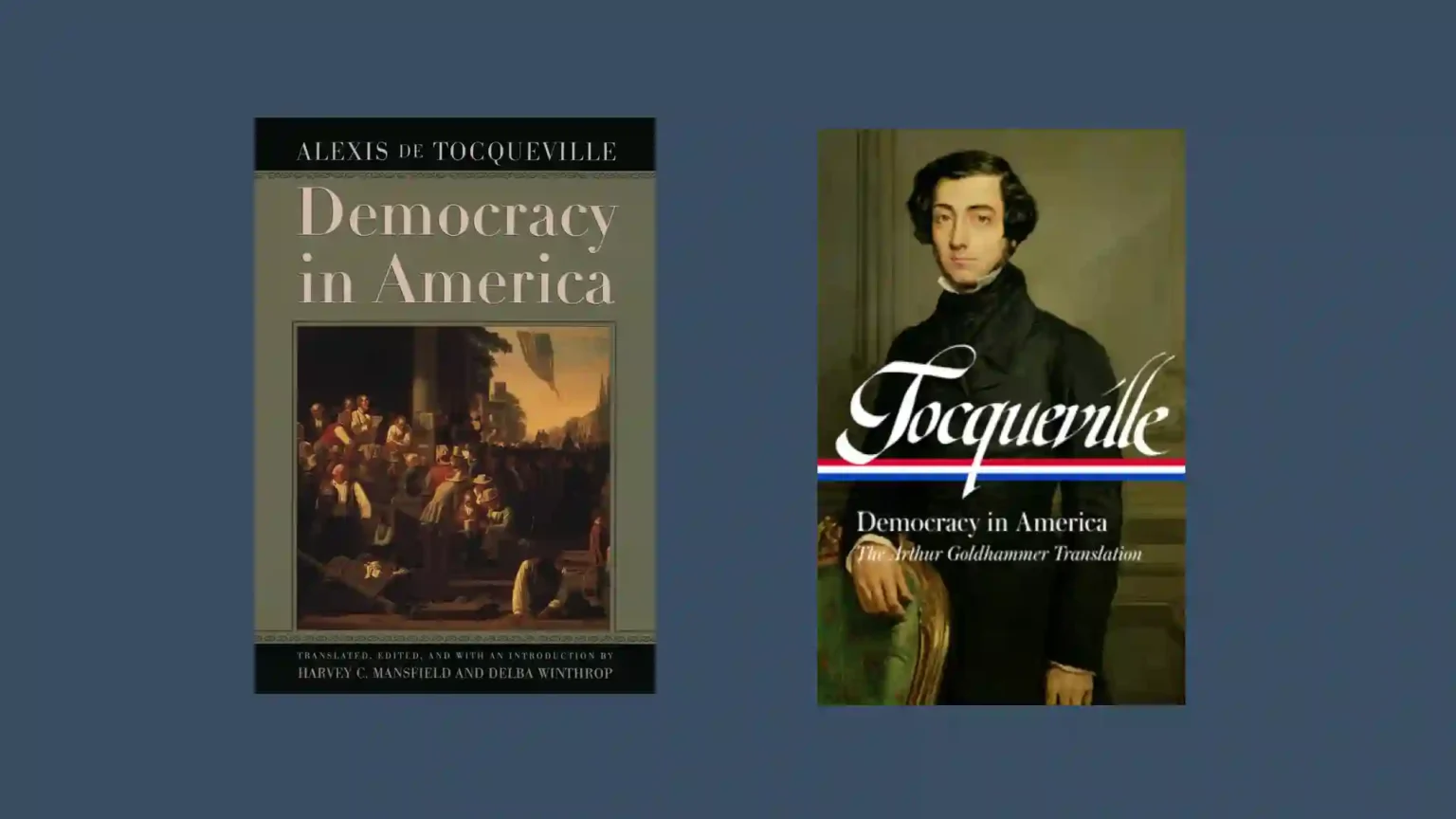
Edition choice can make this preparation easier. The Harvey Mansfield and Delba Winthrop University of Chicago translation offers extensive editorial guidance; the Library of America volume presents Arthur Goldhammer’s translation in a durable reading edition. For historical comparison, the Library of Congress record of Henry Reeve’s nineteenth-century translation is useful evidence of how quickly the book entered Anglophone political discussion. The point is not to find one translation immune to interpretation. It is to know which English voice is mediating Tocqueville’s long, balanced, often deliberately qualified sentences.
A final comparison should stay unresolved while reading: is Tocqueville describing America, using America to diagnose France, or building a general theory of democratic modernity? The answer changes from chapter to chapter. The Cambridge Companion volume and its chapter on twenty-first-century challenges to Democracy in America are useful precisely because they do not force one answer. Tocqueville’s American claims can be historically specific and theoretically ambitious at the same time.
So prepare by learning five distinctions rather than five hundred facts: democracy as social equality versus democracy as constitutional rule; liberty versus equality; laws versus mores; central administration versus local participation; and description of the United States versus diagnosis of democratic modernity. Once these contrasts are visible, the book can do its own work. Read the first volume with a map of institutions nearby, the second with special attention to individualism, associations, public opinion, material well-being, and soft despotism. If a chapter seems to praise America too easily, look for the French comparison underneath it. If it seems to condemn democracy too easily, look for the institutional remedy Tocqueville is testing. Preparation should leave that tension alive.
Cover artwork: credits and source records
- Democracy in America — University of Chicago Press (source record)
- Democracy in America — Library of America (source record)