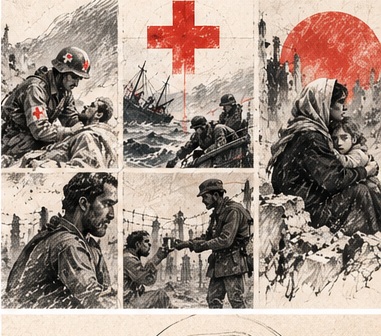
People often ask whether “the Geneva Convention” bans a particular weapon or makes a particular tactic illegal. The question usually contains two mistakes. First, there are four Geneva Conventions of 1949, not one. Second, their central architecture is protective: they establish rules for people who are wounded, sick, shipwrecked, captured, detained or civilian — people who are not, or are no longer, taking part in hostilities.
Rules about means and methods of warfare also belong to international humanitarian law, but they are spread across other treaties, customary law and the Additional Protocols. The cleanest way to understand the 1949 Conventions themselves is to ask one question four times: whom does each treaty protect? For book-length study of the treaty system and its interpretation, BookInLight’s Geneva Conventions reading list is the companion reading route.
The four treaties at a glance
| Convention | Core protected group |
|---|---|
| Geneva Convention I | Wounded and sick members of armed forces in the field, along with medical and religious personnel, units and transports. |
| Geneva Convention II | Wounded, sick and shipwrecked members of armed forces at sea, adapting the land protections to maritime warfare. |
| Geneva Convention III | Prisoners of war: status, humane treatment, captivity, labor, discipline, judicial proceedings, communication and repatriation. |
| Geneva Convention IV | Civilian persons in time of war, especially in the hands of a party to the conflict or occupying power of which they are not nationals. |
The ICRC notes that the four conventions were adopted on 12 August 1949 in the aftermath of the Second World War and have achieved universal ratification. Their scope reflects a century of attempts to turn battlefield mercy into legal obligation, then to extend that obligation to categories of people whose vulnerability had been exposed with particular brutality. For authoritative commentary beyond the summary here, see ICRC Cross-Files — 1949 Diplomatic Conference.
MEMORY RULE: I = wounded and sick on land. II = wounded, sick and shipwrecked at sea. III = prisoners of war. IV = civilians.
Treaty by treaty: who each convention places under protection
Convention I: the wounded and sick on land
The First Convention develops the oldest Geneva tradition. Its 64 articles protect wounded and sick members of armed forces in the field and regulate the status of medical and religious personnel, medical units, transports and protective emblems. The underlying rule is simple but operationally demanding: the wounded and sick must be respected and cared for without adverse distinction grounded in considerations the law does not permit.
This treaty is also why the red cross and related emblems are not merely humanitarian branding. They are part of a legal protective system. Misuse matters because the emblem has to communicate protected status in environments where hesitation can kill.
Convention II: the same protective logic at sea
The Second Convention extends and adapts the first treaty’s logic to naval warfare. Shipwreck creates a distinctive vulnerability: a combatant can move from active participation to helplessness in minutes. The treaty therefore addresses the wounded, sick and shipwrecked at sea, hospital ships and maritime medical protection.
The conceptual point is easy to miss. International humanitarian law does not treat a person as an enemy without limit. Status changes. A person who is hors de combat — out of the fight through wounds, sickness, shipwreck, capture or another protected condition — enters a different legal relationship to the adversary.
Convention III: captivity is regulated, not lawless
The Third Convention is the prisoner-of-war treaty. It regulates capture and captivity in considerable detail: humane treatment, accommodation, food, medical care, labor, discipline, correspondence, judicial proceedings, release and repatriation. The central achievement is to make captivity a legal status rather than a discretionary space.
That status carries both protections and rules. A prisoner of war is not a criminal merely because he or she fought for the opposing armed force. Questions of individual criminal responsibility are separate from POW status. The convention exists precisely to prevent the captor from treating enemy personnel as though their vulnerability erased legal constraint.
Convention IV: civilians enter the center of treaty protection
The Fourth Convention was historically transformative because it addressed civilian protection in a comprehensive treaty devoted to persons in enemy hands and under occupation. The Second World War had demonstrated with catastrophic clarity that a law focused mainly on combatants and wounded soldiers was insufficient.
Occupation law is especially important here. An occupying power acquires control without acquiring unlimited sovereignty. The convention regulates treatment, security measures, internment, relief, protected persons and aspects of occupied territory. It is one of the clearest examples of the broader logic of humanitarian law: power over a person creates duties, not a legal vacuum.
Common Article 3 is a boundary marker, not a fifth Geneva Convention
The same Article 3 appears in all four Conventions. It establishes a minimum humanitarian floor for non-international armed conflicts and requires humane treatment of persons taking no active part in hostilities, including those who have laid down their arms or are hors de combat. Its presence is crucial, but it should not be mistaken for a fifth protected-person treaty. A dedicated Common Article 3 guide is the better place for its threshold, prohibitions and judicial guarantees in detail.
Three questions the four treaties do not answer by themselves
1. Was the resort to force lawful? That is principally a jus ad bellum question governed by the UN Charter and related international law, not by the four Geneva Conventions.
2. Was a particular attack, weapon or tactic lawful? The conduct of hostilities is governed by a wider body of IHL, including customary law, the Hague tradition, Additional Protocols and specialized treaties. The Geneva Conventions are indispensable, but they are not a complete code of targeting and weapons law.
3. What minimum treaty rules apply in a non-international armed conflict? Common Article 3 supplies the baseline, with Additional Protocol II applying in the circumstances defined by that treaty and customary IHL supplying further rules.
Why the protected-person map matters
The four-treaty map prevents several common category errors. It separates protection of persons from the legality of starting a war; it separates captivity and civilian protection from the detailed rules governing attacks; and it shows why status can change the legal relationship between adversaries. Once a combatant is hors de combat through wounds, shipwreck or capture, the applicable protection rules matter precisely because prior enemy status does not by itself make that person a lawful target.
A quick reference before you leave the page
Think in persons, not slogans: wounded and sick on land; wounded, sick and shipwrecked at sea; prisoners of war; civilians. Then add Common Article 3 as the minimum treaty floor for non-international armed conflict. From there, move outward to the separate questions of Hague law, conduct of hostilities, Additional Protocols, customary IHL and jus ad bellum. The page’s job is deliberately narrow: to show what each of the four 1949 treaties is principally built to protect.
Where treaty text meets interpretation
For legal questions, treaty language is the starting point rather than the end of the analysis. First, Oxford — The 1949 Geneva Conventions: A Commentary provides a more specialized scholarly treatment and makes the interpretive stakes visible. Second, ICRC — Treaties and customary law supplies authoritative legal text or institutional interpretation. Finally, ICRC IHL Database — First Geneva Convention supplies authoritative legal text or institutional interpretation. Reading these materials together helps separate black-letter rule, authoritative commentary, and the harder question of how the rule is interpreted or applied in practice.
That source hierarchy also disciplines the conclusion. The article keeps treaty text, institutional commentary, judicial or customary development, and the page’s own synthesis distinct. Where legal authorities or commentators differ about scope or application, the disagreement is reported rather than hidden behind a simplified rule.
Continue with law and war
Treaties and official guidance
ICRC — Treaties and customary law — Official overview of the four 1949 Conventions, their protected categories, Additional Protocols and customary IHL.
ICRC IHL Database — First Geneva Convention — Treaty text, states parties and commentary.
ICRC Cross-Files — 1949 Diplomatic Conference — Drafting history and links to all four convention texts and commentaries.
ICRC Commentary — First Geneva Convention introduction — Historical context, drafting process and interpretation.
ICRC — Common Article 3 resources — Official treaty text and commentary access point.