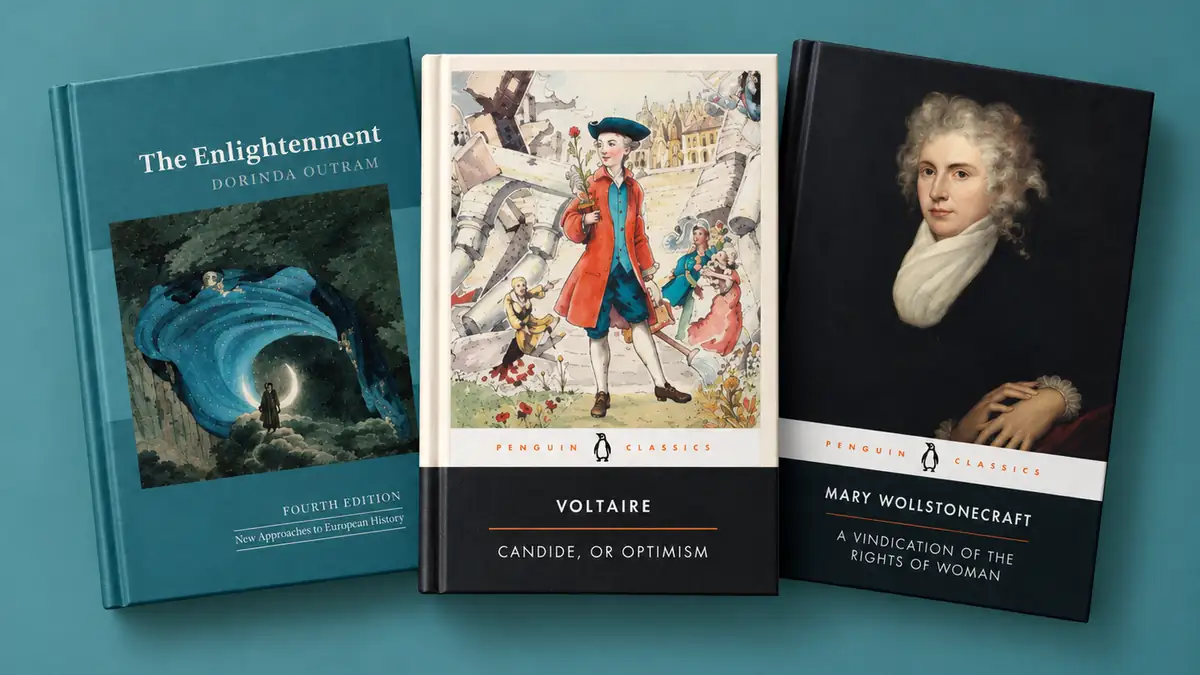
Best Books on the Enlightenment begin with Dorinda Outram’s historical map, move through the most useful primary voices and tensions, and end with Ritchie Robertson’s synthesis once the arguments are recognizable.
Introduction
The Enlightenment was not one doctrine. French, Scottish and German projects overlapped without becoming identical, as the Stanford Encyclopedia of Philosophy overview shows. This sequence therefore alternates context with primary texts.
The shortest honest answer
Start with Outram; then read satire, public reason, skepticism, rights, civic freedom and feminist critique before returning to a large modern synthesis.
Before you start: how to approach the Best Books on the Enlightenment
Do not read the period as reason defeating superstition. Track authority, evidence, religion, empire, education and political membership—and notice where universal claims stop.
The best first book on the Enlightenment
Start with: The Enlightenment by Dorinda Outram
Outram works as a map, not a substitute for primary texts. Read it quickly, keep it nearby, then go straight to Voltaire.
The core reading sequence

Book 1
The Enlightenment by Dorinda Outram
Edition shown: Cambridge University Press / fourth edition / paperback / 2019 / ISBN 9781108440776
Place in the sequence: Orientation before argument.
Outram gives beginners what individual philosophers cannot: scale. Her survey treats the Enlightenment as social, political and intellectual history, and Cambridge’s description of the fourth edition explicitly stresses its global reach. That matters because salons, print, colonial encounters, political economy and religious conflict change what “ideas” mean. Do not memorize names on the first pass. Instead, notice the recurring problems: who may reason publicly, what counts as evidence, how commercial society alters morals, and where universal claims stop. The book’s virtue is proportion; its limitation is compression. It will not replace primary texts, and it should not. Read the whole volume before proceeding, then return to relevant chapters as the sequence becomes more contentious.
Difficulty: Beginner
“Provides a clear, updated overview which will appeal to students of philosophy as well as to historians”
— Cambridge University Press • Cambridge Aspire

Book 2
Candide, or Optimism by Voltaire
Edition shown: Penguin Classics / translated and edited by Theo Cuffe / introduction by Michael Wood / paperback / 2006 / ISBN 9780140455106
Place in the sequence: The quickest encounter with Enlightenment irony.
After a survey, encounter the movement as literature rather than doctrine. Candide tests metaphysical optimism against war, earthquake, religious persecution, exploitation and sheer contingency. The Stanford Encyclopedia of Philosophy account of Voltaire helps place the satire inside his broader campaign against dogmatism. Read the novella whole; it is short, and its rhythm matters. Do not flatten the final garden into a cheerful slogan about hard work. The more useful question is what remains after systems promising providential explanation have failed. Theo Cuffe’s translation is lively without making Voltaire sound contemporary in the wrong way. This book comes early because it gives the reader an emotional and rhetorical feel for Enlightenment criticism before the more abstract vocabulary of autonomy, causation and sovereignty arrives.
Difficulty: Beginner
“contained in the text is a serious attack on Leibnizian philosophy”
— J.B. Shank • Stanford Encyclopedia of Philosophy

Book 3
An Answer to the Question: ‘What is Enlightenment?’ by Immanuel Kant
Edition shown: Penguin Great Ideas / paperback / 2009 / ISBN 9780141043883
Place in the sequence: The movement names its own problem.
Kant’s 1784 essay is famous for the injunction to dare to know, but its sharper issue is institutional: when may a person reason publicly while still occupying an office governed by rules? The SEP discussion of Kantian reason is useful because it keeps reason tied to politics rather than turning the essay into self-help about independent thinking. Read the title essay twice. On the second pass, mark every distinction between private and public uses of reason, obedience and criticism, enlightenment and an “enlightened age.” The Penguin volume supplies related shorter writings, but beginners need not master all of them now. Kant belongs here because Outram and Voltaire have already supplied a world in which the abstraction—maturity—has concrete institutions behind it.
Difficulty: Moderate
“Anyone concerned with Kantian reason and politics must consider his famous essay”
— Garrath Williams • Stanford Encyclopedia of Philosophy

Book 4
An Enquiry Concerning Human Understanding by David Hume
Edition shown: Oxford World’s Classics / edited by Peter Millican / paperback / 2008 / ISBN 9780199549900
Place in the sequence: A limit placed inside the age of reason.
Hume makes the sequence more honest. Enlightenment confidence in inquiry did not mean confidence that reason could prove everything. His Enquiry asks what impressions ground ideas, why causal inference outruns logical demonstration, and what habits sustain ordinary knowledge. The SEP entry on Hume supplies conceptual orientation without dissolving the puzzles. Peter Millican’s Oxford edition is especially good for beginners because its introduction, notes and glossary explain the philosophical background while preserving Hume’s 1777 text. Prioritize Sections II–VII and XII on a first pass; add the sections on miracles and providence when following the religion path. Hume should precede political theory here because he trains the reader to ask what kind of claim is actually being made before evaluating its moral appeal.
Difficulty: Moderate
“Hume’s Enquiry is one of the most important philosophical works addressing central questions of human life and knowledge”
— Oxford University Press • OUP Japan

Book 5
Two Treatises of Government by John Locke
Edition shown: Cambridge Texts in the History of Political Thought / edited by Peter Laslett / paperback / 1988 / ISBN 9780521357302
Place in the sequence: Political vocabulary that later Enlightenment debates inherit and contest.
Locke predates the mature eighteenth-century Enlightenment, which is exactly why he belongs here rather than at the beginning. By now the reader can see natural freedom, equality, property, consent and resistance as arguments with contexts, not timeless slogans. The SEP account of Locke’s political philosophy is a reliable guide to the interpretive disputes. For a beginner, the Second Treatise is essential; the First Treatise can be sampled unless biblical patriarchalism is part of your research question. Laslett’s Cambridge edition remains valuable because its editorial apparatus restores historical and textual context. Pay special attention to the transition from the state of nature to political society, and to the uneasy relationship between property and equality. Locke becomes more illuminating when Rousseau follows immediately after him.
Difficulty: Demanding
“In the Two Treatises of Government, he defended the claim that men are by nature free and equal”
— Alex Tuckness and Tim Stanton • Stanford Encyclopedia of Philosophy

Book 6
The Social Contract and Other Later Political Writings by Jean-Jacques Rousseau
Edition shown: Cambridge Texts in the History of Political Thought / second edition / edited and translated by Victor Gourevitch / paperback / 2018 / ISBN 9781316605448
Place in the sequence: The complication of liberal freedom.
Rousseau asks a harder question than whether government has consent: what form of association could make obedience compatible with freedom? The SEP overview of Rousseau is especially helpful on freedom, inequality and the general will. Read Books I and II of The Social Contract slowly, then continue through the whole work if political theory is your main path. Gourevitch’s translation and notes are worth choosing because Rousseau’s terms—especially sovereignty, law and general will—are easily domesticated into modern vocabulary. The book comes after Locke so that the contrast is visible: Rousseau is not merely another advocate of “rights.” He is asking how social dependence reshapes the self and whether citizens can collectively author the laws they obey. That tension also prepares the ground for Wollstonecraft’s challenge to supposedly universal education and citizenship.
Difficulty: Demanding
“In The Social Contract, Rousseau sets out to answer what he takes to be the fundamental question of politics”
— Christopher Bertram • Stanford Encyclopedia of Philosophy
Book 7
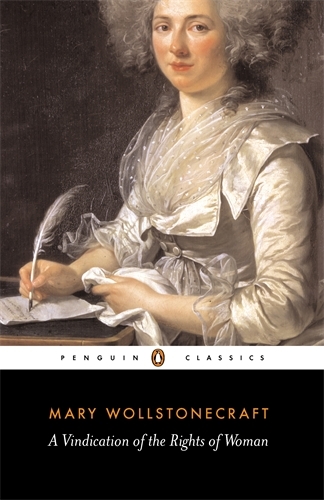
A Vindication of the Rights of Woman by Mary Wollstonecraft
Edition shown: Penguin Classics / edited with introduction by Miriam Brody / paperback / 2004 / ISBN 9780141441252
Place in the sequence: The test of Enlightenment universality.
Wollstonecraft is not an appendix to a male canon; she tests its claims. If reason and moral improvement belong to human beings as such, why should women be educated for ornamental dependence? The SEP entry on Wollstonecraft shows how her work exceeds a single contribution to feminism, while the Penguin edition’s Miriam Brody introduction situates the polemical setting. Read the dedication, introduction and central chapters on education and virtue closely; do not rush passages where Wollstonecraft argues with Rousseau’s account of women. That dialogue is why she follows him in this sequence. Her rhetoric can be severe, and some claims about class and virtue remain historically bounded. Precisely for that reason, the book teaches a crucial method: evaluate the Enlightenment not only by its principles, but by whom those principles were prepared to include.
Difficulty: Moderate
“her influence went beyond the substantial contribution to feminism for which she is mostly remembered”
— Sylvana Tomaselli • Stanford Encyclopedia of Philosophy

Book 8
The Enlightenment: The Pursuit of Happiness 1680–1790 by Ritchie Robertson
Edition shown: Penguin / paperback / 2022 / ISBN 9780141979403
Place in the sequence: Synthesis after first-hand reading.
Robertson is the book to read last because its scale becomes an advantage only after the primary texts have acquired texture. Across religion, science, sensibility, toleration, education, reform and happiness, he resists the caricature of an age worshipping cold reason and shows how emotion and improvement belonged to the same historical project. At roughly a thousand paperback pages, this is not the efficient first encounter. It is, however, a superb second-level history: individual claims can now be compared against Voltaire’s irony, Hume’s skepticism, Locke and Rousseau’s competing politics, and Wollstonecraft’s demand for consistency. Read selectively at first—religion, happiness, politics and education are natural bridges from this sequence—then return for a complete reading if the period becomes a serious interest. The payoff is historiographical: “the Enlightenment” stops looking like a handful of quotations and becomes a contested culture of reform.
Difficulty: Advanced
“This is surely the best and most up to date single-volume study of the Enlightenment that we currently possess.”
— David Womersley • Penguin Books
How these books fit together
The path moves from map to argument, from epistemic limits to competing freedoms, then back to history. Robertson is more useful after disagreement has been heard firsthand.
Common beginner mistakes
Avoid treating the Enlightenment as one ideology; reading aphorisms without institutions; equating it with atheism; beginning with the hardest text; or ignoring exclusion when assessing universal claims.
Optional paths depending on your interest
Political thought: Locke, Rousseau and Wollstonecraft, then Montesquieu or Paine.
Knowledge and science: Hume and Kant, then Diderot, Condorcet and experimental culture.
Religion and toleration: Voltaire and Locke, then Bayle, Mendelssohn and religious Enlightenment scholarship.
Global and critical history: Outram and Robertson, then empire, slavery and colonial knowledge.
FAQ
Are the Best Books on the Enlightenment all philosophy?
No. History and literature are indispensable because the Enlightenment was also social, political and institutional.
Should I read the primary texts chronologically?
No. For beginners, pedagogical order is more useful than chronology.
Is Kant the best place to begin?
No. Kant is essential, but Outram supplies the historical map first.
What can I postpone?
Postpone large historiographical battles until you can judge competing definitions against primary texts.
Related BookInLight Reading Guides
Thinking Begins Here — methods for approaching difficult philosophy.
Learning to Think Politically — a broader political-theory pathway.
Freedom Under Tutelage — deeper Rousseau context.
Reason After the Barricades — Kant, revolution and disciplined judgment.
This guide was researched and written by the BookInLight History Department, with bibliographical review, source, quotation and link verification, and editorial fact-checking. We welcome factual corrections, overlooked sources, edition suggestions, interpretive observations and constructive ideas.
Visual treatment is credited to the BookInLight Art Department. Third-party book covers remain the property of their respective rights holders; complete republication, translation, reproduction or reuse of this article requires prior written authorization from BookInLight.
Sources and Further Reading
Cambridge University Press — Outram edition.
Penguin Classics — Voltaire edition.
Penguin Great Ideas — Kant edition.
Oxford University Press — Hume edition.
Cambridge University Press — Locke edition.
Cambridge University Press — Rousseau edition.
Penguin Classics — Wollstonecraft edition.
Penguin Books — Robertson edition.
SEP: Enlightenment — conceptual context.
J.B. Shank, SEP — Voltaire.
Garrath Williams, SEP — Kant.
SEP: David Hume — philosophical context.
Tuckness and Stanton, SEP — Locke.
Christopher Bertram, SEP — Rousseau.
Sylvana Tomaselli, SEP — Wollstonecraft.
Jonathan Israel, Five Books — historiographical range.
Image Credits
Outram, The Enlightenment, 4th ed., Cambridge UP paperback, 2019 — image: Cambridge Bookshop; edition source.
Voltaire, Candide, or Optimism, Penguin Classics paperback, 2006 — image: Penguin; edition source.
Kant, An Answer to the Question: ‘What is Enlightenment?’, Penguin paperback, 2009 — image: Penguin; edition source.
Hume, An Enquiry Concerning Human Understanding, Oxford World’s Classics paperback, 2008 — image: Amazon media; edition source.
Locke, Two Treatises of Government, Cambridge Texts paperback, 1988 — image: Amazon media; edition source.
Rousseau, The Social Contract and Other Later Political Writings, 2nd ed., Cambridge paperback, 2018 — image: Amazon media; edition source.
Wollstonecraft, A Vindication of the Rights of Woman, Penguin Classics paperback, 2004 — image: Penguin; edition source.
Robertson, The Enlightenment: The Pursuit of Happiness 1680–1790, Penguin paperback, 2022 — image: Penguin; edition source.
By the BookInLight Modern History Desk