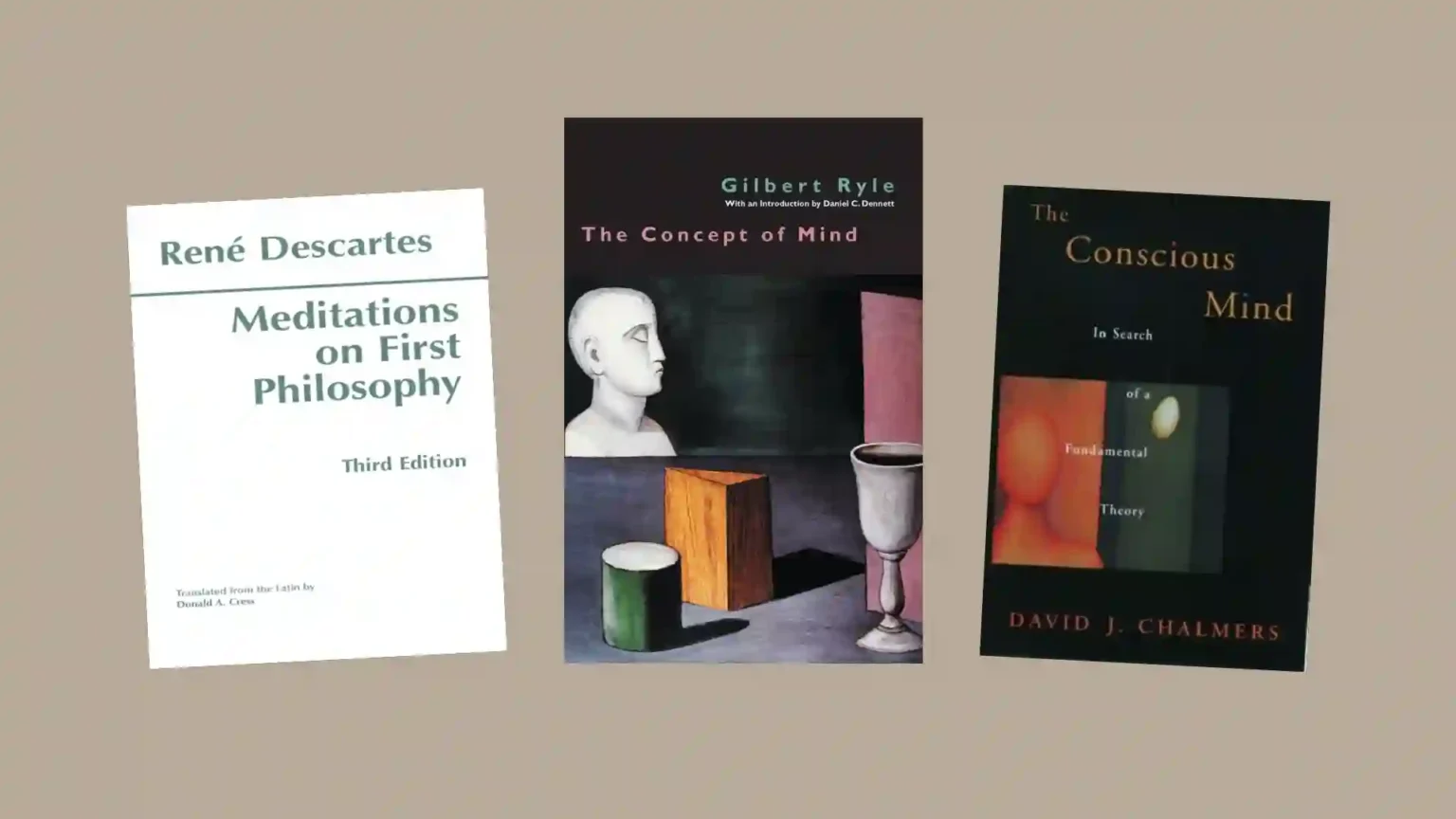
This philosophy of mind reading route starts with the mind–body problem and leads through functionalism, intentionality, and consciousness.
The most common mistake is to begin philosophy of mind by collecting positions: dualism, physicalism, functionalism, behaviorism, eliminativism. That gives you labels before you have a problem. A better route begins with pressures that any theory of mind must answer: how mind relates to body, how mental states can be about things, whether computation is enough for understanding, and why conscious experience seems difficult to capture in third-person terms.
The route below alternates books and landmark papers. That is deliberate. Philosophy of mind is one of those fields where a sixteen-page article can redirect an entire debate, while a book can teach the conceptual machinery needed to understand why.
Stage 1 — Philosophy of Mind Begins with the Mind–Body Problem
Start with Descartes, but do not read all of Meditations on First Philosophy as if every page were equally relevant to philosophy of mind. Concentrate on the Second and Sixth Meditations: the first develops the thinking self; the sixth argues for a real distinction between mind and body while also confronting their intimate union. The Stanford account of Descartes’ Meditations gives the publication and argumentative context, while its current entry on dualism maps the later mind–body problem without making Cartesian dualism the only form of dualism.
Your question at this stage is not “Is Descartes right?” It is: What needs explaining if mental and physical descriptions appear radically different, yet minds and bodies interact? Write down the ontological problem and the causal problem separately. That distinction will keep later theories from blurring together.
Stage 2 — Let Ryle Attack the Picture
Next read Gilbert Ryle’s The Concept of Mind. The University of Chicago Press edition begins with “Descartes’ Myth” and develops Ryle’s famous diagnosis of category mistakes. Ryle is valuable for a beginner because he does not merely announce a rival substance theory; he questions whether the traditional picture of an inner mental theater has been built from misused concepts.
Read Chapters I and II first, especially the contrast between knowing how and knowing that. Then ask: if we explain intelligence, agency, and skill through patterns of capacities and dispositions, how much “inner machinery” still needs to be posited? Ryle will not settle the field for you. He will teach you to suspect that some philosophical problems are generated by the grammar of our own descriptions.
Stage 3 — Understand Functionalism as a Model, Not a Slogan
Before jumping to objections, read a clear overview of functionalism. The basic move is to characterize mental states by the roles they play in a system rather than by the material from which that system is made. Pain, for example, is approached through characteristic inputs, relations to other states, and behavioral outputs rather than through one particular biological constitution.
Now you can see why functionalism became attractive in an age of computation: it promises multiple realizability. But it also creates the next problem. If the right formal or causal role can be implemented in different media, does implementing the right program amount to having a mind?
Stage 4 — Test Computation with Searle
Read John Searle’s 1980 paper “Minds, Brains, and Programs”. It is the home of the Chinese Room argument. Searle’s target is not the trivial claim that computers are useless or that machines cannot think. His stated argument is against the sufficiency of implementing a computer program for intentionality or understanding.
This is where many beginners accidentally debate a cartoon. Keep two claims apart: a system can behave as if it understands; and a system can possess the intentionality that makes its symbols mean something to it. You do not have to accept Searle’s conclusion to benefit from the distinction. If artificial intelligence is one of your reasons for entering philosophy of mind, this paper should be read early rather than saved as a historical curiosity.
Stage 5 — Turn from Function to Experience
Then read Thomas Nagel’s 1974 “What Is It Like to Be a Bat?” and Frank Jackson’s 1982 “Epiphenomenal Qualia.” The bibliographic record for Nagel’s article is The Philosophical Review 83(4), 435–450, available through its JSTOR DOI. Jackson’s paper is recorded by Oxford Academic in The Philosophical Quarterly 32(127), 127–136.
Nagel makes subjective character hard to ignore: an objective physical description may leave open what an experience is like for its subject. Jackson’s Mary case sharpens a related pressure through knowledge: if a complete physical knower learns something on first seeing color, what was missing? Treat these as challenges to reductive explanation, not as instant proofs of any single metaphysics.
| Problem | Best first reading | What to test |
|---|---|---|
| Mind and body | Descartes, Meditations II & VI | Can mental and physical reality be distinct yet causally united? |
| Conceptual picture | Ryle, The Concept of Mind I–II | Are some mind–body puzzles category mistakes? |
| Mental-state identity | SEP “Functionalism” | Can roles define mental states across different realizations? |
| Understanding / AI | Searle, “Minds, Brains, and Programs” | Is program implementation sufficient for intentionality? |
| Subjective experience | Nagel + Jackson | Can complete physical description capture what experience is like? |
| Explanatory gap | Chalmers | Why should physical processing produce experience at all? |
Stage 6 — Read Chalmers Only After the Pressure Is Visible
David Chalmers’s “Facing Up to the Problem of Consciousness” is where the phrase “hard problem” is introduced: explaining why and how physical or functional processing is accompanied by subjective experience. Follow it with selected chapters of The Conscious Mind, especially the opening chapters on concepts of mind, supervenience, and reductive explanation.
Reading Chalmers earlier can make the field appear to be only about consciousness. Reading him here has a different effect. You can see the hard problem as one pressure among several: Descartes raises ontology and causation; Ryle raises conceptual misuse; functionalism raises realization; Searle raises intentionality; Nagel and Jackson raise subjectivity and explanatory completeness. Chalmers then asks why those explanatory resources still seem to leave experience outstanding.
Where the Route Branches
After this sequence, choose a branch rather than continuing chronologically. For mental content and reference, BookInLight’s philosophy of language reading guide gives a path through Frege, Quine, Grice, and Kripke. If your interest is persistence of persons rather than the nature of mental states, the personal identity guide shifts the question toward memory, embodiment, narrative, and agency.
For a general orientation to reading difficult philosophy, BookInLight’s beginner philosophy route is useful as a study-method companion, not as a substitute for the primary texts above.
A Practical Reading Rule
At the end of each stage, write one sentence that begins: “This reading makes the following explanation harder to maintain…” That forces the debate to remain cumulative. Ryle should change how you read Descartes; Searle should change how you read functionalism; Nagel and Jackson should change how confidently you identify successful functional explanation with complete explanation.
You do not need a final theory of mind after six stages. A successful first pass gives you something more useful: a map of what a theory would have to explain, which objections are conceptual, which are empirical, and which turn on the nature of explanation itself.
Compact scholarly trail
For continuing reference, keep the Stanford entries on consciousness, functionalism, and dualism open beside the primary texts. They are maps of live disputes, not replacements for the arguments.
Cover artwork: credits and source records
- Meditations on First Philosophy — Hackett Publishing Company (source record)
- The Concept of Mind — University of Chicago Press (source record)
- The Conscious Mind: In Search of a Fundamental Theory — Oxford University Press (source record)