Before Augustine’s Confessions, trace the influences and controversies that made the work more than a straightforward autobiography.
This guide will not try to make Augustine easy, and it will not turn Confessions into a coded autobiography for which every symbol needs advance explanation. The useful preparation is narrower. Know the sequence of intellectual worlds Augustine passes through—classical rhetoric, Manichaeism, philosophical conversion through Platonist texts, Christian Scripture, and the preaching of Ambrose—and know that Books X–XIII change the apparent genre of the work. With that map, the reader can recognize why memory, time, interpretation, and creation belong to the same book as childhood, ambition, friendship, sex, grief, and conversion.
The Route
354 — Augustine is born in Thagaste in Roman North Africa. The social world is Latin, Christianizing, rhetorically educated, and still marked by competing religious and philosophical traditions.
c. 373 — Reading Cicero’s lost Hortensius awakens a desire for wisdom. The text itself does not survive complete; Augustine’s report of its effect matters more than pretending it can be assigned as a normal prerequisite.
370s–380s — He adheres for years to Manichaeism, attracted by its account of evil and its claim to rational religious explanation, then becomes increasingly dissatisfied.
384 — Augustine arrives in Milan as an ambitious teacher of rhetoric and encounters Bishop Ambrose, whose preaching changes what Christian interpretation can look like to him.
386 — Reading ‘books of the Platonists’ helps Augustine conceive immaterial reality and rethink evil; the conversion narrative reaches its decisive garden scene.
397–400 — Confessions is composed after Augustine has become a Christian bishop. The narrator therefore writes from a later theological position about the earlier selves he is interpreting.
Rhetoric
The first prerequisite is not a philosopher but a profession. Augustine was trained as a rhetorician, and the Stanford Encyclopedia of Philosophy overview is useful for tracing how deeply classical education shaped his intellectual life. Rhetoric explains more than his polished sentences. It explains his sensitivity to praise, ambition, audience, persuasion, imitation, and the moral danger of language detached from truth. When he remembers school exercises or public success, he is not adding colorful biography around a philosophical core. He is asking what education trains a person to love.
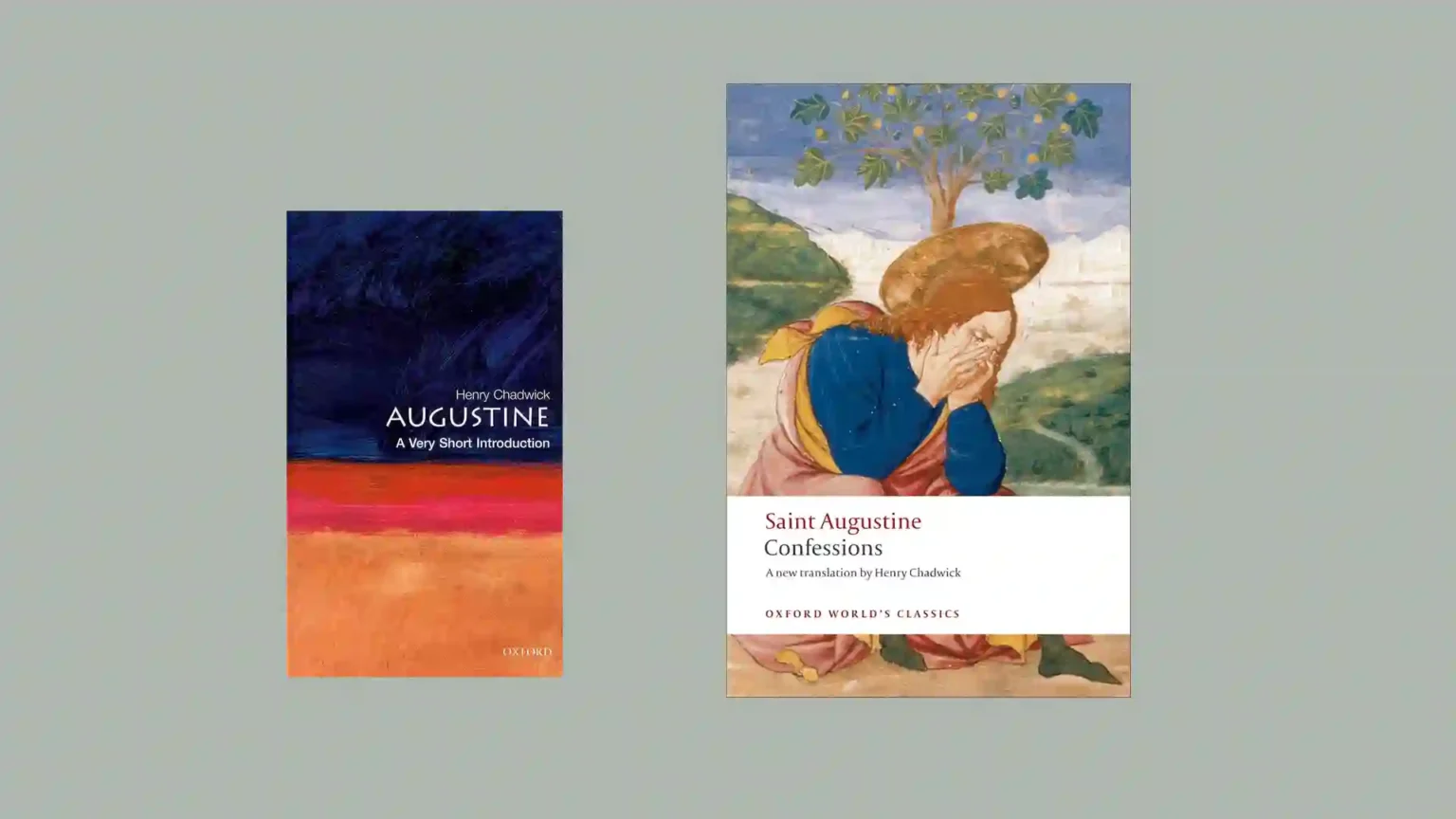
That question also explains why Cicero matters. Henry Chadwick’s concise Augustine: A Very Short Introduction and its chapter on Augustine’s formation through Cicero, Mani, Plato, and Christ give a reliable map. Cicero’s lost Hortensius becomes important in Confessions because Augustine remembers it as a conversion of desire toward wisdom before his Christian conversion. The exact content of Hortensius matters less than the pattern: a book can reorder what a reader wants.
Manichaeism
The second prerequisite is Manichaeism. Do not reduce it to a cartoon of ‘good versus evil.’ Augustine joined a sophisticated transregional religion that promised explanatory clarity about evil, matter, cosmic conflict, and scriptural difficulties. His later critique is retrospective and polemical; it should not be mistaken for a neutral ethnography of Manichaean belief. What matters for reading Confessions is the problem Manichaeism helped him formulate. If God is good and powerful, where does evil come from? Augustine’s eventual answer depends on changing the metaphysics of evil itself rather than locating evil in an independent material principle.
Platonism
The third prerequisite is a small amount of late antique Platonism. There is no need to read the whole Platonic tradition before Augustine. Learn three moves: intelligible reality is not reducible to sensible bodies; the mind can turn inward and upward rather than merely outward; and evil need not be a positive substance. The collection Augustine’s Confessions: Philosophy in Autobiography is valuable because it treats these philosophical structures inside the autobiographical form rather than separating ‘life’ from ‘argument.’ The point is not that Platonism supplies Augustine with Christianity in advance. It gives him conceptual resources that make some Christian claims newly thinkable while leaving incarnation, grace, and scriptural history unresolved.
Scripture
The fourth prerequisite is interpretive rather than encyclopedic: Augustine learns to read Scripture differently. Ambrose matters because allegorical and figurative interpretation loosens the crude picture Augustine had rejected when younger. A reader should therefore enter Confessions expecting biblical phrases and scenes to be woven into Augustine’s own language. The work is addressed to God, not merely to us; autobiography becomes prayer, exegesis, and theological argument at once. The Cambridge Companion to Augustine’s Confessions is especially helpful when the biblical texture becomes difficult because its essays treat the book as a deliberately composed theological and philosophical work.
The Turn
The conversion in Book VIII is famous enough to distort the whole work. It is better read as a hinge than as an ending. Books I–VII have already shown conversion occurring in stages: intellectual, moral, interpretive, social. After the garden scene and the death of Monica in Book IX, Book X asks what it means for the converted narrator to examine himself now. Memory becomes a vast problem because the self is present to itself imperfectly. Desire does not disappear when biography reaches baptism.
This is where many first readings lose confidence. Books XI–XIII turn toward time, Genesis, and creation, and can look like an appendix to the ‘real story.’ They are not. Augustine’s meditation on time asks how a creature stretched across memory, attention, and expectation can speak about an eternal creator. His Genesis reading asks how language, interpretation, and created order can bear multiple true meanings without collapsing into arbitrariness. The Oxford Bibliographies overview of Augustine scholarship and the Liverpool study of the social and intellectual context of Confessions are useful next steps when these final books become the center rather than the obstacle.
Reading Decision
For a first pass, read Books I–IX continuously, pause, then read X and XI slowly before deciding whether to continue immediately through XII–XIII. Readers coming from literature should resist extracting only the narrative scenes; readers coming from philosophy should resist skipping childhood, friendship, grief, sexuality, and ambition as mere anecdote. Augustine’s arguments are carried by remembered life. BookInLight’s route into Dante’s Divine Comedy already treats Confessions as an important precedent for an inward journey ordered by desire, memory, and conversion; the connection works because Augustine makes the movement of a life intellectually interpretable.
The next reading decision depends on what caused difficulty. If the problem was evil, return to Augustine’s anti-Manichaean background. If it was mind and memory, move toward his philosophical psychology. If it was grace and will, read later anti-Pelagian works with care for chronology. If it was time and creation, stay with Books XI–XIII rather than fleeing to a summary. The preparation has succeeded when Confessions no longer looks like a saint’s autobiography interrupted by philosophy. Its governing question is continuous: how can a divided, temporal, desiring creature learn to understand both itself and the source toward which its desire is being redirected?
Cover artwork: credits and source records
- Confessions — Oxford University Press (source record)
- Augustine: A Very Short Introduction — Oxford University Press (source record)