This moral relativism reading path tests cultural difference, moral disagreement, and metaethical claims without assuming they are equivalent.
The disagreement begins before the argument begins. Philosophers use “moral relativism” for several distinct theses, while non-specialists often use it for a social attitude: being tolerant, recognizing cultural difference, or refusing to judge other societies too quickly. Those are not the same thing. The current Stanford Encyclopedia of Philosophy entry on moral relativism treats the field as a family of metaethical and normative positions, not a single doctrine. A useful reading path therefore has to make the definition harder before it makes the bibliography longer.
Start with one distinction and keep it visible. Descriptive moral diversity is the empirical claim that people or cultures disagree about values and practices. Metaethical relativism says, in one form or another, that the truth or justification of moral judgments is relative to a framework, culture, or standpoint. Normative tolerance is a moral recommendation about how we should respond to difference. The first does not logically entail the second, and the second does not entail the third. A society could be culturally diverse while moral objectivism is true; a relativist framework could contain intolerant norms; and an objectivist could defend tolerance as an objectively justified principle.
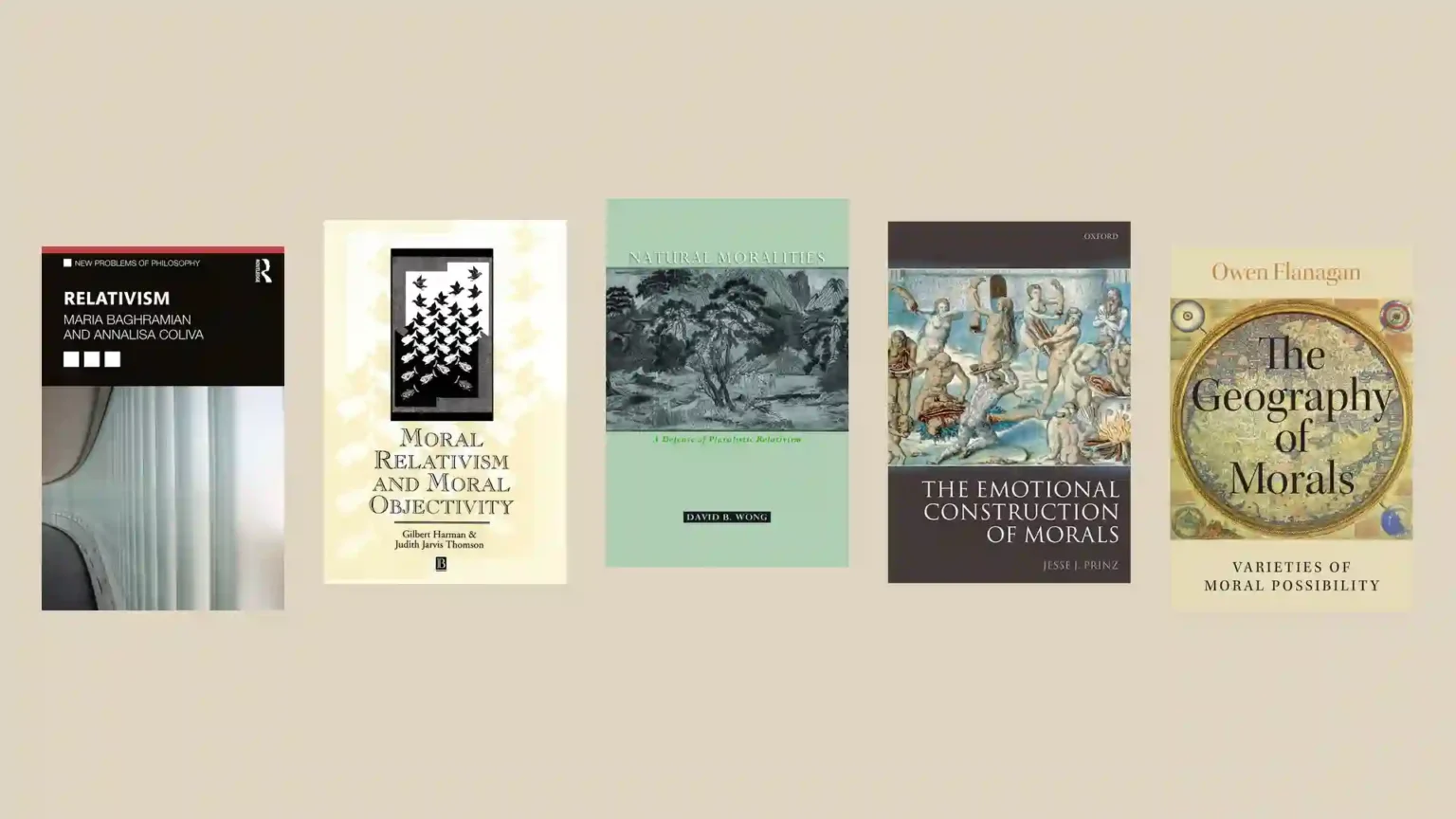
That is why the first book should not be the most committed defense of relativism. Maria Baghramian and Annalisa Coliva’s Relativism is a better map. It places moral relativism beside relativism about truth, knowledge, and conceptual schemes, allowing the reader to see which problems belong to relativism in general and which are specifically ethical. Read it for vocabulary: framework dependence, disagreement, self-refutation, incommensurability, and the difference between saying that standards vary and saying that every standard is equally good.
The second stop should be an argument in which the disagreement is built into the book itself. Gilbert Harman and Judith Jarvis Thomson’s Moral Relativism and Moral Objectivity is unusually valuable because Harman defends a relativist position while Thomson rejects the case against objectivity, and the two respond to one another. The book makes a crucial pedagogical correction: the debate is not between a sophisticated relativist and a naïve absolutist. Both sides can acknowledge disagreement, social embeddedness, and the complexity of moral evidence while drawing different conclusions about objectivity.
At this point, pause before accumulating more theory. Ask what kind of fact would actually support relativism. Mere disagreement is weak evidence because disagreement occurs in domains where we still think some answers are better than others. Persistent, apparently rationally irresolvable disagreement is more important, but even that does not settle the issue. You now have a diagnostic question for the rest of the route: when a writer appeals to cultural variation, emotional formation, or social practices, what is the inferential step from those facts to a claim about moral truth?
The route changes when you move from abstract disagreement to how moral worlds are actually formed
David B. Wong’s Natural Moralities is the third major stop because it tries to build a pluralistic position rather than merely infer relativism from diversity. Wong argues that morality responds to recurrent human needs and problems while allowing more than one adequate way of organizing values. This is a much more demanding thesis than “different cultures have different morals.” It asks whether constraints supplied by human nature and social coordination can permit genuine moral plurality without collapsing into anything-goes subjectivism.
Wong is best read slowly because the position changes the reader’s burden of proof. If several moral systems can be adequate responses to the human situation, objectivity need not mean that there is one uniquely correct total ordering of values. Yet pluralism is not automatically relativism. The reader has to track where Wong thinks standards of criticism remain available and where he thinks underdetermination permits more than one acceptable moral arrangement. This is where the earlier conceptual map pays off: labels matter less than the exact scope of the relativity being defended.
Jesse Prinz’s The Emotional Construction of Morals should come next because it changes the evidential base. Instead of beginning primarily from cross-cultural disagreement, Prinz gives emotion a central role in moral judgment and develops a form of moral relativism from an empirically informed account of how sentiments are acquired. The reader should not ask only whether emotions influence morality—few serious positions deny that. The key question is whether the psychological explanation of moral judgment supports the metaethical conclusion Prinz draws from it. This is an excellent place to practice separating genealogy from justification: explaining why people hold a moral belief is not yet the same as showing what makes the belief true or false.
Owen Flanagan’s The Geography of Morals broadens the inquiry again by placing moral philosophy beside psychology, anthropology, and comparative traditions. Flanagan’s project is useful for readers tempted by two opposite simplifications: that moral diversity makes philosophical evaluation impossible, or that philosophical principles can be discussed as if they floated free of forms of life. His attention to multiple moral ecologies makes the comparative problem concrete. The task becomes learning how to compare ways of living without assuming either a universal ranking from the outset or an automatic prohibition on cross-cultural criticism.
This is also the right moment to read BookInLight’s guide to Richard Rorty and pragmatism, not because Rorty provides a simple moral-relativist doctrine—he does not—but because accusations of relativism often attach to anti-foundationalist views too quickly. Rorty helps a reader see that rejecting one picture of philosophical foundations does not immediately answer the practical question of which solidarities, vocabularies, or institutions to defend. The exercise is diagnostic: when a critic calls a position “relativist,” what precise proposition is being attributed to it?
Four objections the route must survive
Now return to the objection side. One persistent challenge is self-reference: if the relativist says “all moral truth is relative,” is that statement itself relative or universally true? Some versions of relativism can answer by restricting their claim or by treating it as a meta-level proposal rather than an exceptionless universal truth. Another challenge concerns reformers. If rightness is fixed by the norms of a society, how can a dissenter correctly condemn the society’s accepted injustice? Sophisticated relativists respond by making the relevant framework more complex than majority convention, but each increase in complexity raises a new question about what fixes the framework and why it has authority.
A third objection concerns disagreement itself. Relativism can appear to dissolve disagreement by translating “X is wrong” into “X is wrong relative to our standards” and “X is permissible” into “X is permissible relative to theirs.” If both are true, the apparent contradiction disappears. But moral argument often feels like genuine conflict: parties claim not merely to report their own frameworks but to say what should be done. A viable relativism therefore needs an account of why disagreement can remain practically and intellectually serious even when truth conditions are framework-sensitive.
A fourth objection comes from the relation between tolerance and relativism. If tolerance is justified because moral truth is relative, then tolerance itself must either be a relative norm—binding only within some frameworks—or a special cross-framework requirement. The first option cannot condemn an intolerant relativist culture simply for being intolerant; the second needs an argument explaining why tolerance escapes the relativity applied elsewhere. This is why the beginner’s slogan “relativism means respecting everyone’s values” should be discarded early rather than refined late.
There is another reason to resist a binary map of relativism versus objectivism. Moral philosophy contains positions that deny robust objective moral facts without making truth relative to cultures, as well as pluralist positions that defend objective constraints while allowing more than one permissible form of life. Error theories, expressivisms, constructivisms, and forms of pluralism therefore sit close enough to relativism to be confused with it, but they answer different questions. The practical reading rule is simple: never classify a view from its attitude toward disagreement alone. Ask what makes a moral judgment true, what makes it justified, and whether those standards vary with a framework.
Use concrete disputes to test each account. Imagine two communities that disagree over filial obligation, punishment, or the moral status of a practice. Does the theory say both communities can be correct relative to their frameworks? Does it instead say one framework gives better reasons? Can members criticize their own inherited norms? Can a person belong to overlapping frameworks whose demands conflict? Questions like these expose the operational content of a theory more quickly than asking whether its author is “a relativist.” They also keep philosophical comparison from turning cultures into internally uniform blocks.
That discipline matters especially when the topic becomes politically charged. Relativism is sometimes praised as humane openness and sometimes blamed for moral paralysis. Neither reaction can substitute for identifying the actual truth conditions and justificatory claims at stake.
Decide which position is actually being defended
The final stage of the route is comparative rather than doctrinal. Put Harman beside Thomson and ask what each thinks moral facts or reasons would have to be. Put Wong beside Prinz and ask whether pluralism grounded in human needs differs from relativism grounded in sentimental construction. Put Flanagan beside both and ask what comparative moral inquiry can accomplish without assuming a single cultural template. Then return to the Stanford overview and see whether the categories now feel like summaries of arguments rather than labels.
If you want the shortest serious route, read Baghramian and Coliva for the conceptual map, Harman and Thomson for a controlled debate, and Wong for a sophisticated pluralist-relativist construction. If psychology interests you, add Prinz. If your concern is how moral philosophy can engage cultural difference without either imperial confidence or paralysis, add Flanagan. The point of the sequence is not to emerge “for” or “against” relativism. It is to become able to say exactly which form is under discussion, what evidence is supposed to support it, and which objection actually reaches that form rather than a caricature.
Cover artwork: credits and source records
- Relativism — Routledge (source record)
- Moral Relativism and Moral Objectivity — Wiley-Blackwell (source record)
- Natural Moralities — Oxford University Press (source record)
- The Emotional Construction of Morals — Oxford University Press (source record)
- The Geography of Morals — Oxford University Press (source record)