Small presses for world literature in translation use distinct editorial models; six publishers illustrate what their decisions make possible.
In 2015, Tilted Axis Press began building a list around contemporary Asian literature in translation; in 2013, Deep Vellum and Two Lines Press started different nonprofit models in the United States; Open Letter had already tied a translation press to the University of Rochester; Archipelago had been publishing since 2003. Put these institutions side by side and “best small press” stops being a beauty contest. Each press solves a different part of the translation ecosystem.
Institutional-date distinction: Two Lines Press began publishing books in 2013, whereas the literary journal Two Lines began in 1993. Deep Vellum was also founded in 2013. The dates refer to the presses’ publishing programs, not the age of their parent literary organizations. Source: Two Lines Press official history.
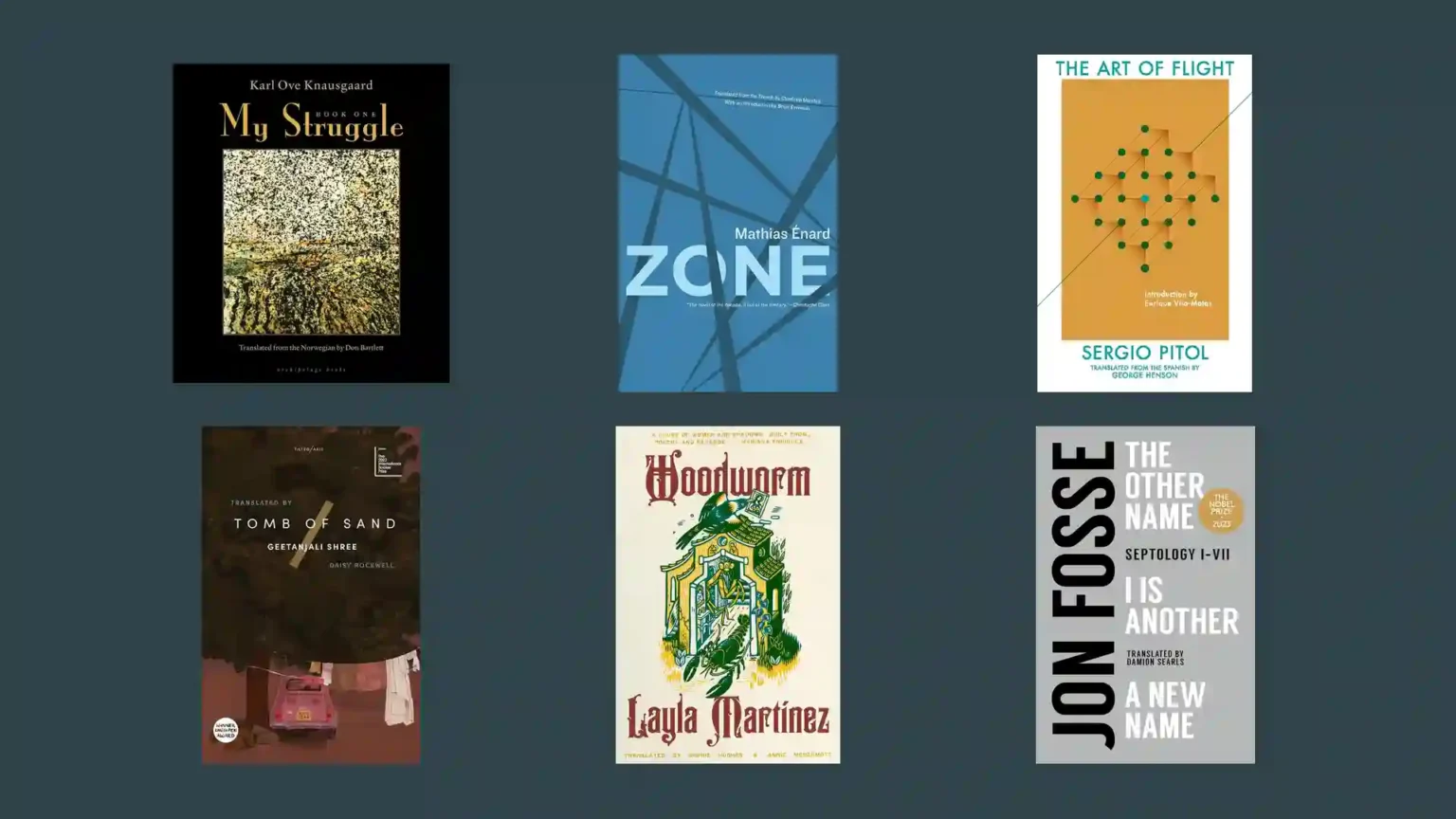
Books shown in the featured image (illustrative catalog examples)
The six photographed covers are examples associated with the six presses discussed here, not a second ranked list of recommended titles. They are: Archipelago — My Struggle: Book One; Open Letter — Zone; Deep Vellum — The Art of Flight; Tilted Axis — Tomb of Sand; Two Lines — Woodworm; and Transit Books — Septology. The comparison below concerns the presses’ publishing models, not a critical review of these six individual books.
The useful question is therefore: what kind of world literature do you want a press to make possible? The six presses below differ in geography, institutional structure, list size, editorial risk, backlist strategy, and how explicitly translation itself becomes part of the public mission. For a different framework focused on the political history of translation, see the translation-and-empire reading route.
Archipelago Books: long-life world literature
Archipelago describes itself as a nonprofit press devoted to contemporary and classic world literature in translation. Its current site shows a list moving across Spanish, French, Icelandic, Croatian, Arabic, Swedish, Turkish, Haitian French, Italian, Japanese, Chinese, Finnish, Polish, and other languages. The model is not simply “publish foreign books.” It is to keep a curated international backlist alive long enough for readers, teachers, prizes, and later books by the same writers to accumulate around it.
That durability is visible in the press’s support language: Archipelago says it was founded as a nonprofit so it could acquire books without making sales potential the sole test and emphasizes keeping titles in print. Its awards record shows how translators and authors can continue gathering recognition years after publication. Choose Archipelago when you want a press whose catalog behaves like a slowly built world-literature library.
Open Letter Books: translation as a university public mission
Open Letter Books is the University of Rochester’s nonprofit literary-translation press. Its own description says it publishes ten translated titles each year and pairs the list with the Three Percent platform. That institutional setting matters: Open Letter is not merely a campus imprint, but the university connection gives translation advocacy, criticism, education, and publishing a shared infrastructure.
Its distinctive strength is discoverability as a mission. The press explicitly wants works that may become “the classics of tomorrow,” so the list often functions as a bridge between international literary systems and an Anglophone readership that has little prior demand data. Choose Open Letter if you want contemporary literary discovery backed by an institution that treats translation culture itself as part of the project.
Deep Vellum: scale, acquisition, and the expanded backlist
Deep Vellum started in Dallas in 2013 and has grown into a much larger nonprofit literary organization with multiple imprints, including Dalkey Archive Press. Its history page now describes a backlist above 1,500 titles from more than 100 countries and calls the organization the largest publisher of translated literature in the United States. That scale makes it an unusual member of the “small press” category.
The key mechanism is institutional aggregation. By acquiring or housing imprints with distinct histories, Deep Vellum can combine new translations, experimental traditions, reprints, local literary programming, and backlist preservation. Choose it when you want breadth and continuity rather than one narrowly defined regional or aesthetic program.
Tilted Axis Press: editorial geography as an argument
Tilted Axis Press states its politics and geography more explicitly. Founded in 2015, it publishes contemporary literature by the Global Majority in translation or in varied Englishes and frames its practice as an alternative to language hierarchy and the monoculture of globalization. Its “Translating Waters” direction organizes acquisitions through connected bodies of water rather than conventional national-literature shelves.
That is a publishing model, not just branding. It changes what counts as proximity among books: Indian Ocean, Pacific, Black Atlantic, and Black Pacific relations can cut across national categories that a bookstore or area-studies course might otherwise treat separately. Choose Tilted Axis when you want a list whose editorial architecture itself challenges the default map of “world literature.”
Two Lines Press: translation as an art with an institutional home
Two Lines Press is a program of the Center for the Art of Translation in San Francisco. The press grew from the Two Lines journal and specializes in new writing and overlooked classics that have not previously appeared in English. Because the parent organization is devoted to translation, the translator is structurally visible rather than an afterthought attached to a finished book.
That makes Two Lines especially useful for readers who want to follow translators as well as authors. The press’s catalog and programming treat translation as a creative practice with its own community, events, and institutional future. Choose it when the process and practitioners of translation are part of what you want to read about, not merely the invisible route by which a book arrived.
Transit Books: selective internationalism
Transit Books is a nonprofit Bay Area publisher founded in 2015. Its list mixes international and American literature across fiction, narrative nonfiction, essays, and children’s books. Compared with presses dedicated almost exclusively to translation, Transit’s model is more porous: translated and English-language works can inhabit one editorial list.
That porosity is useful for readers who dislike shelving “translated literature” as a separate genre. Transit’s name suggests movement, but the editorial effect is integration: a translated novel competes for attention inside a literary list rather than inside a translation-only compartment. Choose Transit when you want international literature without requiring translation to be the list’s sole organizing identity.
Evidence matrix: six different publishing problems
| Press | Institutional model | Distinctive problem it solves | Start here if you want… |
|---|---|---|---|
| Archipelago | Independent nonprofit | Long-term availability across many languages | A durable world-literature backlist |
| Open Letter | University nonprofit press | Discovery + criticism + translation advocacy | New international writers with strong context |
| Deep Vellum | Nonprofit with multiple imprints | Scale, rescue, reprint, and catalog breadth | A very large translated-literature ecosystem |
| Tilted Axis | Independent nonprofit | Language hierarchy and inherited literary geographies | Experimental Global Majority writing |
| Two Lines | Program of translation arts nonprofit | Translator visibility and translation culture | Translation as both art and institution |
| Transit | Independent nonprofit | Integrating translated and Anglophone literary lists | Selective international literature across categories |
How to choose without turning the list into a ranking
If you are building a personal library, follow catalogs rather than prizes. Sample five books from one press across different source languages and ask whether the editorial logic remains visible. If you are a teacher, look for stable backlist availability and classroom-friendly metadata. If you are a translator, inspect how prominently the press credits translators and whether its surrounding programs treat them as authors of literary decisions. If you are mainly a discovery reader, subscribe to one list for a year and let the press’s editorial sequence—not an algorithm—set part of your reading agenda.
BookInLight’s live guides to Penguin Classics and Oxford World’s Classics offer a useful counterpoint. Large classics series solve problems of scale, standardization, teaching, and replacement translation. The small presses here are more willing to create demand before it exists, sustain relationships with living translators, and make an editorial identity from linguistic risk. Neither model makes the other obsolete.
The matrix also explains why annual output is a poor ranking device. Tilted Axis can publish six to nine books a year and make that selectivity part of a coherent geographic argument; Open Letter’s ten-title rhythm supports a different university-based ecology; Deep Vellum’s multi-imprint scale serves preservation and breadth. Small-press value lies in the relationship between mission, list, translation labor, and backlist—not in maximizing title count.
A second caution is territorial. Fitzcarraldo Editions, for example, is a major force in contemporary translated literature, but its mix of English-language originals and translations and its UK-centered rights structure make it a different comparison case from US nonprofit translation presses. The six presses here are not an exhaustive world ranking; they are a deliberately varied map of publishing models a reader can actually follow.
The practical next-reading decision is simple. Pick the institutional function you value most—backlist longevity, university advocacy, scale, anti-hierarchical geography, translator-centered culture, or selective integration—and then choose three titles from that press published at least five years apart. A “best press” is most legible not from one celebrated book but from the pattern a list sustains over time.
Cover artwork: credits and source records
- My Struggle: Book One — Archipelago Books (source record)
- Zone — Open Letter (source record)
- The Art of Flight — Deep Vellum (source record)
- Tomb of Sand — Tilted Axis Press (source record)
- Woodworm — Two Lines Press (source record)
- Septology — Transit Books (source record)