Before The Arcades Project, become familiar with Benjamin’s unfinished research method, montage, commodities, and Parisian modernity.
Open The Arcades Project almost anywhere and the ordinary expectation of a philosophical book collapses: quotations from advertisements, Fourier, Marx, Baudelaire, police reports, architecture, fashion, gambling, iron construction, boredom, prostitution, photography, and urban dreams sit beside compact reflections filed into named “convolutes.” Conceived in 1927 and still unfinished when Walter Benjamin fled Paris in 1940, the project survives as a research architecture rather than a completed monograph. Preparation should therefore teach you how to move through fragments, not supply a doctrine that turns them back into chapters.
Three backgrounds that unlock the archive
The first dependency is Parisian modernity. Read Charles Baudelaire’s The Painter of Modern Life before you read an entire shelf on nineteenth-century France. Baudelaire’s painter of modern life, the crowd, fashion, transience, and the demand to extract something enduring from the fugitive present give Benjamin a vocabulary of urban attention. What matters is not memorizing Baudelaire’s biography. It is learning to see the street, commodity display, dress, and the passer-by as historically legible forms.
The second dependency is the commodity. You do not need all three volumes of Capital first, but you do need Marx’s account of commodity fetishism and enough of his theory of exchange to understand why things can appear to possess social powers that actually arise from relations among people. The Stanford Encyclopedia entry on Marx is an efficient conceptual map if you are not already familiar with value, alienation, and fetishism. Benjamin does not simply illustrate Marx with department stores. He asks what commodity culture looks and feels like when it becomes architecture, dream, display, collecting, novelty, and habit.
A third background comes from urban sociology. Georg Simmel is not a formal prerequisite, but the philosophical overview of Simmel helps explain why modern metropolitan life can be approached through money, nervous stimulation, sociability, distance, and forms of interaction rather than through a single institutional history. Simmel and Benjamin are not interchangeable: Benjamin’s method is more historical, materialist, literary, and montage-driven. The point of Simmel is to make “the city” stop looking like a neutral container for events.
Before the Arcades, read Benjamin himself in a smaller form. One-Way Street is ideal because its short prose blocks train the reader in a thinking style that moves by juxtaposition, inscription, object, joke, dream, and sudden conceptual turn. The first volume of Benjamin’s Selected Writings situates that experiment among his early work. Do not read One-Way Street merely for themes that recur later. Read it to acquire a tolerance for argument that is distributed across fragments rather than announced as a thesis and defended in sequence.
The hinge: from reading fragments to reading constellations
At this point, stop adding prerequisites and learn three operations. First, quotation is not passive evidence. Benjamin tears sentences from one context and makes them collide with others. The scholarship on the politics of quotation in The Arcades Project is useful because the montage form changes what counts as an argument. Second, historical objects are double: they belong to the past, yet become legible from a later “now.” Third, the nineteenth century appears as a dream-world whose promises and myths can be awakened rather than merely catalogued.
Now read a cluster from the 1930s rather than another large predecessor. The third volume of the Selected Writings contains the second version of “The Work of Art in the Age of Its Technological Reproducibility” along with texts from the years when the Arcades research was maturing. The essay is not a key that unlocks every convolute, but it sharpens the relation among technology, perception, mass culture, politics, and historical change. Pair it with “A Little History of Photography” or “The Author as Producer” if your interests lean toward media and cultural production.
Then read the Arcades Project’s own exposés—“Paris, the Capital of the Nineteenth Century”—before wandering through the convolutes. The WorldCat record for the English edition usefully confirms the architecture of the translated volume: exposés, convolutes, early drafts, addenda, editorial material, guide to names and terms, and index. The exposés are not a finished introduction, but they tell you what Benjamin thought the project was trying to assemble at different moments.
Do not begin with Convolute N because you have been told it contains “the theory.” Start with an object-rich cluster: arcades, fashion, the collector, interiors, photography, or Baudelaire. Mark recurring terms, but also mark recurring physical things—glass, iron, mirrors, dust, dolls, panoramas, tickets, lamps, ruins. Then read N once you have seen what its methodological remarks are trying to describe. Method is easier to grasp when it has an archive beneath it.
The strongest secondary orientation is not a paraphrase of all 1,000 pages. Use the Stanford Encyclopedia entry on Benjamin for intellectual coordinates and a focused study such as the Cambridge discussion of Benjamin’s “phantasmagoria” for one central concept. Secondary scholarship should help you discriminate among historical materialism, theology, surrealism, aesthetics, and media theory without pretending these strands were fused into a single stable system.
What can you safely postpone? The entire history of German idealism; every text by Marx; a complete reading of Proust; exhaustive Parisian urban history; all of Benjamin’s theology. Each becomes valuable for particular convolutes, but none is a gatekeeper. A dependency map should reduce delay. If a prerequisite does not change what you can see on the page, it is probably enrichment rather than preparation.
A minimal first-pass reading order
A practical first pass is therefore: Baudelaire on modern life; Marx on commodity fetishism; One-Way Street; one 1930s media essay; the two Arcades exposés; then three chosen convolutes. On the second pass, follow cross-references and build your own constellation. The book’s index and guide are not auxiliary conveniences; they are navigational instruments for a work whose meanings accumulate laterally.
This approach also changes how you read Benjamin politically. A current BookInLight essay on Reyes Mate and the inheritance of forgetting touches Benjamin’s messianic politics from a different angle; it is useful after, not before, you have encountered Benjamin’s own method of making suppressed histories flash into the present. The connection should feel like an extension, not a prerequisite.
Return now to the opening scene: a page of quotations, objects, and abrupt notes that initially looked like unfinished disorder. After the preparation above, the assumption that has changed is not that the book has secretly become linear. It is that linearity is no longer the only form in which historical argument can become rigorous.
How to work with Benjamin’s fragments
One more dependency is methodological rather than textual: learn to distinguish collection from explanation. Benjamin amassed quotations on nineteenth-century Paris, but accumulation alone is not his method. The archive is arranged so that distant materials can illuminate one another when placed in a constellation. The reader therefore has to resist two opposite mistakes—treating every quotation as Benjamin’s own claim, or treating quoted material as inert evidence that can be skipped until the “real” commentary appears. In The Arcades Project, selection and juxtaposition are themselves intellectual acts.
Baudelaire becomes especially important at this point. Benjamin is interested not merely in the poet but in figures through which modern experience becomes legible: the flâneur, the crowd, the commodity, fashion, the prostitute, the collector, the ragpicker. Reading The Painter of Modern Life lets you see why ephemeral surfaces can carry historical knowledge. It also helps prevent the Arcades from becoming a book “about shopping malls.” The passages are laboratories for new relations among private interior, public street, spectacle, labor, technology, and desire.
Do the same with Marx. The commodity fetish is not a password you insert whenever Benjamin mentions a shop window. Ask what social relation has become perceptible as an attribute of a thing, image, or environment. A dream-house such as the arcade does not merely conceal capitalism; it organizes wishes generated within capitalism. This is where Benjamin’s language of dream and awakening becomes more than metaphor. Historical critique must decipher the wish embedded in obsolete forms without simply celebrating or condemning it.
The reader should also expect temporal dislocation. The project does not narrate the nineteenth century from 1800 to 1900. It asks how fragments of that century become legible from Benjamin’s own crisis-ridden present. Fashion is exemplary because it announces the new while recycling the old; ruins are exemplary because apparently dead objects can disclose the structure that once animated them. The SEP account of Benjamin is helpful here because it relates historical materialism to remembrance without reducing either to conventional historiography.
A good first notebook mirrors the book’s structure. Give each page three zones: object, quotation, inference. Under “object,” record the material thing or practice—arcade, mirror, gaslight, panorama, barricade. Under “quotation,” note whose voice Benjamin has imported. Under “inference,” write what relation becomes visible through the juxtaposition. This prevents your notes from becoming a dictionary of terms and makes rereading cumulative.
After three convolutes, return to One-Way Street and notice how miniature forms now read differently. You will see that the apparent eccentricity of the earlier book is methodological training: attention to signage, commodities, domestic arrangements, childhood memory, and urban space already contests the division between “serious” conceptual material and trivial surfaces. The Arcades Project enlarges that wager to a historical scale.
Only then is it worth pursuing the theological question in depth. Benjamin’s notions of remembrance, rescue, and historical interruption cannot be translated without remainder into Marxist social science, yet neither should messianic language be detached from material history. The tension is constitutive. Secondary scholarship is useful when it keeps both vocabularies active, not when it chooses one as the secret code that explains the other.
One last practical rule follows from all of this: do not read the 1,000-page English volume front to back on the first pass. The project was not composed in that order, and forcing it into continuous sequence can hide its cross-connections. Choose a constellation, follow its references, then cross into a second one when an object or quotation recurs. Navigation is part of interpretation. A reader interested in photography will build a different first constellation from one interested in architecture, revolution, or fashion, yet each can eventually reach the same methodological core.
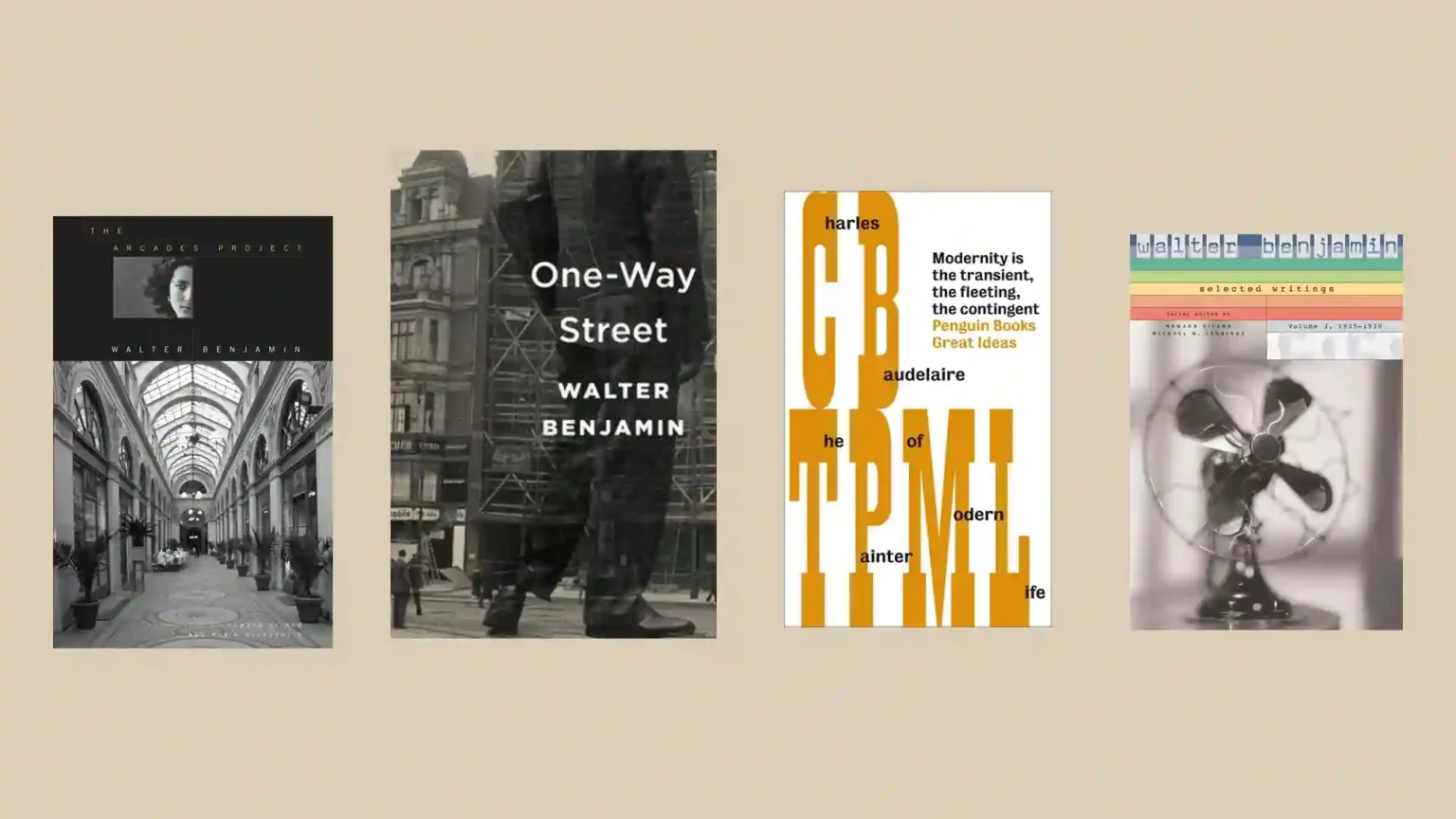
Cover artwork: credits and source records
- The Arcades Project — Harvard University Press (source record)
- One-Way Street — Harvard University Press (source record)
- The Painter of Modern Life — Penguin (source record)
- Selected Writings, Volume 3: 1935-1938 — Harvard University Press (source record)