Seven books on post-truth politics offer rival explanations: media structure, institutional distrust, ideology, and changing public argument.
Consider two political scenes that look deceptively alike. In one, a government knowingly repeats a false claim because the falsehood serves power. In the other, citizens inhabit rival information environments, distrust common referees, and treat evidence itself as partisan. Both can be called “post-truth.” Only the second requires us to ask whether the problem is larger than lying. That difference is why a useful bibliography should not consist of seven books that all announce the death of facts. It should preserve disagreement about diagnosis.
1. Lee McIntyre, Post-Truth — the direct diagnosis
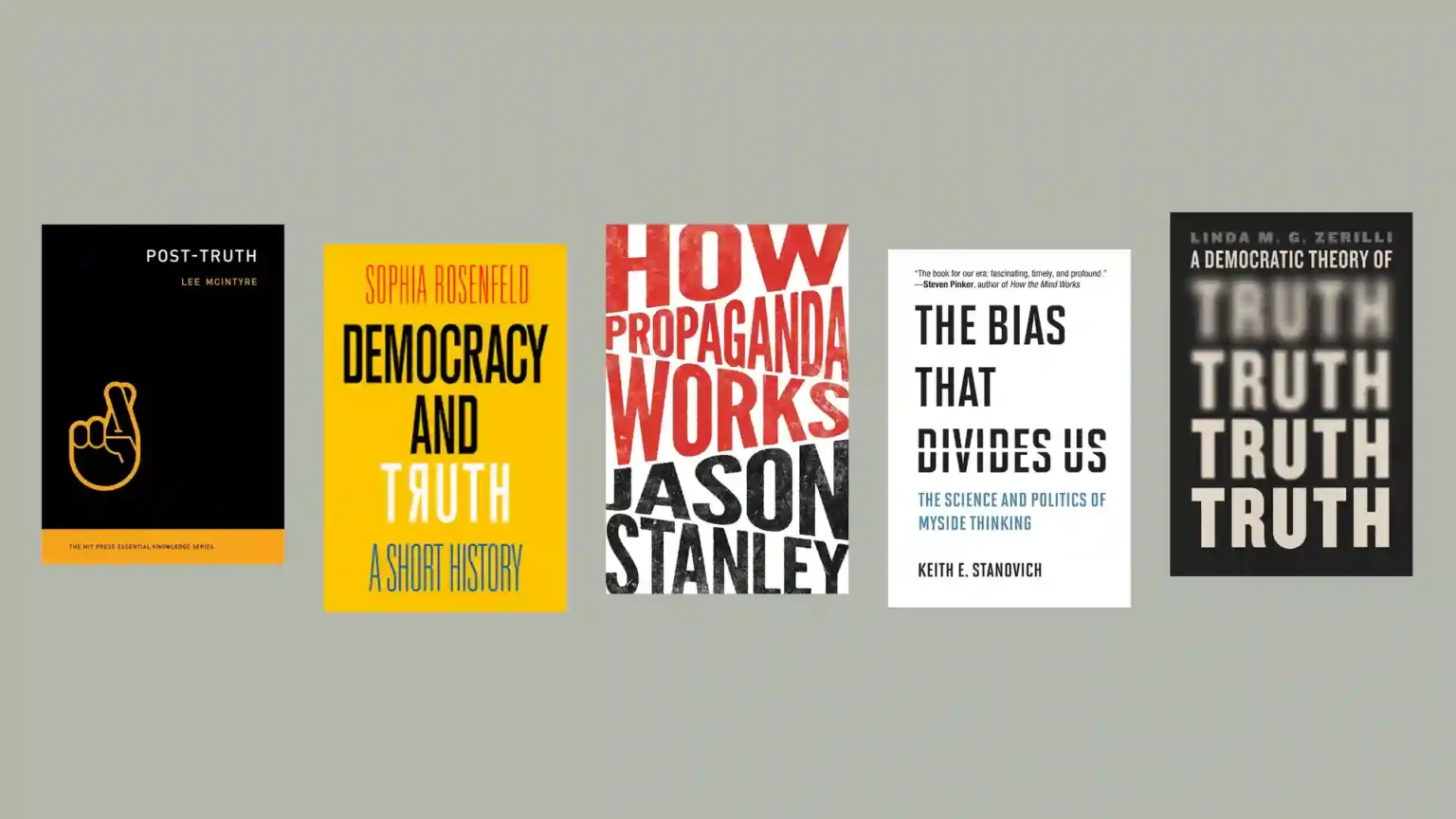
McIntyre’s Post-Truth is the cleanest entry point. He traces post-truth through science denial, “fake news,” cognitive bias, and information silos, defining the phenomenon as more than isolated falsehood: it is a political attempt to subordinate factual standards to ideological commitment. Read it first because later books will dispute how novel that condition is and whether “post-truth” names the right causal mechanism.
2. Sophia Rosenfeld, Democracy and Truth — the historical correction
Rosenfeld’s Democracy and Truth: A Short History changes the time scale. The tension between popular judgment and expert authority, she argues, is built into modern democratic culture rather than invented by social media. Her history from the Enlightenment through populism and technocracy makes “post-truth” look simultaneously new and old: new in media environment and intensity, old in the structural conflict over who gets to certify public knowledge.
3. Jason Stanley, How Propaganda Works — falsehood is not the only weapon
How Propaganda Works widens the mechanism. Stanley is interested in propaganda that exploits flawed ideologies and can use the vocabulary of democratic ideals while undermining those ideals in practice. This matters because a politics of epistemic distortion does not require every statement to be literally false. Framing, ideology, presupposition, and unequal social conditions can corrupt democratic deliberation while speakers continue to invoke freedom, reason, or equality.
4. Michael Hannon and Jeroen de Ridder, eds., Political Epistemology — turn the slogan into separate problems
The Oxford collection Political Epistemology is where the reading route stops treating “post-truth” as one object. The chapters address political ignorance, disagreement, deliberation, misinformation, polarization, legitimacy, and weaponized skepticism. The gain is taxonomic. Different epistemic failures require different remedies: improving individual reasoning is not the same task as repairing media institutions, and neither is identical to deciding what democratic legitimacy should demand from citizens.
5. Keith Stanovich, The Bias That Divides Us — perhaps we are not post-truth at all
Stanovich’s The Bias That Divides Us offers a direct counter-diagnosis. He argues that the central problem is “myside” thinking rather than a wholesale abandonment of truth: citizens believe that their own side possesses the facts. That distinction matters empirically and politically. A population that values truth but selectively processes evidence may need interventions aimed at identity-protective cognition and partisan asymmetry, not sermons about recovering belief in facts as such.
6. Taylor Dotson, The Divide — certainty can polarize as much as relativism
Dotson’s The Divide pushes the disagreement further. His provocative claim is that an obsession with undeniable truth can itself damage democratic life when citizens imagine that sufficient factual certainty should make politics unnecessary. If politics concerns durable conflicts of value and interest as well as factual questions, then demanding that opponents first accept one total epistemic settlement can deepen division. This book is an antidote to the fantasy that fact-checking alone can dissolve political conflict.
7. Linda Zerilli, A Democratic Theory of Truth — the problem becomes institutional and political
Zerilli’s A Democratic Theory of Truth asks how factual truth can be defended without turning democracy into rule by experts. This is the most demanding endpoint because the question is no longer merely how to identify misinformation. It is how truth claims acquire public standing in a political form committed to equality and contestation. Readers who have already followed BookInLight’s route into Hannah Arendt will recognize why factual truth and political judgment cannot simply be collapsed into each other.
A sequence for discussion rather than a stack of diagnoses
Read McIntyre and Rosenfeld side by side first: novelty versus historical continuity. Then put Stanley beside Stanovich: propaganda and ideology versus myside bias. Move to Political Epistemology to disaggregate the mechanisms. Dotson should come after those diagnoses because he challenges the assumption that more certainty automatically produces healthier politics. Finish with Zerilli, where the practical question becomes what democratic institutions must do to sustain factual authority without pretending that politics can be replaced by epistemic administration.
The most useful historical companion inside BookInLight is the Arendt reading path, especially because Arendt’s work keeps factual truth, lying, political action, and the common world in tension rather than treating truth as a synonym for policy agreement. A second, quite different cross-check is BookInLight’s guide to Richard Rorty and pragmatism: anti-foundationalism is often accused of causing post-truth politics, but that accusation itself needs argument rather than repetition.
The books also disagree about the remedy — and that disagreement is part of the evidence
If McIntyre is right about ideological attacks on factual standards, strengthening norms of evidence, journalism, and scientific literacy becomes central. If Stanovich is right that citizens largely remain truth-oriented but process information through partisan “myside” bias, then interventions that merely repeat correct facts may leave the motivational structure intact. If Stanley is right to emphasize propaganda’s dependence on flawed ideology and unequal social conditions, epistemic repair cannot be separated from political and institutional reform.
Rosenfeld and Zerilli make the remedy harder still because expertise itself is politically situated. Democracies need specialized knowledge, yet democratic equality resists the idea that experts should simply rule. The historical problem is therefore not to replace popular judgment with certified truth, but to build institutions in which expert claims can be tested, criticized, and trusted without becoming immune to public contestation. That is a different project from content moderation or debunking, even though those tools may be part of it.
Dotson supplies the most uncomfortable counterweight. Political communities cannot turn every conflict into a dispute awaiting decisive factual settlement. Some disagreements persist because citizens value different goods or accept different risks. Treating opponents as people who would agree with us if only they knew the facts can itself become anti-political. Political Epistemology helps place that warning: democracies need better epistemic practices, but epistemic excellence does not eliminate legitimate disagreement about collective choice.
One practical implication follows from the disagreement over remedies. A newsroom, a school, a legislature, and a social platform do not occupy the same epistemic role. Policies appropriate to one institution can fail in another. Transparency can improve accountability while also flooding citizens with material they cannot evaluate; expert panels can improve accuracy while intensifying suspicion if their authority is socially opaque. The seven books therefore encourage institutional specificity rather than a universal anti-misinformation recipe. They also imply different standards of success: fewer false beliefs, less partisan hostility, more trustworthy institutions, stronger democratic contestation, or better public reasoning are related goals, but they are not identical outcomes. A policy can improve one while worsening another. That tradeoff is itself a political judgment, not merely a technical problem of information quality.
By the end of the route, “post-truth politics” has split into at least five rival diagnoses: strategic lying; propaganda embedded in ideology; cognitive myside bias; institutional failures in the production and circulation of knowledge; and a democratic conflict over expertise and authority. The bibliography is useful only if those alternatives remain visible. Rosenfeld’s history supplies the final warning: democracies have long needed both popular judgment and specialized knowledge, and neither side of that tension can simply abolish the other.
Cover artwork: credits and source records
- Post-Truth — MIT Press (source record)
- Democracy and Truth — University of Pennsylvania Press (source record)
- How Propaganda Works — Princeton University Press (source record)
- The Bias That Divides Us — MIT Press (source record)
- A Democratic Theory of Truth — University of Chicago Press (source record)