Hume’s bundle theory of the self belongs to a precise section of the Treatise, while the later Appendix complicates its reception.
Two sentences are often collapsed into one doctrine. Hume first denies that introspection yields an impression of a simple, enduring self; a few paragraphs later he compares the mind to “a kind of theatre” in which perceptions appear and disappear. The place to read the argument is not a later summary of empiricism but A Treatise of Human Nature, Book I, Part IV, Section VI, “Of personal identity”.
Where exactly is the passage?
The section is cited as T 1.4.6. In the standard Selby-Bigge/Nidditch pagination, the crucial opening discussion begins around SBN 251–253. Hume asks what impression could generate the idea of a persisting self and answers that no impression remains constant through a life. The Hume Texts Online presentation is unusually useful because it supplies both the sectional numbering and SBN references, letting readers move between digital text and scholarly editions.
Publication-history distinction: Books I and II of Hume’s Treatise appeared in 1739; the Appendix, published with Book III in 1740, contains Hume’s later difficulty with his account of personal identity. Cite T 1.4.6 and the Appendix as separate textual moments. Source: Hume primary-text edition.
The compressed textbook formula “the self is a bundle of perceptions” is defensible, but it can mislead if it makes Hume sound as though he simply substitutes one object—the bundle—for another object—the soul. The argument is more radical. The identity we attribute to a mind is produced by relations among changing perceptions and by the imagination’s tendency to smooth succession into identity. The recent Stanford Encyclopedia account of Hume emphasizes both the bundle/succession language and the difficulty created by Hume’s later second thoughts.
Bundle, succession, or fiction?
The lexical problem matters. “Bundle” captures simultaneity: at a given moment, a person consists of perceptions without an extra perceived substance binding them. “Succession” captures time: perceptions replace one another. “Fictitious identity” captures the operation by which imagination attributes sameness across change. These phrases answer different questions. Treating them as synonyms erases part of Hume’s account.
A useful comparison is Locke. Locke relocates personal identity from sameness of substance toward continuity of consciousness, whereas Hume questions whether experience licenses the enduring subject presupposed by ordinary identity talk at all. The SEP entry on Locke and personal identity shows how Hume’s treatment emerged in a debate already destabilized by Lockean consciousness-based accounts.
The Appendix is not optional
Readers who stop at 1.4.6 miss the most important textual complication. In the Appendix to the Treatise, Hume says he has become dissatisfied with his explanation of personal identity. He does not straightforwardly retract every claim in 1.4.6; he says instead that he cannot reconcile principles concerning the distinctness of perceptions and the connections needed for the mind’s unity. Modern scholarship therefore disagrees about whether the Appendix wrecks the bundle theory, narrows it, or exposes a problem in the mechanism of association rather than in the anti-substance conclusion itself. The SEP Hume entry explicitly notes that no consensus has emerged.
That disagreement changes how the section should be quoted. If your purpose is to identify Hume’s attack on a simple, continuously perceived self, 1.4.6 is decisive. If your purpose is to attribute a fully stable positive theory of personal identity to Hume, the Appendix must be read beside it. A chapter finder should therefore point to two locations, not one.
Which edition is best for this problem?
For research, use an edition that preserves standard Treatise numbering and makes the Appendix easy to locate. For fast verification, Hume Texts Online is excellent because sections, paragraph numbers, notes, and SBN pagination can be cross-checked. For conceptual orientation, the Personal Identity entry at the Internet Encyclopedia of Philosophy helps situate Hume among soul, bodily, psychological-continuity, and reductionist theories without pretending that his vocabulary maps neatly onto later categories.
Return now to the two sentences with which we began. The first destroys confidence in an introspectively given simple self; the second offers a model of mental multiplicity. After the Appendix, the assumption that changes is this: the “bundle theory” is not a single polished doctrine waiting in one paragraph. It is a cluster of claims whose tension is part of the text itself.
The section’s internal order also matters. Hume does not begin by announcing a “bundle ontology.” He begins with a test inherited from his theory of ideas: if the idea of self is legitimate, from which impression is it derived? The negative result comes first. Only after that does he describe the mind as successive perceptions linked by relations. This sequence is why paraphrases that start with “Hume believes the self is a bundle” can make a methodological conclusion look like an unsupported metaphysical assertion.
There is also a terminological trap around identity. Hume distinguishes strict identity from the looser identity we attribute to changing objects when their parts vary gradually or remain connected by causal relations. His comparison with plants, animals, ships, and republics belongs to the same explanatory strategy: imagination projects identity across succession when change is sufficiently connected. The account of personal identity is thus continuous with a broader theory of how the mind handles persistence.
The Locke comparison sharpens another difference. Locke needs personal identity for forensic purposes: responsibility tracks the person, and personhood tracks consciousness. Hume’s skeptical pressure targets the cognitive basis on which we posit identity in the first place. One can therefore inherit a Lockean psychological picture while rejecting Hume’s account of fictitious identity, or inherit Humean reductionism while reconstructing practical identity in other terms.
A final edition point follows. When quoting Hume in academic work, include both Treatise paragraph numbering and SBN pagination where possible. Paragraph numbers make digital verification easy; SBN pages maintain compatibility with decades of scholarship. The Hume Texts Online apparatus lets you move between those systems without guessing.
Hume’s theater metaphor requires the same care as “bundle.” He immediately warns that the comparison should not tempt us to imagine a place in which perceptions perform. The metaphor is functional: perceptions succeed one another with extraordinary rapidity and stand in relations that generate the appearance of unity. Turning the theater into an inner container would reintroduce precisely the substrate the argument refuses to find.
The Appendix also changes the tone of interpretation. Hume’s willingness to record a difficulty rather than silently repair it is evidence about his method. Scholars therefore use the Appendix not only to ask “Did Hume retract the theory?” but to ask which explanatory burden—association, identity, causal connection, or consciousness—he thought remained unmet. The SEP overview is a good guide to this open dispute.
For teaching, pair a short excerpt from 1.4.6 with the Appendix rather than assigning the famous bundle paragraph alone. Students then see philosophy as revision under pressure instead of a museum of finished doctrines. That pedagogical choice also makes later reductionist theories easier to distinguish from Hume rather than simply calling all of them “bundle theories.”
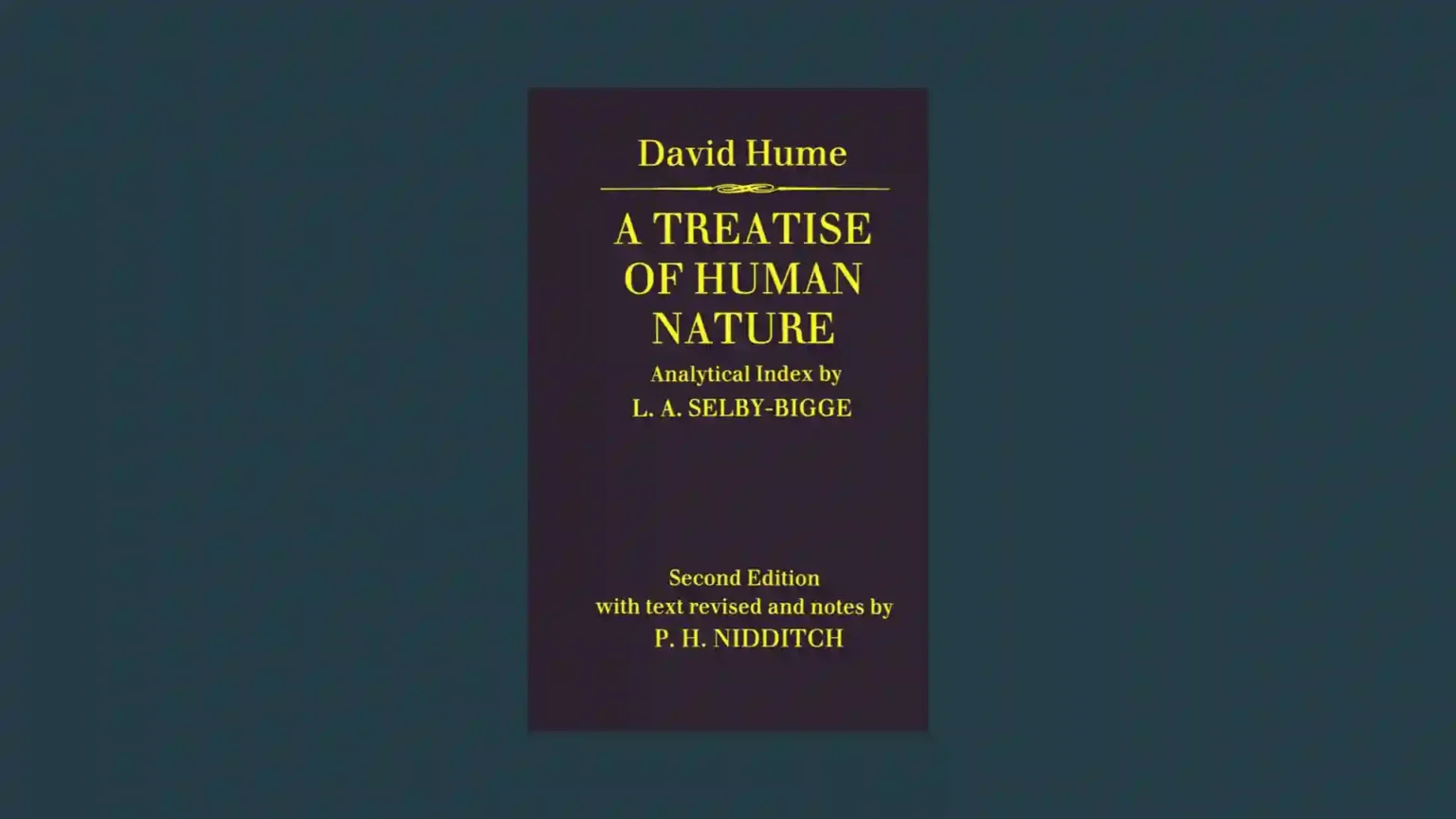
Cover artwork: credits and source records
- A Treatise of Human Nature — Oxford University Press (source record)