The Descartes dream argument occurs in a precise place in the Meditations; locating it keeps the skeptical scenario distinct from later replies.
Readers often remember Descartes’s dream argument as a detachable thought experiment: perhaps I am dreaming now, therefore sensory experience cannot guarantee certainty. Scholars disagree, however, about how much skepticism Descartes means the passage to generate. The Stanford Encyclopedia of Philosophy’s treatment of Descartes’s epistemology distinguishes a narrower “now dreaming” doubt from a stronger “always dreaming” doubt and argues that textual evidence can be found for both. That disagreement matters because the safest way to locate the argument is not by searching for a famous slogan. It is by following the architecture of the Meditations itself.
The exact place is Meditation I, at AT VII 19 / CSM II 13 — but the argument begins before the famous dream paragraph
The canonical location is the First Meditation, “Concerning Those Things That Can Be Called into Doubt.” In the standard Adam–Tannery citation system the most famous passage is at AT VII 19; in the Cottingham–Stoothoff–Murdoch translation it is CSM II 13. The Stanford entry reproduces that reference when Descartes recalls sitting by the fire, holding paper, and then remembers that dreams have sometimes presented him with experiences of comparable vividness. An open modern-English text is also available through Early Modern Texts’ complete Meditations PDF, while its Descartes author page keeps the Meditations beside other Cartesian texts. These are useful for finding the sequence even when a print edition uses different page numbers.
Yet the argument starts one move earlier. Descartes first tests ordinary sensory error: distant towers look round when they are square; perceptual conditions can mislead. That is not enough for his method, because occasional error does not show that ordinary close-range experience is globally unreliable. The dream move increases the pressure. If an experience that seems maximally ordinary from within can occur during sleep, then the meditator lacks an infallible mark, at this stage, that the present sensory situation is waking. The evidence is the passage; the inference is that present sensory judgments lose the certainty required by the method; the stronger judgment that “all experience is a dream” is not yet something Descartes has established.
That distinction is easy to blur in anthologies. A one-paragraph excerpt can make Descartes look as though he jumps directly from “I have dreamed” to total skepticism. The surrounding First Meditation shows a graded sequence instead: ordinary sensory mistakes, dreaming, then the hypothesis of a powerful deceiver. The dream argument destabilizes beliefs tied to the current sensory scene, but Descartes immediately notes that dreams appear to be composed from simpler elements. Shape, quantity, extension, duration, and similar features therefore survive the first dream pressure more readily than claims such as “I am sitting here by the fire.” The later deceiver hypothesis is introduced precisely because Descartes wants to push doubt farther.
Why the Sixth Meditation belongs in any serious citation of the dream argument
If the research question is only “Where is the famous passage?”, Meditation I is the answer. If the question is “What is Descartes’s dream argument?”, stopping there is incomplete. In Meditation VI Descartes explicitly looks back at the earlier doubt. At AT VII 77 / CSM II 53 he recalls that every sensory experience he had taken himself to have while awake could also be represented in sleep. The Stanford analysis treats this retrospective passage as important evidence for the stronger formulation of dreaming doubt: the problem is not merely whether this particular moment is a dream, but what warrants the assumption that waking perception has a different causal relation to external things.
Near the end of Meditation VI the direction changes again. At AT VII 89–90 / CSM II 61–62, Descartes appeals to the way waking perceptions can be connected with memory, multiple senses, and the rest of one’s life. Read superficially, this can sound like a simple continuity test: dreams are discontinuous, waking life is coherent. The actual Cartesian position is less naturalistic. The continuity claim sits inside the larger reconstruction of trust in cognition and within Descartes’s theistic framework. The same Stanford discussion stresses that the conclusion depends on the claim that God is not a deceiver. Thus Meditation VI is not merely a psychological appendix to the famous skeptical scene; it tells us what Descartes thinks has changed since Meditation I.
This return also prevents a common classroom mistake. The dream argument is not a permanent thesis that Descartes leaves untouched. It is an instrument in a method: doubt removes presumptive certainty; subsequent arguments are supposed to rebuild justified confidence under stricter conditions. A reader interested in Descartes’s skepticism should therefore mark at least three textual sites: the dream passage in Meditation I, the retrospective formulation in Meditation VI, and the closing attempt to discriminate waking experience from dreaming.
The edition question has two different answers: best for reading, and best for scholarly cross-reference
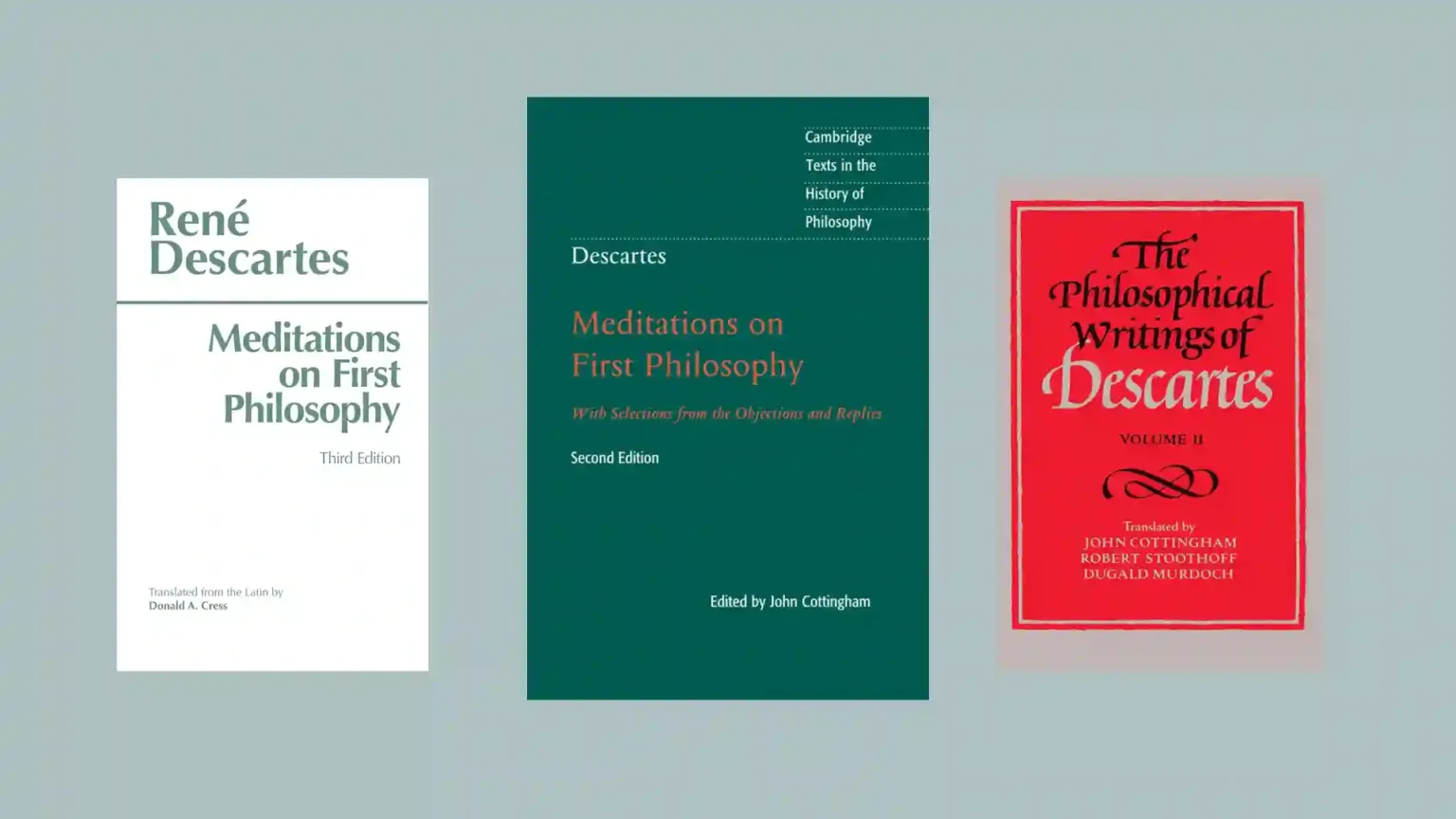
For a compact standalone English text, Donald A. Cress’s Hackett third edition of Meditations on First Philosophy remains unusually practical. Hackett describes the 1993 revision as aiming at both readability and fidelity, and the volume is only seventy-two pages. Its small scale is an advantage if the goal is to read the six meditations as a continuous argument rather than encounter them as isolated excerpts. The table of contents places the First Meditation at the beginning of the main text, making the dream passage easy to relocate in a classroom or personal reading copy.
For readers who want the Meditations together with strategically chosen responses from Descartes’s critics, John Cottingham’s Cambridge second edition, Meditations on First Philosophy: With Selections from the Objections and Replies is stronger. The 2017 edition updates Cottingham’s established translation and includes thematic selections from the Objections and Replies. That matters because skeptical arguments become clearer when one sees what Descartes’s contemporaries pressed him to explain. A reader who already uses BookInLight’s broader guide to learning how to read philosophy through primary texts will also recognize the benefit of pairing a famous argument with the textual context that generated objections.
For research citations, the most useful English reference remains volume 2 of The Philosophical Writings of Descartes, translated by John Cottingham, Robert Stoothoff, and Dugald Murdoch. That Cambridge volume is the source behind the familiar “CSM II” citation form. Using CSM alongside the Latin Adam–Tannery reference has a practical advantage: page numbers in commercial editions can change, but AT/CSM references let readers using different books locate the same passage. For the dream scene, AT VII 19 / CSM II 13 is therefore more portable than saying “page 14” without naming an edition.
The claim to carry forward is narrower than the slogan
The primary text establishes a methodological problem: at the First Meditation stage, the meditator lacks an absolutely certain sign that his present sensory experience is waking rather than dreaming. It does not by itself prove that the external world is unreal, that life is literally a dream, or that Descartes remains a skeptic at the end of the work. Those are interpretations or extrapolations, not the passage itself. The textual record is more disciplined: Descartes raises the dream doubt, escalates beyond it, then later revisits it after the metaphysical work of the intervening meditations.
One further distinction belongs in the locator because it controls how the passage is taught. The dream argument and the evil-deceiver hypothesis are not interchangeable labels for radical doubt. Dreaming begins from an ordinary phenomenon and challenges confidence in the present sensory scene. The deceiver hypothesis is deliberately more artificial: it puts pressure even on judgments that appear independent of current sensation, including elementary reasoning. If a secondary source says that the dream argument by itself makes mathematics doubtful, check the First Meditation sequence again. Descartes has not yet reached that stage. The order of doubts is evidence about their intended scope, not merely a dramatic arrangement.
The same source discipline applies to citation. Page numbers such as “13” or “14” are useful only within a named edition; AT and CSM references travel across editions. When quoting a translation, cite the page of the translation actually used and, where appropriate, add AT VII 19 so another reader can verify the Latin context. When discussing the later solution, cite the Sixth Meditation passage rather than paraphrasing the First Meditation as if it contained Descartes’s final view. This small bibliographic habit prevents a surprisingly common interpretive error: allowing the fame of the dream scene to erase the argumentative chronology of the book.
A locator guide should therefore preserve both the dramatic scene and the citation infrastructure around it. The scene is memorable; the infrastructure is what makes interpretation checkable across translations and classrooms.
For a first reading, use Cress and mark the three dream-related locations. For a course or a reading group, use Cottingham’s standalone Cambridge edition so that selected objections sit nearby; Cambridge’s Volume 2 of The Philosophical Writings of Descartes is the fuller research companion behind the CSM shorthand. For research, cite AT and CSM together and consult the full Cambridge philosophical writings. Those three routes answer three different needs without pretending that one physical edition is universally “best.”
Cover artwork: credits and source records
- Meditations on First Philosophy — Hackett (source record)
- Meditations on First Philosophy — Cambridge University Press (source record)
- The Philosophical Writings of Descartes, Volume 2 — Cambridge University Press (source record)