
What to Read Before Marx’s Capital, Volume I is a narrower question than the book’s reputation suggests. You do not need to complete Hegel, master nineteenth-century economics, or absorb every earlier Marx. You need a firm grip on commodities, value, money, labor-power, and surplus value; a modest acquaintance with classical political economy; and enough industrial history to understand why the working day becomes a battlefield.

Target text
Capital: Critique of Political Economy, Volume 1: The strongest current reading edition
Author: Karl Marx
Translator and editors: Paul Reitter; edited by Paul Reitter and Paul North, with a foreword by Wendy Brown and an afterword by William Clare Roberts
Edition: Princeton University Press hardcover, 2024, ISBN 9780691190075
Why this edition: It translates the second German edition of 1872–73, the last German text Marx personally revised, and supplies unusually substantial linguistic and historical notes. Reitter’s English is more mobile and rhetorically alert than older versions.
Main limitation: Many decades of English-language Marx scholarship cite Ben Fowkes’s Penguin pagination and terminology, so advanced readers will still want the Fowkes translation nearby.
Best suited to: First-time readers who want a readable complete text without sacrificing textual seriousness.
The Short Answer: What to Read Before Marx’s Capital, Volume I
You can begin Capital, Volume I after learning six ideas—commodity, value, abstract labor, labor-power, surplus value, and capital—and reading Marx’s short Value, Price and Profit. Add selected chapters from Adam Smith and David Ricardo, plus a concise account of industrial Britain. Hegel, the Grundrisse, and the whole early Marx can wait.
That is the practical answer. Marx wrote a critique of political economy, not a textbook of Marxism. The book often teaches the concepts that later traditions tell readers they must already possess. Over-preparation can therefore be as damaging as under-preparation: it encourages the reader to import ready-made doctrines into an argument whose categories are deliberately unfolded, tested, and transformed.
The genuine preliminary burden is modest but exacting. Know why a capitalist worker sells labor-power rather than “labor”; why exchange among formally free owners can coexist with exploitation; why value is not simply price; and why Marx begins with the commodity instead of with class struggle or industrial misery. A short orientation to Britain’s factory system, parliamentary regulation, and expropriation from means of subsistence will make the historical chapters legible. Then start the book. Do not wait until you feel qualified by an entire canon.
Why Capital, Volume I Is Difficult
Capital is difficult first because its order is conceptual rather than historical. Marx begins with the commodity, moves through value-form and money, and only then reaches capital, wage labor, the working day, machinery, accumulation, and expropriation. Readers impatient for factories or revolution can mistake the opening chapters for an abstract detour. They are the load-bearing structure: Marx is showing how privately organized labors acquire a social form through exchange and how money becomes capable of functioning as capital.
Second, ordinary words perform technical work. “Value” is not market price, moral worth, or utility. “Abstract labor” is not dull work. “Productive labor” is not socially beneficial labor. “Primitive accumulation” is not merely an early pile of savings. The Stanford Encyclopedia of Philosophy’s account of Marx is useful precisely because it distinguishes these claims from later slogans, though it cannot replace the sequence of Marx’s own exposition.
Third, the book changes register without warning. It can pass from compressed conceptual derivation to sarcastic polemic, algebraic notation, parliamentary evidence, technological history, literary quotation, and scenes of bodily exhaustion. The chapter on the working day relies on factory inspectors and legislation; the chapter on machinery combines economic logic with technical and social history; the final part turns toward conquest, slavery, colonialism, enclosure, and state violence. Background helps, but some difficulty belongs to the book’s construction and cannot be removed in advance.
Finally, English readers now face an edition question. The 2024 Reitter translation follows the second German edition, while the familiar Fowkes translation follows Engels’s fourth German edition. The difference is not simply old English versus new English: it concerns which authorized textual state is foregrounded and how German compounds, irony, and technical vocabulary are rendered. A recent scholarly assessment of the Reitter translation clarifies the stakes of that choice. The new edition is the better first purchase; the Ben Fowkes Penguin edition remains the indispensable scholarly cross-reference.
The Dependency Map at a Glance
Essential Before Reading
Essential before reading For readers asking What to Read Before Marx’s Capital, Volume I, the decisive point is that no external book is absolutely indispensable. What is indispensable is a small conceptual framework. Begin by separating a commodity’s usefulness from its social form as value. A coat and linen are materially different; in exchange they become commensurable. Marx asks what social organization makes that commensurability possible. His answer is not that every commodity contains a visible substance called value, but that products of separate private labors are socially validated through exchange and measured by socially necessary labor time.
The second indispensable distinction is between labor and labor-power. The worker does not sell a predetermined quantity of labor as though handing over a finished object. The worker sells a capacity to work for a period. The value of that capacity is related to the socially necessary means of reproducing it; its use in production can create more value than its own value. This difference allows Marx to explain surplus value while assuming, at the level of the argument, that commodities exchange at their values. Exploitation does not require a shopkeeper’s cheat or an obviously unfair wage contract.
Third, know the elementary circuit. Commodity exchange can be represented as C–M–C: one commodity is sold in order to buy another. Capital moves as M–C–M′: money is advanced to return as more money. The apostrophe matters. The question driving the middle of the book is where the increment comes from if exchange merely swaps equivalents. Labor-power, purchased in the market and consumed in production, is Marx’s answer.
The necessary history is equally selective. Understand that industrial workers were legally free but increasingly separated from land, tools, and independent subsistence; that factory discipline reorganized time around machinery and supervision; and that the length of the working day became a political and legal conflict. The UK Parliament’s history of factory legislation supplies enough chronology for a first reading. Marx’s empirical chapters will then deepen, complicate, and often darken that outline.
Strongly Recommended Background
The best short preparation is Marx speaking to an audience rather than constructing the architecture of Capital. Value, Price and Profit, delivered in 1865, explains wages, labor-power, profit, and the struggle over the working day in a relatively direct manner. It does not solve the opening chapter’s value-form problem, and its compression can make Marx’s theory look more straightforward than it is. Even so, it gives a first-time reader the right questions before the long argument begins.

Short substitute for a larger prerequisite
Wage-Labour and Capital / Value, Price and Profit: Marx’s compact rehearsal
Author: Karl Marx
Edition: International Publishers combined paperback, ISBN 9780717804702
Dependency level: Strongly recommended
Why it matters: The later address gives a concise route into wages, labor-power, surplus value, and trade-union struggle without requiring the reader to reconstruct classical economics first.
How much to read: Read Value, Price and Profit in full. Treat the earlier Wage-Labour and Capital as supplementary because its terminology predates Marx’s mature distinction between labor and labor-power.
Classical political economy matters because Marx’s critique is immanent: he takes questions formulated by Adam Smith and David Ricardo—labor, value, wages, profit, rent, accumulation—and argues that their categories reveal more than their authors understood. You do not need the whole of either major treatise. In Smith, use the Andrew Skinner Penguin edition to read the division of labor, exchange, the components of price, wages, profit, and accumulation. In Ricardo, concentrate on the opening chapter on value and the chapters on wages and profits in the Sraffa-edited Principles. The point is to recognize Marx’s problem-field, not to become a Ricardian before page one.

Strongly recommended
The Wealth of Nations, Books I–III: The vocabulary Marx inherits and overturns
Author: Adam Smith
Editor: Andrew Skinner
Edition: Penguin Classics paperback, 2003, ISBN 9780140432084
Dependency level: Strongly recommended
Why it matters: Smith supplies the canonical account of division of labor, exchange, wages, profit, stock, and productive labor against which Marx repeatedly works.
How much to read: Book I, chapters 1–8, then Book II, chapters 1–3. The remainder is valuable history of economics, not a gateway toll.
Helpful but Optional Context
The Oxford World’s Classics edition of Engels’s 1845 study gives names, streets, diseases, housing conditions, labor processes, and class antagonisms to the world that later appears in Marx’s factory chapters. It should not be treated as neutral reportage: Engels writes polemically, generalizes from selected districts, and belongs to the political history he describes. Read selectively for texture and then let Marx’s own use of parliamentary evidence take priority.

Helpful background
The Condition of the Working Class in England: The industrial landscape behind the evidence
Author: Friedrich Engels
Editor: David McLellan
Edition: Oxford World’s Classics paperback, reissued 2009, ISBN 9780199555888
Dependency level: Helpful background
Why it matters: It makes the factory town, housing crisis, disease environment, reserve labor force, and antagonism of classes materially visible.
How much to read: The introduction, “The Great Towns,” “Competition,” and the chapters on factory labor. Read the whole book only for a historical study project.
Marx’s early writings are more ambivalent preparation. The 1844 manuscripts clarify alienation, objectification, species-being, and Marx’s break with political economy at an earlier stage. They also tempt readers to translate every mature category back into a philosophy of alienated human essence. That move can illuminate some passages and flatten others. The mature critique asks how historically specific social forms operate; it is not simply the youthful theory with more economics added.

Helpful background
Early Writings: Useful ancestry, dangerous master key
Author: Karl Marx
Translator and introduction: Rodney Livingstone and Gregor Benton; introduction by Lucio Colletti
Edition: Penguin Classics paperback, 2005, ISBN 9780140445749
Dependency level: Helpful background
Why it matters: It shows the philosophical vocabulary from which Marx’s critique of alienated labor emerged and the distance the mature work travels.
How much to read: Read the sections on estranged labor after, not necessarily before, the first three chapters of Capital. Postpone the rest unless intellectual development is your subject.
Hegel belongs in this optional category. Marx’s presentation uses inversion, mediation, contradiction, and transitions in which a form generates pressures it cannot contain. Yet reading the entire Science of Logic first is a spectacularly inefficient solution. A concise account of Hegelian dialectic and Marx’s 1873 postface is enough for a first encounter. Readers who need a fuller route can use BookInLight’s Hegel guide linked near the end.
Concepts to Learn First
Commodity, use-value, and value
A commodity is a useful thing produced for exchange. Its use-value names its material usefulness; value names a historically specific social relation expressed through exchange. Exchange-value is the form in which value appears as a quantitative relation between commodities. The common error is to treat value as a substance physically hidden inside the object or to identify it with price. Learn the distinctions in outline, but expect chapter 1 to establish them more rigorously.
Concrete and abstract labor
Concrete labor is labor in a determinate useful form: weaving, tailoring, mining, printing. Abstract labor is not mentally vague labor or merely homogeneous physical effort. It is labor considered in the social form through which unlike private labors count as portions of total social labor in commodity exchange. The distinction is central because the same activity produces a use-value as concrete labor and value as abstract labor.
Socially necessary labor time
Value is not determined by how long an unusually slow worker happens to take. Socially necessary labor time is the labor time required under normal conditions of production, with the average degree of skill and intensity prevalent in a society. The standard is social and mobile. Productivity changes can therefore reduce a commodity’s value even when the physical effort of a particular worker has not changed.
Labor-power and surplus value
Labor-power is the worker’s capacity to labor, sold for a wage. Its use-value for the capitalist is that it can create value beyond the value required to reproduce it. Necessary labor time reproduces the equivalent of the wage; surplus labor time produces surplus value. This is not a moral definition of every injustice at work. It is a structural explanation of how capital expands through production even when exchange is formally lawful and equivalent.
Constant and variable capital
Means of production transfer existing value to the product and are called constant capital. Expenditure on labor-power is variable capital because living labor can create new value greater than the value advanced for wages. “Constant” does not mean technologically fixed, and “variable” does not mean wages fluctuate. The terms describe different roles in the valorization process.
Absolute and relative surplus value
Absolute surplus value increases by extending or intensifying the working period beyond necessary labor time. Relative surplus value increases when productivity lowers the value of labor-power and reduces the portion of the day needed to reproduce the wage. The distinction explains why technology is not simply labor-saving: under capitalist imperatives it reorganizes control, skill, pace, and competition.
Fetishism
Commodity fetishism is not chiefly an obsession with shopping. It is the objective appearance of social relations among producers as relations among things. Because private labors become socially valid through exchange, value seems to belong naturally to commodities and market movements seem autonomous. The BookInLight essay on commodity fetishism develops this distinction, but the concept is best learned after wrestling with Marx’s value-form analysis yourself.
The Texts You Do Not Need to Read First
You do not need Hegel’s Science of Logic or Phenomenology of Spirit before Capital. Hegel matters, but a complete preliminary immersion replaces one difficult project with another and encourages readers to hunt for philosophical templates instead of following Marx’s economic categories. Learn mediation, contradiction, appearance, essence, and immanent critique at an introductory level; return to Hegel when a specific problem demands it.
You do not need the Grundrisse. Its notebooks reveal abandoned routes, exploratory formulations, and insights absent from the published text. They are invaluable for specialists and hazardous as an entrance because they lack the disciplined order Marx chose for publication. Nor is A Contribution to the Critique of Political Economy compulsory, though its 1859 preface and opening discussion of commodities can reward a full scholarly route.
The Communist Manifesto is not a conceptual prerequisite. It is short, famous, and politically electric, but it belongs to 1848 and a different genre. Reading it first can make Capital look like an elaborate proof of conclusions already announced. Likewise, biographies of Marx, histories of Marxism, Lenin, Lukács, Althusser, and twentieth-century debates about “orthodox” Marxism should not govern the first encounter.
You also do not need all three volumes in advance—an impossibility disguised as preparation. Volume I analyzes the production of capital; Volumes II and III address circulation, turnover, reproduction, profit, credit, rent, and the distribution of surplus value. They correct simplistic conclusions drawn from Volume I, but they belong after a first passage through it. Read the book in front of you before importing the system reconstructed by Engels and later interpreters.
The Full Scholarly Preparation Route
- Reconstruct classical political economy. Read Smith’s Book I selections and Ricardo on value, wages, and profits. Add Malthus only if studying Marx’s theory of population, rent, or crisis. The goal is to identify what Marx preserves, reformulates, and historicizes.
- Trace Marx’s conceptual development selectively. Read the 1844 manuscript on estranged labor, the “Theses on Feuerbach,” selected passages from The German Ideology, and the 1859 preface. Do not assume continuity where vocabulary and method change.
- Study the unpublished workshop. Use selected Grundrisse passages on money, precapitalist formations, and machinery only after establishing the published argument. Compare exploratory insights with what Marx retained.
- Deepen the social history. Read Engels beside modern histories of the factory system, working-class formation, slavery, colonial trade, agrarian change, and enclosure. Marx’s account of “so-called primitive accumulation” should be tested, not merely repeated.
- Read textually. Compare the 1872–73 German edition behind Reitter with Fowkes’s translation of the Engels-edited fourth edition and consult the digitized first-edition record when edition history affects interpretation.
Recommended Companions While Reading
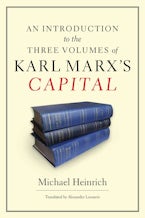
A companion should answer local questions without becoming a substitute text. Michael Heinrich is the best compact conceptual guide. His emphasis on value-form, money, and the unfinished character of Marx’s project corrects crude “labor embodied” readings. It is also an interpretation, not neutral scaffolding; readers should notice where his monetary account of value and rejection of certain collapse theories enter contested terrain.
Recommended companion
An Introduction to the Three Volumes of Karl Marx’s Capital: The clearest compact map
Author: Michael Heinrich
Translator: Alex Locascio
Edition: Monthly Review Press paperback, 2012, ISBN 9781583672884
Dependency level: Strongly recommended
Why it matters: It explains how the categories of all three volumes fit together and warns against reducing Marx to a simple labor-quantity theory.
How much to read: Read the opening chapters alongside Parts One and Two of Capital; save Heinrich’s treatment of later volumes until afterward.
David Harvey offers something different: a paced reading course attentive to crisis, geography, technology, and the movement of the argument. His prose is welcoming and his practical advice helps readers survive chapter 1. The limitation is precisely his strength—he reads Capital through a powerful, long-developed interpretation. Use the Verso companion after making your own notes, not before every paragraph.

Recommended companion
A Companion to Marx’s Capital: The best guided seminar in book form
Author: David Harvey
Edition: Verso paperback, 2010, ISBN 9781844673599
Dependency level: Helpful background
Why it matters: Harvey follows the sequence closely, connects conceptual and historical chapters, and keeps the reader moving through difficult transitions.
How much to read: Read the corresponding chapter only after completing Marx’s section. Compare Harvey with Heinrich when their emphases diverge.
Suggested Reading Sequence
What to Read Before Marx’s Capital, Volume I becomes manageable when preparation and reading alternate rather than forming two separate projects. Use this order.
- Prepare lightly. Complete Value, Price and Profit, learn the six core distinctions, and review industrial legislation. This is enough to begin.
- Read the prefaces and chapter 1 without rushing. Mark every shift among use-value, exchange-value, value, and value-form. Read the fetishism section, then return to the opening pages.
- Finish chapters 2–3 before seeking rescue. The movement from commodity to money clarifies difficulties that no prior glossary can solve. Consult Heinrich afterward.
- Pause after the transformation of money into capital. Revisit labor-power and the M–C–M′ circuit. Read the relevant Smith and Ricardo selections if Marx’s opponents remain indistinct.
- Move steadily through production. The working-day and machinery chapters are long but concrete. Use Engels and factory history selectively; do not turn every footnote into a research project.
- Read accumulation as the return of the opening categories at a larger scale. Commodity, labor-power, surplus value, technology, and class reproduction now become a dynamic system.
- Only after completion, interpret the whole. Compare Reitter with Fowkes, read Postone or Rubin, and proceed to Volumes II and III before making claims about Marx’s complete theory of capitalism.
What to Read Afterward
The first obligation is to continue Marx. Volume II shows why production cannot be understood apart from circulation, turnover, and social reproduction. Volume III examines the transformation of surplus value into profit, the equalization of profit rates, commercial and interest-bearing capital, credit, and rent. Many apparent refutations or defenses of Volume I collapse because they treat its provisional level of abstraction as Marx’s final word.
Then choose an afterlife according to the question the book has opened. Isaak Rubin is exceptionally good on value-form and fetishism. Rosa Luxemburg, Lenin, and later theories of imperialism ask how accumulation exceeds the national frame. Feminist social-reproduction theory presses on the reproduction of labor-power and unpaid work. Histories of slavery, colonial expropriation, race, and ecology test where Marx’s account is powerful, partial, or internally unfinished.
The Cambridge edition of Moishe Postone’s reinterpretation is among the most consequential afterlives because he refuses to identify Marx’s critical standpoint simply with industrial labor. He reads value and abstract labor as historically specific forms of social mediation and domination. That makes the book illuminating after Capital and distorting before it: Postone’s reconstruction is too strong to serve as transparent orientation.

Better read afterward
Time, Labor, and Social Domination: A powerful reinterpretation after the first encounter
Author: Moishe Postone
Edition: Cambridge University Press paperback, 1993, ISBN 9780521565400
Dependency level: Better read afterward
Why it matters: Postone recasts value and abstract labor as impersonal forms of domination, challenging traditional accounts that make labor the uncomplicated standpoint of emancipation.
How much to read: Read the introduction and chapters 4–6 after finishing Volume I; complete the book for advanced work in critical theory.
Related BookInLight Reading Guides
Editorial research and authorship: This reading guide was researched and written by the BookInLight Department of Economics and Political Economy, with bibliographical review, source verification, and editorial fact-checking by the BookInLight research team. Readers who identify a factual correction, an overlooked source, a valuable interpretive possibility, or another constructive improvement are warmly invited to share their comments and suggestions.
Art direction and rights: The editorial art direction, visual composition, cover selection, and presentation of images were developed by the BookInLight Art Department. Individual book covers remain the property of their respective publishers, designers, artists, and rights holders and are credited below. Complete republication, reproduction, translation, or reuse of this article, whether in print or digital form, is permitted only with prior written authorization from BookInLight.
Sources and Further Reading
Primary Texts and Editions
1. Karl Marx, Capital: Critique of Political Economy, Volume 1, translated by Paul Reitter, edited by Paul Reitter and Paul North, Princeton University Press, 2024. Target edition and basis for translation and apparatus judgments.
2. Karl Marx, Capital, Volume I, translated by Ben Fowkes, Penguin Classics. Standard English comparison text and terminology.
3. Karl Marx, Wage-Labour and Capital / Value, Price and Profit, International Publishers. Short preliminary route into wages and surplus value.
4. Karl Marx, Early Writings, translated by Rodney Livingstone and Gregor Benton, Penguin Classics. Marx’s early account of estranged labor.
5. Adam Smith, The Wealth of Nations, Books I–III, edited by Andrew Skinner, Penguin Classics, 2003. Division of labor, wages, profit, and accumulation.
6. David Ricardo, On the Principles of Political Economy and Taxation, in the Sraffa edition. Marx’s principal classical-economic interlocutor on value and distribution.
7. Friedrich Engels, The Condition of the Working Class in England, edited by David McLellan, Oxford World’s Classics, 2009. Industrial and urban context.
Textual and Historical Context
8. German History in Documents and Images, “Karl Marx, Das Kapital, Volume 1, First Edition (1867)”. First-edition publication record and digitized-copy gateway.
9. International Institute of Social History, “Das Kapital Published 150 Years Ago”. Marx’s corrected first-edition copy and publication context.
10. UK Parliament, “The 1833 Factory Act”. Institutional context for the working-day chapters.
11. Paul Reitter and Paul North, “Editor’s Introduction” to the 2024 Princeton edition. Edition history, translation method, and textual choices.
Scholarly Studies and Companions
12. Jonathan Wolff and David Leopold, “Karl Marx,” Stanford Encyclopedia of Philosophy. Reliable orientation to alienation, history, economics, and communism.
13. Michael Heinrich, An Introduction to the Three Volumes of Karl Marx’s Capital, translated by Alex Locascio, Monthly Review Press, 2012. Compact conceptual companion.
14. David Harvey, A Companion to Marx’s Capital, Verso, 2010. Chapter-by-chapter reading assistance.
15. Moishe Postone, Time, Labor, and Social Domination, Cambridge University Press, 1993. Advanced reinterpretation of value and abstract labor.
16. Ulrich Plass, “More Marx, Less Marxism? Reconsidering Capital, Volume 1”, Modern Intellectual History. Scholarly assessment of the Reitter translation.
17. Christian Gehrke, review of the Reitter–North edition, European Journal of the History of Economic Thought, 2025. History-of-economic-thought evaluation of the new edition.
Image Credits
1. Capital: Critique of Political Economy, Volume 1, Princeton University Press hardcover, 2024. Cover designed for Princeton University Press; image delivered via Wikimedia Commons from the publisher asset. Exact-edition source page.
2. Wage-Labour and Capital / Value, Price and Profit, International Publishers combined paperback, ISBN 9780717804702. Cover image delivered via Bol.com’s product-image server and matched to the publisher edition. Publisher source page.
3. The Wealth of Nations, Books I–III, Penguin Classics paperback, 2003, ISBN 9780140432084. Cover image supplied through Penguin UK’s public image service. Publisher source page.
4. The Condition of the Working Class in England, Oxford World’s Classics paperback, 2009, ISBN 9780199555888. Cover image delivered via The Nile and matched to the Oxford edition. Publisher source page.
5. Early Writings, Penguin Classics paperback, 2005, ISBN 9780140445749. Cover image supplied through Penguin UK’s public image service. Publisher source page.
6. An Introduction to the Three Volumes of Karl Marx’s Capital, Monthly Review Press paperback, 2012, ISBN 9781583672884. Cover image supplied through the publisher’s Imgix service. Publisher source page.
7. A Companion to Marx’s Capital, Verso paperback, 2010, ISBN 9781844673599. Cover image supplied through Verso’s public product-image service. Publisher source page.
8. Time, Labor, and Social Domination, Cambridge University Press paperback, ISBN 9780521565400. Cover image supplied through Cambridge University Press’s public asset server. Publisher source page.