Books on Russian Formalism trace disputes over literariness, defamiliarization, narrative construction, and later reinterpretations.
The phrase “Russian Formalism” creates a historical illusion: one movement, one method, one doctrine about form. The books themselves refuse that simplification. Some foreground devices and defamiliarization; some reconstruct rival groups and institutional pressures; some read Formalism retrospectively through structuralism, semiotics, Marxism, or systems theory. The useful question is not “which book defines Formalism correctly?” but “what history of Formalism does this book make possible, and what does that history push to the edge?”
What counts as the primary object?
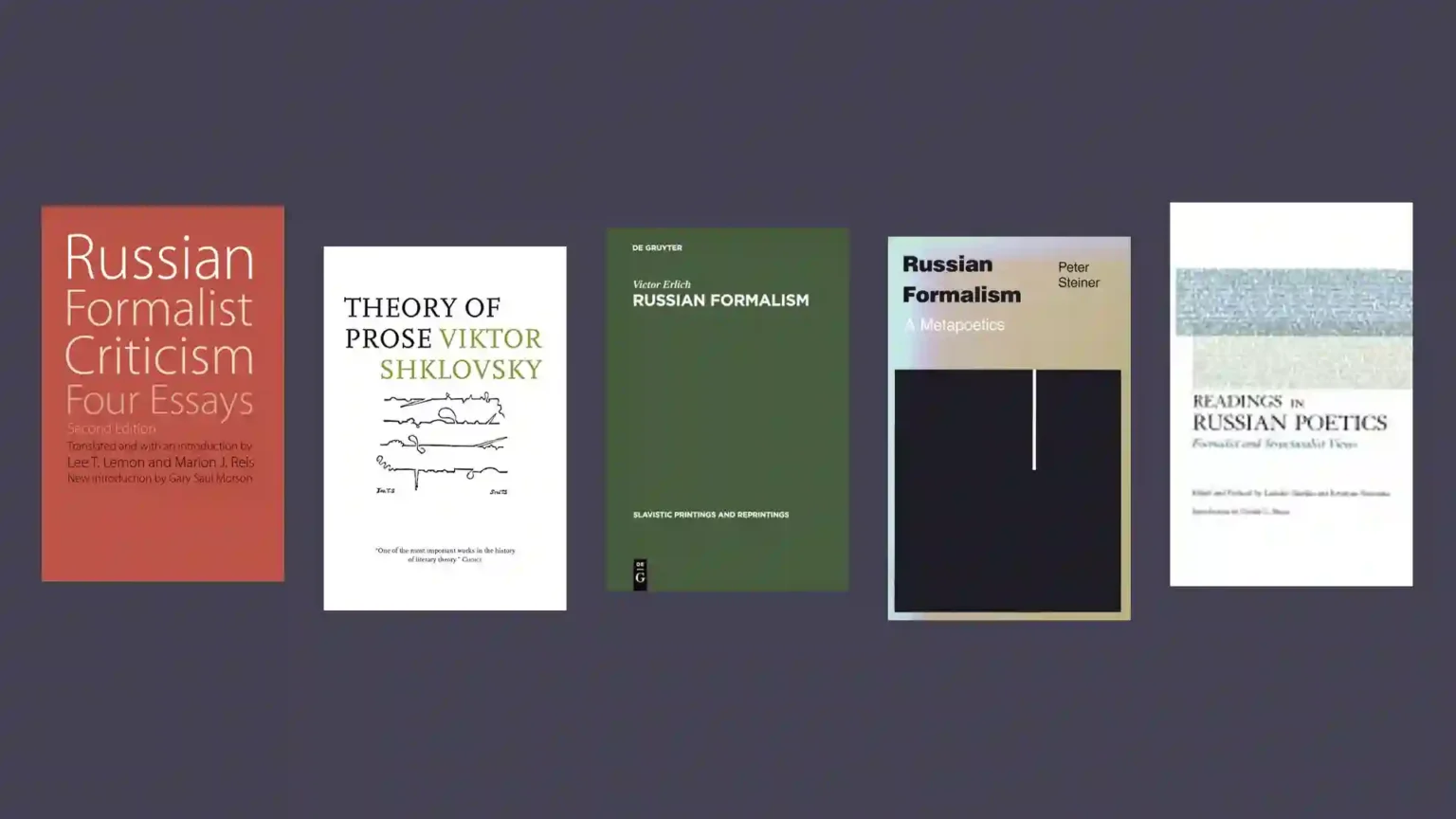
Russian Formalist Criticism: Four Essays is the cleanest compact starting point because it lets four primary interventions disagree in front of you. The Nebraska edition includes Shklovsky’s “Art as Technique,” his essay on Tristram Shandy, Boris Tomashevsky’s “Thematics,” and Boris Eichenbaum’s “The Theory of the ‘Formal Method.’” Read the volume before accepting any secondary description that reduces Formalism to “art makes the familiar strange.” Shklovsky’s device, Tomashevsky’s plotting vocabulary, and Eichenbaum’s retrospective defense are already different intellectual operations.
Shklovsky’s Theory of Prose is the second book because it turns an often-excerpted theorist back into a sustained critic of narrative construction. The Dalkey bibliographic tradition preserves essays on plot devices, framing, repetition, and prose form; the press’s relaunch notes that its scholarly series continues Shklovsky’s work in new editions. Reading only “Art as Technique” makes ostranenie look like a detachable concept. Theory of Prose makes it one instrument inside a much wider practice of analyzing how narrative delays, repeats, embeds, motivates, and rearranges material.
When does “Formalism” become a historical movement?
Victor Erlich’s Russian Formalism: History—Doctrine is still indispensable because it helped stabilize the movement as an object of anglophone intellectual history. Its strength is scale: people, groups, arguments, literary context, and doctrine appear together. Its limitation is equally productive. Once a movement has been written as a coherent historical formation, later readers can forget how much coherence is the historian’s achievement. Read Erlich not only for what happened, but also for the categories by which Formalism became narratable after the fact.
Peter Steiner’s Russian Formalism: A Metapoetics deliberately revises that inherited map. The open-access Cornell/JSTOR edition describes Formalist thought through governing metaphors—mechanism, organism, system—and follows shifts from poetics toward linguistics and theories of literary history. Steiner is valuable because he refuses to make a single slogan bear the whole movement. His “metapoetics” asks how Formalists conceptualized their own explanatory machines. The Cornell open-access copy also makes this one of the easiest serious monographs to place directly beside the primary essays.
The disagreement between Erlich and Steiner is methodological as much as factual. Erlich’s large history encourages a story of emergence, conflict, doctrine, and suppression. Steiner encourages a story about changing models of explanation. Neither perspective is neutral. Put the same Eichenbaum essay under both descriptions and ask what becomes salient: institutional polemic, scientific ambition, methodological self-consciousness, or a stage in a theory of systems.
Which books show the movement escaping its own borders?
A fifth place in the route belongs to anthologies that connect OPOYAZ and the Moscow Linguistic Circle to later structuralist and semiotic work. Here the value is not merely “more Formalist texts.” It is adjacency: Jakobson, Tynianov, poetics, linguistics, genre, and literary evolution begin to disturb the classroom picture in which Formalism studies isolated devices inside self-contained works. The crucial historiographical question becomes whether later structuralism is a continuation, a translation, or a selective reinvention of Formalist problems.
For that purpose, use a substantial reader of Russian poetics rather than another single-author summary. Pair it with the Nebraska primary volume and Steiner. The point is to see how a term such as “system” changes when the unit of analysis moves from a device inside one work to relations among genres, norms, periods, and functions. Formalism then looks less like an anti-history theory of autonomous texts and more like one of the places where twentieth-century literary theory learned to model historical change formally.
The sixth book should be a later critical reframing that forces the political dispute back into view—especially the charge that formal analysis detaches literature from social struggle. Formalism’s opponents did not merely fail to appreciate technique; they contested what counted as an adequate explanation of art in a revolutionary society. Reading that dispute prevents two equally easy myths: the myth of Formalists as apolitical technicians and the myth that any attention to form is automatically an evasion of history.
This is where the famous sequence “formalism → structuralism → poststructuralism” becomes too smooth. Translation history, Cold War academic institutions, selective anthologizing, and the availability of particular texts shaped what anglophone readers could call Russian Formalism. A reader who encountered Shklovsky first through a few canonical essays inherited a different movement from a reader working across Russian editions, Jakobson, Tynianov, Eichenbaum, and later archival scholarship.
How should the six-book route be used?
Use the primary anthology to establish textual control; use Theory of Prose to prevent Shklovsky from becoming one concept; use Erlich to reconstruct the movement as a historical formation; use Steiner to interrogate the explanatory metaphors inside that history; use a poetics reader to follow the migration toward structuralism; and use a politically oriented later critique to reopen the question of form and history. That route does not produce a single final definition. It produces a better disagreement.
For readers approaching Formalism from a general literary-theory syllabus, the neighboring BookInLight archive should eventually connect this article to narrative theory and hermeneutics rather than force an internal link where none is yet exact. The absence of a dedicated live Formalism page is useful here: this article can become the anchor for future pieces on defamiliarization, fabula/syuzhet, Eichenbaum, Jakobson, and Tynianov without cannibalizing a broad “best literary theory books” guide. For the adjacent problems of narration and literary method, see the narrative-theory reading guide.
The unresolved evidence is the right ending. Russian Formalism is both a historical network and a retrospective category; both a defense of literary specificity and a laboratory for theories of change; both a body of primary arguments and an object repeatedly rebuilt by translators and historians. A six-book list is worthwhile only if it leaves those tensions intact.
A concrete six-book shelf
The shelf can therefore be made explicit without pretending that all six books have the same status. First, Russian Formalist Criticism for a compact primary anthology. Second, Shklovsky’s Theory of Prose for sustained device-analysis beyond the canonical excerpt. Third, Erlich’s Russian Formalism: History—Doctrine for the movement as intellectual history. Fourth, Steiner’s Russian Formalism: A Metapoetics for a later critique of its governing models. Fifth, a broad reader in Russian poetics that gives Jakobson and Tynianov room to alter the picture. Sixth, a later study of Formalism’s relation to Marxism, ideology, or cultural history.
Notice that this shelf mixes primary and secondary genres on purpose. Replacing the primary anthology with six histories would make “Formalism” something done to the Formalists by later scholars. Replacing all histories with primary texts would hide the translation, institutional, and retrospective processes by which the movement became legible to later readers. Historiography belongs inside the syllabus, not in a prefatory note that disappears once the “real theory” begins.
One practical benefit follows. When a student writes that Formalism “ignores history,” ask which book or essay makes that claim plausible. Eichenbaum’s account of the method, Tynianov’s interest in literary evolution, Shklovsky’s changing work across decades, and later reconstructions do not line up neatly behind one proposition. The disagreement forces a stronger sentence: which Formalist, at what moment, using what unit of analysis, under what institutional pressure?
The open-access Cornell copy of Steiner is especially valuable for this comparative method because it can remain searchable beside the primary essays. A reader can move from Steiner’s account of mechanism, organism, or system back to the texts he is interpreting and decide where his reconstruction clarifies and where it over-organizes.
Bibliographic cross-checking also matters because the anglophone shelf has its own history. The Dalkey Archive relaunch note identifies Shklovsky’s prose theory as part of its continuing scholarly series; the Bibliothèque nationale de France record for Erlich fixes the third-edition Yale publication data; and Open Library’s edition record documents the early English Dalkey edition of Theory of Prose. These are not substitutes for interpretation. They keep edition history from becoming invisible while the theory is discussed.
Cover artwork: credits and source records
- Russian Formalist Criticism: Four Essays — University of Nebraska Press (source record)
- Theory of Prose — Dalkey Archive Press (source record)
- Russian Formalism: History-Doctrine — De Gruyter (source record)
- Russian Formalism: A Metapoetics — Cornell University Press (source record)
- Readings in Russian Poetics — Dalkey Archive Press (source record)