Books on narrative theory approach voice, plot, temporality, and interpretation through methods that do not always agree.
Narrative theory becomes confusing when its terms are taught as if they belonged to one completed system. They do not. “Narrator,” “focalization,” “implied author,” “storyworld,” “audience,” and “narrativity” come from different projects and often answer different questions. The seven books below are most useful when read as rival instruments. If a concept works beautifully on one text and badly on another, that failure is evidence about the theory, not merely evidence that the student has misapplied it.
1. Wayne C. Booth — The Rhetoric of Fiction
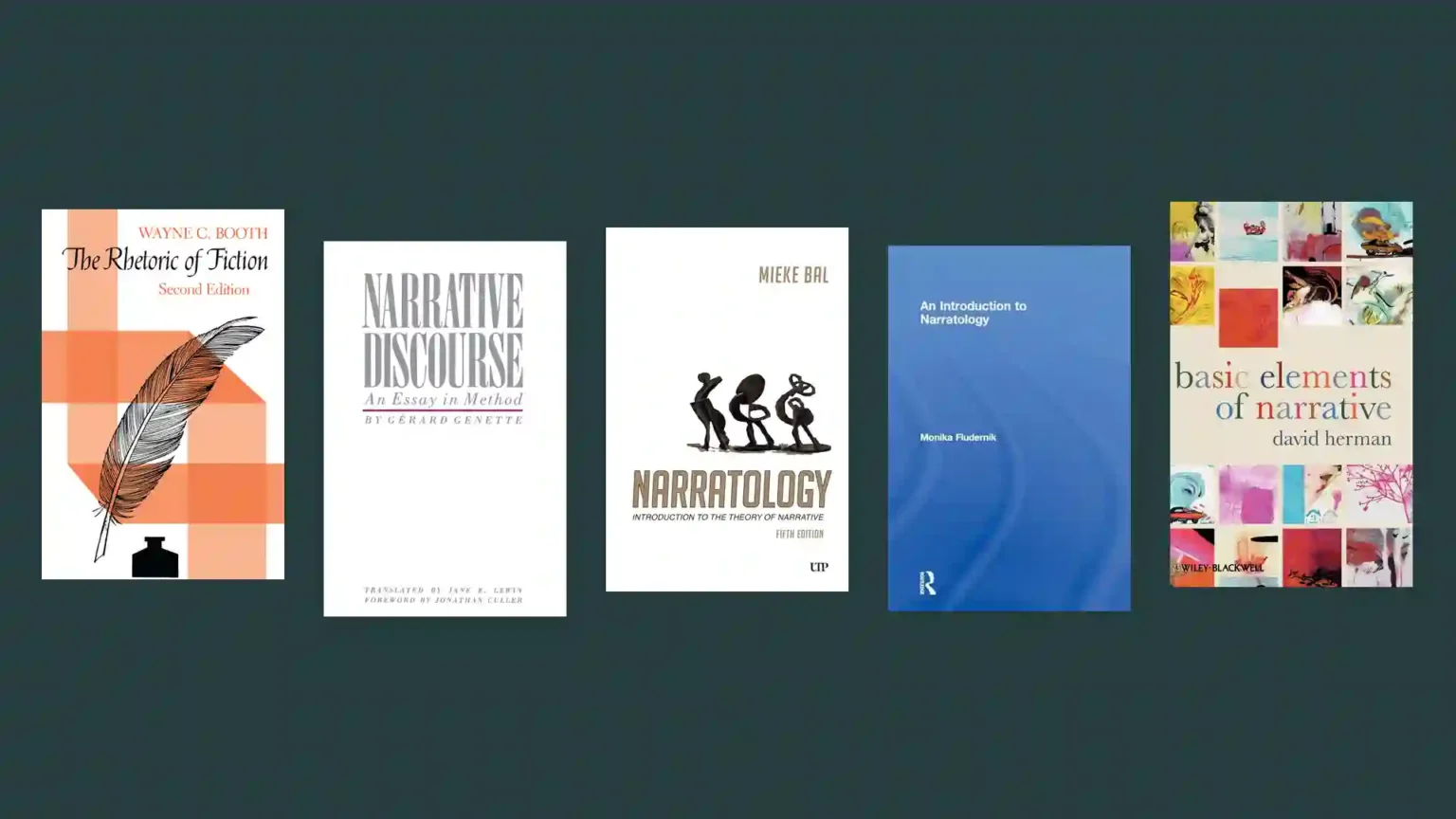
The Rhetoric of Fiction makes narrative a rhetorical transaction before “rhetorical narratology” became a settled label. Booth’s durable terms include the implied author and unreliable narrator, but the larger question is how a work guides judgments, sympathies, distances, and norms. The University of Chicago Press notes how those terms entered the standard critical vocabulary. Read Booth when the puzzle is not simply “who speaks?” but “how does the work position me toward the speaker?”
Counterexample: a theory built around rhetorical guidance can feel overdesigned when a narrative is fragmentary, collectively authored, algorithmically generated, or intentionally resistant to stable norms. That pressure is useful. Booth trains you to ask whether the effect you are describing requires a designed communicative agency or whether you have smuggled one in.
2. Gérard Genette — Narrative Discourse
Narrative Discourse is the classic structural toolkit for relations among story, discourse, and narration. Its analyses of order, duration, frequency, mood, and voice remain extraordinarily productive because they force description before interpretation. Genette’s Proust-centered system is strongest when you need to separate what happened from how the telling arranges what happened.
Counterexample: the system can describe a temporal rearrangement precisely without explaining why a reader cares, what ethical pressure the arrangement creates, or how the telling changes across media. Use Genette to isolate a mechanism; do not assume the mechanism is already an interpretation.
3. Mieke Bal — Narratology
Narratology: Introduction to the Theory of Narrative turns narratology into a teachable analytical practice that can travel beyond the novel. The current University of Toronto Press lineage presents narrative concepts as tools for literary and non-literary texts and continually revises examples as the field changes. Bal is especially useful for readers who need a systematic vocabulary but do not want narrative theory confined to one national canon or one medium.
Counterexample: portability has a cost. A category that travels from a nineteenth-century novel to film, museum display, or visual sequence may gain reach while losing some medium-specific texture. Bal is therefore best read with a question in reserve: what does this category illuminate here, and what features of this medium does it flatten?
4. Monika Fludernik — An Introduction to Narratology
An Introduction to Narratology combines the history of narratological concepts with practical analysis and later cognitive developments. Routledge’s description emphasizes style, narrative structure, speech representation, thought, realism, metafiction, typologies, and practical application. It is one of the strongest bridges between structural narratology and approaches that ask how readers recognize experientiality and narrated consciousness.
Counterexample: a theory attentive to experientiality is tested by narratives that are intentionally impersonal, schematic, procedural, or barely eventful. If a text feels narrative without giving you a richly experienceable consciousness, ask whether experientiality is a threshold, a frequent feature, or only one route to narrativity.
5. David Herman — Basic Elements of Narrative
Basic Elements of Narrative explicitly treats narrative as cognitive structure, text type, and communicative resource across literature, face-to-face storytelling, comics, and film. Herman’s “storyworld” vocabulary is powerful because it explains how readers build worlds rather than simply decode sentences. It also moves narrative theory toward mind, environment, inference, and cross-media comparison.
Counterexample: storyworld language can make even radical linguistic experiment sound too stable. A text may produce incompatible worlds, revoke its own cues, or make world-building itself the object of suspicion. The useful question then becomes not “what is the storyworld?” but “what prevents a single storyworld from settling?”
6. James Phelan — Narrative as Rhetoric
Narrative as Rhetoric begins from the proposition that someone tells a particular story to a particular audience, in a particular situation, for purposes. Phelan adds ethical and affective dimensions to technique: readers make interpretive, ethical, and aesthetic judgments as a narrative progresses. This is especially good for novels whose effects depend on changing relations among teller, audience, character, and disclosure.
Counterexample: the communicative model is hardest to stabilize in narratives with radically indeterminate address or in works where “someone telling somebody else” is precisely what the form makes obscure. Rather than rejecting the theory, use the obscurity as a test of where rhetorical agency can reasonably be located.
7. Gerald Prince — A Dictionary of Narratology
A Dictionary of Narratology is not a grand theory in the same form as the other six. That is why it belongs here. Prince provides a cross-referenced lexicon for a field whose terms are frequently borrowed without their original distinctions. The University of Nebraska Press stresses that the entries are keyed to the scholarship in which concepts originated or were exemplified. It is the book to keep beside the others when two theorists seem to use the same word differently.
Counterexample: a dictionary can tell you that a distinction exists without telling you which distinction is worth preserving in the interpretation in front of you. Terminological discipline is necessary, but it is not the same thing as explanatory power.
The claim ledger
| Book | Narrative is centered on… | Best pressure test |
|---|---|---|
| Rhetorical | Booth + Phelan: norms, audiences, judgments, purposes | agency or address that will not stabilize |
| Structural / analytic | Genette + Bal: temporal, vocal, focal, and textual relations | effects the categories describe but do not explain |
| Cognitive / experiential | Fludernik + Herman: experience, mind, storyworld construction | impersonal narratives or worlds that refuse coherence |
| Lexical / disciplinary | Prince: terms, distinctions, and their scholarly lineages | terminology without interpretive leverage |
This ledger is deliberately not a ranking. A student analyzing temporal order in Proust needs a different instrument from a student asking why a first-person narrator loses our trust; a film scholar and a scholar of conversational storytelling may need still other emphases. The best sequence is therefore diagnostic: begin with the problem your text creates, then choose the theorist whose vocabulary makes that problem more precise.
For readers coming from interpretation more broadly, BookInLight’s hermeneutics guide is a useful adjacent path because it asks a prior question: what does it mean to understand at all? Narrative theory narrows that question toward organized tellings, but the two traditions meet whenever description of form begins to carry claims about meaning, history, suspicion, or the reader’s situation.
The unresolved issue after all seven books is the one the field keeps productively reopening: is narrative primarily a structure in texts, a communicative act, a cognitive resource, an experience, a rhetoric, or a family of practices whose unity is itself theoretical work? A good narrative theory course should leave that disagreement visible.
A reading sequence that lets the disagreements accumulate
Read Booth and Genette back to back. Booth makes you watch the ethical and rhetorical relation between a telling and its reader; Genette makes you slow down and name temporal, modal, and vocal structures without prematurely turning them into value judgments. The friction is productive. A narrator can be technically easy to locate in Genette’s terms and still create a difficult rhetorical relation in Booth’s.
Then place Mieke Bal’s systematic narratology beside Fludernik’s introduction. Bal gives you a portable analytic grammar; Fludernik shows how narratology changes when cognition, experience, linguistic form, and historical development enter the picture. Use the same short story for both. List what each vocabulary can name, then list what it encourages you not to notice.
Finish with Herman, Phelan, and Prince. Herman’s storyworld approach pushes beyond print fiction; Phelan’s rhetorical model returns purpose, audience, judgment, and progression to the center; Prince’s dictionary prevents the vocabulary from becoming impressionistic. This order moves from classic problems of fiction to cross-media and methodological self-consciousness without pretending the later books simply supersede the earlier ones.
For a seminar exercise, choose one difficult scene—a delayed revelation, a narrated memory, a collective “we,” an unreliable first-person account, or a film sequence with minimal verbal narration. Ask seven different questions of it rather than making seven summaries of the books. What does Booth say the work asks the reader to judge? What temporal relation does Genette isolate? What focalization problem would Bal name? What experiential cue matters to Fludernik? What storyworld must Herman’s reader build? What audience relation would Phelan track? Which term in Prince clarifies the dispute? If the answers converge too easily, choose a harder scene.
Keep a one-page glossary while you read, but record each term with its theorist. “Voice” in Genette, “unreliable narrator” in Booth, “storyworld” in Herman, and “audience” in Phelan should not be blended into an anonymous vocabulary. Attribution preserves the disagreements that make the field intellectually useful.
One final discipline keeps comparison honest: distinguish a theory’s descriptive success from its explanatory success. A vocabulary may name a formal relation exactly and still leave its historical, ethical, emotional, or political force open. That gap is not a defect to hide; it is often the reason to put a second theory beside the first.
Cover artwork: credits and source records
- The Rhetoric of Fiction — University of Chicago Press (source record)
- Narrative Discourse — Cornell University Press (source record)
- Narratology — University of Toronto Press (source record)
- An Introduction to Narratology — Routledge (source record)
- Basic Elements of Narrative — Wiley-Blackwell (source record)