Classical Islamic philosophy appears in very different English editions, so the right choice depends on the philosopher and the work.
A useful edition map begins with a refusal: there is no single English series that is “best” for classical Islamic philosophy. The reason is bibliographic, not diplomatic. Different works survive, circulate, and have been translated under different editorial conditions. A classroom anthology can be the best first shelf; a facing-page Arabic edition can be the best research text; a fluent stand-alone translation can be the best way into a philosophical tale. Treating those formats as interchangeable creates category errors before interpretation even begins.
The shelf has three source classes
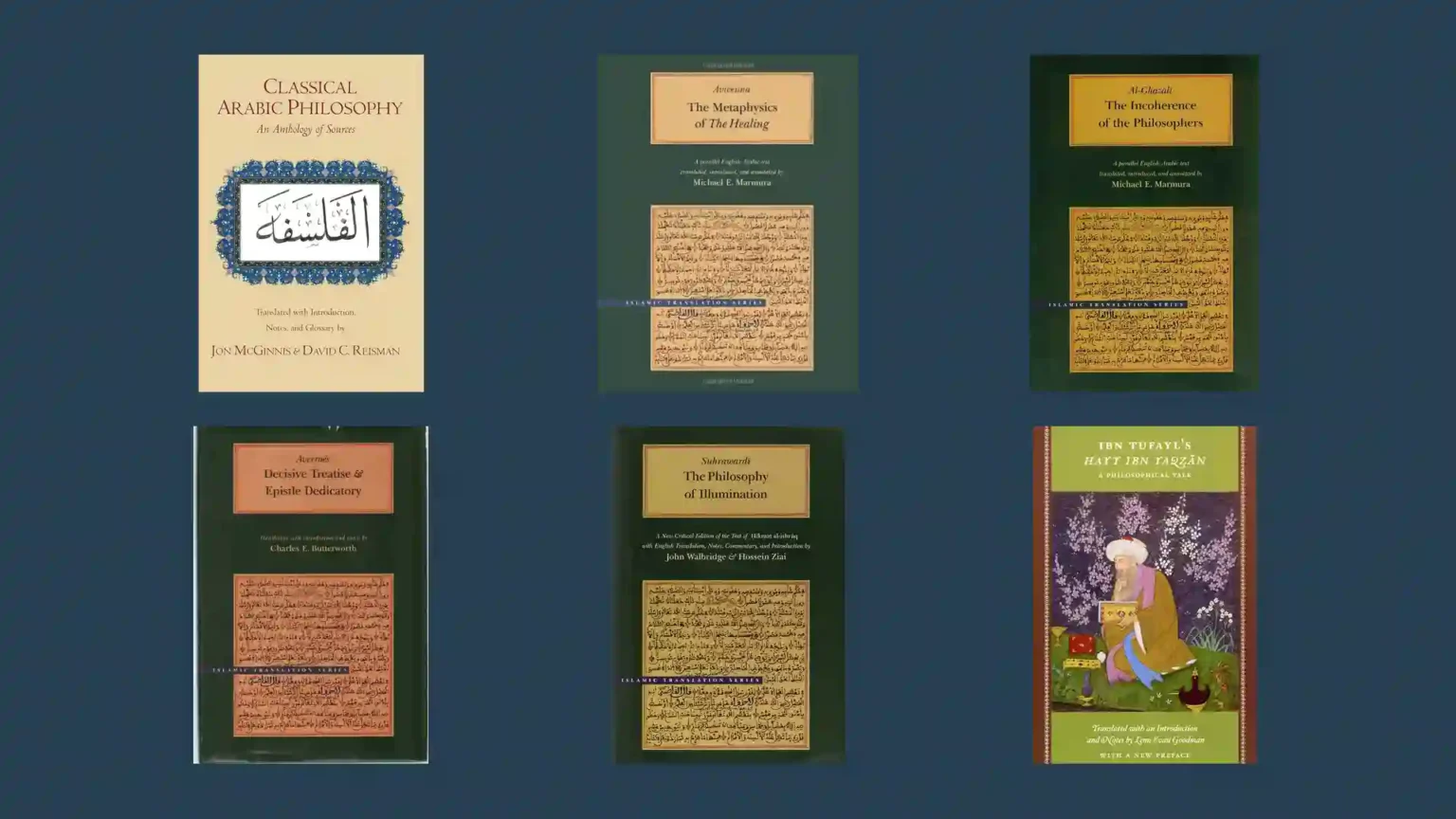
First, use Jon McGinnis and David C. Reisman’s Classical Arabic Philosophy: An Anthology of Sources as the map. Hackett’s volume ranges across al-Kindī, al-Fārābī, Ibn Sīnā, al-Ghazālī, Ibn Bājja, Ibn Tufayl, Ibn Rushd, and Suhrawardī, with material in logic, natural philosophy, metaphysics, ethics, and politics. It is unusually strong as a teaching instrument because one vocabulary and editorial apparatus lets readers compare thinkers. Its limitation follows from the same design: substantial selections are not replacements for every complete work.
Second, for major stand-alone works where Brigham Young University’s Islamic Translation Series produced bilingual or heavily annotated volumes, use those editions as research anchors. Michael Marmura’s The Metaphysics of The Healing gives Avicenna’s metaphysics in a parallel Arabic-English format; his The Incoherence of the Philosophers remains a central English edition for al-Ghazālī; Charles Butterworth’s Decisive Treatise and Epistle Dedicatory gives Averroes with facing Arabic and stable sectioning; John Walbridge and Hossein Ziai’s The Philosophy of Illumination supplies Suhrawardī’s major work with extensive scholarly apparatus. These books do different jobs, but they share a commitment to primary-text seriousness.
Third, some works are best served by a stand-alone literary-philosophical translation rather than a bilingual research format. Lenn E. Goodman’s updated University of Chicago Press edition of Ibn Tufayl’s Hayy Ibn Yaqzan is the obvious example: a philosophical tale whose argument depends on narrative pacing, isolation, language, education, revelation, and society. The edition’s introduction and notes matter, but forcing it into the same evaluation grid as Avicenna’s metaphysical summa would obscure its form.
| Work / use | Recommended English edition | Format strength | Main caution |
|---|---|---|---|
| Survey across the tradition | McGinnis & Reisman, Classical Arabic Philosophy (Hackett) | Broad primary-source anthology, glossary, notes | Selections are not always complete works |
| Avicenna, Metaphysics of The Healing | Marmura, BYU Islamic Translation Series | Parallel Arabic-English, major annotation | Dense; not a beginner survey |
| al-Ghazālī, Incoherence | Marmura, 2nd ed., BYU | Scholarly complete translation | Read beside Avicenna, not as generic anti-philosophy |
| Averroes, Decisive Treatise | Butterworth, BYU | Facing Arabic-English, stable sections | Juridical frame matters to interpretation |
| Ibn Tufayl, Hayy Ibn Yaqzan | Goodman, University of Chicago Press | Readable stand-alone philosophical tale | Narrative form should not be reduced to doctrines |
| Suhrawardī, Philosophy of Illumination | Walbridge & Ziai, BYU | First full English translation with apparatus | Illuminationist vocabulary resists easy Avicennian equivalence |
Why “Islamic philosophy” is not one translation problem
The Stanford survey of Arabic and Islamic metaphysics makes the historical sequence visible: Arabic philosophy begins in intensive engagement with translated Greek materials, Avicenna reorganizes metaphysics into a powerful system, and Averroes later returns to Aristotle through a different commentarial project. BookInLight’s guide to Plato and its locator for Aristotle’s four causes can replace two elementary background detours, but neither Greek source should be treated as a master key. Arabic philosophers inherited translated texts, late-antique commentary, theological problems, scientific traditions, and their own institutional debates.
Edition choice therefore depends on which layer you need to inspect. If the argument turns on an Arabic technical term, parallel text is valuable. If the question concerns the architecture of a complete treatise, a full translation beats an anthology excerpt. If the goal is comparison across thinkers, the anthology may be superior precisely because it normalizes access. If the work is literary-philosophical, readability and narrative integrity become part of scholarly usefulness.
The category “best edition” also becomes unstable over time. New manuscript work, revised translations, and better historical scholarship can change the answer. The safe practice is to record translator, edition, publisher, date, and whether the volume is complete, selective, bilingual, or commentary-heavy. That information should appear in notes before a claim depends on a particular English wording.
There is a deeper payoff. A source ecology prevents the field from looking like a chain of interchangeable “Muslim philosophers.” Avicenna’s metaphysical science, al-Ghazālī’s targeted critique, Averroes’s juridical defense of demonstration, Ibn Tufayl’s philosophical narrative, and Suhrawardī’s illuminationist project belong to overlapping but non-identical intellectual forms. The edition map should preserve those differences before the interpretive essay begins.
Apply the edition rules to actual works
The anthology/full-text distinction deserves to be made concrete. In Classical Arabic Philosophy, a reader can move rapidly from al-Kindī to al-Fārābī, Avicenna, al-Ghazālī, Ibn Rushd, and Suhrawardī while keeping notes and terminology relatively consistent. That is ideal for comparison. It is not ideal when an argument depends on the architecture of a whole book, the placement of a passage, or a translator’s rendering of a term across hundreds of pages. A course reader and a research edition solve different problems; the fact that both contain primary texts does not collapse the difference. For detailed preparation, see the Avicenna metaphysics reading guide.
Parallel Arabic-English editions create a second source class. Marmura’s Metaphysics of The Healing and Butterworth’s Decisive Treatise let a reader test English terminology against the Arabic line by line. That does not make the translation transparent or the Arabic self-interpreting. It does make disagreements auditable. When an article turns on wujūd, māhiyya, burhān, sharīʿa, ḥikma, or another technical term, a facing text can prevent an English word from acquiring more stability than the source warrants. For the work-specific locator, see the guide to Averroes’s Decisive Treatise.
A complete English translation without facing Arabic can still be the right edition when the primary reading problem is different. Goodman’s Hayy Ibn Yaqzan is a case in point. Its philosophical work unfolds through narrative form, and readability across the whole tale is part of responsible access. Likewise, the value of Marmura’s Incoherence of the Philosophers lies not merely in individual disputed propositions but in the sequence of twenty discussions and the way al-Ghazālī distinguishes demonstrative failure, theological consequence, and charges of unbelief. Completeness changes interpretation.
Suhrawardī is the strongest warning against treating “classical Islamic philosophy” as a single Peripatetic shelf. Walbridge and Ziai’s Philosophy of Illumination gives an English reader a work that explicitly contests parts of the Avicennian inheritance while using logic, metaphysics, visionary language, and a self-conscious genealogy of ancient wisdom. If the edition map contains only Aristotle, Avicenna, al-Ghazālī, and Averroes, the map quietly defines the field in advance. Edition choice and canon choice are linked.
Cite the edition, not just the philosopher
There is also a citation rule worth making explicit. A responsible note should say whether it cites a complete work, a selection, or a passage reproduced inside an anthology. It should identify translator and edition when wording matters. And it should avoid citing a modern English page number as if it were a universal locator when the work has stable book, discussion, section, or chapter divisions. The point is not pedantry. It lets another reader find the same textual object.
Finally, “best” must be reader-relative without becoming arbitrary. A beginning reader may legitimately choose the Hackett anthology because its apparatus reduces friction across a wide field. A specialist on Avicenna may need Marmura plus Arabic editions and manuscript-aware scholarship. A historian of Andalusian philosophy may want Butterworth and Goodman for different reasons. A reader of illuminationist philosophy needs Suhrawardī on his own terms. The ranking changes because the research question changes; what should not change is bibliographic clarity about what each volume actually contains.
For an editorial workflow, the map can be reduced to four fields recorded beside every quotation: work, translator, edition, and locator system. Add a fifth field—source class—when the quotation comes from an anthology rather than the complete work. That small discipline prevents several recurrent errors: attributing an anthology editor’s terminology to the original author, mixing page numbers from incompatible editions, treating a selection as if omitted chapters did not matter, or comparing two English renderings without noticing that one is based on a different textual or editorial apparatus. Bibliography becomes part of interpretation because it identifies the textual object being interpreted.
My calibrated shelf is therefore simple: Hackett for breadth; the BYU Islamic Translation Series volumes for several major research texts; Goodman for Hayy Ibn Yaqzan; and current reference scholarship for checking terminology and historical framing. There is no embarrassment in owning more than one English version of a central work. In this field, duplication often reveals the argument hidden inside translation.
Cover artwork: credits and source records
- Classical Arabic Philosophy — Hackett (source record)
- The Metaphysics of The Healing — Brigham Young University Press (source record)
- The Incoherence of the Philosophers — Brigham Young University Press (source record)
- The Decisive Treatise and Epistle Dedicatory — Brigham Young University Press (source record)
- The Philosophy of Illumination — Brigham Young University Press (source record)
- Ibn Tufayl’s Hayy Ibn Yaqzan — University of Chicago Press (source record)