Books on Avicenna’s metaphysics span primary translations and modern interpretation; a serious route separates essence, existence, and necessity.
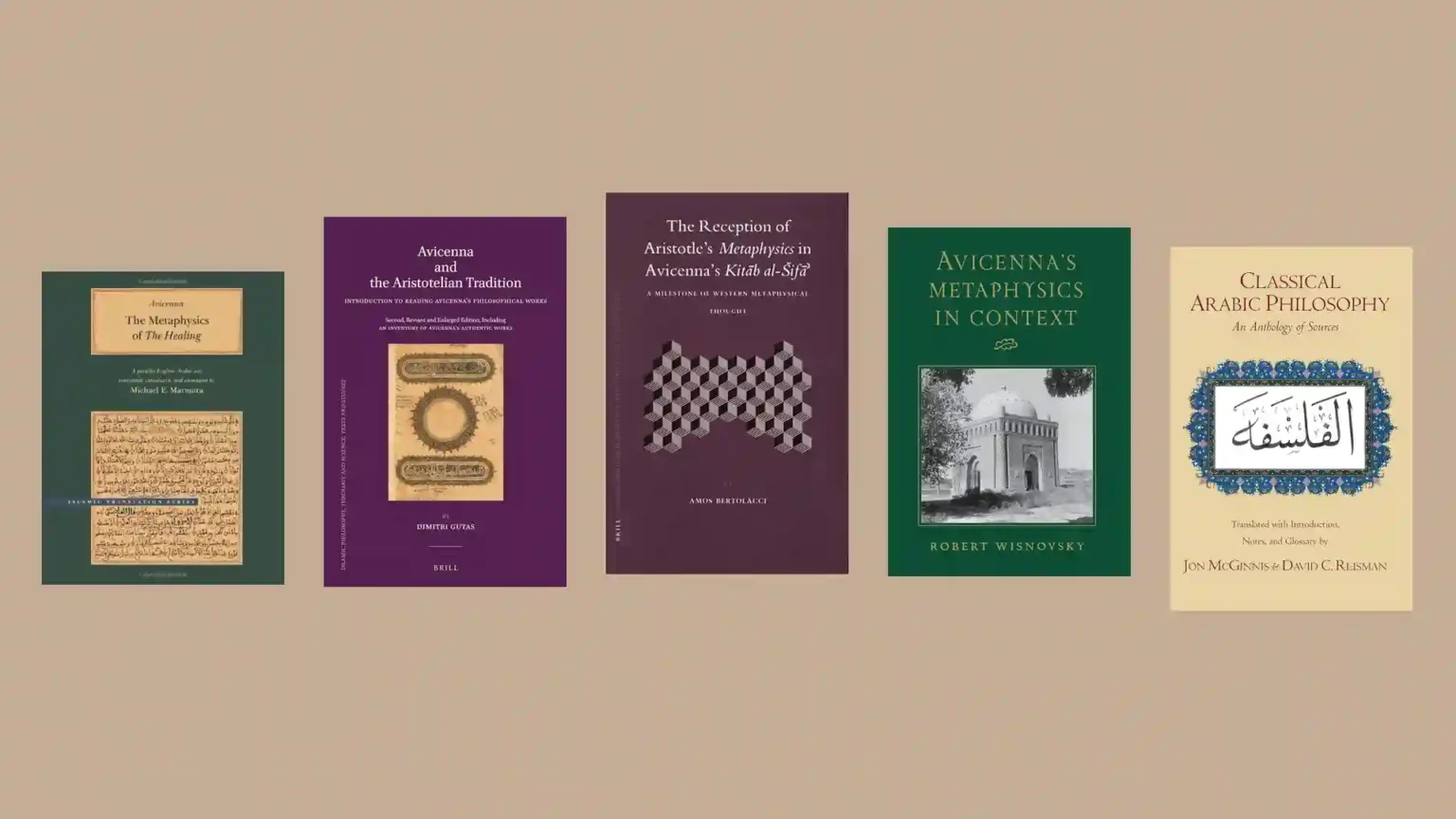
In 2005 Michael E. Marmura’s English translation of Avicenna’s The Metaphysics of The Healing gave Anglophone readers a complete working text for the metaphysical culmination of the Kitāb al-Shifāʾ. The historical problem is that a primary text does not arrive without a map. Over the last several decades, scholars have redrawn that map: away from an exotic “mystical East,” toward the Arabic Aristotle, late antique commentary, Avicenna’s own reorganization of metaphysics, and the long afterlife of his distinctions. Five books make those shifts visible.
The primary text
Marmura’s Metaphysics of The Healing belongs first because later interpretations should be tested against Avicenna’s own architecture. The work moves through being, unity, causes, necessity, divine existence, emanation, providence, prophecy, and politics. The recently revised Stanford Encyclopedia entry on Ibn Sīnā’s metaphysics emphasizes that Avicenna treats metaphysics as a science of being qua being whose scope also establishes principles for other sciences. That is already more specific than the vague label “Islamic Neoplatonism.”
The Aristotelian correction
Dimitri Gutas’s Avicenna and the Aristotelian Tradition changed the field by treating Avicenna’s philosophical project through his relation to Aristotle, the Arabic Peripatetic tradition, his intellectual biography, and a critical inventory of authentic works. The book’s larger historiographical intervention matters as much as any single doctrinal claim: it challenged readings that treated an allegedly “Oriental” or mystical philosophy as Avicenna’s deepest and most authentic position.
That correction does not reduce Avicenna to Aristotle. It makes deviation measurable. Once the Aristotelian inheritance is reconstructed, Avicenna’s changes in the subject matter of metaphysics, modality, causality, and the necessary existent can be seen as philosophical innovations rather than as a vague synthesis. BookInLight’s locator for Aristotle’s four causes can replace a basic background detour here: Avicenna inherits the causal vocabulary, but his metaphysical system reorganizes what causality is doing.
The source history becomes granular
Amos Bertolacci’s The Reception of Aristotle’s Metaphysics in Avicenna’s Kitāb al-Šifāʾ takes the Aristotelian question down to textual transmission and structure. It reconstructs Arabic translations of Aristotle’s Metaphysics, pre-Avicennian readers such as al-Kindī and al-Fārābī, and Avicenna’s redefinition of metaphysics as a discipline. The effect is to make “Aristotle influenced Avicenna” too crude to be useful. Which Aristotle, transmitted through which Arabic materials, organized under which inherited questions?
Causality and the prehistory of Avicenna’s distinctions
Robert Wisnovsky’s Avicenna’s Metaphysics in Context follows the evolution of concepts Avicenna inherited and recombined, especially in accounts of soul, body, God, and causation. The book is valuable because it refuses the picture of a solitary genius inventing technical distinctions from nowhere. The Avicennian synthesis emerges from earlier Peripatetic and Neoplatonic attempts to reconcile texts, terms, and causal models. The synthesis is innovative because the inheritance is specific.
The wider field
The fifth book is again Gutas, but it should be used as a bridge rather than a duplicate—or, if one wants five physically distinct volumes, pair the first edition/history with a broader study of Arabic metaphysics. The most efficient current orientation is the Stanford Encyclopedia article on Arabic and Islamic metaphysics, which tracks the field from the Arabic Aristotle through Ibn Sīnā to Ibn Rushd and later traditions. For a five-book shelf, I would instead make Jon McGinnis and David Reisman’s Classical Arabic Philosophy the comparative fifth volume: its primary-source selections show what changes when Avicenna is placed next to al-Kindī, al-Fārābī, al-Ghazālī, Ibn Rushd, and Suhrawardī.
The five volumes therefore do not line up as “introductory to advanced.” They change scale. Marmura gives the object. Gutas reconstructs the philosophical project. Bertolacci reconstructs Aristotle’s textual reception. Wisnovsky reconstructs conceptual prehistories. McGinnis and Reisman restore the neighboring Arabic philosophical field. Together they change the question from “What did Avicenna believe?” to “What kind of science did Avicenna think metaphysics was, which inherited materials did he reorganize, and why did that reorganization become so durable?”
That historical shift matters for famous doctrines. The essence/existence distinction, the Necessary Existent, emanation, and causal priority can look like detachable Avicennian theses when encountered through later scholastic vocabulary. In the primary and historical literature, they are parts of a system whose categories were formed through Greek-Arabic transmission and then became premises for later Islamic and Latin debates. The SEP Ibn Sīnā article is useful here not as a sixth “book,” but as a current checkpoint against older historiographical habits.
Essence and existence as a historiographical test
The essence/existence distinction is a good way to see the books disagree productively. In textbook form, the doctrine can sound like a finished pair of definitions: what a thing is differs from the fact that it is. But the historical literature asks harder questions. Which Arabic terms are in play? How does Avicenna move from conceptual analysis to modal claims about what is possible or necessary? How does the distinction function inside his proof of a Necessary Existent? And how much of the later Latin formulation should be projected back onto the Arabic text? The current SEP treatment is useful precisely because it connects the distinction to Avicenna’s architecture of metaphysics rather than isolating it as a slogan.
Bertolacci’s Reception of Aristotle’s Metaphysics shows why source history matters here. Avicenna did not encounter a bare Aristotle. The Metaphysics arrived through Arabic translation, late-antique commentary, and earlier Arabic philosophers trying to define what the science of metaphysics studies. Once that transmission is reconstructed, Avicenna’s decision to make “existent as existent” the subject of metaphysics appears as both inheritance and reorganization. The doctrine becomes historical without becoming less philosophical.
The Necessary Existent and the problem of reading backward
The Necessary Existent is another place where later fame can distort first reading. A reader who begins with scholastic debates about proofs of God may treat Avicenna as if his metaphysics were organized around a medieval version of natural theology. Marmura’s translation of The Metaphysics of The Healing shows a different order: necessity, possibility, causality, unity, and the structure of being create the setting in which the divine argument appears. The proof matters because of the system, not because it can be detached from the system.
Wisnovsky’s Avicenna’s Metaphysics in Context sharpens the causal side of this problem by tracing the conceptual history behind Avicenna’s account of God and world. Gutas’s Avicenna and the Aristotelian Tradition sharpens the authorial and chronological side: Avicenna’s works belong to an evolving philosophical project, and not every text should be treated as an interchangeable container of “Avicennism.” The historiographical lesson is methodological: when later traditions make a doctrine famous, return to the work, chronology, and source structure in which the doctrine was doing its first job.
This is where a broad primary-source anthology becomes unexpectedly important. Classical Arabic Philosophy makes it possible to read Avicenna beside predecessors and critics instead of only through later scholastic reception. Al-Fārābī changes the question of metaphysical science; al-Ghazālī tests philosophical claims from a theological and dialectical position; Ibn Rushd reacts against aspects of the Avicennian transformation of Aristotle. Avicenna’s originality is easier to see when it is neither isolated nor treated as the inevitable center of the tradition.
The five-book shelf therefore supports five different claims, and no book should be asked to prove all of them. Marmura supports close doctrinal reading. Gutas supports claims about Avicenna’s project and corpus. Bertolacci supports claims about Aristotle’s Arabic reception and disciplinary structure. Wisnovsky supports claims about causal and conceptual prehistory. McGinnis/Reisman supports controlled comparison across the Arabic philosophical field. That division of labor is more reliable than accumulating citations that all do the same job.
The shift is clearest when essence and existence are treated not as an isolated formula but as part of Avicenna’s account of scientific subject matter, modality, causality, and the Necessary Existent. That broader placement changes the historiographical question. The issue is no longer whether Avicenna merely added one distinction to Aristotle; it is how an inherited metaphysical vocabulary was reorganized into a system whose internal connections could later be adopted, criticized, and transformed in both Arabic and Latin traditions.
The conclusion is deliberately asymmetrical: start with Marmura if you are writing about a doctrine; start with Gutas or Bertolacci if you are writing about intellectual formation; start with Wisnovsky if causality is central; start with the Hackett anthology if the question is comparative. “Avicenna’s metaphysics” is not one shelf position. It is a primary text surrounded by arguments over what counts as its source, structure, novelty, and afterlife.
Compact Scholarly Bibliography
Marmura, The Metaphysics of The Healing · Gutas, Avicenna and the Aristotelian Tradition · Bertolacci, Reception of Aristotle’s Metaphysics · Wisnovsky, Avicenna’s Metaphysics in Context · McGinnis & Reisman, Classical Arabic Philosophy
Cover artwork: credits and source records
- The Metaphysics of The Healing — Brigham Young University Press (source record)
- Avicenna and the Aristotelian Tradition — Brill (source record)
- The Reception of Aristotle’s Metaphysics in Avicenna’s Kitab al-Shifa — Brill (source record)
- Avicenna’s Metaphysics in Context — Cornell University Press (source record)
- Classical Arabic Philosophy — Hackett (source record)