The Gettier paper first appeared in 1963. Here is where to find the original three-page argument, which reprint to use, and how to read it.
The cleanest answer is simple: read Edmund Gettier’s paper in its original journal record first. Oxford Academic lists “Is Justified True Belief Knowledge?” in Analysis, volume 23, issue 6, June 1963, pages 121–123. The article is only three printed pages. That brevity is not incidental; it is part of why the paper is so useful. Gettier does not build a system. He targets a definition.
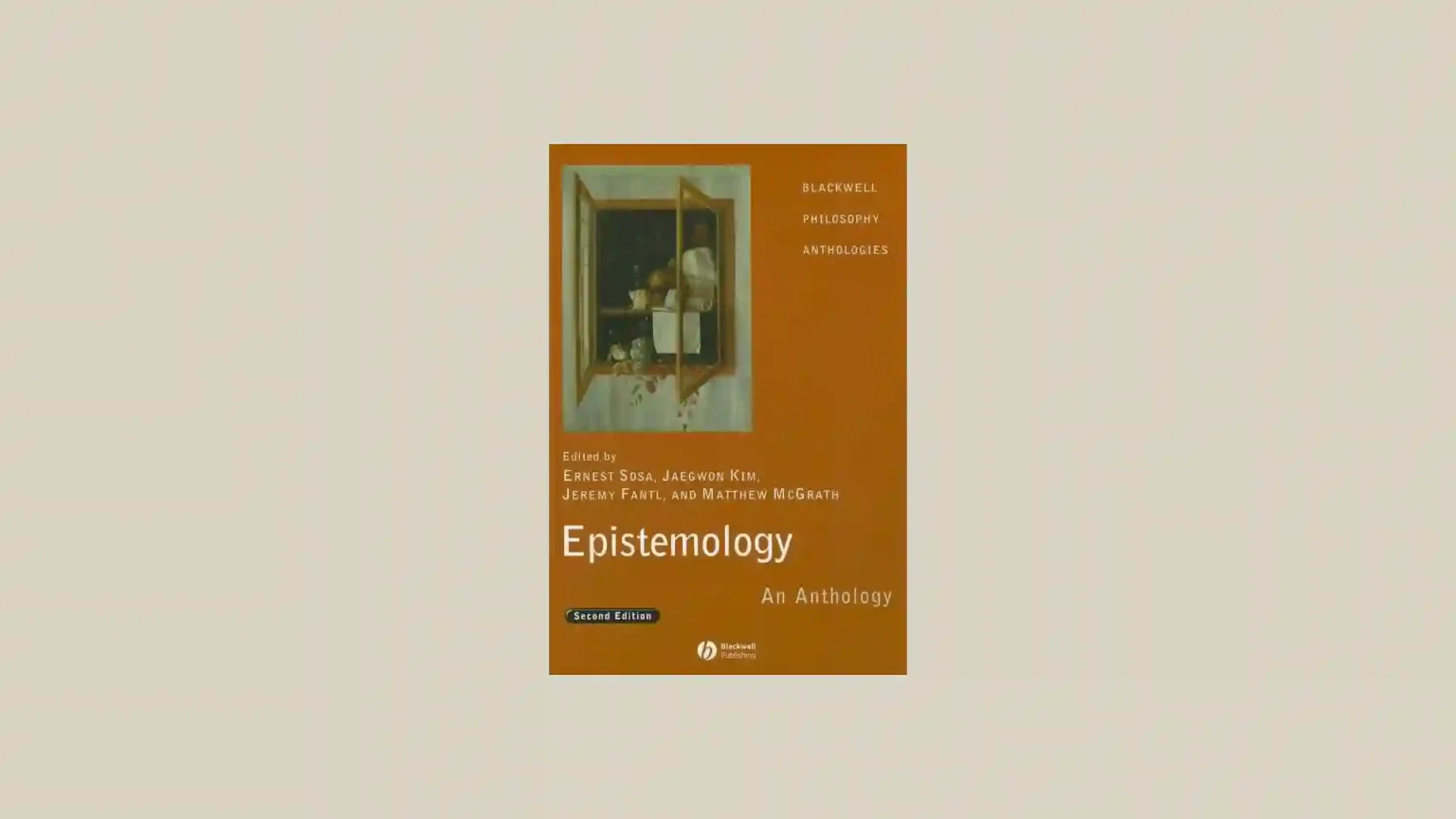
For a durable identifier, use the Oxford DOI record. If your library routes access through JSTOR, the JSTOR record for the same paper is another stable path. If you want the article inside a modern teaching collection rather than as a stand-alone journal item, the second edition of Epistemology: An Anthology, edited by Ernest Sosa, Jaegwon Kim, Jeremy Fantl, and Matthew McGrath, is the more useful reprint environment.
Gettier Paper: Original or Reprint?
| If your aim is… | Read this | Why |
|---|---|---|
| Textual priority | The 1963 Analysis article | It is the original publication: 23(6), 121–123. |
| Library stability | DOI or JSTOR record | Both give durable bibliographic routes to the same paper. |
| Context for study | Epistemology: An Anthology, 2nd ed. | The paper sits among later work on the analysis of knowledge and justification. |
| Conceptual orientation | Stanford Encyclopedia: “The Analysis of Knowledge” | It explains how Gettier’s cases changed the justified-true-belief debate. |
Do not treat the anthology as a “better” text of Gettier. There is almost nothing to improve typographically or interpretively in a paper this short. The advantage of the anthology is adjacency. Its table of contents places Gettier inside a sequence of problems about knowledge, justification, skepticism, and later attempts to repair the analysis. The original journal is best when you want to see the intervention as it appeared; the anthology is best when you want to keep reading.
What You Need Before Page 121
Only one piece of vocabulary is essential. The target is the traditional-looking proposal that knowledge is, roughly, justified true belief: a person knows that p if p is true, the person believes p, and the belief is justified. The modern literature is more careful about how that tripartite idea is formulated. The current Stanford Encyclopedia entry on the analysis of knowledge notes that Gettier himself presents slightly different formulations and that epistemologists often treat them as equivalent for the purpose of the problem.
Gettier then asks whether those conditions are sufficient. His two cases are engineered so that the subject has a justified belief, the belief is true, and yet its truth is secured by luck in a way that makes “knowledge” feel wrong. The famous result is therefore not the discovery that truth, belief, or justification never matter. It is narrower: satisfying those three conditions can still fail to amount to knowledge.
The decision tree is: original wording → exact cases → your judgment about knowledge → only then the later literature.
Read the Three Pages in the Right Order
Start with Gettier’s opening setup. Identify the conditions he is granting for the sake of argument. Do not import a later textbook definition before seeing what the paper actually says.
For each case, write four lines: what the subject believes; why the belief is justified; what makes it true; what introduces the luck. If the fourth line is vague, you have not yet isolated the mechanism.
After the second case, state the conclusion minimally: the specified justified-true-belief conditions are not sufficient for knowledge. Resist jumping immediately to a favorite repair such as “no false lemmas,” reliabilism, safety, or virtue epistemology.
This order matters because later summaries can make the result look larger than it is. Gettier did not show that every account of knowledge built around truth, belief, and epistemic support must fail. He showed that a particular sufficient-condition strategy was vulnerable. The Stanford discussion of Gettier cases and post-Gettier theories is especially useful after, not before, the original because it lets you see how many different repairs have been proposed.
Which Reprint Is Best?
For a reader building an epistemology course around the paper, Epistemology: An Anthology is the strongest practical choice among common reprints. Wiley describes the second edition as a broad collection of canonical readings on skepticism, the definition of knowledge, epistemic justification, foundationalism, coherentism, and virtue epistemology. The publisher record confirms the second edition and its editors; a library table of contents for that edition locates Gettier within the knowledge-analysis materials.
There is a useful principle here. A reprint is valuable when its editorial neighborhood helps answer the next question. Gettier’s next question is not “Where else can I find these three pages?” It is “What, if anything, should replace the insufficient analysis?” A good anthology makes that transition easier.
One Bibliographic Trap
Do not confuse the Oxford DOI with the JSTOR DOI. The original article has the Oxford journal DOI 10.1093/analys/23.6.121; JSTOR also exposes a stable record and its own legacy DOI 10.2307/3326922. They identify access/bibliographic routes to the same 1963 article, not two different versions of Gettier’s argument. The full Analysis issue record is a useful final check on date, pagination, and issue context.
The Short Recommendation
Read the Oxford original first if you can access it. Use JSTOR as an alternative stable route. If you are studying rather than merely locating the paper, keep the second edition of Epistemology: An Anthology beside it and move from Gettier directly into competing analyses of knowledge. Three pages are enough to create the problem; the rest of epistemology is where the attempted solutions begin.
Cover artwork: credits and source records
- Epistemology: An Anthology, 2nd Edition — Wiley-Blackwell (source record)