The Decisive Treatise is available in different scholarly contexts; choose a reliable complete text and understand its jurisprudential vocabulary.
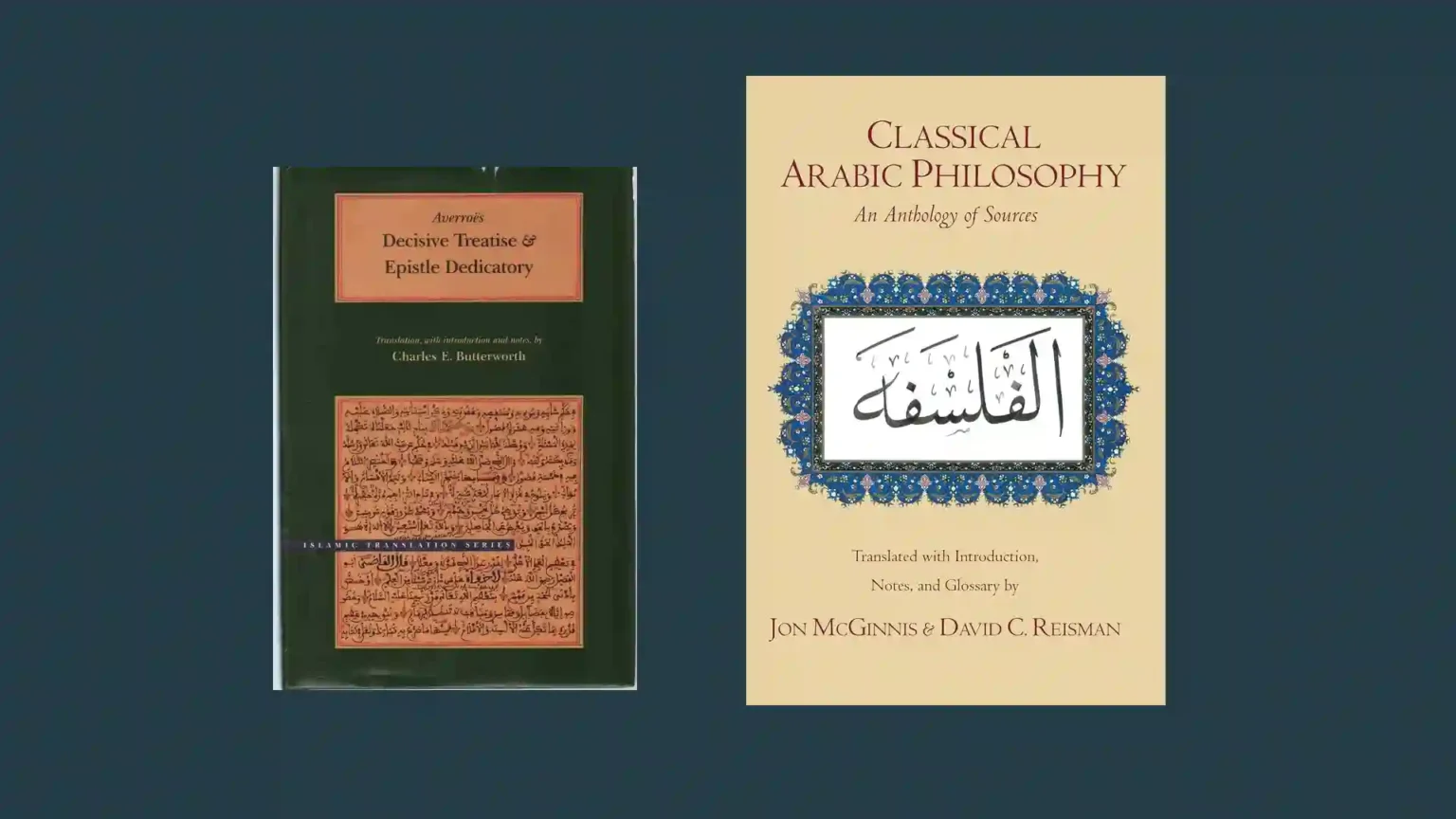
Open Charles E. Butterworth’s edition and the first surprise is material: the Decisive Treatise and Epistle Dedicatory is not presented as an isolated inspirational essay. The 2001 Brigham Young University Press volume supplies the Arabic text on facing pages, an English translation, introductions, notes, a bibliography, and indexes. That apparatus matters because Averroes is arguing inside the language of law, demonstration, interpretation, and religious obligation.
1. The complete English text to use
For a reader who wants the complete treatise in a modern scholarly English edition, Butterworth is the clearest answer. The University of Chicago Press distributor record identifies the volume as a translation with introduction and notes and prints a table of contents in which the Decisive Treatise runs from its introduction through the conclusion before the separate Epistle Dedicatory begins. WorldCat’s record confirms the 2001 Brigham Young University Press edition and its bibliographic identity.
The edition also solves a common citation problem. The Stanford Encyclopedia of Philosophy entry on Ibn Rushd cites the Butterworth translation by section number and notes that the volume provides the Arabic with facing English. Section-based citation is more stable than relying on ordinary page numbers when comparing translations or discussing the Arabic title, Faṣl al-maqāl wa-taqrīr mā bayna al-sharīʿa wa-l-ḥikma min al-ittiṣāl.
2. Do not confuse the treatise with a generic “harmony of religion and philosophy” essay
Older English references often describe the work under titles such as “On the Harmony of Religion and Philosophy.” That shorthand catches part of the subject but can flatten the argument. Averroes does not begin by balancing two abstract domains called faith and reason. He asks a legal question: what does revealed law require concerning philosophical investigation for people capable of demonstration? The SEP discussion of the Decisive Treatise emphasizes this jurisprudential frame and the claim that demonstrative reasoning, correctly conducted, cannot conflict with true law.
That wording also explains why al-Ghazali is never far away. The treatise answers an intellectual environment in which philosophers had been accused of serious doctrinal error. The current Stanford bibliography for al-Ghazali lists Butterworth’s bilingual edition alongside Avicenna and later responses, making visible the argumentative network in which the book belongs. Read in that network, the treatise is less a timeless manifesto for “rationalism” than a carefully bounded defense of philosophical demonstration within an Islamic legal-theological order.
3. What does the Hackett anthology give you?
Classical Arabic Philosophy: An Anthology of Sources by Jon McGinnis and David C. Reisman is excellent for context. Its Ibn Rushd chapter includes the Decisive Treatise alongside selections from the Incoherence of the Incoherence and commentaries on Aristotle. That makes it a better comparative classroom collection than a stand-alone working edition. But if the research question is specifically the complete Decisive Treatise, with a stable bilingual text and an apparatus devoted to it, Butterworth remains the stronger primary volume.
| Need | Best choice | Why |
|---|---|---|
| Complete treatise + Arabic | Butterworth, BYU 2001 | Facing Arabic/English, notes, section-based citation |
| Broad Arabic philosophy context | McGinnis & Reisman, Hackett 2007 | Places Ibn Rushd among al-Kindī, al-Fārābī, Ibn Sīnā, al-Ghazālī, Ibn Tufayl, Suhrawardī |
| Orientation to the argument | Stanford Encyclopedia: Ibn Rushd | Explains law, demonstration, interpretation, and the al-Ghazālī background |
A final caution concerns translation. “Law,” “wisdom,” “demonstration,” and “interpretation” are not neutral English containers. They carry technical weight in the Arabic philosophical and juridical setting. A bilingual edition does not eliminate interpretation, but it makes the interpretive choices inspectable. That is exactly the kind of text where facing Arabic earns its place.
The ruling is therefore narrow. For the complete text, use Butterworth. For comparison across the classical Arabic philosophical tradition, use the Hackett anthology beside it. For intellectual orientation, consult the SEP entry before turning the treatise into a general statement about religion and philosophy. What has been ruled out is the convenient but misleading idea that any anthology excerpt or modern slogan can substitute for the legal form of Averroes’s own argument.
4. Why the Epistle Dedicatory should stay attached
The companion “Epistle Dedicatory” is not filler added by a modern editor. The Butterworth volume prints it as a distinct text after the Decisive Treatise, and the SEP bibliography treats both as part of the same working edition. Keeping them together prevents a subtle mistake: the legal argument of the Decisive Treatise can look more self-contained than Averroes’s actual philosophical practice. The epistle presses questions about divine knowledge and the relation between philosophical demonstration and formulations inherited in religious discourse. Even when an article focuses only on Faṣl al-maqāl, the adjoining text shows what kind of problem continues once permission to philosophize has been defended.
For academic work, cite the treatise by the sectioning used in Butterworth and name the translation in the bibliography. If an argument turns on a technical Arabic term, use the facing text rather than reverse-engineering the Arabic from an English phrase. The SEP entry is especially helpful because its own citations model this practice. A phrase such as “truth does not oppose truth” is memorable, but the surrounding sections determine what kind of truth, reasoning, audience, and interpretation Averroes has in view.
A final comparison is worth making before purchase. A library record such as WorldCat tells you that the Butterworth book exists, which edition you are locating, and where it may be held; it does not replace the text. An anthology such as Classical Arabic Philosophy gives comparative reach; it does not give the same object as a volume devoted to the treatise. A web summary can orient you; it cannot stabilize wording for citation. The bibliographic distinction is simple, but it changes the quality of the argument.
Further Reading
Ibn Rushd [Averroes], Stanford Encyclopedia of Philosophy · Classical Arabic Philosophy, Hackett
Cover artwork: credits and source records
- The Decisive Treatise and Epistle Dedicatory — Brigham Young University Press (source record)
- Classical Arabic Philosophy — Hackett (source record)