These books on modernism and empire challenge the idea that literary innovation developed apart from imperial history.
“Modernism,” “empire,” and “postcolonial literature” are often made to do the same work. They should not. Modernism names a contested set of aesthetic experiments and institutions; empire names political, economic, linguistic, and racial structures; postcolonial criticism names several later traditions for interpreting colonial and anti-colonial histories. The seven books below are useful precisely because they do not collapse those three terms.
1. Empire as a field of writing
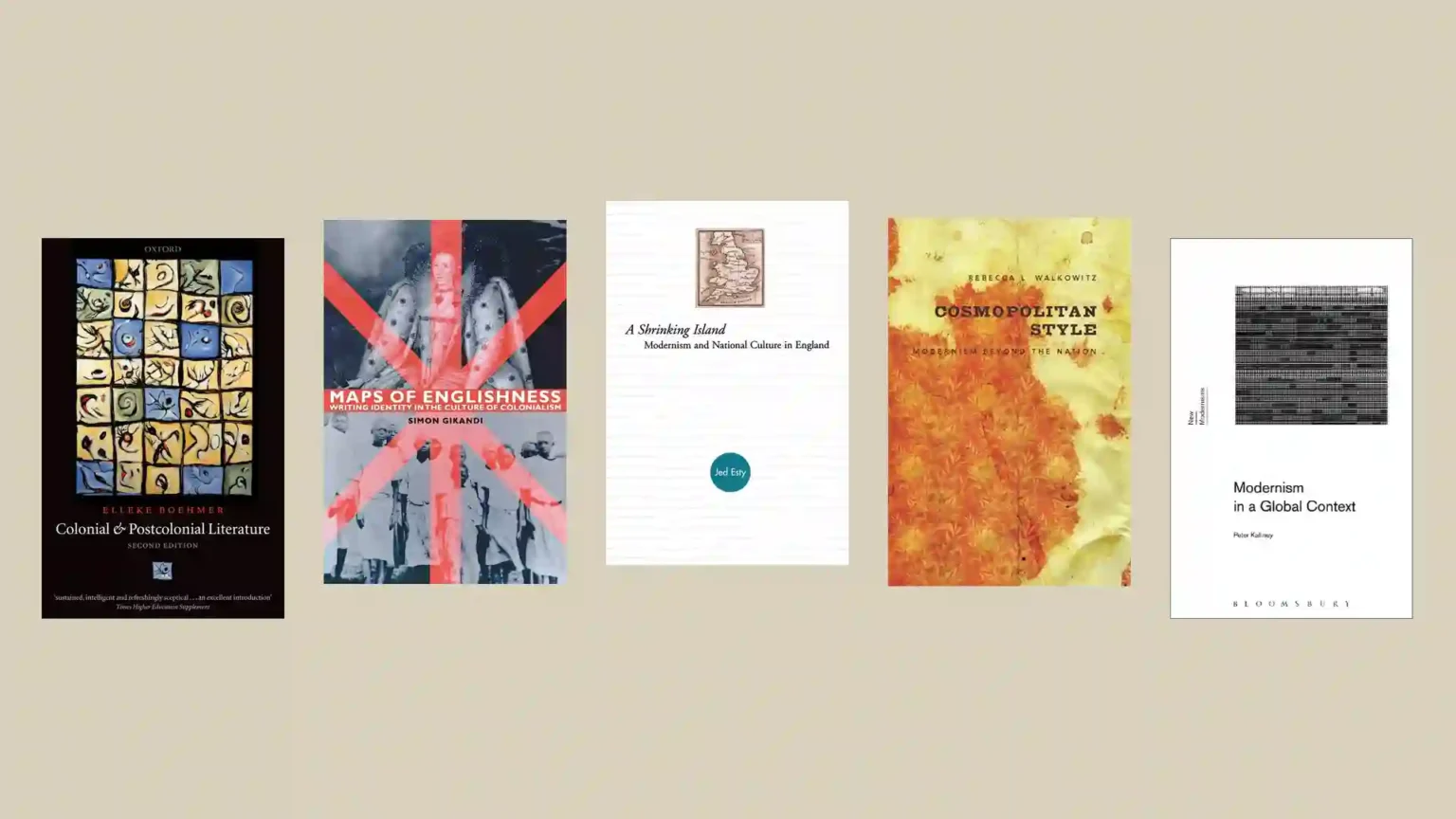
Start with Elleke Boehmer’s Colonial and Postcolonial Literature: Migrant Metaphors. Its scale is larger than modernism, beginning from the writing of empire and resistance rather than from a modernist canon. That breadth is productive: Conrad, Kipling, nationalism, migration, hybridity, and postcolonial writing appear inside one historical arc. Use Boehmer when the question is where modernism sits inside a much longer colonial literary system.
2. Englishness as a colonial construction
Simon Gikandi’s Maps of Englishness asks how colonial experience helped produce English identity itself. Its chapter on late colonialism and modernist narrative makes the imperial relation internal to “Englishness,” not an overseas context added after the fact. It is especially useful when modernism is being read as a metropolitan style supposedly separable from race, travel, gender, and colonial representation.
3. Race inside modernist language
Michael North’s The Dialect of Modernism moves the problem into diction, dialect, linguistic imitation, and racial masquerade. This is a different causal map: empire is not only a topic represented by modernist texts; racialized language and fantasies of vernacular freedom participate in modernist formal experiment. Pair North with Gikandi to see why “form versus history” is a poor description of the debate.
4. Imperial contraction and national culture
Jed Esty’s A Shrinking Island follows a later British moment, especially the 1930s and after, when declining imperial power changes the cultural meaning of English modernism. The book tracks a movement from high modernist universal ambition toward questions of national culture. It is the right counterexample to any account in which empire matters only during expansion: contraction, decolonization, and the prospect of diminished power also reshape form.
5. Cosmopolitanism beyond the nation
Rebecca Walkowitz’s Cosmopolitan Style complicates the nation/empire binary. She argues that modernist style can register stances and forms of affiliation that exceed national frames. The value of the book in this sequence is not that cosmopolitanism dissolves imperial inequality, but that it forces a question the previous books cannot settle alone: when a text crosses national borders, is that mobility resistance, privilege, imperial circulation, or some unstable combination?
6. Poetry as transnational exchange
Jahan Ramazani’s A Transnational Poetics provides the poetic counterpart. Its account of cross-cultural exchange runs through modernism, the Harlem Renaissance, postcolonial and Black British writing, and later poetry. Read it when a prose-centered modernism syllabus makes “empire” look like a problem confined to the novel. Ramazani keeps translation, influence, appropriation, and formal crossing visible at the level of poetic practice.
7. The global turn as a map of institutions
Peter Kalliney’s Modernism in a Global Context is the clearest synthesis for readers who want the enlarged field itself: imperialism, cosmopolitanism, cultural institutions, little magazines, prizes, photography, cinema, and radio. A contemporary Review of English Studies assessment situates the book within the “new modernist studies,” where the field widened beyond a small Euro-American canon and narrow formalism.
What changes when the seven are read together?
The sequence produces at least four incompatible-but-complementary pictures. Boehmer and Gikandi make colonial history constitutive of literary identities; North shows racialized language inside formal innovation; Esty makes imperial decline an aesthetic pressure; Walkowitz and Ramazani track forms that travel across national borders; Kalliney makes institutions and media part of the object called modernism. None reduces to “modernists wrote about empire.”
That difference should guide reading order. For a first course, Boehmer → Gikandi → Kalliney gives the historical frame, a concentrated case, and then the enlarged map. For a project on form, North → Walkowitz → Ramazani gives three different accounts of linguistic and stylistic mobility. For late British modernism, Esty belongs near the center rather than at the end. The point is not to construct a seven-book canon. It is to keep seven explanatory models in play long enough to see which one your primary text actually needs.
A novel, poem, or little magazine may participate simultaneously in metropolitan prestige, colonial administration, racialized language, anti-colonial circulation, and transnational experiment. “Modernism and empire” therefore names an intersection, not a solved thesis. The best book in the set is the one whose mechanism you can test against the text in front of you—and whose blind spots another book can expose.
Three false equivalences to keep out of the reading
First, metropolitan modernism is not synonymous with imperial modernism. A London publication site can conceal colonial materials, but a colonial setting does not by itself determine a work’s formal logic. Second, transnational movement is not automatically anti-imperial. Travel, translation, cosmopolitan education, and access to metropolitan publication can reproduce unequal structures even when they cross borders. Third, postcolonial reading is not simply the recovery of political “content” from formally innovative texts. Several of these books argue that form is itself where racial, linguistic, and geopolitical relations become legible.
How do the books behave against a difficult primary text?
Consider a text whose narrator moves between standard English and racialized vernacular. North makes the linguistic switch an event in modernist form; Gikandi asks what identity the switch helps construct; Boehmer places the scene inside longer histories of colonial representation. A cosmopolitan reading might then ask whether stylistic mobility loosens national belonging, while Casanova-style global accounts—not represented by a separate volume here—would ask what institutions allow that mobility to acquire prestige. The same page can support several mechanisms without proving all of them.
The counterexample is equally important. Some modernist works have weak or indirect relations to formal empire. Forcing every break in syntax, chronology, or perspective into an imperial allegory produces a total theory that the evidence cannot carry. The seven-book set is most useful when it supplies discriminations: which historical relation is documented, which formal feature is being explained, and what rival explanation would fit the passage just as well?
A research sequence is not a canon
The set is intentionally uneven in scale. Boehmer and Kalliney are survey-like maps; North and Esty are narrower interventions; Walkowitz and Ramazani organize transnational problems through different genres; Gikandi connects identity and colonial culture over a longer history. That unevenness is an advantage for research. A reading list should not make unlike books pretend to perform the same job.
Cover artwork: credits and source records
- Colonial and Postcolonial Literature — Oxford University Press (source record)
- Maps of Englishness — Columbia University Press (source record)
- A Shrinking Island — Princeton University Press (source record)
- Cosmopolitan Style — Columbia University Press (source record)
- Modernism in a Global Context — Bloomsbury (source record)