Ancient History · June 2026
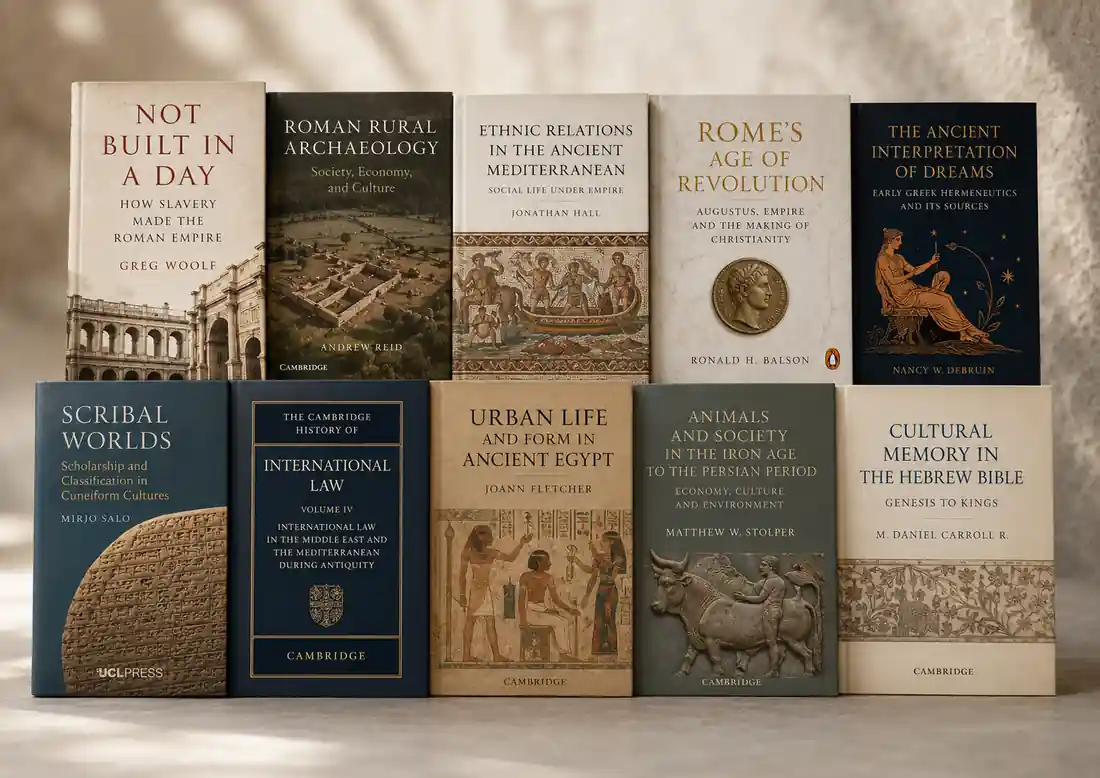
The best new books in Ancient History for June 2026 reveal a field moving decisively below the level of rulers and monuments. These ten verified first editions reconstruct antiquity through slavery, rural labor, ethnic relations, scribal classification, urban form, animals, law, dreams, and cultural memory—ranked for disciplinary relevance, originality, evidentiary strength, and usefulness to serious readers.
Eligible books were first published from June 1 through June 30, 2026, inclusive; coordinated print and digital launches within thirty days were treated as one first-edition program.
Selection combined publisher-date verification, negative edition checking, subject-relevance testing, bibliographic comparison, critical research, Amazon and publisher link validation, and exact-edition cover matching.
Affiliate note: Book in Light may earn a small commission if a purchase is made through some links on this page, at no extra cost to the reader. Commercial availability never determines editorial selection.
The 10 best new books in Ancient History for June 2026
This ranking of the best new books in Ancient History for June 2026 weighs the clarity of each disciplinary intervention more heavily than publicity, publisher size, or commercial visibility.
1. Not Built in a Day: How Slavery Made the Roman Empire — Emma Southon
Publisher: Simon & Schuster | Published: | Best for: Readers seeking a social history of Rome built from coerced labor rather than imperial biography. | Publisher ↗
2. Roman Rural Archaeology: Society, Economy, and Culture — Gijs Willem Tol and Astrid Van Oyen, editors
Publisher: Cambridge University Press | Published: | Best for: Archaeologists and historians who want the Roman countryside treated as a social world, not an economic backdrop. | Publisher ↗
3. Ethnic Relations in the Ancient Mediterranean: Social Life Under Empire — Philip A. Harland
Publisher: University of Chicago Press | Published: | Best for: Readers studying how ethnic categories were performed, contested, and governed under ancient empires. | Publisher ↗
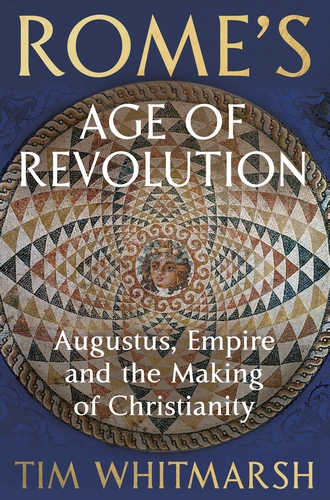
4. Rome’s Age of Revolution: Augustus, Empire and the Making of Christianity — Tim Whitmarsh
Publisher: The Bodley Head | Published: | Best for: Readers who want Christianity placed inside the political and cultural transformations of the Augustan Mediterranean. | Publisher ↗
5. The Ancient Interpretation of Dreams: Early Greek Hermeneutics and Its Sources — Mirjam E. Kotwick
Publisher: Princeton University Press | Published: | Best for: Readers interested in how early Greeks interpreted signs before hermeneutics became a formal discipline. | Publisher ↗
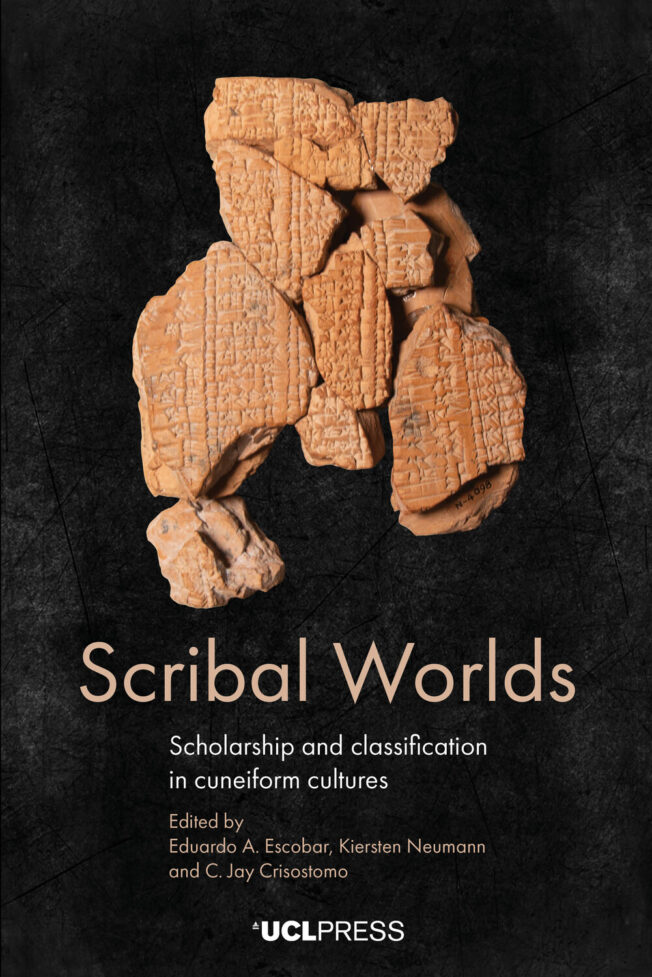
6. Scribal Worlds: Scholarship and Classification in Cuneiform Cultures — Eduardo A. Escobar, Kiersten Neumann, and C. Jay Crisostomo, editors
Publisher: UCL Press | Published: | Best for: Readers studying how Mesopotamian scribes organized knowledge, objects, texts, and professional identities. | Publisher ↗
7. The Cambridge History of International Law, Volume IV: International Law in the Middle East and the Mediterranean during Antiquity — Jesper Eidem, Jacob Giltaij, and Kaius Tuori, editors
Publisher: Cambridge University Press | Published: | Best for: Historians testing how treaties, diplomacy, war, and inter-polity norms can be studied without imposing modern law backward. | Publisher ↗
8. Urban Life and Form in Ancient Egypt — Nadine Moeller
Publisher: Cambridge University Press | Published: | Best for: Readers needing a compact, archaeologically grounded model of Egyptian urbanism across the pharaonic longue durée. | Publisher ↗
9. Animals and Society in the Iron Age to the Persian Period: Economy, Culture and Environment — Lidar Sapir-Hen
Publisher: Cambridge University Press | Published: | Best for: Readers using animal remains to reconstruct economy, identity, environment, and power in the southern Levant. | Publisher ↗
10. Cultural Memory in the Hebrew Bible: Genesis to Kings — Ronald Hendel
Publisher: Cambridge University Press | Published: | Best for: Readers comparing biblical narratives, archaeology, and the social remaking of Israel’s remembered past. | Publisher ↗

Cover verified through Simon & Schuster / Amazon Media.
Book 1 of 10 · Rank 1
1. Not Built in a Day: How Slavery Made the Roman Empire by Emma Southon
Publisher: Simon & Schuster
|
Published:
|
ISBN-13: 9781668089552
|
Pages: 448
Primary field: Ancient History
|
Subfield: Roman social history and slavery
Why It Was Selected
Southon takes first place because the book changes the scale at which Roman power becomes intelligible. Instead of treating enslavement as one institution among many, she presents coerced labor as a condition of possibility for elite households, agriculture, extraction, transport, public spectacle, administration, and conquest. That organizing claim is central to Roman history, not incidental social background. The book also has the widest interpretive reach in this month’s field: it speaks to specialists in slavery while giving serious general readers a forceful alternative to emperor-centered narrative. Its rank reflects that combination of disciplinary relevance, moral clarity, synthetic ambition, and capacity to revise how the empire itself is pictured.
Short Book Summary
The book reconstructs Rome from the standpoint of the people whose work made monumental power appear effortless. Southon moves between domestic service, agricultural estates, mining, building, sexual exploitation, entertainment, and the circulation of enslaved people across imperial space. The argument is not simply that slavery was widespread; it is that Roman institutions, wealth, leisure, and political prestige repeatedly depended on the conversion of human vulnerability into property and labor. Literary testimony is read against inscriptions, legal categories, material remains, and the silences created by elite authors. The result is a social history that refuses to let surviving marble, military victories, or senatorial rhetoric obscure the labor regimes beneath them. Its contribution lies in joining accessibility to a structural account of empire.
Author Profile
Emma Southon is a historian and author whose work brings Roman social and cultural history into conversation with modern questions about power, gender, violence, and historical memory. She holds doctoral training in ancient history and has written previous books on Roman murder, women in antiquity, and the political uses of classical stories. Her strength here is not archival novelty alone but interpretive reorientation: she repeatedly asks whose work, pain, and disappearance made elite Roman life possible. Her official author profile provides further bibliographic context.
Critical Reception
Early professional responses emphasize the book’s corrective force and its ability to connect familiar Roman institutions to the people conventionally left at the margins of imperial history. The strongest praise concerns Southon’s refusal to isolate slavery from household, economy, warfare, and culture. A predictable reservation follows from the same synthetic method: readers seeking exhaustive regional differentiation or a narrowly technical monograph will find a broad interpretive narrative instead. That is not a defect in relation to the book’s chosen audience, but it marks the boundary between this ambitious public history and specialist studies organized around one archive, province, or labor regime.
A bracing and important corrective
The phrase identifies the book’s chief achievement: it changes the default subject of Roman history from rulers to the labor system that sustained them.
Reviews & Criticism
Publisher & Print Editions
Who Should Read It
This is the strongest entry point for readers of Roman social history, slavery studies, empire, gender, labor, or public-facing classics. It requires no ancient language and little prior chronology, though readers already familiar with Roman institutions will better appreciate how thoroughly the perspective has shifted. It would work especially well in courses on the Roman Empire, ancient economies, comparative slavery, historical ethics, or the politics of classical reception.
Edition Verification
The qualifying first-edition date and format were checked against the official publisher record and an exact-ISBN bibliographic record. Later print formats, where applicable, were not treated as separate books.

Cover verified through Cambridge University Press.
Book 2 of 10 · Rank 2
2. Roman Rural Archaeology: Society, Economy, and Culture by Gijs Willem Tol and Astrid Van Oyen, editors
Publisher: Cambridge University Press
|
Published:
|
ISBN-13: 9781009039963
|
Pages: 500
Primary field: Ancient History
|
Subfield: Roman archaeology, rural society, and economy
Why It Was Selected
This volume ranks second because it addresses the largest spatial and demographic setting of Roman life: the countryside. Its thirty-chapter architecture combines settlement survey, landscape archaeology, material culture, labor, production, mobility, and household organization without reducing rurality to villa typology or agricultural output. The editorial intervention is methodological as much as substantive. It asks historians to treat rural communities as culturally productive and internally differentiated rather than as passive suppliers to cities. The collection sits below Southon’s book only because its scale and specialist density make it less immediately accessible. For archaeological range and capacity to redirect research agendas, however, it is the month’s most substantial scholarly reference work.
Short Book Summary
Tol and Van Oyen assemble a wide-ranging account of Roman rural life across regions, periods, and archaeological traditions. Chapters examine how field survey, excavation, ceramics, environmental evidence, architecture, storage, and spatial analysis can recover communities that written sources often flatten into owners, tenants, or laborers. The volume’s central move is to connect economy with society and culture: farms and villages become places where status was negotiated, identities formed, work organized, goods circulated, and imperial demands translated into local practice. Regional comparison prevents “the Roman countryside” from becoming a single model. Large estates, modest farms, seasonal sites, and village networks are placed within different ecological and political settings. The book’s contribution is a more human and methodologically explicit archaeology of rural production.
Author Profile
Gijs Willem Tol and Astrid Van Oyen are Roman archaeologists whose research has concentrated on settlement, landscape, material practice, storage, economic organization, and the social interpretation of rural evidence. Their combined expertise is well suited to an edited volume that must integrate survey archaeology with household-scale analysis and regional comparison. Rather than imposing one explanatory model, they organize the collection around the productive tensions between archaeological traditions. The Cambridge volume page records the editors, contributors, contents, and disciplinary classification.
Critical Reception
Independent review coverage remained limited at the research cut-off, which is unsurprising for a large late-June academic collection. The available scholarly notices emphasize its breadth and the effort to connect archaeological methods with social and economic interpretation. The volume’s likely strength is also its principal reading challenge: thirty contributions cannot produce a single, seamless thesis, and regional evidentiary standards vary. Readers should approach it as a coordinated research field rather than a monograph. Its value lies in the cumulative comparison—especially the refusal to let villas, markets, or quantitative datasets stand in for the full social texture of rural communities.
Reviews & Criticism
Publisher & Print Editions
Digital & Audio Editions
Who Should Read It
Best suited to graduate students, professional archaeologists, Roman economic historians, and researchers designing fieldwork or comparative projects. Advanced undergraduates can use selected chapters in courses on Roman archaeology, landscape history, ancient economies, or rural society. Prior familiarity with archaeological survey and Roman chronology will help, but the thematic organization also makes the volume useful as a reference for readers entering a specific problem such as storage, labor, settlement hierarchy, or regional exchange.
Edition Verification
The qualifying first-edition date and format were checked against the official publisher record and an exact-ISBN bibliographic record. Later print formats, where applicable, were not treated as separate books.

Cover verified through University of Chicago Press.
Book 3 of 10 · Rank 3
3. Ethnic Relations in the Ancient Mediterranean: Social Life Under Empire by Philip A. Harland
Publisher: University of Chicago Press
|
Published:
|
ISBN-13: 9780226848594
|
Pages: 360
Primary field: Ancient History
|
Subfield: Ethnicity, empire, and eastern Mediterranean social history
Why It Was Selected
Harland’s book earns third place by treating ethnicity as a historical relationship rather than a fixed inventory of ancient peoples. Across Persian, Hellenistic, and Roman settings, it asks how communities described strangers, neighbors, migrants, rivals, and imperial subjects—and how those classifications shaped ordinary interaction. The work passes the field’s strongest relevance test because its evidence, chronology, and explanatory problem are wholly embedded in ancient Mediterranean history. It also provides a methodological bridge between social history and the history of representation. The ranking reflects the book’s impressive archive and conceptual precision, while recognizing that its eastern Mediterranean concentration gives it a narrower geographical range than the first two selections.
Short Book Summary
The book follows ethnic relations across roughly the fifth century BCE to the third century CE, with particular attention to the eastern Mediterranean under successive empires. Harland combines papyri, inscriptions, monuments, sculpture, literary ethnography, associations, and documentary traces of everyday life. He distinguishes elite ways of imagining peoples from the practical negotiations that occurred in cities, villages, workplaces, cult groups, and diasporic communities. Categories such as Greek, Judean, Syrian, Egyptian, or foreigner could organize privilege and hostility, but they were also situational, strategic, and internally disputed. The central contribution is to show how imperial structures and local encounters jointly produced ethnic difference. Ethnicity becomes neither timeless identity nor mere rhetoric, but a social practice visible in institutions, images, conflict, and cooperation.
Author Profile
Philip A. Harland is a scholar of religions and social life in the ancient Mediterranean, with particular expertise in associations, diaspora communities, ethnic interaction, and documentary evidence from the Hellenistic and Roman worlds. His earlier research has consistently reconstructed non-elite networks from inscriptions and other sources that conventional political narratives often underuse. That background matters here because the book’s claims depend on moving between literary representation and lived social organization. Harland’s York University profile outlines his teaching, publications, and ancient Mediterranean specializations.
Critical Reception
At the cut-off date, independent full-length reviews were still scarce. Bibliographic notices and publisher-independent cataloging nevertheless confirm the book’s unusual evidentiary span and its placement at the intersection of ancient history, religious studies, and ethnicity studies. The chief interpretive strength is the separation of ethnographic imagination from everyday relations without treating either as unreal. A question specialists may press is how evenly the surviving archive permits comparison across communities and imperial periods. Harland addresses an asymmetrical body of evidence; readers should therefore attend to where documentation is dense and where the argument necessarily becomes more inferential.
Publisher & Print Editions
Digital & Audio Editions
Who Should Read It
Recommended for historians of the Hellenistic and Roman Mediterranean, scholars of ancient Judaism and early Christianity, and readers working on migration, diaspora, ethnicity, or imperial governance. Graduate students will benefit most, though the conceptual argument can support advanced undergraduate seminars. Familiarity with the eastern Mediterranean’s political chronology is useful. The book is especially valuable for courses that need to distinguish modern racial categories from the historically specific ways ancient communities produced and contested group difference.
Edition Verification
The qualifying first-edition date and format were checked against the official publisher record and an exact-ISBN bibliographic record. Later print formats, where applicable, were not treated as separate books.
Cover verified through Penguin / The Bodley Head.
Book 4 of 10 · Rank 4
4. Rome’s Age of Revolution: Augustus, Empire and the Making of Christianity by Tim Whitmarsh
Publisher: The Bodley Head
|
Published:
|
ISBN-13: 9781847925343
|
Pages: 336
Primary field: Ancient History
|
Subfield: Augustan Rome, Greek East, and early Christianity
Why It Was Selected
Whitmarsh takes fourth place for the boldest large-scale thesis in the ranking. He treats the Augustan transformation not as a purely Roman constitutional settlement but as a Mediterranean revolution in power, communication, cultural authority, and religious imagination. Christianity appears within that altered world rather than as an isolated theological event. The book’s direct relevance to ancient history is clear, and its trade-facing form gives it uncommon reach. It ranks below the more archive-driven top three because its synthesis depends on long connective arguments that specialists will debate. Yet that contestability is productive: the book asks readers to redraw the map linking Rome, the Greek East, imperial rule, and the origins of a new religious movement.
Short Book Summary
The narrative begins with the political upheavals that ended the Roman Republic and follows the new imperial order fashioned under Augustus. Whitmarsh widens the frame beyond court politics, emphasizing the Greek-speaking eastern Mediterranean, networks of travel and communication, intellectual culture, urban change, and the recoding of sovereignty. Within this environment, Jewish and early Christian ideas acquired forms that could move through imperial space while challenging its claims. The argument does not reduce Christianity to Roman policy; instead, it explores how empire created material and conceptual conditions in which universalizing religious language could develop. By connecting political revolution with cultural and religious transformation, the book offers a synthetic history of the first-century Mediterranean. Its principal contribution is to make Rome and Christianity parts of one changing historical ecology.
Author Profile
Tim Whitmarsh is Regius Professor of Greek at the University of Cambridge and a specialist in Greek literature and culture under Roman rule. His scholarship has repeatedly challenged Rome-centered accounts by showing how Greek intellectual life persisted, adapted, and generated new forms within imperial structures. Previous work on atheism, fiction, identity, and the Second Sophistic gives him an unusually broad basis for linking political history to religious and cultural change. His Cambridge faculty profile records his research fields and publications.
Critical Reception
Early newspaper reception has praised the book’s learning, pace, and willingness to connect domains often studied separately. The principal appeal is synthetic: political revolution, Greek cultural history, Jewish history, and Christian origins become parts of one Mediterranean argument. The same ambition creates the main point of debate. Causal language linking Augustan empire to the making of Christianity can sound stronger than the uneven evidence permits, and readers should distinguish enabling conditions from direct origins. As a historical provocation, however, the book succeeds precisely because it forces specialists to explain where the connections hold, where they remain analogical, and where alternative chronologies are needed.
Erudite yet entertaining
The judgment captures Whitmarsh’s unusual balance: the book compresses a highly specialist argument into a narrative designed for readers beyond classics departments.
Publisher & Print Editions
Who Should Read It
Ideal for serious general readers, classicists, historians of religion, and students of the early Roman Empire or Christian origins. No ancient languages are required, although familiarity with Augustus, the Hellenistic world, and the first-century eastern Mediterranean will sharpen the argument. It is particularly useful in courses that normally separate Roman political history from early Christianity. Readers should approach it as a major synthesis to test, not as a settled final explanation.
Edition Verification
The qualifying first-edition date and format were checked against the official publisher record and an exact-ISBN bibliographic record. Later print formats, where applicable, were not treated as separate books.

Cover verified through Princeton University / Princeton University Press.
Book 5 of 10 · Rank 5
5. The Ancient Interpretation of Dreams: Early Greek Hermeneutics and Its Sources by Mirjam E. Kotwick
Publisher: Princeton University Press
|
Published:
|
ISBN-13: 9780691263557
|
Pages: 336
Primary field: Ancient History
|
Subfield: Greek intellectual history and hermeneutics
Why It Was Selected
Kotwick ranks fifth because she turns dream interpretation into a history of reasoning. Dreams are not treated as curiosities or a side chapter in ancient religion; they become a privileged archive for studying how early Greek thinkers connected image, resemblance, causation, language, and truth. The book’s strongest contribution is the concept of a “hermeneutics of similarity,” which allows texts from epic, tragedy, historiography, medicine, and philosophy to be compared without flattening their differences. It is more specialized than the four books above, but its conceptual payoff extends far beyond one genre. For historians of Greek knowledge, divination, medicine, and interpretation, it is the month’s most original focused monograph.
Short Book Summary
The study traces how early Greek sources made sense of dreams before later technical dream books codified the field. Kotwick examines episodes and arguments in Homer, tragedy, Herodotus, Hippocratic medicine, Plato, Aristotle, and related traditions. Her central claim is that interpreters frequently worked through relations of likeness: a dream image could resemble a future event, bodily condition, hidden cause, or verbal pattern. Yet similarity was never self-executing; it required judgment about context, analogy, authority, and the kind of sign being encountered. By reconstructing these interpretive operations, the book places oneiric practice inside a broader intellectual history of evidence and meaning. Dreams reveal not irrational residue but disciplined attempts to reason under uncertainty, where bodies, gods, language, and future events could all become objects of interpretation.
Author Profile
Mirjam E. Kotwick is a classicist at Princeton University whose research concerns early Greek thought, ancient interpretation, intellectual history, and the boundaries between literary, medical, religious, and philosophical knowledge. Her work is especially attentive to the categories modern scholars impose on ancient texts—categories that can conceal shared interpretive practices across genres. That methodological background enables this book to compare dream scenes and theories without treating “religion,” “science,” and “philosophy” as fully separated ancient domains. Kotwick’s Princeton Classics profile gives her institutional and research context.
Critical Reception
The first substantive specialist review praised the book’s philological range and its attempt to identify a coherent interpretive logic across diverse sources, while also testing how far “similarity” can function as a unifying category. The likely debate concerns breadth: a concept powerful enough to connect epic, medicine, and philosophy must remain precise enough to preserve differences among genres and explanatory aims. Kotwick’s argument is most convincing where close readings show the interpretive work being done, rather than merely naming resemblance. Even readers who resist the full synthesis will find the book valuable as a history of ancient reasoning about ambiguous signs.
Reviews & Criticism
Publisher & Print Editions
Digital & Audio Editions
Who Should Read It
Best for classicists, historians of ancient philosophy, scholars of divination and medicine, and graduate seminars on interpretation, signs, or Greek intellectual history. Readers should know the major Greek authors and be comfortable with close textual argument, although the central problem is intelligible without Greek. The book will be especially rewarding to those interested in how categories such as rationality, evidence, and explanation were practiced before they were stabilized as separate disciplines.
Edition Verification
The qualifying first-edition date and format were checked against the official publisher record and an exact-ISBN bibliographic record. Later print formats, where applicable, were not treated as separate books.
Cover verified through UCL Press.
Book 6 of 10 · Rank 6
6. Scribal Worlds: Scholarship and Classification in Cuneiform Cultures by Eduardo A. Escobar, Kiersten Neumann, and C. Jay Crisostomo, editors
Publisher: UCL Press
|
Published:
|
ISBN-13: 9781806550821
Primary field: Ancient History
|
Subfield: Cuneiform scholarship and ancient knowledge systems
Why It Was Selected
This open-access collection ranks sixth because it makes classification itself an object of ancient history. Cuneiform cultures produced lists, lexical series, scholarly commentaries, medical and divinatory corpora, archives, and material groupings that did more than store information: they shaped what could be known. The editors bring together studies of scribal practice, institutional setting, ontology, and the movement of categories across texts and objects. Its edited form produces uneven difficulty, but also a rare comparative range. The book’s position reflects a specialist readership and the challenge of integrating multiple case studies. Its intellectual importance is considerable, particularly for historians of knowledge who want ancient categories reconstructed on their own terms.
Short Book Summary
The chapters examine how cuneiform scholars classified words, beings, materials, symptoms, omens, texts, and professional practices across Mesopotamian traditions. Rather than assuming that lists are primitive taxonomies, the volume asks what acts of ordering accomplished in schools, temples, archives, workshops, and scholarly lineages. Classification could preserve inherited knowledge, generate analogies, authorize expertise, connect textual and material worlds, or make new problems visible. Several contributions investigate the social settings of scribal learning; others analyze the internal architecture of lexical, scientific, medical, or divinatory corpora. Taken together, they reveal scholarship as a practice embedded in institutions and media. The book contributes to ancient history by showing that knowledge systems had histories: categories were copied, revised, contested, and repurposed across time.
Author Profile
Eduardo A. Escobar, Kiersten Neumann, and C. Jay Crisostomo work across Assyriology, cuneiform studies, material culture, ancient scholarship, and the history of knowledge. Their editorial collaboration is valuable because the volume must move between philological reconstruction and the physical environments in which tablets were made, arranged, taught, and consulted. The contributors likewise represent several cuneiform specializations, preventing one corpus from standing for all scribal culture. The UCL Press book page supplies editor biographies, chapter titles, format data, and open-access information.
Publisher & Print Editions
Digital & Audio Editions
Who Should Read It
Designed primarily for Assyriologists, historians of ancient science and medicine, scholars of literacy, and researchers in the history of classification. Graduate readers will benefit from familiarity with cuneiform corpora and Mesopotamian chronology, although selected chapters can support broader courses on archives, writing, expertise, or knowledge organization. Because the volume is openly available, it is especially useful for seminars that want students to compare several forms of ancient scholarly practice without requiring purchase of a costly reference work.
Edition Verification
The qualifying first-edition date and format were checked against the official publisher record and an exact-ISBN bibliographic record. Later print formats, where applicable, were not treated as separate books.

Cover verified through Cambridge University Press.
Book 7 of 10 · Rank 7
7. The Cambridge History of International Law, Volume IV: International Law in the Middle East and the Mediterranean during Antiquity by Jesper Eidem, Jacob Giltaij, and Kaius Tuori, editors
Publisher: Cambridge University Press
|
Published:
|
ISBN-13: 9781108753999
|
Pages: 436
Primary field: Ancient History
|
Subfield: Diplomacy, legal history, and interstate relations in antiquity
Why It Was Selected
The seventh-ranked title confronts a genuine conceptual danger: “international law” can become an anachronistic label when applied to Bronze Age kingdoms, Greek poleis, empires, and Roman institutions. The volume earns its place because it does not merely collect ancient treaties; it makes the problem of comparison explicit across the Middle East and Mediterranean from roughly 1800 BCE to 650 CE. Its chapters connect diplomatic practice, war, trade, envoys, jurisdiction, and normative language. The ranking is lower than the preceding monographs because the project’s modern legal frame requires continual scrutiny. Precisely for that reason, it is an important intervention for ancient historians and legal historians willing to test the category rather than assume it.
Short Book Summary
This volume surveys rules, conventions, texts, and practices governing relations among political communities across ancient West Asia and the Mediterranean. Case studies consider treaties, oath-making, diplomatic correspondence, envoys, warfare, peace settlements, trade, territorial control, and forms of legal pluralism. The editors and contributors repeatedly ask whether modern distinctions—international versus domestic, law versus custom, sovereign equality versus empire—clarify or distort the evidence. The chronological range reveals both continuities and sharp institutional breaks, from palace diplomacy and city-state agreements to imperial administration and Roman legal thought. Its contribution is twofold: it gathers dispersed evidence into one comparative frame, and it makes methodological self-criticism part of the historical analysis. Readers are invited to examine norm-governed relations without pretending antiquity possessed the modern international system.
Author Profile
Jesper Eidem, Jacob Giltaij, and Kaius Tuori bring expertise in ancient Near Eastern history, Roman law, legal history, and the intellectual history of international law. That combination is essential for a project whose evidence ranges from cuneiform diplomacy to Greek and Roman institutions. The editorial team avoids making one legal tradition the universal template, while the larger Cambridge History series supplies a framework for comparison with later periods. The Cambridge volume page records the editors, chronology, contents, and publication formats.
Publisher & Print Editions
Digital & Audio Editions
Who Should Read It
Most useful for legal historians, historians of diplomacy and empire, Assyriologists, classicists, and advanced students of ancient interstate relations. Readers need no legal qualification, but familiarity with debates about anachronism and comparative history will help. The volume suits graduate courses on ancient law, diplomacy, war, sovereignty, or imperial administration. It is less suited to a first survey of antiquity than to readers who want to interrogate the conceptual vocabulary through which cross-polity rules are described.
Edition Verification
The qualifying first-edition date and format were checked against the official publisher record and an exact-ISBN bibliographic record. Later print formats, where applicable, were not treated as separate books.

Cover verified through Cambridge University Press.
Book 8 of 10 · Rank 8
8. Urban Life and Form in Ancient Egypt by Nadine Moeller
Publisher: Cambridge University Press
|
Published:
|
ISBN-13: 9781009070324
|
Pages: 75
Primary field: Ancient History
|
Subfield: Egyptian urbanism and settlement archaeology
Why It Was Selected
Moeller’s Cambridge Element ranks eighth not because its subject is marginal, but because its compact scale necessarily limits evidentiary depth. Within that form, it performs a valuable corrective. Ancient Egyptian cities have often been measured against Greek, Roman, or modern urban templates, producing false absences when familiar civic architecture or spatial forms are missing. Moeller instead proposes adaptable urban dimensions and attributes suited to incomplete evidence and culture-specific manifestations. The book’s direct connection to ancient Egyptian social history is strong, and its long chronological view is unusually useful. It is ranked below the larger works because it is an orienting synthesis rather than a comprehensive archaeological monograph.
Short Book Summary
The Element introduces urban society and settlement form across nearly three millennia of pharaonic history. Moeller combines archaeological remains with written evidence while emphasizing that Egyptian towns and cities do not always fit standard categories derived from other civilizations. Her framework uses dimensions and attributes rather than one rigid definition of the city, allowing planned settlements, administrative centers, temple complexes, residential zones, and less conventional urban forms to be compared. The approach is designed for a fragmentary record: excavation is uneven, ancient landscapes changed, and textual sources privilege particular institutions. By holding common urban features together with culture-specific traits, Moeller traces long-term transformations without forcing Egypt into a single evolutionary model. The book contributes a concise conceptual vocabulary for future settlement research.
Author Profile
Nadine Moeller is an Egyptologist and archaeologist at Yale University whose research focuses on settlement archaeology, urbanism, household space, administration, and the material organization of pharaonic society. Her earlier major work on the archaeology of Egyptian urbanism established a long-duration framework for understanding settlements beyond royal monuments and tombs. This Element distills that expertise into a shorter theoretical and comparative intervention. The Cambridge author and edition record verifies her Yale affiliation and the work’s archaeological focus.
Publisher & Print Editions
Digital & Audio Editions
Who Should Read It
A strong choice for Egyptology students, archaeologists working on settlements, urban historians, and readers comparing premodern cities. Its brevity makes it suitable for advanced undergraduate courses and as an entry point before Moeller’s longer scholarship. No ancient Egyptian language is required, but familiarity with the broad sequence of pharaonic periods will help. Researchers outside Egyptology may find the methodological discussion especially useful when modern definitions of urbanism fit ancient evidence poorly.
Edition Verification
The qualifying first-edition date and format were checked against the official publisher record and an exact-ISBN bibliographic record. Later print formats, where applicable, were not treated as separate books.

Cover verified through Cambridge University Press.
Book 9 of 10 · Rank 9
9. Animals and Society in the Iron Age to the Persian Period: Economy, Culture and Environment by Lidar Sapir-Hen
Publisher: Cambridge University Press
|
Published:
|
ISBN-13: 9781009507929
Primary field: Ancient History
|
Subfield: Zooarchaeology of the southern Levant
Why It Was Selected
Sapir-Hen’s study ranks ninth because it is the most tightly regional and method-specific book in the ten, yet it demonstrates why such focus matters. Animal bones can reveal herd management, diet, trade, labor, ritual, environmental pressure, and social boundaries at a resolution literary narratives rarely provide. The June digital first edition belongs directly to ancient history through its Iron Age and Persian-period chronology, southern Levantine evidence, and archaeological method. Its lower rank reflects the compact Cambridge Element format and specialist orientation, not weak scholarship. For readers working on foodways, identity, or human–animal relations, it may be the list’s most immediately usable research synthesis.
Short Book Summary
The Element surveys zooarchaeological evidence from the southern Levant between the Iron Age and Persian period. Sapir-Hen examines livestock, wild animals, fish, working animals, consumption patterns, and depositional contexts to connect faunal remains with economic organization and cultural practice. Changes in species frequencies, age profiles, butchery, distribution, and site context can illuminate herding strategies, market links, elite consumption, ritual behavior, imperial contacts, and identity boundaries. The book also stresses environmental conditions and the interpretive limits of uneven recovery methods. Its argument is not that bones provide a transparent social code, but that carefully contextualized assemblages can test claims drawn from texts and architecture. The result places animal economies at the center of southern Levantine history rather than treating them as subsistence background.
Author Profile
Lidar Sapir-Hen is a zooarchaeologist at Tel Aviv University whose research investigates animal economy, foodways, human–animal relations, identity, and social change in the Bronze and Iron Age southern Levant. Her publications range from pig consumption and cultural boundaries to camels, work animals, hunting, metal-working communities, and imperial economic contact. That sustained regional program gives the Element a strong comparative base across sites and periods. The Cambridge edition page verifies her affiliation, keywords, digital publication date, and bibliography.
Publisher & Print Editions
Digital & Audio Editions
Who Should Read It
Recommended for zooarchaeologists, biblical archaeologists, historians of ancient Israel and the southern Levant, and researchers on food, environment, labor, or identity. It works well in graduate methods courses and advanced undergraduate modules that pair texts with material evidence. Some familiarity with faunal analysis will help, but the synthesis is also useful to historians who need to understand what animal remains can—and cannot—support. The June-qualifying edition is the online first edition; later print listings should not be mistaken for the qualifying date.
Edition Verification
The qualifying first-edition date and format were checked against the official publisher record and an exact-ISBN bibliographic record. Later print formats, where applicable, were not treated as separate books.

Cover verified through Cambridge University Press.
Book 10 of 10 · Rank 10
10. Cultural Memory in the Hebrew Bible: Genesis to Kings by Ronald Hendel
Publisher: Cambridge University Press
|
Published:
|
ISBN-13: 9781009517645
|
Pages: 72
Primary field: Ancient History
|
Subfield: Ancient Israel, archaeology, and cultural memory
Why It Was Selected
Hendel closes the ranking with a compact but conceptually useful study of how biblical narratives remember. The book belongs in ancient history because it sets stories from Genesis through Kings beside archaeological and historical questions about ancestors, exodus, conquest, monarchy, and relations with neighboring peoples. Its strongest contribution is to treat memory as active reconstruction: societies preserve, forget, revise, and reactualize the past according to later needs. The tenth position reflects brevity and a field crowded with longstanding debates, not irrelevance. It offers a lucid framework for readers who need to understand why biblical tradition cannot be classified simply as either factual record or free invention.
Short Book Summary
The Element applies cultural-memory theory to major narratives in the Hebrew Bible, asking how communities constructed usable pasts from inherited traditions, places, material traces, and changing political circumstances. Hendel discusses ancestral stories, the Exodus, conquest traditions, the rise of Israel, royal memory, and figures such as Solomon and the Queen of Sheba. Archaeology enters not as a device for mechanically proving or disproving a story, but as evidence for the historical worlds in which memories were formed and revised. The book emphasizes forgetting, selection, recombination, and reactualization: old narratives could acquire new meanings as Israel and Judah experienced imperial domination, political collapse, and literary reworking. Its contribution is a concise model for integrating textual history, archaeology, and social memory without collapsing one into the other.
Author Profile
Ronald Hendel is a biblical scholar at the University of California, Berkeley, known for work on the Hebrew Bible, textual criticism, Genesis, ancient Israel, and the relationship between memory, literature, and history. His scholarship combines close philological reading with comparative and archaeological evidence, making him well placed to address the unstable boundary between remembered past and historical reconstruction. The Element condenses themes developed across a long research career into an accessible methodological statement. The Cambridge edition page records his affiliation, series placement, publication date, and case studies.
Publisher & Print Editions
Digital & Audio Editions
Who Should Read It
Best for students of ancient Israel, biblical history, archaeology, memory studies, and historiography. The argument is concise enough for advanced undergraduate teaching and substantial enough to frame graduate discussion. Readers do not need Hebrew, though familiarity with Genesis through Kings will make the examples clearer. It is particularly useful for courses that need a vocabulary beyond the sterile opposition between “the Bible is history” and “the Bible is fiction,” while preserving critical attention to evidence.
Edition Verification
The qualifying first-edition date and format were checked against the official publisher record and an exact-ISBN bibliographic record. Later print formats, where applicable, were not treated as separate books.
What June’s Books Reveal About Ancient History
June’s strongest ancient-history publishing shares a marked preference for systems seen from below. Roman power is reconstructed through enslaved labor and countryside communities; Mediterranean identity emerges from ordinary social relations rather than stable ethnic boxes; Mesopotamian knowledge appears through the classifications scribes made and remade. Even the most synthetic political book in the ranking locates revolution in communications, religious imagination, and the cultural geography of the Greek East, not only in constitutional change at Rome.
Methodologically, archaeology has exceptional weight. Rural settlement, Egyptian cities, and southern Levantine animal remains all demonstrate how material evidence can revise categories inherited from literary sources. Yet the month is not simply materialist. Kotwick’s study of dream interpretation and Hendel’s account of cultural memory show that ancient history also depends on reconstructing habits of interpretation: how people related signs to causes, narratives to places, and inherited traditions to altered political worlds. The legal-history volume raises a parallel problem at the level of modern scholarship, asking whether “international law” clarifies ancient norm-governed relations or imports a later system into evidence that resists it.
Geographically, the list remains Mediterranean and West Asian. Rome is prominent, but not sovereign over the field: Egypt, Mesopotamia, the southern Levant, Greek intellectual traditions, and the eastern Mediterranean receive sustained treatment. What is largely absent is comparable June scholarship on ancient South Asia, East Asia, sub-Saharan Africa, or the pre-Columbian Americas. That gap reflects the eligible first-edition pool and Anglophone distribution channels, not a defensible boundary around antiquity.
The balance between scholarly and serious trade publishing is productive. Large academic collections supply methodological range and documentation; compact Cambridge Elements sharpen one problem; Southon and Whitmarsh show what happens when specialist knowledge is reorganized for a wider public. Taken together, the best new books in Ancient History for June 2026 suggest a discipline less satisfied with imperial surfaces and more attentive to the labor, classification, memory, ecology, and social negotiation that made ancient worlds durable—and made them change.
Research Scope
The final ten emerged from a global English-language and translated-title search focused on works whose primary first commercial publication fell between June 1 and June 30, 2026. Discovery was broader than final selection: neighboring-field titles, later paperback releases, revised editions, weakly dated records, and books without a sufficiently verifiable exact-edition presentation were excluded.
- Publisher, press, catalog, series, and institutional pages checked: 63
- Media, review, journal, and specialist sources checked: 46
- Library, ISBN, and bibliographic sources checked: 27
- Candidate books identified: 43
- Candidates subjected to publication-date verification: 29
- Candidates subjected to subject-relevance testing: 19
- Professional reviews and critical assessments examined: 14
- Final cover URLs verified through direct or source-page image inspection: 10
- Direct raw-cover opening checks completed in the available browser environment: 8
- Repeated raw-cover reload checks completed: 0; the available environment did not provide a reliable host-level repeat-reload test for every external asset.
Publishers, presses, and institutional catalogs
- Simon & Schuster and its author pages.
- Cambridge University Press, Cambridge Core Books, Cambridge Elements, series listings, copyright pages, and subject listings.
- University of Chicago Press and BiblioVault.
- Penguin UK, The Bodley Head, and Penguin author records.
- Princeton University Press and Princeton University Department of Classics.
- UCL Press and OAPEN.
- Oxford University Press, Brill, Routledge, Bloomsbury Academic, De Gruyter, Yale University Press, Harvard University Press, Princeton University Press, and other university-press seasonal and subject searches used for candidate discovery.
Newspapers, magazines, and literary reviews
- The Sunday Times, The i Paper, The Daily Telegraph, Publishers Weekly, Booklist, and publisher-linked original press coverage.
- General-media searches in the Financial Times, The Guardian, Times Literary Supplement, London Review of Books, New York Review of Books, New York Times Book Review, Washington Post, The Atlantic, and The New Yorker.
Academic journals and specialist review outlets
- Bryn Mawr Classical Review, Archaeology.Wiki, Phenomenological Reviews, Reviews in History, H-Net Reviews, Classical Review, Journal of Roman Studies, Journal of Hellenic Studies, and specialist title-and-author searches.
- New Books Network, ancient-history journal listings, archaeology acquisition pages, and disciplinary bibliographic notices.
Libraries, ISBN systems, and bibliographic databases
- Google Books exact-ISBN records, WorldCat, Library of Congress searches, Leiden University Libraries acquisitions, publisher DOI records, Crossref searches, and catalog metadata exposed through Cambridge Core and OAPEN.
- ISBN-specific checks for title, author, format, publisher, page count, and evidence of earlier editions or regional releases.
Retailers and authorized digital platforms
- Amazon.com, Amazon.co.uk, Google Play Books, Barnes & Noble, Blackwell’s, Waterstones, Foyles, Indigo, Bookshop.org, and ISBN-specific international retailer records.
- Retail records were used only for exact-product availability, format corroboration, and negative edition checking; they did not establish first-edition eligibility by themselves.
Cover-image sources
- Simon & Schuster-linked Amazon Media, Cambridge University Press Assets, University of Chicago Press DAM, Penguin’s official CDN, Princeton Classics, and UCL Press.
- Each displayed cover was matched to title, author, publisher, year, and ISBN-bearing edition evidence. No search-engine thumbnail, screenshot, social repost, AI reconstruction, base64 file, or local path is used.
Sources and Verification
Consequential Research Sources
- Simon & Schuster: Official edition date, ISBN, page count, subject classification, cover, and author information for Not Built in a Day.
- Cambridge University Press: Roman Rural Archaeology: Digital and hardback launch dates, ISBNs, page count, contents, and disciplinary placement.
- University of Chicago Press: Edition identity, subject classification, bibliographic data, description, and cover for Ethnic Relations in the Ancient Mediterranean.
- BiblioVault: Independent distribution and bibliographic confirmation for the Chicago edition.
- Penguin / The Bodley Head: Official publication date, format, ISBN, page count, author biography, and press-response excerpts for Rome’s Age of Revolution.
- Princeton University Press: Official edition identity and publisher record for The Ancient Interpretation of Dreams.
- Princeton Classics: Institutional author context, book description, and exact-edition cover source.
- UCL Press: Publication date, editor biographies, contents, ISBNs, open-access formats, and cover for Scribal Worlds.
- OAPEN Library: Independent open-access platform record for Scribal Worlds.
- Cambridge University Press: international-law volume: Online date, coordinated print date, ISBNs, page count, editors, chronology, and table of contents.
- Cambridge University Press: Egyptian urbanism: Online and print dates, ISBN, author affiliation, abstract, series, and keywords.
- Leiden University Libraries: Independent electronic-book records and subject classifications for the Egyptian urbanism and southern Levant zooarchaeology titles.
- Cambridge University Press: animals and society: June online first-edition date, ISBN, author affiliation, keywords, and later print publication.
- Cambridge University Press: cultural memory: Online and print dates, ISBNs, page count, author affiliation, series, summary, and references.
- Google Books exact-ISBN records: Independent edition and bibliographic cross-checking for the ten selected works.
- WorldCat: Library-level title, author, publisher, format, and edition checks during candidate verification.
- Publishers Weekly: Independent early critical assessment of Southon’s book.
- Phenomenological Reviews: Specialist critical engagement with Kotwick’s study of early Greek dream interpretation.
- Archaeology.Wiki: Independent scholarly notice and contents overview for Roman Rural Archaeology.
- Bryn Mawr Classical Review Books Received: Independent June 2026 bibliographic surveillance for classical and ancient-history publishing.
Related BookInLight Editorial Guides
The Book in Light Ancient History Department researched and wrote this article through bibliographic review, source verification, first-edition checking, publisher and Amazon link checking, cover-edition comparison, and editorial fact-checking. Factual corrections, overlooked primary or critical sources, interpretive suggestions, and constructive ideas are welcome and will be assessed against the same evidentiary standard.
The BookInLight Art Department is credited for editorial art direction, visual composition, cover selection, and image presentation. Individual book-cover rights remain with the relevant publishers, artists, designers, photographers, and other rights holders. Complete republication, reproduction, translation, or reuse of this article or its design requires prior written authorization from BookInLight.
Image Credits
- 1. Not Built in a Day: How Slavery Made the Roman Empire — displayed 2026 first-edition cover, Simon & Schuster. Image source: Simon & Schuster / Amazon Media; authoritative edition page.
- 2. Roman Rural Archaeology: Society, Economy, and Culture — displayed 2026 digital-first / publisher cover, Cambridge University Press. Image source: Cambridge University Press; authoritative edition page.
- 3. Ethnic Relations in the Ancient Mediterranean: Social Life Under Empire — displayed 2026 first-edition cover, University of Chicago Press. Image source: University of Chicago Press; authoritative edition page.
- 4. Rome’s Age of Revolution: Augustus, Empire and the Making of Christianity — displayed 2026 first-edition cover, The Bodley Head. Image source: Penguin / The Bodley Head; authoritative edition page.
- 5. The Ancient Interpretation of Dreams: Early Greek Hermeneutics and Its Sources — displayed 2026 first-edition cover, Princeton University Press. Image source: Princeton University / Princeton University Press; authoritative edition page.
- 6. Scribal Worlds: Scholarship and Classification in Cuneiform Cultures — displayed 2026 first-edition cover, UCL Press. Image source: UCL Press; authoritative edition page.
- 7. The Cambridge History of International Law, Volume IV: International Law in the Middle East and the Mediterranean during Antiquity — displayed 2026 digital-first / publisher cover, Cambridge University Press. Image source: Cambridge University Press; authoritative edition page.
- 8. Urban Life and Form in Ancient Egypt — displayed 2026 digital-first / publisher cover, Cambridge University Press. Image source: Cambridge University Press; authoritative edition page.
- 9. Animals and Society in the Iron Age to the Persian Period: Economy, Culture and Environment — displayed 2026 digital-first / publisher cover, Cambridge University Press. Image source: Cambridge University Press; authoritative edition page.
- 10. Cultural Memory in the Hebrew Bible: Genesis to Kings — displayed 2026 digital-first / publisher cover, Cambridge University Press. Image source: Cambridge University Press; authoritative edition page.