Before A Theory of Justice, learn the contractual, moral, and distributive debates that Rawls reworks rather than importing his conclusions too early.
Start with a definition problem: Rawls’s social contract is not a historical event but a device of justification. You do not need to read the whole history of political philosophy before John Rawls. You need five distinctions. Can principles be justified by agreement rather than by maximizing welfare? What is the difference between a rule for institutions and a rule for individual conduct? Why should morally arbitrary facts such as class position or native talent not determine basic rights? What does it mean to treat persons as free and equal? And how does a hypothetical choice situation test fairness without pretending that a contract actually occurred? Once those questions are visible, A Theory of Justice becomes difficult rather than opaque.
Do you need Hobbes, Locke, and Rousseau first?
Not in full. You need the contract idea as a device of justification. The Stanford Encyclopedia entry on contractarianism can supply the map: contract arguments ask what principles persons would or could agree to under specified conditions. Rawls changes the tradition by designing the conditions so that bargaining advantages produced by social fortune cannot enter the choice. If you already understand that a “state of nature” or “original position” can be a model rather than an episode in history, you know enough to begin.
What should you understand about utilitarianism?
Rawls presents justice as fairness partly as an alternative to utilitarianism, so learn the appeal before learning the objection. Utilitarian reasoning aggregates welfare: losses to some may be justified by larger gains elsewhere if the overall balance improves. Rawls thinks the basic structure of society cannot treat persons as if their separate lives were entries in one social account. You do not need every version of Mill or Sidgwick. You need to be able to see why maximizing an aggregate can conflict with the priority of basic liberties.
BookInLight’s political-philosophy beginner route is useful here because it places Rawls after Mill and the social-contract tradition rather than presenting him as an isolated twentieth-century system-builder. That sequence makes the central rivalry visible before the details of the two principles arrive.
How much Kant do you need?
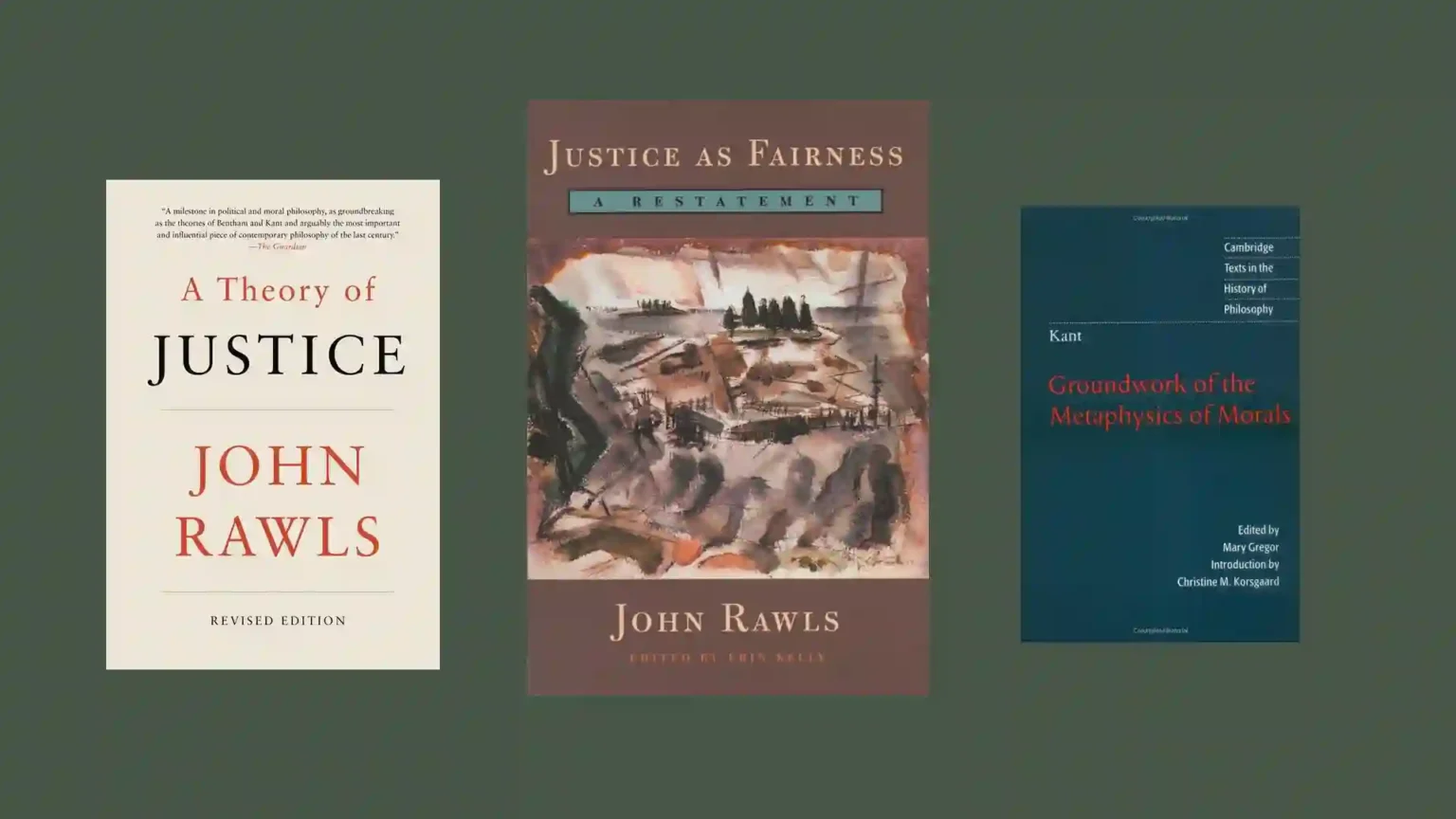
Enough to understand autonomy, not enough to become a Kant specialist. Rawls’s own account is not a simple restatement of Kant, but the Groundwork of the Metaphysics of Morals clarifies why moral principles should not depend on contingent desires or social rank. Read the discussion of persons as ends and the idea of self-legislation. Then stop. The purpose is to recognize why the original position removes knowledge that would let a chooser tailor principles to a private advantage.
Why read Rawls before Rawls?
The most efficient preparation is Rawls’s 1958 essay “Justice as Fairness”. It is not a substitute for the book. It is a compressed view of the project before the architecture becomes enormous. Read it for the claim that fairness is fundamental to justice, the use of a choice situation, and the attempt to justify principles through conditions no participant could reasonably design for personal gain.
There is a second Rawls-to-Rawls option, but it should be used carefully. Justice as Fairness: A Restatement is later, shorter, and reflects decades of revision. It is excellent for orientation, but if your goal is to experience the argument of A Theory of Justice historically, do not let the restatement silently replace the 1971 structure. Use it as a map, then return to the book.
Which edition of A Theory of Justice should you use?
For a first complete reading, the 1999 revised edition is the default. It incorporates changes Rawls made after the first edition, while the original 1971 edition remains important for scholars studying reception and textual development. Do not mix quotations or section references across editions without checking them. The differences are not merely typographical.
What is the “basic structure,” and why learn it early?
The basic structure is the system of major social institutions – constitutional arrangements, legal rules, and economic structures – whose combined effects shape rights, duties, opportunities, and life prospects. Many beginner readings go wrong by treating Rawls as if he were offering a morality for every private choice. He is primarily asking what principles should regulate this institutional structure. The Stanford Encyclopedia overview of Rawls is the best compact reference for this architecture.
What are primary goods doing in the argument?
Primary goods are not a list of everything worth wanting. They are things citizens generally need in pursuing many different reasonable conceptions of the good: rights, liberties, opportunities, income and wealth, and the social bases of self-respect. Learn this before you reach the difference principle. Otherwise the second principle can look like a simple instruction to redistribute money toward the poorest. Rawls’s object is the design of institutions under fair equality of opportunity and a broader metric of citizens’ prospects.
What should you know before the original position?
Three things. First, the parties are representatives in a model, not actual historical founders. Second, the veil of ignorance removes information that would let them choose principles biased toward a known class, religion, talent, race, gender, or conception of the good. Third, the argument depends on what information remains available: general social theory, psychology, economics, and facts about human circumstances. The model is therefore constrained ignorance, not empty ignorance.
Then learn the priority structure before memorizing the two principles. Rawls does not present liberty, opportunity, and distribution as values to be traded on one common scale whenever the social total improves. Equal basic liberties have priority, and fair equality of opportunity constrains the way distributive inequalities are assessed. If you approach the difference principle as an isolated formula for helping the least advantaged, you miss the institutional ordering that makes the theory distinct from a maximizing welfare rule.
This is where the revised A Theory of Justice rewards slow reading. The original position is only one device inside a larger argument moving from the circumstances of justice and the public conception of justice to institutions, distributive shares, duties, stability, and moral psychology. The Stanford Rawls entry is useful for holding that architecture in view while the book moves through local arguments.
A second habit helps: distinguish justification from prediction. Rawls is not claiming that real people placed behind an actual curtain would psychologically choose his principles. He is specifying fair conditions of representation and asking which principles can be justified from that standpoint. Objections about risk-aversion or bargaining behavior matter only after you ask whether they attack the model’s normative purpose or merely imagine a different psychology for the parties.
Finally, notice the evolution from the 1958 “Justice as Fairness” essay to the book and then to the later Restatement. Reading across those versions shows why “Rawls’s theory” should not be treated as one frozen set of slogans. For a first encounter, however, this history is orientation, not a detour: use it to identify changes, then let the 1999 revised edition be the text you actually read.
What can you safely skip before starting?
You can skip a complete reading of Kant’s critical philosophy, all of Sidgwick, the entire history of contract theory, and the later Rawls of Political Liberalism. You can also postpone the technical secondary literature on the maximin rule. Those materials become useful when the book has already generated a precise problem for you. Preparation should reduce cognitive load, not move the real reading indefinitely into the future.
A practical six-step route
| Step | Read or learn | Why it belongs before Rawls |
|---|---|---|
| 1 | Contractarianism overview | Understand hypothetical agreement as justification |
| 2 | Utilitarianism at concept level | See the rival aggregative picture |
| 3 | Kant: autonomy and persons as ends | Recognize the moral grammar behind fairness |
| 4 | Rawls 1958, “Justice as Fairness” | Preview the project in compressed form |
| 5 | SEP Rawls: basic structure and two principles | Acquire the map without replacing the text |
| 6 | A Theory of Justice, revised edition | Read the complete architecture in order |
A good preparation route should change one reader decision: instead of asking whether the original position is “realistic,” ask what kinds of bias the model is designed to exclude and whether the information it retains is sufficient to justify the principles Rawls wants. Once you can ask that question, you are ready. The rest of the difficulty belongs to the book itself.
Cover artwork: credits and source records
- A Theory of Justice — Harvard University Press (source record)
- Justice as Fairness: A Restatement — Harvard University Press (source record)
- Groundwork of the Metaphysics of Morals — Cambridge University Press (source record)