Ethics and the Limits of Philosophy is best approached through Bernard Williams’s criticism of ethical theory and his distinctive view of practical life.
The puzzle in Bernard Williams’s Ethics and the Limits of Philosophy is not that a philosopher criticizes moral theory. It is that Williams wants ethical reflection to remain serious after the aspiration to a complete moral system has been cut down. The book’s title names the tension exactly: philosophy can clarify concepts, expose bad arguments, and criticize distorted self-understandings, yet it may not be able to deliver the kind of impersonal, exceptionless foundation that modern moral theory often promises.
From moral system to ethical life
Williams’s target is broader than utilitarianism or Kantianism taken one at a time. He distrusts a style of moral philosophy that begins by asking for the correct general theory and then treats lived ethical experience as material to be sorted by it. The Stanford Encyclopedia entry on Williams emphasizes his resistance to reductive system-building and his insistence that moral psychology, history, luck, character, and practical identity matter to ethical understanding.
That resistance is not anti-rational. Williams repeatedly asks whether the reasons a theory attributes to agents can actually connect with motivation and deliberation. The distinction between internal and external reasons became one of the central flashpoints. On an internalist reading, a statement that an agent has a reason must bear some relation—possibly through informed deliberation and correction—to that agent’s motivational set. The attraction is explanatory: reasons are not mysterious commands floating free of agency. The danger is equally obvious: if motives are corrupt, confused, or impoverished, can the view criticize them strongly enough?
This dispute altered the reception of the book. One camp reads Williams as protecting a realistic account of agency against moral theories that issue reasons no recognizable person could own. Another sees the same move as too conservative, because existing motivations are shaped by prejudice and power. Williams’s answer is not that every desire validates itself. Deliberation can correct false beliefs, reveal conflicts, extend imagination, and transform a motivational outlook. But he rejects the shortcut in which philosophy simply stipulates a reason and assumes that its authority explains action.
The historical dimension deepens the challenge. Ethical concepts belong to forms of life; they can change, decay, or become unintelligible when detached from the practices that gave them sense. Williams contrasts this with the stronger expectation of convergence often associated with science. The implication is unsettling: ethical reflection may become more truthful about its own history without converging on one final vocabulary. That is not yet relativism. It is a demand that philosophy explain why ethical concepts should enjoy the same kind of ahistorical authority that scientific truth sometimes seems to promise.
Reasons, integrity, and conflict
The earlier collection Moral Luck shows that these concerns were not invented for the later book. In “Internal and External Reasons”, Williams develops the reasons dispute directly. In “Persons, Character and Morality”, he pressures ethical views that treat projects and character as morally secondary. These arguments converge on a single suspicion: a theory can be elegant while misdescribing what an agent is.
Integrity is the clearest example. The Stanford Encyclopedia discussion of integrity helps distinguish Williams’s point from a demand for moral purity. Projects, commitments, loyalties, and attachments are not optional decorations added after impersonal morality has spoken. They partly constitute the person who deliberates. A moral system that repeatedly requires agents to view their deepest projects as merely one set of consequences among others may not simply be demanding; it may be alienating in a way that reveals a defect in its picture of agency.
Critics can reasonably object that “integrity” risks protecting objectionable commitments. A racist, fanatic, or exploiter also has projects. That objection matters because it shows that personal identity cannot itself settle what one ought to do. Williams’s point is subtler: ethical criticism must address a person whose motivations and history have structure. It cannot assume that removing all partial commitments would leave behind a morally purified decision-maker. The work of criticism is transformation and judgment, not the deletion of agency.
Conflict supplies a second test. In the essay on conflicts of values, Williams resists the hope that a sufficiently complete theory will rank every value so that rational choice leaves no moral remainder. Sometimes one genuine value is sacrificed for another, and regret can remain appropriate even when the decision was justified. A theory that redescribes all justified losses as fully cancelled by the winning reason may achieve formal neatness at the cost of phenomenological truth.
This is where Williams’s skepticism about moral systems becomes positive ethics rather than mere demolition. He wants a moral psychology capable of representing regret, luck, partiality, character, and conflict without assuming in advance that these are noise to be removed by theory. The ethical life may contain reasons that are real yet not commensurable on one scale, commitments that are open to criticism yet constitutive of agency, and decisions that are justified yet leave loss behind.
What the anti-theory argument can—and cannot—establish
The sharpest criticism of Williams is that exposing the limits of system does not automatically produce standards for condemning cruelty, domination, or inherited injustice. If ethical concepts are historically situated and reasons connect with motivation, how can reflection reach beyond a corrupt outlook? Early readings often treated this as the decisive threat: anti-theory seemed to purchase realism by weakening normativity. Later work in virtue ethics, moral psychology, reasons, partiality, and political critique has made the picture less binary. One can reject a universal decision procedure without giving up argument, evidence, consistency, or criticism.
Williams himself does not defend the lazy proposition that every ethical outlook is as good as every other. Reflection can expose false empirical beliefs, incoherence, self-deception, ideological distortion, and failures to understand other people. Historical understanding can undermine confidence in a concept by revealing how contingent or self-serving its authority became. What Williams doubts is that these critical resources must culminate in one philosophical theory capable of deriving every justified verdict from a small foundational set.
The historiographical change is important. The debate has moved from “Can morality survive without a system?” toward “What exactly must a theory explain about human agents before its prescriptions count as ethically illuminating?” That shift makes the book less a manifesto against philosophy than a test imposed on it. Systematic theories remain possible, but their abstraction carries a burden: they must show that what they leave out—history, motivation, character, conflict, luck, and loss—is genuinely dispensable rather than inconvenient.
The strongest reading therefore refuses both caricatures. Williams does not prove that moral theory is useless, and Ethics and the Limits of Philosophy does not supply a replacement system. It changes the burden of proof. A theory must show not only that its principles are coherent but that the picture of agency required by those principles is recognizably human. The opening puzzle returns with one assumption altered: perhaps ethical uncertainty is not always a defect that more philosophy will remove. Sometimes it marks the limit of what a philosophical system may reasonably demand from ethical life.
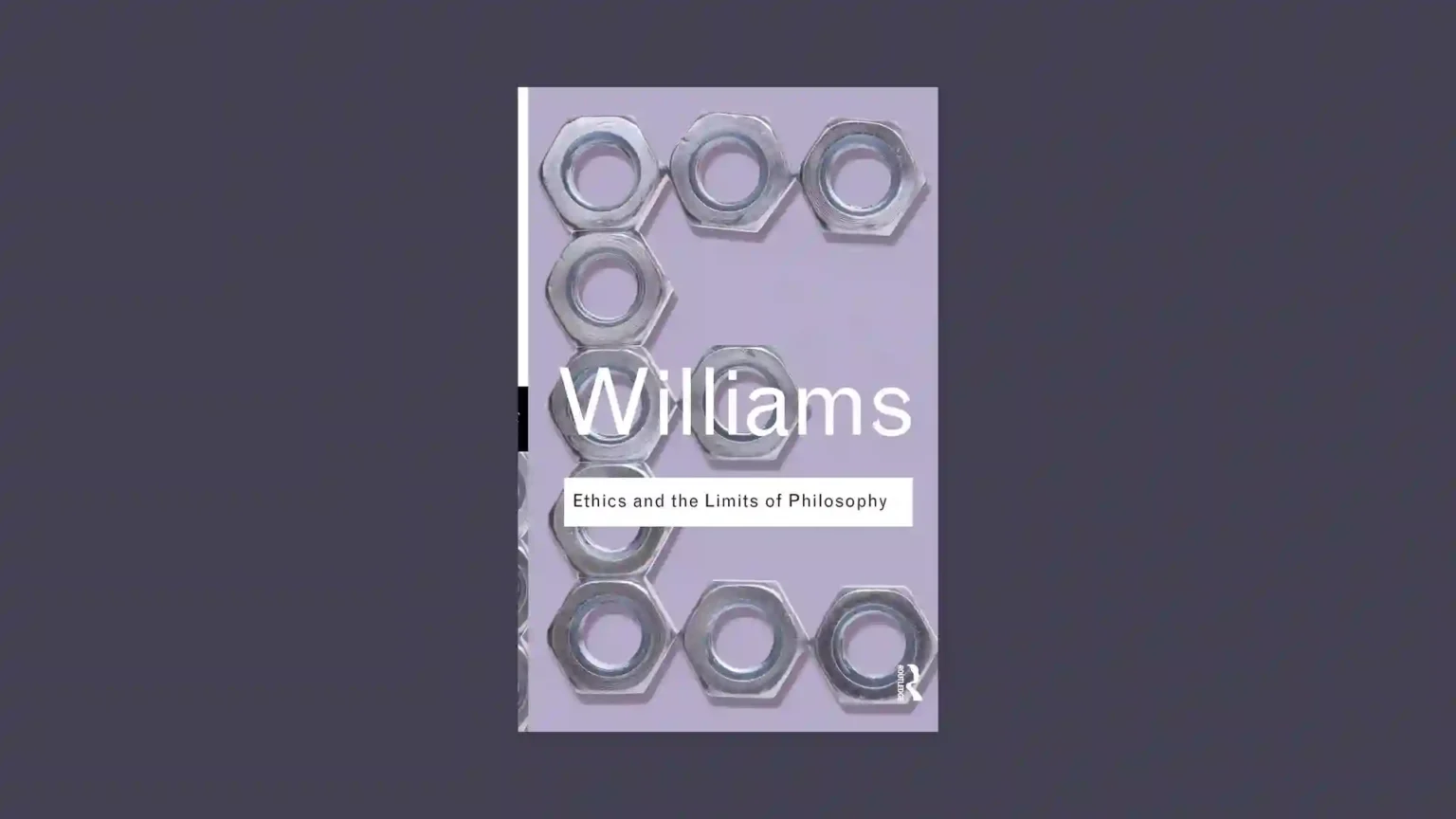
Cover artwork: credits and source records
- Ethics and the Limits of Philosophy — Routledge (source record)