Best Books to Understand Existentialism should not begin with the longest or most intimidating classics. The clearest route starts with Sarah Bakewell’s lucid intellectual history, then moves through Sartre, Camus, Beauvoir, Kierkegaard, and Nietzsche to explain freedom, absurdity, responsibility, faith, nihilism, and life without final guarantees for serious readers approaching the tradition for the first time.
Introduction
Existentialism survives partly because it names experiences that refuse to stay academic: the feeling that one has been thrown into a life not of one’s choosing; the pressure of decisions that cannot be delegated; the temptation to hide inside convention; the fear that the world offers no final authorization for what we value. Yet the term also creates confusion. It gathers together Christian and atheist thinkers, systematic philosophers and anti-systematic writers, novelists and phenomenologists, people who embraced the label and people who rejected it.
The Stanford Encyclopedia of Philosophy’s account of existentialism is useful precisely because it presents the movement through recurring problems—freedom, authenticity, situatedness, affect, embodiment—rather than pretending that every writer subscribed to a common creed. The Internet Encyclopedia of Philosophy’s overview likewise shows why the category remains contested, especially around Heidegger and Camus.
This guide therefore does not rank famous names. It constructs a learning sequence. The order begins with historical orientation, proceeds to an unusually accessible primary statement, tests that statement against absurdity and ethics, and only then moves backward to two nineteenth-century precursors whose religious and genealogical challenges make the later movement intelligible. The sequence is pedagogical rather than chronological: it gives beginners a map before asking them to navigate the difficult terrain. That principle, rather than fame alone, determines which works qualify here as the Best Books to Understand Existentialism.
The shortest honest answer
For most beginners, start with Sarah Bakewell’s At the Existentialist Café. Then read Sartre’s Existentialism Is a Humanism, Camus’s The Myth of Sisyphus, and Beauvoir’s The Ethics of Ambiguity. Finish the first path with Kierkegaard’s Fear and Trembling and Nietzsche’s The Gay Science, which reveal the religious and anti-metaphysical pressures behind the twentieth-century movement.
That is the shortest honest route through the Best Books to Understand Existentialism. Bakewell supplies names, conflicts, and historical sequence; Sartre states the case for freedom; Camus examines life without ultimate meaning; Beauvoir turns freedom toward ethics and oppression; Kierkegaard complicates rational universality through faith; Nietzsche asks what becomes possible after inherited values lose authority. No preliminary course in phenomenology is required, and Being and Nothingness or Being and Time can wait.
Before you start: how to approach existentialism
The main beginner error is to treat existentialism as a mood: black clothing, cafés, cigarettes, despair, and the slogan that “life is meaningless.” Its writers do attend to anxiety, death, abandonment, and absurdity, but usually because these experiences reveal something about agency. Anxiety can disclose possibility. Despair can expose a failed relation to oneself. Absurdity can strip away false consolation. The point is not to cultivate darkness; it is to ask how one lives when inherited certainties no longer settle one’s choices. The Best Books to Understand Existentialism keep that practical pressure visible even when their methods sharply diverge.
Primary texts should come early, but not first. A brief historical orientation prevents the reader from collapsing every thinker into Sartre. It also clarifies that “existentialist” is often a retrospective label. Kierkegaard wrote within Christian theology; Nietzsche attacked Christianity and systematic morality; Heidegger rejected Sartre’s humanist interpretation; Camus resisted being classified as an existentialist. Their convergence lies in problems, not membership cards.
Chronology therefore helps only after the reader knows what to notice. Read the twentieth-century debate first, then return to its precursors. Learn a small vocabulary—freedom, facticity, bad faith, absurdity, ambiguity, authenticity, despair, nihilism—but do not wait to master phenomenology, German idealism, or Hegel before beginning. The concepts become clearer through use. A notebook with two columns—“what is given” and “what is chosen”—is more useful at this stage than a shelf of commentaries.
The best first book on existentialism: Best Books to Understand Existentialism
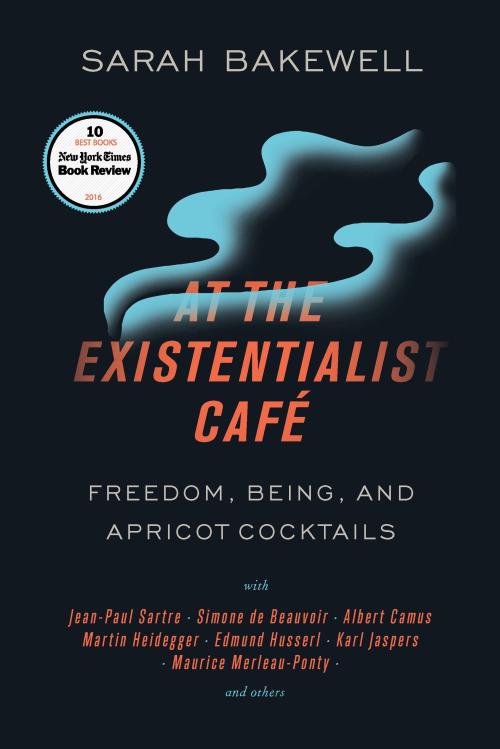
Start with: At the Existentialist Café by Sarah Bakewell
Bakewell is the strongest first choice because she gives existentialism back its human scale without reducing ideas to biography. Husserl’s phenomenology enters through a conversation over apricot cocktails; Sartre and Beauvoir appear as collaborators, rivals, lovers, political actors, and disciplined readers; Heidegger’s intellectual achievement is presented alongside the moral catastrophe of his Nazism. The result is not a neutral textbook, but it is an unusually effective map of who read whom, which disputes mattered, and why philosophical claims became matters of public urgency.
The book does not replace primary texts. Its account is selective, its narrative momentum sometimes smooths over technical disagreements, and readers interested in non-European existentialisms will need to go elsewhere. Those are limitations of scope, not reasons to begin with a denser survey. The Other Press paperback shown below is readily identifiable and portable; after finishing it, move immediately to Sartre’s lecture while Bakewell’s historical frame is still fresh. That sequence turns names into arguments.
The core reading sequence
Book 1
At the Existentialist Café by Sarah Bakewell
Edition shown: Other Press paperback, 2017, 464 pages, ISBN 9781590518892
Place in the sequence: Historical orientation and conceptual map
Bakewell begins where a beginner actually stands: surrounded by famous names but unsure how phenomenology, existentialism, literature, politics, and biography connect. Her governing method is narrative. She follows Husserl’s demand to return “to the things themselves,” the migration of phenomenology from Germany to France, and the transformations by which Sartre and Beauvoir turned abstract analysis into a language of freedom, situation, and commitment. This gives the reader a chronology without making chronology the argument.
Read for relationships as much as doctrines. Raymond Aron’s report of German phenomenology matters because ideas travel through friendship; Beauvoir’s philosophical labor matters because the old picture of her as Sartre’s disciple is untenable; the conflict between Sartre and Camus matters because existential freedom did not dictate one politics. Bakewell also keeps Heidegger’s work and political record in the same frame. That is indispensable preparation for a tradition in which the question “how should one live?” cannot be separated from the conduct of its thinkers, yet cannot be answered by biography alone.
The book’s limitation is also its strength: technical arguments are often rendered through scenes, personalities, and intellectual turning points. Do not treat its summaries as final statements of Husserl, Heidegger, Sartre, or Merleau-Ponty. Mark the figures and concepts that recur—intentionality, being-in-the-world, bad faith, ambiguity, authenticity—and let the later primary works correct the simplifications. Read the entire book, but resist stopping there. Its purpose in this sequence is to make the next five books feel like interventions in a live conversation rather than isolated monuments.
A productive way to read is to keep a one-page cast list. Under each thinker, record one question rather than a complete doctrine: Husserl—how is experience structured? Heidegger—what does it mean to be in a world? Sartre—what does freedom demand? Beauvoir—how are freedoms entangled? Camus—how can one live without appeal? This keeps biography subordinate to inquiry while preserving the narrative links that make Bakewell so helpful.
Difficulty: Beginner
“This lively history of the existentialist movement makes a strong, if sometimes disorienting, case for the inextricability of philosophy and biography.”
— The New Yorker editors, The New Yorker

Book 2
Existentialism Is a Humanism by Jean-Paul Sartre
Edition shown: Yale University Press paperback, translated by Carol Macomber, introduced by Annie Cohen-Solal, 2007, ISBN 9780300115468
Place in the sequence: The accessible primary statement of freedom and responsibility
Sartre’s 1945 lecture is the right first primary text because it stages existentialism as a public defense. He answers Christian charges of despair and Marxist charges of bourgeois quietism by arguing that human beings are not made according to a preset design. “Existence precedes essence” means that a person first finds himself or herself existing and then becomes someone through action. Freedom is therefore not cheerful unlimited choice; it is the inescapable burden of taking a position within circumstances one did not create.
The Stanford Encyclopedia’s Sartre entry helps place the lecture beside the much harder Being and Nothingness. While reading, attend to three claims: choice discloses values rather than merely applying them; refusing to choose is itself a choice; and choosing for oneself proposes an image of humanity. These claims explain why anguish accompanies freedom. The issue is not private self-expression but responsibility without a divine or metaphysical rulebook capable of choosing in one’s place.
Its limitation is serious. A polemical lecture compresses Sartre’s ontology, underplays embodiment and social constraint, and can make freedom sound more sovereign than his broader work permits. The Yale edition is preferable because Carol Macomber’s translation is paired with contextual material and Sartre’s discussion of Camus’s The Stranger. Read the whole volume, including the questions and supplementary text. Then turn to Camus, who shares the problem of a godless world but refuses Sartre’s vocabulary and conclusions. The contrast prevents this compact lecture from becoming a definition of the entire movement.
It is also worth distinguishing freedom from preference. Sartre is not saying that every desire is equally authentic or that circumstances disappear when we decide. He is arguing that even constrained action expresses a stance toward one’s situation. Keep a list of moments when he moves too quickly from individual choice to universal responsibility. Those tensions will become the questions Beauvoir later handles with greater social and ethical precision.
Difficulty: Beginner
“To understand Jean-Paul Sartre is to understand something important about the present time.”
— Iris Murdoch, Yale University Press
Book 3
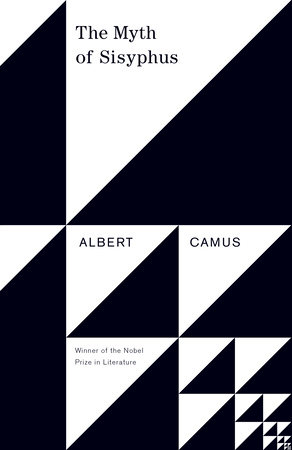
The Myth of Sisyphus by Albert Camus
Edition shown: Vintage paperback, translated by Justin O’Brien, 2018, 160 pages, ISBN 9780525564454
Place in the sequence: The absurd and the refusal of false consolation
Camus begins with a brutally practical question: if the world offers no ultimate meaning, why not die? The absurd arises neither from the world alone nor from human consciousness alone, but from their confrontation—the demand for clarity meeting the world’s silence. This is not identical to Sartre’s claim that we create ourselves through choice. Camus is less interested in founding values through freedom than in preserving lucid tension without escape into religion, metaphysics, or suicide.
The Stanford Encyclopedia’s Camus entry stresses an important qualification: Camus rejected the existentialist label even while asking one of the tradition’s defining questions. Read the essays as a sequence of tests. Philosophical suicide names systems that leap beyond the absurd; Don Juan, the actor, and the conqueror become figures of intensified living; Sisyphus embodies persistence without hope of final resolution. “Revolt” here is not yet a political program. It is the stance of continuing consciously.
The difficulty lies in Camus’s method. He shifts between argument, literary portrait, and aphoristic declaration, and the famous final image can be mistaken for a simple motivational slogan. Read the title essay completely, but on a first pass the extended engagements with Kierkegaard, Chestov, and phenomenology may be marked for return rather than mastered line by line. The 2018 Vintage paperback retains Justin O’Brien’s established translation. Its limitation is historical: the translation can sound more formal than contemporary English, and Camus’s treatment of “man” is not gender-neutral. After Camus, Beauvoir is essential because she asks what freedom owes to other freedoms.
Do not equate the absurd with nihilism. The nihilist concludes that nothing has value; Camus suspends that conclusion and asks what fidelity to experience permits. His answer—lucidity, revolt, freedom, and passion—remains vulnerable to criticism, but it is not resignation. This distinction explains why Sisyphus is imagined as happy: not because labor secretly acquires a final purpose, but because consciousness refuses both deception and surrender.
Difficulty: Moderate
“showing a way out of despair and reaffirming the value of existence.”
— Penguin Random House editors, Penguin Random House
Book 4
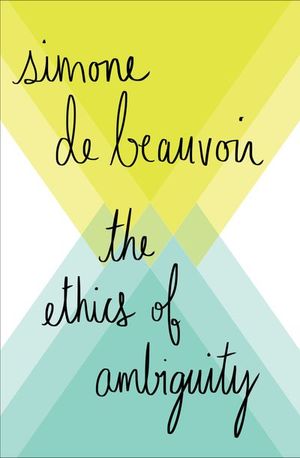
The Ethics of Ambiguity by Simone de Beauvoir
Edition shown: Open Road Media ebook, Bernard Frechtman translation, 2018, ISBN 9781504054218
Place in the sequence: Existential freedom developed into an ethics of reciprocity and liberation
Beauvoir corrects the impression that existentialism can only tell us to choose. Human existence is ambiguous because we are at once free subjects and finite objects, transcendence and facticity, projects toward the future and bodies exposed to need, violence, and death. An ethics adequate to that condition cannot rely on eternal values, yet it cannot celebrate arbitrary will. My freedom becomes ethically serious when it wills itself as freedom and recognizes that it depends upon the freedom of others.
The Stanford Encyclopedia’s Beauvoir entry is valuable here because it treats her as an original philosopher rather than a supplement to Sartre. Read especially for her portraits of failed attitudes: the sub-man who flees freedom, the serious man who treats chosen values as absolute, the nihilist who destroys after discovering their contingency, and the adventurer who pursues projects without caring whom they crush. These types turn existential categories into diagnoses of moral evasion.
The final sections on oppression and action are the book’s decisive advance. Beauvoir shows that freedom is situated unevenly; some people are prevented from converting possibility into action. This makes liberation a concrete ethical demand rather than an abstract respect for choice. The Frechtman translation is historically established but occasionally dated in diction, and the Open Road edition is an ebook reissue rather than a newly translated critical edition. Read the whole book, slowly. Its limitation is that certain historical examples and formulations require later feminist, anticolonial, and race-conscious scholarship. Even so, it is the indispensable fourth step: it transforms existentialism from heroic individuality into a problem of shared and conflicting freedoms.
Pause over Beauvoir’s claim that one cannot will oneself free without also willing others free. It is not a demand for harmony. Projects collide, political action risks violence, and liberation can require resisting those who deny freedom. Her achievement is to make conflict part of ethics rather than evidence that ethics has failed. That is why the book should follow Camus: revolt now acquires social agents, unequal situations, and responsibilities that cannot be solved by private lucidity.
Difficulty: Moderate
“One of de Beauvoir’s most intriguing and original philosophical works.”
— Philosophy Now editors, Open Road Media
Book 5
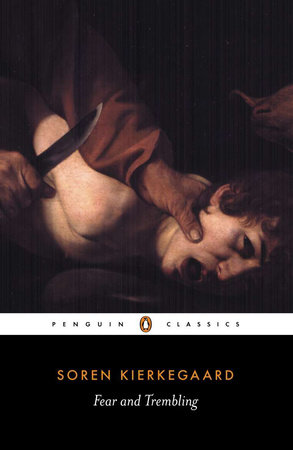
Fear and Trembling by Søren Kierkegaard
Edition shown: Penguin Classics paperback, translated and introduced by Alastair Hannay, 1986, 160 pages, ISBN 9780140444490
Place in the sequence: Religious inwardness and the singular individual before the universal
After Sartre, Camus, and Beauvoir, Kierkegaard feels both ancestral and alien. Writing as “Johannes de silentio,” he returns repeatedly to Abraham’s willingness to sacrifice Isaac. The problem is not whether Abraham is admirable in an ordinary ethical sense. It is whether faith can place the single individual in an absolute relation to God that cannot be translated into universal reasons. The famous “teleological suspension of the ethical” names this scandalous possibility.
The Stanford Encyclopedia’s Kierkegaard entry cautions that calling him the “father of existentialism” can conceal as much as it reveals. Keep that warning active. Kierkegaard is not an early Sartre. His concern with choice, anxiety, inwardness, and becoming a self is inseparable from Christianity, indirect communication, and a critique of Hegelian mediation. The pseudonym matters: the book dramatizes the limits of what its narrator can understand, rather than simply transmitting Kierkegaard’s doctrine.
Read the “Attunement,” “Speech in Praise of Abraham,” and three “Problemata” in full, but allow the repetitions to do their work. Each retelling strips away an easy interpretation. The danger for beginners is to romanticize private conviction as permission to ignore ethics. The text offers no such comfortable license; Abraham’s silence is terrifying because it cannot be publicly justified. Hannay’s Penguin translation and introduction provide a dependable entry, chronology, and notes. This book belongs late in the path because the reader can now see how existential singularity arose from a religious crisis before it became a secular philosophy of freedom.
Keep two interpretive levels separate. At the dramatic level, the book asks what Abraham’s act means. At the authorial level, Kierkegaard uses a pseudonym who admires faith but confesses that he cannot make the movement himself. That distance prevents a simple identification of “Johannes de silentio says” with “Kierkegaard believes.” It also trains the reader for existential writing in which form, voice, and indirect communication carry philosophical weight.
Difficulty: Demanding
“The infamous and controversial work that made a lasting impression on both modern Protestant theology and existentialist philosophers such as Sartre and Camus”
— Penguin Random House editors, Penguin Random House Higher Education
Book 6
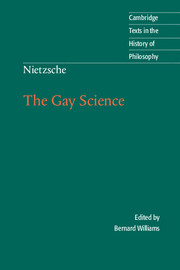
The Gay Science by Friedrich Nietzsche
Edition shown: Cambridge Texts in the History of Philosophy paperback, translated by Josefine Nauckhoff with poems translated by Adrian Del Caro, edited by Bernard Williams, 2001, ISBN 9780521636452
Place in the sequence: Nihilism, perspectivism, self-overcoming, and the creation of values
Nietzsche ends this beginner path because he destabilizes nearly every formula acquired earlier. He does not offer a doctrine called existentialism. Instead, his aphorisms ask what happens when the highest inherited values undermine themselves, when the “death of God” becomes a cultural event rather than an atheist boast, and when truth, morality, and identity are examined as historical achievements rather than timeless structures. Sartrean freedom and Camusian lucidity become more difficult once the genealogy of valuing itself comes into view.
The Stanford Encyclopedia’s Nietzsche entry is a useful guard against reducing him to slogans. In The Gay Science, look for experiments rather than a system: the madman announcing God’s death, the question of eternal recurrence, the suspicion directed at the will to truth, and the effort to affirm life without metaphysical guarantees. The book’s gaiety is methodological. Thought becomes an art of testing perspectives, styles, affects, and possible forms of life.
Read Books I–IV completely if possible, then the 1887 preface and Book V; the poems may be sampled on a first reading. Aphoristic form invites selective quotation, but isolated lines often reverse meaning when restored to their neighborhood. The Cambridge edition is especially valuable for a beginner moving toward advanced study: Nauckhoff’s translation, Del Caro’s versions of the poems, and Bernard Williams’s introduction and notes make the textual architecture visible. Its principal difficulty is that Nietzsche attacks positions faster than he replaces them. Ending here is deliberate. A mature introduction to existentialism should conclude not with a settled creed, but with the problem of how values can be created without disguising their human, historical origin.
The Cambridge apparatus helps with another danger: reading Nietzsche as if each aphorism announced a stable personal belief. His voices shift, experiments fail, and later sections revisit earlier claims under new pressure. Annotate recurring images—health, dance, sea, masks, horizons—and note when a psychological observation becomes a cultural diagnosis. This slower practice reveals why Nietzsche influenced existentialism without belonging neatly inside it: he supplies problems and provocations rather than a common doctrine.
Difficulty: Advanced
“This is one of Nietzsche’s most important and influential philosophical works, widely taught to undergraduates”
— Cambridge University Press editors, Cambridge University Press
How these books fit together
The architecture moves from map to argument, then from argument to complication. Bakewell supplies the social and intellectual world. Sartre gives the cleanest public formulation of freedom. Camus tests whether lucidity can sustain life without metaphysical meaning. Beauvoir demonstrates that freedom is never solitary and that oppression alters the field in which projects become possible. Kierkegaard then reveals the religious crisis of singular existence, while Nietzsche exposes the historical collapse of inherited values and the danger of nihilism.
Phenomenology remains the missing technical bridge. Readers who want to pursue it can consult the Stanford Encyclopedia’s overview of Heidegger before attempting Being and Time. But for a first path, postponement is an editorial virtue. The six books above establish the central pressures—situation, choice, absurdity, ambiguity, faith, nihilism—before the reader enters the movement’s most difficult ontology. In that sense, the Best Books to Understand Existentialism form an argument across disagreements, not a shelf of interchangeable introductions.
Common beginner mistakes
Beginning with the largest monument
Starting with Being and Nothingness or Being and Time often produces vocabulary fatigue before the questions become urgent. Difficulty is not proof of seriousness. Build conceptual traction first.
Treating Sartre as the definition
Sartre popularized the label, but Kierkegaard’s Christianity, Nietzsche’s genealogy, Beauvoir’s ethics, Camus’s absurdism, and Heidegger’s ontology cannot be reduced to “existence precedes essence.” Use the slogan as a doorway, not a constitution.
Confusing freedom with unlimited power
Existential freedom operates within facticity: bodies, histories, social classifications, economic limits, prior actions, and mortality. Beauvoir is particularly important because she shows how oppression constrains the practical realization of freedom without turning persons into objects without agency.
Collecting quotations instead of following arguments
Existentialist writing is unusually quotable, which makes it unusually easy to misread. The madman, Sisyphus, Abraham, and Sartre’s slogans belong to developed rhetorical settings. Read around the famous line. The Best Books to Understand Existentialism become useful only when their images and slogans are returned to the arguments that produced them.
Optional paths depending on your interest
If you are interested in freedom, responsibility, and political commitment, prioritize Existentialism Is a Humanism and then The Ethics of Ambiguity. The second book tests and socializes the first book’s account of choice.
If you are interested in absurdity, suicide, and meaning without religion, prioritize The Myth of Sisyphus. Follow it later with Camus’s The Rebel, not as a substitute for the present sequence but as its political continuation.
If you are interested in faith, anxiety, and the singular individual, prioritize Fear and Trembling. Continue with Kierkegaard’s The Sickness Unto Death for a more explicit analysis of despair and selfhood.
For a more advanced path, continue with The Gay Science and then Heidegger’s Being and Time. At that point, a phenomenology guide and a reliable commentary become useful rather than premature.
FAQ
Are novels necessary among the Best Books to Understand Existentialism?
Not necessary, but eventually valuable. Sartre’s Nausea, Camus’s The Stranger, and Beauvoir’s She Came to Stay dramatize experiences that philosophical prose analyzes. Begin with the six-book conceptual path, then add fiction when you can recognize the arguments embodied in form and character.
Should I avoid older translations?
Not automatically. An older translation may remain standard and readable, as with Justin O’Brien’s Camus or Bernard Frechtman’s Beauvoir, but it can preserve dated gendered language or obscure technical choices. Check the translator, read the introduction, and compare a difficult paragraph when alternatives exist.
How much phenomenology do I need first?
Very little for this sequence. Know that phenomenology studies structures of experience and how things appear as meaningful. More detail becomes necessary when reading Husserl, Heidegger, Sartre’s ontology, or Merleau-Ponty. Bakewell gives enough orientation to begin.
Can I use audiobooks for these works?
Bakewell works well in audio. Sartre and Camus can also be followed aloud if you pause for notes. Beauvoir, Kierkegaard, and Nietzsche reward visual rereading because their distinctions, repetitions, pseudonymous strategies, and aphoristic structures are easy to miss in continuous listening.
Related BookInLight Reading Guides
Five Best Books on Phenomenology explains the method that underlies Husserl, Heidegger, Sartre, and Beauvoir, making it the natural technical companion to this beginner route.
What Should You Read Before Heidegger’s Being and Time? provides the next-stage preparation for readers ready to move from existential themes into fundamental ontology.
Seven Books on Hermeneutics for Serious Readers of Interpretation extends the inquiry from existence and understanding toward the theory and history of interpretation.
This article was researched and written by the BookInLight Department of Philosophy and Intellectual History, with bibliographical review, source verification, quotation verification, link verification, and editorial fact-checking. Readers are invited to send factual corrections, overlooked sources, edition suggestions, interpretive observations, and constructive ideas for future revision.
Editorial art direction, visual composition, cover selection, and presentation were developed by the BookInLight Art Department. Rights in third-party book covers remain with their publishers, artists, designers, and other rights holders. Complete republication, reproduction, translation, or reuse of this article requires prior written authorization from BookInLight.
Sources and Further Reading
Primary Texts and Editions
Sarah Bakewell, At the Existentialist Café, Other Press, 2017 paperback. Publisher edition record; used for bibliographical data and the book’s historical scope.
Jean-Paul Sartre, Existentialism Is a Humanism, trans. Carol Macomber, Yale University Press, 2007. Yale edition record; used for translation, contents, publication context, and critical testimony.
Albert Camus, The Myth of Sisyphus, trans. Justin O’Brien, Vintage, 2018. Penguin Random House edition record; used for ISBN, format, date, and publisher description.
Simone de Beauvoir, The Ethics of Ambiguity, trans. Bernard Frechtman, Open Road Media, 2018 ebook. Open Road Media edition record; used for edition identification and critical description.
Søren Kierkegaard, Fear and Trembling, trans. Alastair Hannay, Penguin Classics, 1986. Penguin Random House Higher Education record; used for translator, contents, notes, and ISBN.
Friedrich Nietzsche, The Gay Science, trans. Josefine Nauckhoff, poems trans. Adrian Del Caro, ed. Bernard Williams, Cambridge University Press, 2001. Cambridge edition record; used for translation, editorial apparatus, format, and ISBN.
Scholarly Context and Reference
Kevin Aho, “Existentialism,” Stanford Encyclopedia of Philosophy; used for the movement’s recurring themes and contested boundaries.
Jack Reynolds, “Jean-Paul Sartre,” Stanford Encyclopedia of Philosophy; used to place the 1945 lecture within Sartre’s larger project.
Ronald Aronson, “Albert Camus,” Stanford Encyclopedia of Philosophy; used for Camus’s relation to existentialism and the philosophy of the absurd.
Debra Bergoffen and Megan Burke, “Simone de Beauvoir,” Stanford Encyclopedia of Philosophy; used for Beauvoir’s independent contributions to ethics, phenomenology, and feminism.
John Lippitt, “Søren Kierkegaard,” Stanford Encyclopedia of Philosophy; used for pseudonymity, faith, and the limits of the “father of existentialism” label.
Brian Leiter and Michael Rosen, “Friedrich Nietzsche,” Stanford Encyclopedia of Philosophy; used for Nietzsche’s critique of truth, morality, and inherited values.
“Existentialism,” Internet Encyclopedia of Philosophy; consulted for the broader historical field and disputes over inclusion.
Further Studies and Critical Reception
Thomas R. Flynn, Existentialism: A Very Short Introduction, Oxford University Press, 2006. Oxford Academic record; consulted as a concise thematic overview.
Steven Crowell, ed., The Cambridge Companion to Existentialism, Cambridge University Press, 2012. Cambridge Core record; consulted for the movement’s philosophical range and afterlives.
The New Yorker editors, “Briefly Noted: At the Existentialist Café,” The New Yorker; used for the verified critical quotation on Bakewell’s book.
Image Credits
At the Existentialist Café, Other Press paperback, 2017. Cover image supplied through Other Press.
Existentialism Is a Humanism, Yale University Press paperback, 2007. Cover image supplied through Yale University Press.
The Myth of Sisyphus, Vintage paperback, 2018. Cover image supplied through Penguin Random House.
The Ethics of Ambiguity, Open Road Media ebook, 2018. Cover image supplied through Open Road Media.
Fear and Trembling, Penguin Classics paperback, 1986. Cover image supplied through Penguin Random House Higher Education.
The Gay Science, Cambridge Texts in the History of Philosophy paperback, 2001. Cover image supplied through Cambridge University Press.