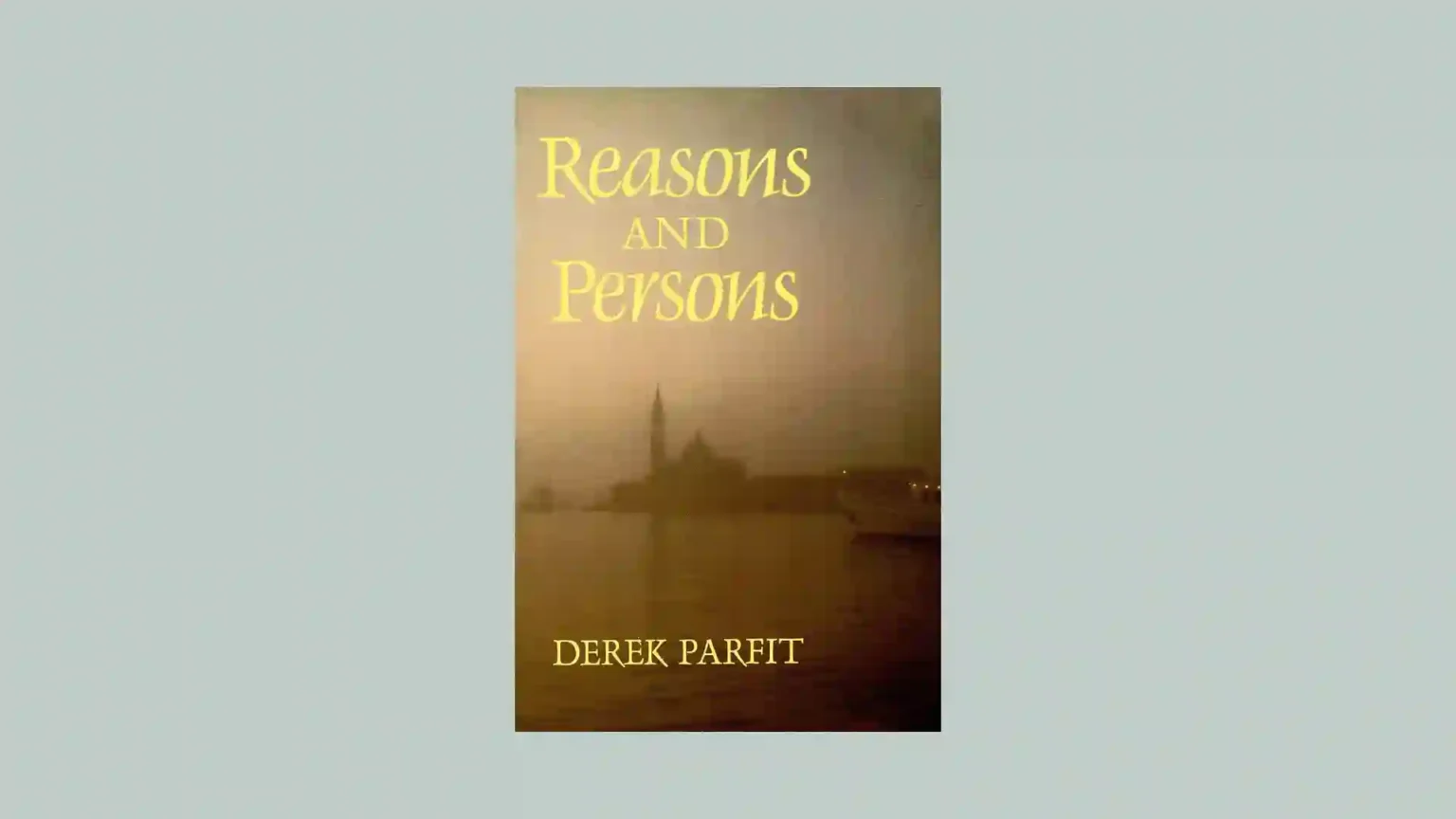
Before Reasons and Persons, learn the identity, population, and rational-choice problems that make Derek Parfit’s ambitious argument hard to simplify.
A striking fact about Reasons and Persons is that the book is famous for several arguments that can look like separate research programs: self-defeating moral theories, prudence across time, personal identity, the non-identity problem, and population ethics. The wrong preparation strategy is therefore to master one giant background tradition. The useful strategy is to map the dependencies: which concepts must be in place before each part becomes intelligible?
Bibliographic distinction: Reasons and Persons was first published by Oxford University Press in 1984. The corrected paperback followed in 1986, with a further corrected reprint in 1987. These are edition dates for the same book, not three original publications. Source: Oxford University Press copyright-page record.
Do you need a full course in moral philosophy first?
No. You need three working contrasts: consequentialist versus non-consequentialist reasoning; prudential reasons versus moral reasons; and person-affecting versus impersonal comparisons of outcomes. Parfit often builds arguments by accepting an apparently plausible principle and constructing cases in which its implications collide with another plausible principle. Learn to follow that method before accumulating secondary literature.
Part One is especially useful training because it asks when theories become self-defeating. The background you need is methodological rather than encyclopedic: distinguish a theory’s goal from the decision procedure an agent follows, and distinguish what would be best from what motives it would be best for people to have. Parfit repeatedly changes one element of a case while holding others fixed. If you track the changed variable, later thought experiments become much less bewildering.
What do you need before the personal-identity section?
You need the basic vocabulary of psychological continuity, bodily continuity, memory, and numerical identity. The Stanford Encyclopedia entry on personal identity supplies that map. Then read BookInLight’s guide to seven books on personal identity and the self selectively, especially the discussion of Parfit, so that you can see where his reductionism sits among rival accounts rather than treating it as the definition of the field.
Inside Parfit, chapter 12—“Why Our Identity Is not What Matters”—is the decisive hinge. The fission cases are not science-fiction decoration. They are designed to separate identity from the psychological relations that normally accompany it. If those relations can survive when identity does not, Parfit argues that identity may not be what prudential concern ultimately tracks.
Before reading those cases, make one distinction explicit in your notes: numerical identity is all-or-nothing, while psychological connectedness can come in degrees. Memory, intention, character, and other psychological links can weaken across time even though ordinary identity language remains unchanged. That difference is what allows Parfit to ask whether rational concern for a future person should vary with psychological relation rather than simply with the fact that the future person is “me.”
What do you need before the rationality arguments?
Understand that Parfit is attacking a simple picture of self-interest across time. If a future self is less psychologically connected with the present self, should temporal distance itself matter? Chapter 14, “Personal Identity and Rationality”, shows why his metaphysics of persons changes questions about prudence. You do not need to solve the metaphysics first, but you do need to notice the dependency: a theory of what a person is constrains a theory of what present agents have reason to care about.
This is where a minimal acquaintance with time preference helps. You do not need economics. You need only to recognize the difference between discounting a future benefit because uncertainty or opportunity cost changes its value and discounting it merely because it occurs later. Parfit’s cases probe whether temporal distance by itself supplies a reason. Once personal identity is also treated as less deep, prudence begins to look less like obedience to one enduring owner of a life and more like concern among temporally related stages of a person.
What do you need before morality enters the identity argument?
Read enough distributive ethics to recognize the “separateness of persons” objection to aggregation. Parfit’s chapter “Personal Identity and Morality” asks whether reductionism changes the force of that objection and how commitments, compensation, desert, and distribution should be understood when persons are less metaphysically deep than common sense assumes. The point is not that identity disappears. It is that its practical significance becomes divisible.
Do not infer too quickly that weaker identity makes interpersonal aggregation easy. Parfit’s strategy is exploratory: if relations within one life are not categorically different from relations between lives, some moral boundaries may need re-examination. But the ethical conclusion still requires argument. This is a recurring lesson in the book: a metaphysical result can remove one reason for a moral distinction without automatically proving the opposite moral rule.
What do you need before future generations?
This is the sharpest conceptual jump. Learn the difference between making someone worse off and making the outcome worse even though no particular person is worse off. Parfit’s non-identity problem arises because many policies affect which people will exist. A future person may have a life worth living and therefore cannot say that the policy made that same person worse off than an alternative under which they would never have existed. Yet the policy can still seem morally objectionable.
A simple case ledger helps here. For every population case, write down: who exists under option A; who exists under option B; whether the same individuals appear in both; whether anyone is made worse off; and whether the outcome still seems worse. This prevents a common reading error in which ordinary harm language is carried into cases where the identity of the future people changes with the decision.
After that, learn why population ethics resists easy aggregation. The Stanford Encyclopedia entry on the Repugnant Conclusion explains the problem generated when very large populations with lives barely worth living compete, under apparently plausible principles, with smaller populations enjoying very high welfare. Parfit did not present the problem because he had a neat solution. Its importance lies in showing how quickly intuitive principles become mutually unstable when both population size and identity vary.
What is the shortest preparation route that still preserves the architecture?
1. Read an overview of consequentialism and deontology only far enough to recognize what Parfit is testing. 2. Learn the vocabulary of personal identity. 3. Read the introduction and Part One of Reasons and Persons without trying to memorize every case. 4. Before Part Three, review psychological continuity, connectedness, and fission. 5. Before Part Four, learn the person-affecting intuition, non-identity, and the difference between average and total welfare. 6. Keep a case ledger: for every thought experiment, write the principle being tested and the minimum fact that would make the judgment change.
Which parts can wait?
You do not need a complete history of utilitarianism, a full metaphysics of time, or contemporary population-ethics impossibility theorems before starting. Those become useful after Parfit has created the problem-space. Nor should you begin with the Repugnant Conclusion and then read backward. The architecture matters: Part One teaches Parfit’s method; Part Two destabilizes simple self-interest; Part Three weakens the metaphysical importance of identity; Part Four exploits those revisions in ethics across generations.
Three reader routes are therefore defensible. For the full argument, move through all four parts in order and keep a case ledger. For personal identity, prepare with the SEP personal-identity overview and BookInLight’s personal-identity reading guide, then read Parts Two and Three before sampling Part Four. For population ethics, resist the temptation to jump directly to the famous conclusion: at minimum, read enough of identity and non-identity to understand why “who will exist?” changes the structure of the moral question.
Sources consulted
The dependency map above follows the structure of the Oxford Academic edition of Reasons and Persons and its chapter records on identity and rationality, identity and morality, and future generations, supplemented by the Stanford Encyclopedia entries on personal identity and the Repugnant Conclusion.
The best preparation is therefore not a larger pile of books but a map of dependencies. Read Parfit when you can keep three questions distinct: what makes an action rational, what makes a person the same person over time, and what makes one outcome morally better than another. The force of Reasons and Persons comes from showing that answers to those questions cannot remain independent.
Cover artwork: credits and source records
- Reasons and Persons — Oxford University Press (source record)