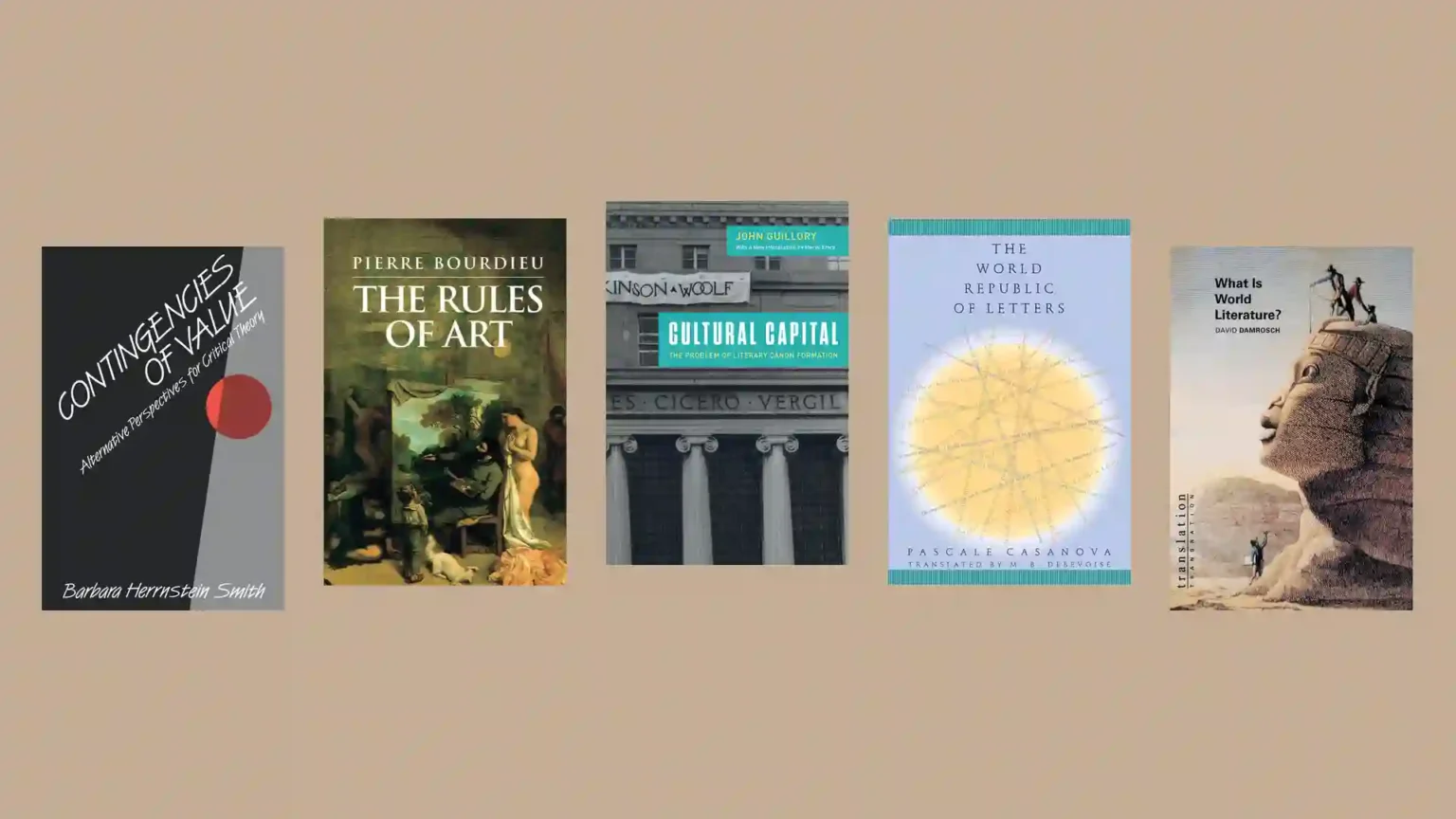
Books on literary canon formation connect institutions, education, publishing, historical exclusion, and aesthetic judgments.
“The literary canon” sounds like a list. The term is less stable than the list metaphor suggests. Is a canon made by inherited rules, repeated judgments of value, professional fields, school curricula, unequal international prestige, or circulation across languages? Six books answer with six mechanisms. Reading them as a claim ledger is more useful than staging another yes-or-no canon war.
The canon has a history before it has a list
Claim: canon formation is first a history of changing concepts of authority. Jan Gorak’s The Making of the Modern Canon supplies the strongest test. It follows canonicity from older religious and cultural uses into modern critical argument, then studies figures such as Frye, Kermode, and Said. Verdict: supported, but incomplete. Genealogy explains why “canon” can carry rule, inheritance, interpretation, and crisis at once; it does not by itself explain why particular works continue to circulate.
Claim: works become canonical because they possess stable value. Barbara Herrnstein Smith’s Contingencies of Value is designed to unsettle that sentence. Her argument treats value as produced and revised through changing relations among works, readers, institutions, interests, and conditions of evaluation. Verdict: “intrinsic versus political” is too crude. Value judgments can be serious without being historically unconditioned.
Who has the power to consecrate?
Claim: canon formation can be understood by looking at authors and critics alone. Pierre Bourdieu’s The Rules of Art makes that unit too small. His literary field includes struggles among writers, publishers, critics, markets, institutions, and forms of symbolic capital. The point is not that aesthetic judgment disappears into sociology; it is that autonomy itself has a social history. Verdict: consecration is relational.
Claim: the canon problem is mainly whether demographic groups are fairly represented in the list. John Guillory’s Cultural Capital redirects attention to schools and the distribution of linguistic and cultural competence. His argument is deliberately disenchanted: changing texts on a syllabus matters, but the institution that distributes access to literacy and prestige is part of the mechanism. Verdict: selection cannot be separated from pedagogy.
What happens when the scale becomes global?
Claim: once national canons are opened to the world, the hierarchy problem fades. Pascale Casanova’s The World Republic of Letters gives the opposite prediction. Translation, publication, literary languages, metropolitan centers, and accumulated prestige create an unequal world literary space. Writers do not enter international circulation with equal resources. Verdict: enlargement can reproduce hierarchy in a new geometry.
Claim: world literature is simply a larger canon. David Damrosch’s What Is World Literature? offers a different model: world literature is better understood through modes of circulation and reading, and works change as they move beyond their original contexts. Verdict: movement matters as much as membership. A work can become differently legible when translated, anthologized, taught, or exported.
What the six mechanisms explain—and what they do not
Taken together, the six books shift attention from a shelf to a process: genealogy (Gorak), valuation (Smith), field struggle (Bourdieu), schooling (Guillory), international prestige (Casanova), and circulation (Damrosch). A contemporary publisher can participate in several at once. BookInLight’s guide to Vintage Classics and the “moving canon” is a useful concrete reminder that reissue design and backlist maintenance are not neutral afterlives; they are mechanisms of renewed availability.
No mechanism is sufficient. Gorak can tell us why the concept of a canon became thinkable in a particular way without predicting sales. Bourdieu can explain positions in a field without reducing the singular effects of a text to position. Guillory can make curriculum central without making schools the only gatekeepers. Casanova and Damrosch can both describe transnational movement while disagreeing over whether inequality or transformation should dominate the picture.
The strongest conclusion is therefore narrower than “the canon is political” and stronger than “the best works survive.” Literary canons persist when multiple systems repeatedly align: evaluation, institutions, teaching, publication, translation, and circulation. Those systems can be contested, and their alignment can break. A canonical list is the visible residue of that harder, less stable process.
A canon is not the same thing as a syllabus, market, or archive
The distinction matters because the six mechanisms operate on different objects. A syllabus is a local pedagogical selection. A market records purchases under particular commercial conditions. An archive preserves what institutions or collectors acquired. A canon is a more diffuse pattern of repeated recognition across time. The four can reinforce one another, but they also diverge: a commercially weak work can be heavily taught; a widely sold work can vanish from curricula; an archive can preserve what no current syllabus values.
This prevents an easy causal shortcut. A book does not become canonical merely because a professor assigns it, a publisher reprints it, or a prize committee honors it. Repetition across institutions matters. Guillory explains why schooling deserves special attention, Bourdieu why institutions occupy positions in fields, and Casanova why international recognition follows unequal routes. Their claims overlap without becoming identical.
Two propositions that cannot both remain simple
“The canon excludes because gatekeepers choose.” “The canon endures because readers repeatedly find value.” Both propositions describe real phenomena; neither survives in that simple form after these six books. Smith complicates stable value, while Gorak complicates the idea of one timeless gate. Bourdieu turns gatekeepers into a field of competing agents. Damrosch shows that a work can acquire new value in circulation. The historiographical gain is not a compromise slogan but a more specified causal vocabulary.
A single work can demonstrate the interaction. A novel may be revived by a publisher, legitimized by criticism, assigned in universities, translated into a prestige language, anthologized as “world literature,” and then redesigned for a mass classics series. At each stage the object is the same enough to remain identifiable and different enough to enter a new institutional relation. Canon formation is the accumulation of those relations, not one decisive vote.
This also explains why anti-canon gestures can become canonical. A text introduced as a challenge to inherited selection may, once repeatedly taught and reprinted, acquire institutional durability of its own. The history of canon reform is therefore also a history of new stabilization. Gorak’s genealogy and Guillory’s institutional analysis are particularly useful at that point because they make “opening the canon” a historical process rather than a permanent state.
A bibliographic caution sharpens the comparison. Smith’s monograph develops arguments with an earlier life in her 1983 Critical Inquiry essay, while Casanova’s English-language intervention arrived through translation and a Harvard University Press edition whose bibliographic trail is visible in WorldCat. Even theories of canon formation reach readers through publication and translation histories—the very mechanisms the theories ask readers to analyze.
Cover artwork: credits and source records
- Contingencies of Value — Harvard University Press (source record)
- The Rules of Art — Polity (source record)
- Cultural Capital — University of Chicago Press (source record)
- The World Republic of Letters — Harvard University Press (source record)
- What Is World Literature? — Princeton University Press (source record)