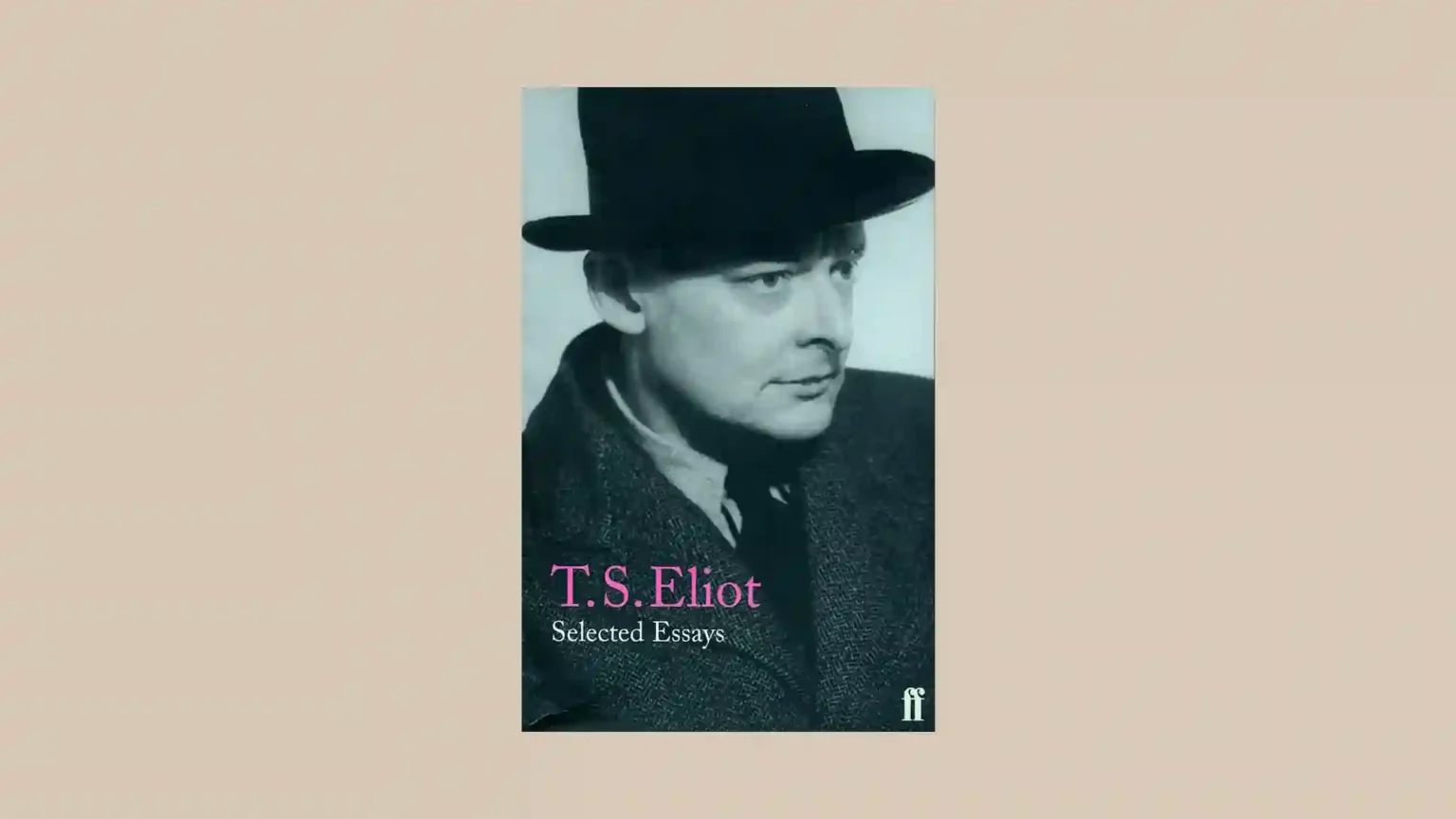
“The Metaphysical Poets” appears in a specific Eliot publication history; a complete text and the review context matter.
“A thought to Donne was an experience; it modified his sensibility.” That sentence is often lifted from T. S. Eliot’s “The Metaphysical Poets” as if it were a freestanding definition of seventeenth-century poetry. Read in place, it is doing something more specific. Eliot is testing a recently reconstructed literary category—“the metaphysical poets”—against the felt relation between thought and sensation in Donne and his contemporaries. The essay is therefore easiest to understand when the text in front of you is connected to the anthology that prompted it.
The essay began beside Grierson, not inside a theory textbook
The first thing to establish is publication history. A British Academy account of Herbert Grierson’s editorial work identifies Eliot’s 20 October 1921 Times Literary Supplement piece as an anonymous review of Grierson’s Metaphysical Lyrics & Poems of the Seventeenth Century. That review became the essay now known as “The Metaphysical Poets.” This matters because Eliot was not inventing a school from nowhere. He was responding to an editorial object that had put Donne, Marvell, Herbert, Crashaw, Cowley, and others back into a newly visible relation.
Once that origin is visible, “dissociation of sensibility” looks less like a law of English literary history and more like a critical hypothesis produced in an act of canon revision. Eliot’s claim is that certain earlier poets could experience an idea with a kind of sensory immediacy that later poetic culture separated into thought on one side and feeling on the other. The phrase is famous because it is portable; its evidentiary force, however, depends on the poems and editorial grouping it was designed to explain.
Grierson’s role is especially important because his anthology did more than gather convenient examples. It helped re-establish a seventeenth-century poetic lineage that nineteenth-century taste had often treated as eccentric or minor. The British Academy history of Grierson’s Donne scholarship shows that his editorial work on Donne preceded the 1921 anthology and that Eliot’s review emerged from that larger recovery. The critical sequence is therefore material: textual editing made poems newly available; anthology design made them newly comparable; Eliot supplied a historical theory for why their combination of intellect and sensation mattered to modern poetry.
This sequence also puts pressure on the label “metaphysical.” The term had older histories, especially through Dryden and Samuel Johnson, but Eliot is not merely inheriting a settled school-name. He is participating in a twentieth-century reconstruction of the group. A careful reader should therefore separate three claims that are often fused: that certain poets can be grouped for practical reading, that they share formal or intellectual habits, and that English poetry later underwent the historical break Eliot calls a dissociation of sensibility. The first can be useful even if the third proves too sweeping.
That is why a reader who encounters the essay only as an abstract theory of poetic difficulty can miss its argumentative pressure. Eliot repeatedly moves between individual poets, historical comparison, and judgments about modern poetry. The essay is not merely saying that Donne is “intellectual.” It is asking what kind of poetic mind can make heterogeneous materials—emotion, argument, image, learned reference—arrive as one experience rather than as assembled parts.
Where should you read the complete essay?
The standard bibliographic home is Eliot’s Selected Essays, 1917–1932. A National Library of New Zealand catalog record for a 1934 Faber printing lists “The metaphysical poets (1921)” in the contents alongside “Andrew Marvell,” “John Dryden,” “William Blake,” and other essays, confirming the collection context rather than treating the piece as an isolated pamphlet. Open Library’s work record also tracks later Faber and American editions.
For ordinary reading, any complete edition of Selected Essays that clearly identifies the essay will do. For academic quotation, do not inherit a page number from a secondary source unless it matches the edition in your hand. The 1932 first edition, later enlarged Faber editions, and modern reprints do not share stable pagination. The intellectual object is the same essay; the citation object is not.
There is also a contextual reason to prefer Selected Essays over a random web extract. The neighboring essays show that Eliot’s account of metaphysical poetry belongs to a wider critical program. “Tradition and the Individual Talent” gives one model of historical relation; “Hamlet and His Problems” gives another model of evaluative criticism; “The Metaphysical Poets” then turns historical discontinuity into a problem of poetic sensibility. Penguin Random House’s Eliot overview likewise identifies Selected Essays as the central collection of his literary criticism.
The collection context also exposes a productive contradiction in Eliot’s method. He argues for historical relation and impersonality, yet his own judgments are intensely selective. “The Metaphysical Poets” elevates some kinds of difficulty, compression, and heterogeneous imagery because they answer modernist needs as well as seventeenth-century facts. That does not invalidate the essay; it tells you what kind of evidence to seek. When Eliot says the modern poet must become more indirect or difficult because modern civilization is complex, the claim should be tested against poems, not converted into a period slogan.
What changes when Grierson is read beside Eliot?
Put the 1921 anthology and Eliot’s review back together and three interpretive choices become clearer. First, “metaphysical” is not a neutral period label. Grierson’s anthology was itself an argument about which poems belonged together and deserved renewed attention. Eliot’s essay intensifies that act of selection by giving the grouping a historical psychology.
Second, the famous contrast between unified and dissociated sensibility becomes testable rather than ceremonial. Compare Donne’s argumentative love poetry with later verse that keeps abstract reflection and sensory immediacy in more separate registers. You do not have to accept Eliot’s chronology in order to see what evidence he thinks would make it plausible. The useful question is not “Was Eliot right?” in the abstract, but “Which poetic effects does his distinction illuminate, and which poems resist it?”
Third, the essay’s influence on the canon becomes part of its meaning. Grierson helped make the seventeenth-century poets available as a coherent object; Eliot helped make that object conceptually urgent for modernist readers. The history of “metaphysical poetry” in the twentieth century is therefore partly a history of editing, anthologizing, and criticism feeding one another.
A useful close-reading exercise is to follow one of Eliot’s own movements from quotation to generalization. Notice how quickly a line by Donne or Herbert becomes evidence about an age, then about a later decline, then about the predicament of the modern poet. That speed is part of the essay’s brilliance and its vulnerability. The local reading may be exact while the historical conclusion is much larger than the sample can securely prove. Reading Eliot well therefore means preserving both scales at once: the sentence-level insight and the canon-level leap.
That method also protects the essay from a familiar classroom distortion. “Dissociation of sensibility” is memorable enough to become the answer before the question is asked. Begin instead with the poems Eliot quotes, reconstruct the local claim, and only then decide how far the historical thesis can travel. The term becomes more useful when it is treated as a hypothesis with a range, not a password for identifying metaphysical style.
If your goal is simply to locate the essay, use a complete Selected Essays and cite that edition. If your goal is to understand “dissociation of sensibility,” read the essay beside several Donne poems rather than beside definitions of the phrase. If your goal is literary history, add Grierson’s anthology and the publication history of the 1921 review. Those three routes produce three different Eliots: the collected critic, the close reader, and the canon-maker.
Sources consulted: Selected Essays bibliographic record; British Academy history of Grierson and the 1921 review; Open Library edition history.
Cover artwork: credits and source records
- Selected Essays — Faber & Faber (source record)