Federalist No. 10 is available as a primary text; the challenge is choosing a reliable version and recognizing Madison’s argument about faction.
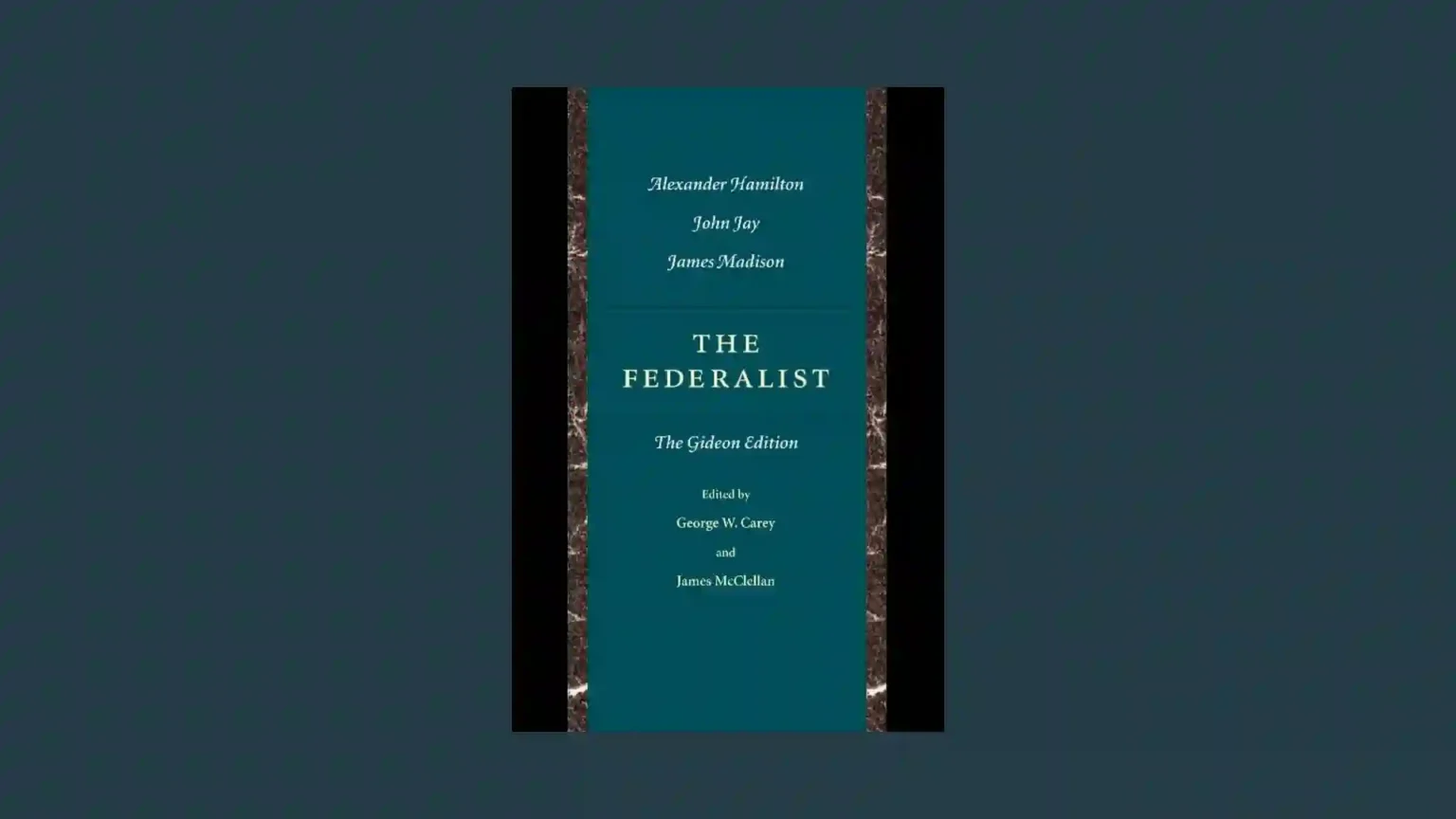
If your immediate question is simply where to read Federalist No. 10, use the Founders Online transcription. It gives the complete text under the historical heading “The Federalist Number 10” and dates it to 22 November 1787. For a printed collection you can keep and cite across all eighty-five essays, the strongest all-purpose choice is The Federalist: The Gideon Edition, edited by George W. Carey and James McClellan for Liberty Fund. The edition matters because Federalist No. 10 is not an isolated essay about “factions.” Its argument works inside a ratification campaign, a disputed authorship history, and a sequence of essays about how the proposed Constitution might make republican government durable.
Complete text or book? Choose by the job you are doing
For exact wording, first publication context, and a stable research trail, Founders Online is the better starting point. It is a documentary edition rather than a generic quotation site. The larger introductory note to The Federalist is especially useful when a reader needs to understand authorship, attribution, and the later editorial history of the essays. The Library of Congress also maintains a Federalist Papers primary-document guide that connects the essays to Constitutional Convention records and other founding-era sources.
For sustained reading, however, an edition that prints the whole sequence is better than a web page. Federalist No. 10 begins from a problem that only becomes fully visible beside Nos. 9, 14, 39, 48, 51, and 55: how can popular government survive conflict without abolishing the liberty that produces conflict? A reader who opens only No. 10 can easily turn “faction” into a synonym for a bad political group. Madison’s argument is harder. He treats faction as a recurrent consequence of unequal faculties, interests, property, opinion, and attachment, then asks what institutional design can control effects that cannot safely be removed at the source.
Why the Gideon Edition is the best default collection
Liberty Fund’s Gideon Edition is unusually useful for this problem because it does more than reproduce the essays. It is based on the 1818 Gideon edition, includes a reader’s guide, glossary, constitutional cross-reference, appendixes, and editorial material explaining the relation among editions. That apparatus lets a reader move from No. 10 to the constitutional provisions and neighboring Federalist arguments it was meant to defend. It also preserves the historical fact that later editions became part of the authorship and textual history rather than treating one modern typesetting as transparent.
If you prefer a slimmer classroom edition, the Oxford World’s Classics version edited by Lawrence Goldman is another defensible choice; Oxford’s account of the edition emphasizes the eighty-five essays as a single ratification-era body of argument. But the decision is not “which publisher is prestigious?” It is whether you need a portable reading text or an edition that helps you trace constitutional cross-references and editorial history.
Read one paragraph differently once you know the context
The most famous move in Federalist No. 10 is not the claim that factions exist. It is the decision to control their effects rather than destroy their causes. In the complete Founders Online text, Madison argues that removing the causes of faction would require either destroying liberty or forcing citizens into the same opinions and interests. The first remedy is worse than the disease; the second is impossible. The institutional question therefore changes: not “How do we eliminate political division?” but “How can a republic keep division from becoming durable oppression?”
That shift explains why size becomes important. Madison’s extended republic is supposed to multiply interests and make it harder for an unjust majority to coordinate across the whole political field. This is not a simple celebration of bigness. It is an argument about the probability of coalition, representation, and the difficulty of converting a temporary majority into a stable instrument of injustice. Read alongside BookInLight’s political philosophy route, No. 10 belongs less to a unit called “American government” than to the larger problem of legitimacy: when does majority rule remain republican, and when does it become another form of domination?
Representation is equally important. Madison is not proposing that distance magically improves citizens. He is betting that representation can refine and enlarge public views while the larger electoral field makes it harder for a narrow faction to capture the whole union. The mechanism therefore has two moving parts: scale changes the coalition problem, and representation changes the route by which preferences become public decisions. Read the wording in Federalist No. 10 closely enough to keep those claims separate.
This is also why the familiar classroom contrast between “pure democracy” and “republic” deserves care. Madison’s republic is not simply democracy with elections. It is a representative scheme extended over a larger territory and population. The claim depends on institutional mediation, not on contempt for popular government. The Library of Congress research guide is useful when you want to place this argument beside Convention records rather than interpret it as a free-standing theory invented after ratification.
Authorship history matters for a smaller reason too: modern readers often encounter the essays as a canonical book, but they were written under the shared pseudonym Publius for an immediate political campaign. The Founders Online introductory note tracks later attribution, including the Gideon edition and Madison’s corrections. That history is a reminder that a “best collection” should expose editorial mediation instead of making the canonical text look authorless and timeless.
What should you cite?
If you are quoting the essay itself, cite the documentary text or the specific print edition actually in your hands. Do not combine pagination from one edition with wording taken from another. For online work, the Founders Online page is the cleanest citation target; for a book-length study, the Gideon Edition gives the most useful cross-reference apparatus. A digitized historical copy is also available through the Library of Congress, useful when you need to inspect nineteenth-century presentation rather than only modern transcription.
The opening question therefore has two answers. Read Federalist No. 10 online at Founders Online when you need the verified complete essay now. Read it inside The Federalist: The Gideon Edition when you want the argument to remain connected to the constitutional design and editorial history that give it meaning. The text does not become more authoritative because it is bound in a book; it becomes easier to interpret because the right book restores the network of arguments around it.
Cover artwork: credits and source records
- The Federalist: The Gideon Edition — Liberty Fund (source record)