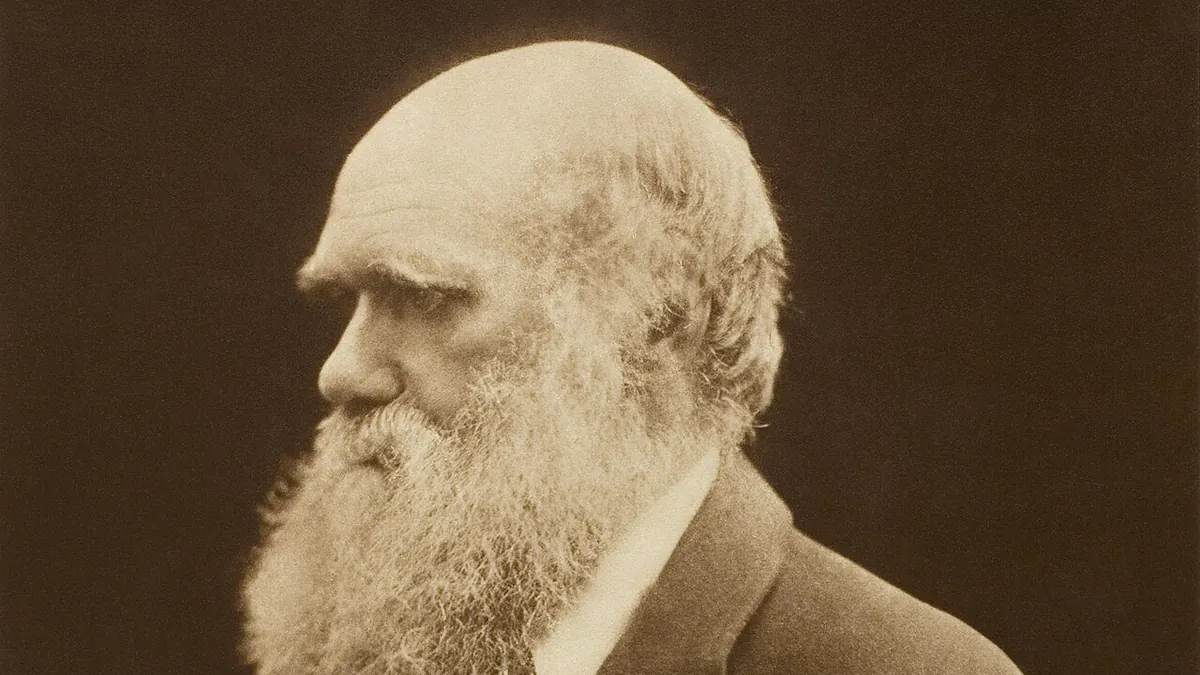
Darwin and Human Exceptionalism meet at the point where Victorian moral philosophy became most vulnerable: the claim that conscience proved humanity belonged to a different order of being from other animals. In The Descent of Man (1871), Darwin did not deny the force of moral obligation. He tried something more unsettling. He treated conscience as a natural-history problem, rooted in social instincts and enlarged by memory, reason, habit, and public judgment. The crisis was therefore not the disappearance of morality, but the loss of a metaphysical boundary that had long made morality seem uniquely human.
It is tempting to describe Darwin’s argument as one more nineteenth-century blow against human pride. Copernicus displaced the Earth; geology deepened time; Darwin lowered humanity into animal ancestry. The sequence is memorable and too simple. The Descent of Man does not merely reduce human beings to animals. It asks how capacities that Victorians used to mark an absolute human exception—reason, language, sympathy, conscience, aesthetic judgment—could have arisen through processes continuous with the rest of life. The argument is corrosive because Darwin preserves much of what exceptionalism valued while changing the kind of explanation it could receive.
That distinction matters. If Darwin had simply declared morality an illusion, the philosophical problem would be obvious and relatively crude. Instead, he called the moral sense the most important difference between humans and other animals, then denied that this importance required a separately created faculty. Darwin and Human Exceptionalism therefore form a more difficult relation than “science versus religion” or “animal continuity versus human dignity.” The moral sense remains elevated in function while losing its status as evidence of a discontinuity in origin.
The strongest reading of The Descent of Man is consequently neither triumphalist nor nihilist. Darwin naturalized the conditions of moral agency without proving that evolutionary success is morally right. He weakened traditional arguments for a special human essence without showing that all species differences are ethically irrelevant. And he widened sympathy in one register while reproducing racial and gender hierarchies in another. The book’s deepest tension lies there: the same theory that dissolves one hierarchy can be recruited to naturalize others.
The Victorian Problem Darwin Could No Longer Postpone
When On the Origin of Species appeared in 1859, Darwin famously confined human origins to a single prospective sentence: “light will be thrown on the origin of man and his history.” The restraint did not prevent the implication from becoming public. By 1863, Charles Lyell’s arguments about human antiquity and Thomas Henry Huxley’s anatomical case in Evidence as to Man’s Place in Nature had forced questions of human deep time and ape kinship into the center of Victorian debate. The Darwin Correspondence Project’s record of 1863 shows how directly Darwin followed these developments. Human beings were no longer protected by silence from the logic of descent.
The problem was not anatomy alone. If human bodies belonged to evolutionary history, what of mind? The pressure intensified in 1869 when Alfred Russel Wallace, Darwin’s co-discoverer of natural selection, argued that natural selection could not adequately explain the highest human capacities. Wallace increasingly appealed to an additional guiding power. Darwin replied that he could see no need for an extra proximate cause in the case of humanity. Their 1869 disagreement over human evolution helped define the intellectual task of The Descent of Man: a theory of evolution that stopped before conscience, mathematical reason, or aesthetic judgment would leave the old human exception largely intact.
There was also a religious transformation hidden inside the scientific dispute. Natural theology had long treated complex adaptation and the apparent elevation of human reason as evidence of purposive design. Darwin’s theory did not force every believer into atheism; figures such as Asa Gray worked to reconcile selection with divine providence. But the explanatory burden shifted. The more successfully ordinary causes could account for faculties once treated as marks of special creation, the less work remained for an appeal to a unique supernatural intervention in human nature. Wallace’s retreat from strict naturalistic continuity made this pressure visible because he accepted evolution widely and still preserved a providential exception for humanity.
The chronology matters. Darwin had been thinking about human mentality and social instincts since his private notebooks of the 1830s, so The Descent of Man was not invented in response to one late controversy. But the public world of the 1860s changed the stakes of publication. Fossil discoveries, arguments over human antiquity, comparative anatomy, ethnology, and the increasingly explicit debate over natural selection’s reach made silence less sustainable. What had been a private implication of descent became a public demand for an account of mind and morals.
This is the immediate crisis behind the book. Darwin had to show continuity where even an evolutionary ally wanted a break. Yet he also faced a social interpretation of evolution that threatened to make competition morally normative. Critics could caricature natural selection as a defense of “might is right,” while industrial rivalry, imperial conquest, and class competition supplied ready-made analogies for the struggle for existence. If evolution were taken to mean that ruthlessness is nature’s law, then a naturalistic account of morality risked becoming a moral apology for domination.
Piers J. Hale’s study of Darwin’s other-regarding ethics makes clear how inadequate that caricature is. Humanity is treated as a social species. Sympathy, parental attachment, loyalty, praise, blame, and sacrifice become evolutionary facts requiring explanation. Darwin was not trying to prove that selfishness is secretly virtuous. He was trying to explain how genuinely other-regarding conduct could emerge within a world shaped by selection.
Darwin and Human Exceptionalism Under Natural Selection
The pivotal move occurs in Darwin’s account of the moral sense. He begins by conceding its extraordinary importance. Conscience can command sacrifice against immediate appetite; it carries the peculiar authority of “ought.” But Darwin then asks what kind of antecedents would be sufficient for such a faculty to arise. His answer is not a moral law implanted from outside nature. It is a sequence.
Social animals possess persistent instincts that bind them to companions and offspring. A creature with sufficiently developed memory can later recall occasions when a temporary appetite defeated those more durable social tendencies. The remembered conflict generates dissatisfaction. With language and social life come public approval, blame, instruction, and the transmission of norms. Reason extends foresight; habit stabilizes conduct; religion may intensify sanctions at later stages. Conscience is therefore a highly complex product, but complexity is not the same as supernatural interruption.
The important conceptual point is continuity without identity. Darwin does not say a dog already possesses Victorian moral philosophy. He argues that the psychological materials from which moral life develops are not unique in kind. The Stanford Encyclopedia of Philosophy’s account of Darwin’s moral theory emphasizes this transformation of the older moral-sense tradition: what had often functioned as a distinctively human moral faculty is reconstructed through an evolutionary history of social instinct, reflection, and communal judgment.
Darwin’s famous counterfactual about a social animal with human-like intellectual powers makes the point sharply. Any such creature, he suggests, could acquire something like a moral sense. That proposition breaks the monopoly of Homo sapiens on the very capacity that Darwin simultaneously calls our highest distinction. The moral crisis of human exceptionalism is concentrated in this double claim: morality matters enormously, but its origin does not certify a metaphysical gulf.
From Smith’s Sympathy to Darwin’s Social Instinct
Darwin’s most important philosophical inheritance here is not Herbert Spencer’s progressive evolutionism. Nor is it a simple transfer of utilitarian calculation into biology. The better genealogy runs through the British moral-sense and sentimentalist traditions, especially the idea that sympathy and social feeling precede abstract moral reasoning.
Darwin knew Adam Smith’s The Theory of Moral Sentiments and engaged James Mackintosh’s account of conscience; he also positioned himself against explanations that made morality primarily a product of rational association or calculated self-interest. The Darwin Correspondence Project’s materials on moral nature preserve his efforts to test such questions against John Stuart Mill and other contemporary discussions. What Darwin wanted was an origin for moral motivation deeper than calculation. Parental and filial affection, social attachment, and sympathy supplied that basis.
This inheritance is transformed, not merely repeated. Smith’s impartial spectator is a structure of moral judgment formed through social relations. Darwin asks a prior question: how could a creature capable of such sympathy and social judgment have come into existence at all? He pushes moral psychology backward into phylogeny. The moral sentiments become part of the history of life.
At the same time, Darwin does not reduce moral consciousness to one instinct. His mature account is layered. Social instincts provide the foundation; memory produces comparison across time; language permits communal judgment; reason anticipates consequences; habit fixes dispositions. This is one reason the popular phrase “survival of the fittest” is so misleading when used as a summary of Darwinian ethics. Fitness is an explanatory concept in evolutionary theory, not an all-purpose moral ranking. Darwin’s moral psychology is built precisely around the fact that social dependence and self-restraint can matter to the persistence of groups.
What the Theory Cannot Contain
The hardest problem is not how morality begins but what evolutionary explanation can justify. Darwin can explain why creatures like us experience obligation. That does not by itself establish which obligations are valid. The distinction between the genealogy of a moral capacity and the truth of a moral judgment is where later evolutionary ethics repeatedly runs into trouble.
Darwin sometimes writes as though moral advance and social success reinforce one another. A community containing courageous, faithful, sympathetic members may defeat less cohesive rivals; selection among groups can therefore favor dispositions beneficial to communal survival. But survival cannot simply be equated with goodness. A well-organized predatory society could be highly successful. Loyalty can sustain persecution as easily as rescue. Courage can serve conquest. Once the origin of conscience is naturalized, the authority of conscience still requires philosophical discrimination.
Darwin was aware of a version of this difficulty in his thought experiment about radically different social conditions. If human beings had been reared under the conditions of hive bees, he suggested, our moral intuitions might sanctify acts we now condemn. The example makes morality historically and biologically plastic. It is powerful evidence against a simplistic belief that every moral intuition transparently reveals an eternal law. But it creates a second problem: if selection and social formation can generate radically different consciences, what gives us grounds to criticize the conscience we inherit?
This is where Darwin’s account is strongest as moral genealogy and weaker as moral foundation. Robert J. Richards has defended a more robust interpretation of Darwin’s evolutionary ethics, while other philosophers stress the logical gap between explaining moral capacities and vindicating moral norms. Contemporary work on morality and evolutionary biology preserves this distinction between descriptive evolutionary explanation and normative or metaethical argument. The disagreement should not be flattened. Darwin gives us reasons to reject the assumption that morality must come from outside nature. He does not give us a complete theory of why one moral principle is true rather than another.
The Boundaries Return Inside Humanity
No account of The Descent of Man is adequate if it celebrates continuity between humans and animals while ignoring the hierarchies Darwin retained among humans. Modern scholarship on the book has made this impossible to evade. Darwin opposed slavery and never abandoned the common ancestry of human populations, a position incompatible with theories of separately created human kinds. Yet common descent did not lead him to cultural or racial equality in his descriptions.
His language repeatedly ranks peoples along Victorian scales of “civilization” and “savagery.” He speculates about the extinction and replacement of populations in ways inseparable from nineteenth-century colonial assumptions. His discussions of sex differences likewise naturalize claims about male intellectual superiority even while sexual selection grants female choice a substantial causal role. Erika Lorraine Milam and Suman Seth’s study of race, sex, and human nature treats these questions as structurally entangled in Descent rather than as detachable embarrassments around a pure evolutionary core.
This matters to the problem of human exceptionalism because hierarchy does not simply vanish when a species boundary is dissolved. It can migrate. The old opposition between “human” and “animal” may be replaced by graded distinctions between supposedly higher and lower humans, civilized and primitive peoples, masculine and feminine capacities. Myrna Perez Sheldon’s analysis of sexual selection as race-making shows how Darwinian population thinking could participate in a modern racial vocabulary even while undermining fixed notions of separately created racial essences.
The contradiction is therefore sharper than saying Darwin was “a man of his time.” That phrase can describe almost anyone and explain almost nothing. His evolutionary method had resources for common ancestry, variability, and continuity; it also absorbed the classificatory prejudices and imperial data of Victorian anthropology. The intellectual lesson is that naturalization does not automatically emancipate. A boundary can be destabilized at one level and rebuilt at another.
A further difficulty follows from Darwin’s own language of progress. He sometimes imagines sympathy widening from kin and tribe toward strangers, other races, disabled people, and eventually nonhuman animals. That trajectory has genuine moral power because it makes ethical enlargement continuous with capacities already present in social life. But Darwin also describes history through conquest, replacement, and differential “advancement.” The two narratives sit uneasily together: widening sympathy and competitive displacement are both made parts of human development.
This tension is more than a historical blemish. It reveals that an evolutionary genealogy of morality can explain how sympathy expands without guaranteeing that the categories through which sympathy is distributed are just. A society may become more cooperative internally while remaining violent externally. Moral inclusion can grow alongside empire. The natural history of conscience therefore needs a political history of who was counted as a full object of conscience.
From Huxley to Evolutionary Ethics
The afterlife of Darwin’s moral argument split quickly. Herbert Spencer’s name became attached retrospectively to “social Darwinism,” but the label obscures as much as it reveals. Spencer had his own progressive theory of evolution, developed through an intellectual trajectory that cannot simply be reduced to Darwin’s natural selection, and he often treated evolution as movement toward more developed forms of social organization and conduct. To project that system back onto Darwin is historically careless.
Thomas Henry Huxley posed a different challenge in his 1893 Romanes Lecture, Evolution and Ethics. Huxley accepted human evolution while arguing that ethical life often requires resistance to the competitive “cosmic process.” His horticultural imagery—the disciplined garden set against unregulated nature—made vivid a distinction later moral philosophy would repeatedly defend: explaining how a tendency evolved does not authorize us to obey it.
Other descendants of Darwin took the cooperative side of the evolutionary legacy. Peter Kropotkin’s Mutual Aid emphasized sociality and cooperation as evolutionary forces, rejecting a narrow reading of nature as universal war. In the twentieth century, sociobiology and evolutionary psychology reopened questions about whether moral capacities, kin preference, reciprocity, punishment, or cooperation could be explained biologically. Contemporary philosophy now separates descriptive evolutionary ethics from normative and metaethical projects more carefully than many nineteenth-century writers did.
The useful line is clear. Evolutionary history can explain dispositions, constraints, and recurring social patterns. It can sometimes undermine moral claims that depend on false empirical assumptions. It cannot by itself turn adaptive success into moral authority. The modern field of evolutionary ethics lives largely inside that distinction.
Why Darwin and Human Exceptionalism Remain Unsettled
James Rachels gave one of the strongest modern statements of Darwin’s ethical consequence. If traditional human dignity rests on the belief that humans were separately created, endowed with a categorically distinct nature, and placed above animals by origin, Darwin removes crucial supports from that picture. As Rachels argues in Created from Animals, the consequence has particular force in animal ethics: mere species membership begins to look morally insufficient when morally relevant capacities such as suffering, attachment, memory, or agency cross species lines.
Yet Darwin and Human Exceptionalism should not be reduced to the slogan that humans are “nothing special.” Evolution itself permits large differences to emerge gradually. Language, cumulative culture, institutional norm-making, and reflective moral criticism may be extraordinary without being miraculous. A trait need not be metaphysically discontinuous to be practically distinctive.
The more precise post-Darwinian question is therefore which kind of exceptionalism one means. Biological exceptionalism understood as separate origin is untenable. Metaphysical exceptionalism based on a scientifically demonstrable rupture is unsupported by Darwinian continuity. Moral exceptionalism, however, cannot be settled by ancestry alone. Whether humans deserve a distinctive moral status depends on a normative account of interests, agency, vulnerability, relationships, or capacities—not on the bare fact that our lineage branches from the same tree as other animals.
That distinction also prevents a reverse mistake. To deny that species membership is a magic moral boundary does not require pretending that all organisms have identical claims. Darwin’s achievement is not to flatten moral life into sameness. It is to force moral philosophy to justify distinctions that theology or taxonomy once seemed able to guarantee in advance.
The Human Difference After Descent
The most durable pressure exerted by The Descent of Man is not the thought that human beings are merely animals. “Merely” does the ideological work. Darwin’s deeper argument is that the animal world is already social, affective, communicative, competitive, cooperative, and historically productive enough to contain the preconditions from which human morality could emerge.
That is why the book remains morally disturbing. It removes one easy answer to the question of why conscience commands us. We cannot point to the origin of conscience and assume its authority has been proved. We cannot point to continuity with animals and assume every human distinction has disappeared. We cannot celebrate a natural history of sympathy while overlooking the racial and gender hierarchies carried inside Darwin’s own narrative of progress.
Darwin and Human Exceptionalism therefore end not in humiliation but in a demand for argument. After descent, dignity must be defended without relying on separate creation; moral norms must be assessed without treating their evolutionary origin as either a proof or a refutation; human distinctiveness must be described without turning difference into domination. Darwin did not resolve that moral crisis. He made it impossible to resolve it by invoking a boundary that biology could no longer sustain.
Related BookInLight Reading Guides
- The Debt Inside Conscience: Nietzsche’s Genealogy of Guilt — a complementary study of how conscience becomes a historical problem rather than a timeless given, without collapsing Nietzsche’s genealogy into a simple Darwinian inheritance.
- Six Essential Books on Free Will and Moral Responsibility — useful for the distinct problem Darwin leaves open once human conduct is situated inside natural causal history: what grounds agency, blame, responsibility, and desert?
- 10 Works Sigmund Freud Read and Discussed: From Oedipus to Darwin — traces a documented later encounter with Darwin, including the afterlife of The Descent of Man in Freud’s attempt to naturalize human culture and psychic history.
This article was researched and written by the BookInLight Department of Science, Knowledge, and Intellectual History, with bibliographical review, source verification, and editorial fact-checking across primary texts, correspondence, and modern scholarship. Readers are invited to send factual corrections, overlooked sources, interpretive suggestions, and constructive ideas that could strengthen future revisions.
Editorial typography, visual composition, text hierarchy, and presentation were developed by the BookInLight Art Department. The article is intentionally text-only. Complete republication, reproduction, translation, or reuse requires prior written permission from BookInLight.
Sources and Further Reading
Primary Texts and Contemporary Responses
- Charles Darwin, On the Origin of Species by Means of Natural Selection, London: John Murray, 1859, first edition. Used to establish the deliberately deferred treatment of human origins in the original Origin.
- Charles Darwin, The Descent of Man, and Selection in Relation to Sex, 2 vols., London: John Murray, 1871. The principal primary text for Darwin’s first published account of human descent, moral sense, sexual selection, race, and social instincts.
- Charles Darwin, The Descent of Man, and Selection in Relation to Sex, second edition, revised and augmented, London: John Murray, 1877. Darwin Online identifies this as the final text; consulted for the mature form of Darwin’s argument.
- Charles Lyell, The Geological Evidences of the Antiquity of Man, London: John Murray, 1863. Provides the geological and chronological context in which human antiquity became publicly inseparable from evolutionary debate.
- Thomas Henry Huxley, Evidence as to Man’s Place in Nature, London: Williams and Norgate, 1863. A key contemporary anatomical argument for human–ape continuity.
- St. George J. Mivart, review of The Descent of Man, and Selection in Relation to Sex, Quarterly Review 131, July 1871, 47–90. A substantial contemporary critique, particularly useful for reconstructing objections to Darwin’s naturalization of the moral sense.
- Thomas Henry Huxley, Evolution and Ethics, London: Macmillan and Co., 1893. Used for Huxley’s influential argument that ethical cultivation cannot be inferred straightforwardly from evolutionary struggle.
Correspondence and Intellectual Context
- Darwin Correspondence Project, “Moral Nature”. Institutional selection of Darwin’s notebooks and correspondence concerning conscience, sympathy, social instincts, Mill, and the evolutionary origin of morality.
- Darwin Correspondence Project, “1869: Forward on All Fronts”. Used to reconstruct Darwin’s disagreement with Alfred Russel Wallace over whether distinctively human mental powers required an additional causal principle.
- Robert J. Richards, Darwin and the Emergence of Evolutionary Theories of Mind and Behavior, University of Chicago Press, 1987. A major reconstruction of Darwin’s theories of instinct, mind, moral evolution, and their philosophical antecedents.
- Piers J. Hale, Political Descent: Malthus, Mutualism, and the Politics of Evolution in Victorian England, University of Chicago Press, 2014. Used for the political and ethical contests surrounding competition, cooperation, Malthusianism, and Darwinian evolution.
Scholarly Studies of Race, Sex, Morality, and Human Nature
- Evelleen Richards, Darwin and the Making of Sexual Selection, University of Chicago Press, 2017. Used for the cultural, gendered, aesthetic, and social contexts in which Darwin constructed sexual selection.
- Piers J. Hale, “Charles Darwin, Sexual Selection and the Evolution of Other-Regarding Ethics,” BJHS Themes 6 (2021): 157–177. Supports the interpretation of Darwinian ethics as centrally concerned with sociality, cooperation, sympathy, and genuinely other-regarding conduct.
- Erika Lorraine Milam and Suman Seth, “Descent of Darwin: Race, Sex, and Human Nature,” BJHS Themes 6 (2021): 1–8. Frames recent scholarship treating race, sexual difference, aesthetics, morality, and human nature as integral to the architecture of Descent.
- Myrna Perez Sheldon, “Sexual Selection as Race Making,” BJHS Themes 6 (2021): 9–23. Used to examine how Darwin’s population-based account of sexual selection intersected with nineteenth-century and emerging modern concepts of race.
- Gregory Radick and Mark Steadman, “Of Lice and Men: Charles Darwin, Henry Denny and the Evidence for the Human Races as Varieties or Species,” BJHS Themes 6 (2021): 81–95. Important for distinguishing Darwin’s commitment to common ancestry from the more complicated nineteenth-century classificatory debate over races, varieties, and species.
- John C. Greene, “Darwin as a Social Evolutionist,” Journal of the History of Biology 10, no. 1 (1977): 1–27. A classic study of the relation between Darwin’s biological theory and his accounts of social and moral development.
Moral Afterlife and Contemporary Interpretation
- James Rachels, Created from Animals: The Moral Implications of Darwinism, Oxford University Press, 1990. Used for the influential modern argument that Darwinism undermines traditional species-based conceptions of human dignity and forces a reconsideration of animal ethics.
- Stanford Encyclopedia of Philosophy, entry on Darwin’s Origin, Descent, and evolutionary philosophy. Consulted for the philosophical reconstruction of Darwin’s moral-sense theory and its relationship to earlier traditions.
- Stanford Encyclopedia of Philosophy, “Morality and Evolutionary Biology”. Consulted for the contemporary distinction among evolutionary explanations of moral psychology, normative ethics, and metaethical arguments.
Photo credit: Julia Margaret Cameron, c. 1868 — Source:
Wikimedia Commons