Sigmund Freud left an unusually traceable record of his reading because books by other people repeatedly became evidence, adversaries, analogies, and working instruments inside his own writing. These ten works Sigmund Freud read and discussed are not a list of supposed favourites: each survives in a specific documentary encounter that shows what he praised, appropriated, interpreted, disputed, or remembered as formative.

Thinker at a glance
Full name: Sigmund Freud
Life: 6 May 1856 – 23 September 1939
Country / tradition: Moravian-born Austrian physician; founder of the psychoanalytic tradition
Primary field: Neurology, psychoanalysis, psychology of culture
Intellectual context: Fin-de-siècle Vienna; modern medicine; classical, German, English, and comparative cultural traditions
Principal period: Late nineteenth and early twentieth centuries
Featured works: 10
Main evidence: Freud’s published books and essays, autobiographical testimony, correspondence references, and surviving library material
The literary cases are especially revealing because Freud did not regard poets as merely furnishing pretty examples for doctrines already complete. In his study of Jensen’s Gradiva, he called storytellers valuable allies; in The Interpretation of Dreams, he described the uncovering of Oedipus’s history as resembling psychoanalysis; in his late essay on Dostoevsky, he confessed that analysis had to “lay down its arms” before the problem of artistic creation even while attempting a fiercely reductive account of the novelist’s parricidal themes. The friction between literary admiration and analytic appropriation is one of the central patterns in the works Sigmund Freud read and discussed.
The selections below privilege direct, work-level evidence. They omit attractive but weaker claims where the documentation remains only author-level. Freud’s well-known interest in Schopenhauer and Nietzsche, for example, is historically important, but it does not automatically license choosing those philosophers’ most famous titles. By contrast, each work here can be tied to an explicit title, a published discussion, an autobiographical recollection, or a documented library encounter. The result is less a shelf of “Freud’s favourite books” than a map of the texts he made intellectually productive.
The Works That Mattered Most
1 · Extended Interpretation
Oedipus Rex — Sophocles
Few encounters between a modern theory and an ancient work are as consequential as Freud’s reading of Sophocles’ tragedy, probably first performed around 429 BCE. In The Interpretation of Dreams, Freud does not merely invoke Oedipus as a cultural shorthand. He retells the structure of the drama, stresses that Oedipus’s guilt is gradually uncovered, and remarks that the action proceeds through a revelation resembling the work of psychoanalysis. He then makes his most ambitious move: the tragedy remains powerful, he argues, because its fate is psychically recognizable to its audience.
Freud’s claim is not that readers consciously desire the events represented onstage. The point is precisely that the wish has been repressed. Oedipus becomes for Freud a dramatic form in which the child’s attachment to the mother and rivalry with the father can return at a safe mythic distance. That interpretation gives the play an exceptional role in the formation of the idea later known as the Oedipus complex. The work is therefore more than an example attached to a theory; it helps Freud name, dramatize, and universalize the theory.
Documented evidence
What Freud said: “His fate moves us only for the reason that it might have been ours.”
Context: The Interpretation of Dreams, in Freud’s discussion of Sophocles’ tragedy and infantile wishes; first published in German in 1899 with a 1900 title date and expanded in later editions.
Source: Freud, The Interpretation of Dreams, Project Gutenberg text
Why it mattered: Oedipus Rex gave Freud a pre-existing cultural form for a claim he wanted to make about unconscious family desire. The evidence securely establishes interpretation and theoretical appropriation. Whether Sophocles’ tragedy “proves” the universality Freud assigned to the complex is a separate question; historically, what matters is that Freud made the play one of psychoanalysis’s central conceptual texts.
2 · Comparative Interpretation
Hamlet — William Shakespeare
Freud placed Shakespeare’s Hamlet, written around 1600–1601, beside Oedipus Rex in The Interpretation of Dreams. The comparison allowed him to distinguish two historical forms of the same underlying conflict. In the Greek tragedy, he argued, the forbidden wish is externalized and enacted as destiny. In the modern play, the wish remains repressed. Hamlet can contemplate action, analyse action, and perform many actions, yet becomes inhibited before the particular task of killing the man who has killed his father and taken his father’s place beside his mother.
This reading mattered because it offered Freud something more psychologically intricate than a simple repetition of Oedipus. Hamlet’s hesitation could be treated as an effect of unconscious identification: Claudius has carried out the deed that corresponds, in Freud’s reconstruction, to Hamlet’s own repressed childhood wish. The revulsion Hamlet directs toward his uncle is therefore entangled with self-reproach. Freud’s interpretation is historically influential but should not be confused with an empirically established account of Shakespeare’s intention. It tells us with certainty how Freud used the play; it does not settle what the play finally means.
Documented evidence
What Freud said: “Hamlet can do everything but take vengeance.”
Context: The Interpretation of Dreams, Freud’s comparison of Shakespeare’s tragedy with Sophocles’ Oedipus Rex.
Source: Freud, The Interpretation of Dreams, Project Gutenberg text
Why it mattered: Hamlet let Freud model repression not as the absence of desire but as a conflict that deforms action. It became an unusually compact literary demonstration of inhibition, identification, guilt, and displaced self-accusation. That is a much more specific relationship than the generic statement that Freud admired Shakespeare.
3 · Intellectual Debt and Revision
The Golden Bough — James George Frazer
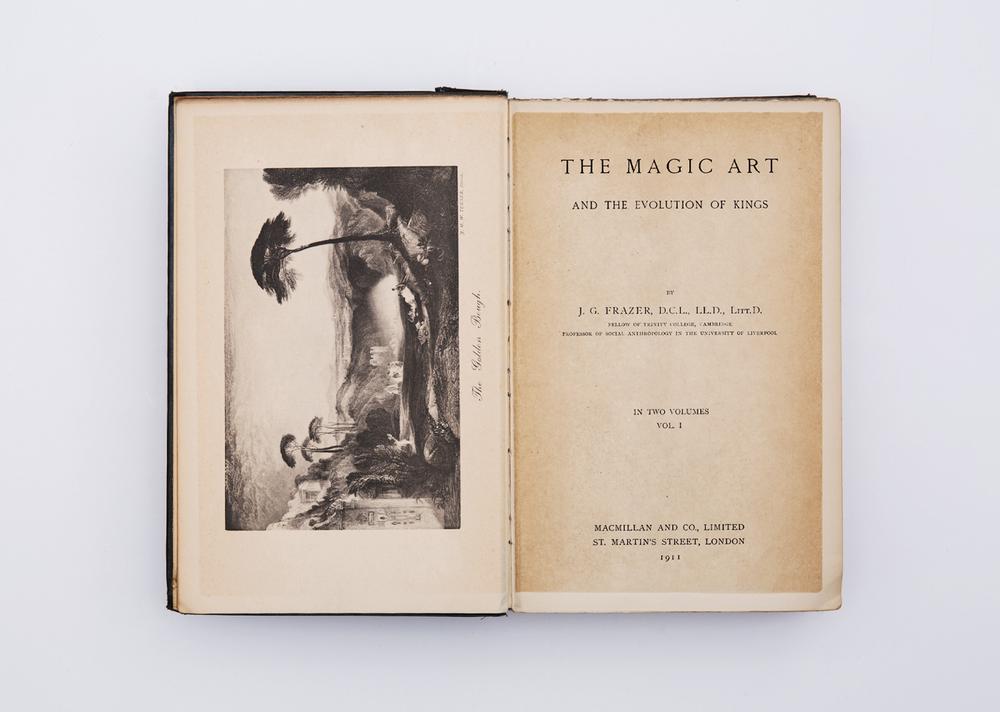
A 1911 volume from Frazer’s expanded third edition, photographed for the Freud Museum’s account of Freud’s reading of The Golden Bough.
Frazer’s vast comparative study of magic, ritual, myth, and religion began as a two-volume work in 1890 and grew across later editions. Freud was reading the enlarged third edition while developing Totem and Taboo in 1911–1913. The Freud Museum’s surviving copy matters here because the engagement is not inferred from possession alone: Freud cites Frazer repeatedly in Totem and Taboo, and the museum’s account connects his pencil markings and correspondence to the ideas he was extracting from the work.
His attitude was hardly reverential. The museum preserves his complaint that Frazer was “long-winded” and so dense with detail that the reader must immediately forget much of it. Yet this irritation coexisted with major intellectual use. Frazer supplied materials about magic, animism, taboo, totemism, ritual, and the imagined sequence from magical to religious and scientific worldviews. Freud then recoded such material psychologically, asking what collective customs might reveal about wish, repression, ambivalence, and the persistence of archaic mental forms.
Documented evidence
What Freud said: He described The Golden Bough as “so full of details that one must immediately forget.”
Context: Freud’s 1911 reading, preserved through correspondence and his marked library copy; documented by the Freud Museum alongside the genesis of Totem and Taboo.
Source: Freud Museum London, “Totem and Taboo: The Golden Bough”
Why it mattered: Frazer gave Freud a comparative archive large enough to support a leap from individual neurosis to cultural prehistory. Freud did not simply adopt Frazer’s evolutionary anthropology; he treated it as raw material for a psychoanalytic theory of magic, omnipotence of thought, ritual, and taboo. The connection is both documentary and consequential, while the surviving criticism usefully prevents us from turning dependence into discipleship.
4 · Explicit Praise and Appropriation
Lectures on the Religion of the Semites — William Robertson Smith
Robertson Smith’s Lectures on the Religion of the Semites, first published in 1889, supplied one of the decisive pieces in Freud’s argument in the final essay of Totem and Taboo. Freud worked from the revised second edition of 1907. Smith’s reconstruction of ancient sacrifice emphasized the communal meal and the bond created when members of a religious community shared the body of a sacrificial animal. Freud saw in that theory a possible bridge between totemic prohibition, collective killing, incorporation, and guilt.
Unlike his impatient remarks about Frazer, Freud’s praise of Smith is unusually explicit. Before excerpting Smith’s argument, he warns that a summary cannot reproduce the original’s lucidity or argumentative force. Yet Freud’s eventual construction goes far beyond Smith. He combines the sacrificial meal with Darwin’s hypothetical primal horde and with psychoanalytic ideas about ambivalence toward the father, producing the speculative scenario of brothers killing and devouring the dominant father and subsequently instituting prohibitions in the wake of guilt.
Documented evidence
What Freud said: “I shall now cite from Robertson Smith’s excellent book.”
Context: Totem and Taboo, fourth essay, where Freud reconstructs Smith’s theory of sacrifice and cites the second edition of 1907.
Why it mattered: Smith furnished the ritual mechanism Freud needed for one of his most characteristic cultural arguments: ambivalent love and hostility could be imagined as preserved in a communal act of killing, eating, mourning, and identification. The historical anthropology behind that construction has long been challenged, but the documentary importance of Smith’s book to Freud’s reasoning is direct and unmistakable.
5 · Literary Model
Gradiva: A Pompeian Fantasy — Wilhelm Jensen

Author: Wilhelm Jensen
First published: 1903 book edition, following periodical publication in 1902
Freud’s engagement: Full-length psychoanalytic literary study
Documented in: Delusion and Dream in Jensen’s Gradiva
Date: 1907
Jensen’s archaeological fantasy gave Freud the opportunity to do something different from the compact interpretive gestures in The Interpretation of Dreams: he devoted an entire monograph to a contemporary work of fiction. The novella follows the archaeologist Norbert Hanold, whose fixation on the image of a walking woman develops into delusion and is eventually disentangled through the return of repressed childhood feeling. Freud recognized in the story a sequence that could be read almost as an invented case history.
The Freud Museum notes that Jung brought the story to Freud’s attention and that Freud was charmed by it. The affinity also became material: Freud acquired a cast of the classical relief associated with Gradiva and displayed it in his consulting room. More important for this article, however, is what Freud did in print. He treated Jensen as someone who had reached psychologically convincing insights without analytic technique, using the story to argue that imaginative writers can intuit processes that the clinician later formulates systematically.
Documented evidence
What Freud said: “During the perusal of this really poetic material, the reader experienced all sorts of feelings of familiarity and concurrence.”
Context: Delusion and Dream in Jensen’s Gradiva, Freud’s 1907 full-length study of the novella.
Source: Freud, Delusion and Dream in Jensen’s Gradiva, Project Gutenberg text
Why it mattered: Gradiva became a demonstration that psychoanalysis could enter into disciplined conversation with fiction rather than merely diagnose an author. Freud mapped repression, dream formation, delusion, recognition, and therapeutic recovery onto a literary narrative. It is one of the clearest instances in which a particular book became a laboratory for psychoanalytic interpretation.
6 · Explicit Praise and Late Interpretation
The Brothers Karamazov — Fyodor Dostoevsky
Freud’s 1928 essay “Dostoevsky and Parricide” is one of the strongest cases in the record because extraordinary praise and aggressive psychoanalytic interpretation appear together. Dostoevsky’s final novel, serialized in 1879–1880 and published in book form in 1880, centres on a father whose sons have powerful reasons to hate him and on the moral and psychological consequences of his murder. Freud immediately recognized the fit with a line of literary works he had been tracing since The Interpretation of Dreams.
His admiration is difficult to overstate but easy to quote precisely: he calls The Brothers Karamazov “the most magnificent novel ever written” and singles out the Grand Inquisitor episode as a summit of world literature. Yet the essay then turns Dostoevsky himself into an analytic object, linking the novel’s parricidal structure to Freud’s controversial reconstruction of the novelist’s guilt and seizures. Modern readers should distinguish the secure literary fact—Freud’s explicit valuation and sustained interpretation—from the much more contestable retrospective diagnosis of Dostoevsky.
Documented evidence
What Freud said: “The Brothers Karamazov is the most magnificent novel ever written.”
Context: “Dostoevsky and Parricide,” written in 1927 and published in 1928 as an introduction to a volume of materials connected with Dostoevsky’s novel.
Source: Freud, “Dostoevsky and Parricide,” Psychoanalytic Electronic Publishing record
Why it mattered: The novel enabled Freud to extend the Oedipal chain from Sophocles and Shakespeare into the modern psychological novel. It also exposed a tension central to his literary criticism: he could acknowledge that artistic creation exceeds the explanatory power of analysis while still attempting to read biography, symptom, guilt, and fiction through the same parricidal structure.
7 · Critical Appropriation
Psychologie des foules (The Crowd) — Gustave Le Bon
When Freud turned from the isolated patient to the psychology of groups in Group Psychology and the Analysis of the Ego (1921), he began with Gustave Le Bon’s Psychologie des foules (1895). Le Bon’s account stressed the loss of individual restraint, suggestibility, emotional contagion, and intellectual simplification in crowds. Freud thought the description powerful enough to reproduce at length, calling the book deservedly famous.
But praise was only the opening move. Freud wanted an explanation of group cohesion, not simply a phenomenology of the crowd. What makes individuals surrender independence? Why does a leader matter? What psychic bond links members to one another? Freud argued that Le Bon’s discussion of prestige and leaders did not fully harmonize with his account of the collective mind. He therefore reframed mass psychology through libido, identification, idealization, and the relation of the ego to a leader or shared ideal.
Documented evidence
What Freud said: He introduced quotations from “Le Bon’s deservedly famous work Psychologie des foules.”
Context: Chapter II of Group Psychology and the Analysis of the Ego, 1921.
Source: Freud, Group Psychology and the Analysis of the Ego, Project Gutenberg text
Why it mattered: Le Bon gave Freud the problem in an influential modern form; Freud then tried to supply a psychoanalytic mechanism. This is a textbook case of serious engagement without simple endorsement. The book matters because Freud’s group psychology is clearer when read as a response to a predecessor he both respected and found insufficient.
8 · Extended Interpretation
The Sand-Man — E. T. A. Hoffmann
Hoffmann’s 1816 tale occupies the centre of Freud’s 1919 essay “The Uncanny.” The story’s recurring threats to eyes, doubling of figures, uncertainty about living and mechanical beings, and return of childhood terror offered a difficult test for Freud’s theory that the uncanny involves something familiar that has undergone repression and then returns in altered form.
Freud’s most forceful claim concerns the fear of losing one’s eyes. Against an aesthetic explanation that would treat the Sand-Man primarily as a literary device, he connects the eye anxiety to the castration complex, drawing on dreams, myths, and clinical interpretation. The move is characteristic: a literary motif becomes meaningful because it condenses a broader psychical structure. Yet Freud also recognizes Hoffmann’s extraordinary technical control of uncertainty. His essay is not simply a diagnosis of a story; it is an attempt to explain how narrative procedures activate repressed infantile material.
Documented evidence
What Freud said: “We shall venture, therefore, to refer the uncanny effect of the Sand-Man to the anxiety belonging to the castration complex of childhood.”
Context: “The Uncanny” (Das Unheimliche), 1919, in Freud’s sustained reading of Hoffmann’s story.
Why it mattered: The Sand-Man allowed Freud to show psychoanalytic interpretation operating at the junction of form and childhood anxiety. It is important not because Freud thought Hoffmann “proved” castration theory, but because the tale became the principal literary object through which he formulated one of psychoanalysis’s most durable aesthetic concepts.
9 · Scientific Borrowing
The Descent of Man, and Selection in Relation to Sex — Charles Darwin
Freud’s admiration for Darwin is often stated at the author level, but Totem and Taboo provides a work-level connection to The Descent of Man (1871). In the fourth essay, Freud introduces “a hypothesis of Charles Darwin about the primal social state of man.” The accompanying reference points to the discussion in volume II, chapter 20 of the work, known in German as Die Abstammung des Menschen. Darwin had speculated from the social habits and jealousy of higher animals about small early human groups dominated by a powerful male.
Freud takes that cautious evolutionary conjecture into a very different intellectual environment. With the help of J. J. Atkinson and Robertson Smith, he turns the primal group into the setting for his own hypothetical drama: expelled sons unite, kill the father, consume him, and subsequently institute restrictions that express both triumph and remorse. Nothing in Darwin entails Freud’s parricidal scene. The direction of borrowing is therefore specific: Darwin supplies the model of the dominant male and expelled rivals; Freud adds the psychoanalytic story of crime, identification, guilt, and law.
Documented evidence
What Freud said: “This attempt is associated with a hypothesis of Charles Darwin about the primal social state of man.”
Context: Totem and Taboo, fourth essay, with a note to Darwin’s Descent of Man, vol. II, chapter 20.
Why it mattered: Darwin gave Freud a natural-historical scaffold on which psychoanalysis could construct a prehistory of social authority. The influence is real but bounded. Freud did not inherit his parricide theory from Darwin; he appropriated one speculative element from The Descent of Man and combined it with other sources to produce a theory recognizably his own.
10 · Formative Reading
Die Natur (“Nature”) — Georg Christoph Tobler, long attributed to Goethe
This is the chronologically earliest encounter in the article and one of the strongest examples of Freud explicitly attributing a life decision to a text. In An Autobiographical Study (1925), he remembers hearing what he called “Goethe’s beautiful essay on Nature” read at a popular lecture by Professor Carl Brühl shortly before he left school. The experience, he says, decided him to become a medical student. Freud entered the University of Vienna in 1873.
There is a bibliographical complication that makes the case more interesting rather than less secure. The fragment Die Natur circulated anonymously in the Tiefurter Journal in 1782–1783 and was long attributed to Goethe. Modern Goethe scholarship generally assigns the text to the Swiss theologian Georg Christoph Tobler, who had been in Weimar and whose formulation reflected ideas close to Goethe’s own thinking about nature. Freud’s retrospective statement is therefore accurate evidence for what he heard and believed, but not for modern authorship attribution.
Documented evidence
What Freud said: Hearing “Goethe’s beautiful essay on Nature” read aloud “decided me to become a medical student.”
Context: An Autobiographical Study, 1925; retrospective testimony about Freud’s final school years and choice of university study.
Source: Freud, An Autobiographical Study, James Strachey translation
Why it mattered: Unlike many claims of intellectual influence reconstructed after the fact, this one is Freud’s own causal recollection: the reading helped determine his choice of medical study. Because the statement was written more than fifty years later, it should be identified as retrospective rather than contemporaneous. Even with that caveat, no other work in this selection is tied by Freud so plainly to a concrete biographical decision.
What These Works Reveal About Sigmund Freud
Taken together, these works Sigmund Freud read and discussed reveal a reader less interested in disciplinary loyalty than in transferable problems. He asks Sophocles and Shakespeare how a forbidden wish can become action, inhibition, or guilt; Jensen and Hoffmann how fiction can stage repression and the return of childhood anxiety; Dostoevsky how parricide can organize a modern novel; Frazer, Robertson Smith, and Darwin how speculative accounts of early society might be converted into a psychology of taboo, sacrifice, authority, and remorse; and Le Bon how a person changes inside a group.
The recurrent operation is neither passive “influence” nor simple recommendation. Freud extracts. He takes a structure from a work, reformulates it, and inserts it into a psychoanalytic argument. Sometimes he announces admiration, as with Robertson Smith or Dostoevsky. Sometimes he begins with praise and proceeds to correction, as with Le Bon. Sometimes a source becomes more useful precisely because Freud departs from it: Darwin’s dominant male is not Freud’s murdered primal father, and Frazer’s comparative ritual material is not itself a theory of unconscious ambivalence. Intellectual dependence in Freud is often visible at the point where appropriation becomes transformation.
Literature occupies a special position. Freud repeatedly grants poets and novelists a form of prior knowledge. The creative writer can represent a psychic truth before the analyst has named its mechanism. Yet Freud also subjects literary works to interpretations that many later critics find reductive. That double movement—respect for artistic intuition and confidence in analytic explanation—explains why his literary readings remain provocative even when their specific psychological claims are disputed.
The list also clarifies what should not be said. It would be misleading to call all ten works “books that influenced Freud” in the same sense. Die Natur is formative by Freud’s own retrospective testimony. Oedipus Rex and Hamlet become conceptual models. The Golden Bough and Religion of the Semites are research sources transformed inside Totem and Taboo. The Crowd is an honoured predecessor that Freud revises. The Sand-Man and Gradiva are objects of interpretation. The Brothers Karamazov is both admired art and analytic material. The value of documentary intellectual history lies precisely in preserving those differences.
What kind of reader, then, was Freud? A highly acquisitive one in the intellectual sense: alert to myths, plots, ritual structures, scientific conjectures, and psychological descriptions that could be made to travel. Reading became intellectual production when Freud converted another author’s problem into a psychoanalytic one. That is the most stable pattern across these works Sigmund Freud read and discussed—and a more accurate account of his intellectual world than any generic shelf of “favourites.”
Sources
Primary writings and collected texts
- The Interpretation of Dreams, Sigmund Freud — supports the work-level discussions of Oedipus Rex and Hamlet.
- Delusion and Dream in Jensen’s Gradiva, Sigmund Freud — primary text for Freud’s extended reading of Jensen’s novella.
- “The Uncanny”, Sigmund Freud, Internet Archive record — primary text for Freud’s discussion of Hoffmann’s The Sand-Man.
- Totem and Taboo, Sigmund Freud — supports Freud’s use of Frazer, Robertson Smith, and Darwin.
- Group Psychology and the Analysis of the Ego, Sigmund Freud — primary text for the engagement with Gustave Le Bon.
- “Dostoevsky and Parricide”, Sigmund Freud, International Journal of Psycho-Analysis record — primary source for Freud’s praise and interpretation of The Brothers Karamazov.
- An Autobiographical Study, Sigmund Freud, trans. James Strachey — primary retrospective testimony for Die Natur and Freud’s early attraction to Darwin.
Archival and institutional sources
- “Who was Sigmund Freud?”, Freud Museum London — biographical dates, historical identity, Vienna and London context.
- “From The Library of Sigmund Freud: Delusions and Dreams in Jensen’s ‘Gradiva’”, Freud Museum London — corroborates Freud’s full-length literary engagement, library copy, and archaeological interest.
- “Totem and Taboo: The Golden Bough”, Freud Museum London — documents Freud’s 1911 reading, marked copy, and ambivalent comments on Frazer.
- “Freud Museum Reading Group – Dostoevsky and Parricide”, Freud Museum London — institutional corroboration of Freud’s Oedipus–Hamlet–Karamazov sequence.
- “Group Psychology and the Analysis of the Ego”, Freud Museum London — contextualizes Freud’s engagement with Le Bon and the problem of mass psychology.
Bibliographic and historical corroboration
- The Descent of Man, 1871, The Complete Work of Charles Darwin Online — authoritative digital edition for Darwin’s work and publication context.
- “Goethe oder nicht Goethe? Ein altes Rätsel und seine heutige Auflösung”, Goethe-Gesellschaft in Weimar — supports the modern attribution of Die Natur to Georg Christoph Tobler and explains its historical association with Goethe.
Image Credits
- Sigmund Freud portrait, circa 1921: Wikimedia Commons — photograph by Max Halberstadt.
- Wilhelm Jensen, Gradiva, 1903 first edition: Wikimedia Commons — photograph by Buchmaniac, licensed CC BY-SA 4.0 on the file page.
- James George Frazer, The Golden Bough, 1911 volume: Freud Museum London — image presented in the museum’s online story on Freud’s reading of Frazer.