Estimated reading time: about 19 minutes
A serious Nicomachean Ethics interpretation has to begin by discarding two reassuring reductions: that Aristotle is teaching moderation, and that happiness is an inward state achieved by possessing a good character. His claim is more demanding. Happiness is an activity, and activity needs a world in which it can be performed. Virtue must be learned through repeated action, tested in particular circumstances, sustained by friendship, protected by law, supplied with some external goods, and exposed throughout to fortune. The book is less a handbook for private serenity than an inquiry into the social architecture that makes a good life possible.
Happiness is something done across a life, not something stored inside a person.
The celebrated mean is an achievement of perception and judgment, not a rule of numerical moderation.
The work’s deepest tension lies between ethical agency and the unequal conditions that permit agency to flourish.
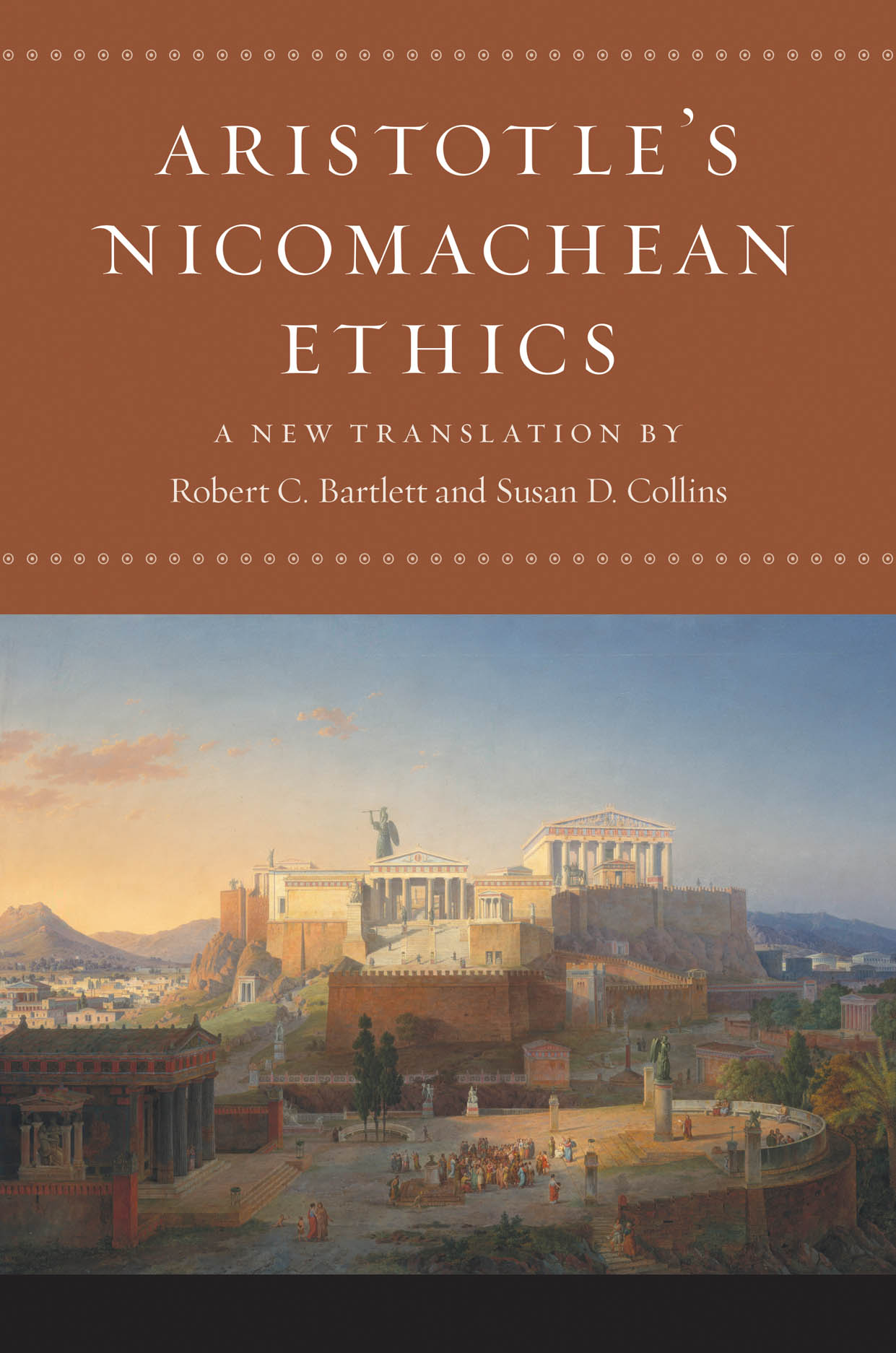
The 2011 Bartlett–Collins translation combines close attention to Aristotle’s Greek with extensive notes, a glossary, and an interpretive essay. Edition source. Amazon.
Nicomachean Ethics interpretation: Happiness Is an Activity We Build Together
The familiar picture of Aristotle’s ethics is compact enough to fit on a poster: cultivate virtue, avoid extremes, and happiness will follow. Almost every term in that formula is misleading. Virtue is not a possession that automatically issues correct conduct. The mean is not a safe midpoint between passionate alternatives. Happiness does not simply “follow” as a reward. In the public-domain Ross translation, Aristotle defines the human good as activity of soul in accordance with excellence over a complete life. The grammar matters: activity, accordance, completion. Each word prevents happiness from being reduced to mood, moral credit, or one triumphant choice.
The Greek term eudaimonia is conventionally rendered as “happiness,” but flourishing or living well often better preserves its objective force. Someone may feel satisfied while living badly; someone acting nobly under pressure may feel grief. Aristotle is not indifferent to pleasure—he eventually argues that pleasure completes unimpeded activity—but he refuses to let the pleasant sensation define the worth of the life. The question is not primarily “How do I feel?” It is “What am I doing, through what settled capacities, toward what intelligible good, and across what shape of life?” The Stanford Encyclopedia’s account of Aristotle’s ethics rightly stresses that this inquiry is practical: its aim is not merely knowing what virtue is but becoming capable of virtuous activity.
Yet the agent who acts is never self-created. Before one can choose well, one must have acquired a character capable of taking pleasure and pain in appropriate things. Before one can deliberate well, one needs experience. Before friendship of character is possible, there must be time, reciprocity, and a shared life. Before contemplation can become continuous, there must be leisure and material support. Aristotle’s most famous ethical ideal is therefore dependent upon arrangements the individual cannot supply alone. The text’s central drama is not a contest between reason and emotion. It is the attempt to reconcile responsible agency with the fact that character and opportunity are formed by families, laws, education, wealth, health, friendship, civic stability, and luck.
The Nicomachean Ethics is best reread as a theory of socially supported activity. Aristotle makes the person answerable for becoming a certain kind of agent, while showing that good agency depends on habits, relationships, institutions, external goods, and fortune that no person wholly commands. Its lasting power lies in refusing to dissolve either side of that tension.
This reading also gives the title a sharper role. “Nicomachean” does not name an abstract system such as utilitarianism or deontology. It attaches ethics to a person, perhaps Aristotle’s son Nicomachus, perhaps his father, perhaps an editorial history now irrecoverable. Whatever the precise explanation, the title bears the trace of transmission: a teaching handed on, arranged, heard, remembered, and practiced. It is ethics as an inheritance between generations. That is a better entry into the work than the fantasy of a universal decision procedure arriving from nowhere.
The Lyceum Behind the Ethics
The work took shape in the intellectual world of fourth-century BCE Athens, during Aristotle’s later career and the teaching associated with the Lyceum. It is not a polished dialogue like Plato’s Republic. Its compressed formulations, abrupt transitions, repetitions, shared books with the Eudemian Ethics, and changes of pace suggest materials connected with teaching and later textual organization. The title Ēthika Nikomacheia is ancient, but the exact relation between the surviving arrangement and Nicomachus remains uncertain. Treating that uncertainty as a defect misses something useful: the text itself looks like thought meant to train judgment, not a monument designed to close debate.

The excavated Lyceum in Athens recalls that Aristotle’s ethics emerged from an institution of teaching, inquiry, exercise, and civic life rather than from an isolated authorial study. Wikimedia Commons.
The institutional setting clarifies Aristotle’s insistence that ethics cannot reach mathematical exactness. Practical life concerns variable matters. A geometrical proof remains what it is regardless of the student’s character; an ethical account succeeds only when the hearer has been educated to respond to reasons. Aristotle therefore limits his audience. Someone ruled by undisciplined appetite may understand the sentences yet fail to grasp their point, because ethical understanding requires affective formation. This is an unsettling claim for modern readers accustomed to separating argument from upbringing. It also explains why the book repeatedly moves between analysis and pedagogy.
Athens supplied the polis as the ordinary horizon of action, while Macedonian power had transformed the political landscape in which Aristotle worked. The text does not offer a democratic theory, and its social assumptions—male citizenship, household hierarchy, slavery, leisure supported by others—place firm limits on its universality. Those exclusions cannot be dissolved by translating anthrōpos as a timeless “human being.” Still, the ethical project is inseparable from political science. The final chapter turns from contemplation back to legislation and education, and the inquiry flows toward the Politics. The Internet Encyclopedia of Philosophy’s account of Aristotle’s politics makes the connection explicit: the city exists not merely for survival but for living well.
What later readers often project backward is the modern image of ethics as a separate domain of private choice, bounded off from politics, economics, and education. Aristotle’s practical philosophy recognizes no such clean frontier. Laws shape habits; constitutions reward particular characters; distributions of honor and wealth influence civic friendship; education directs pleasure and pain. The ethical agent is accountable, but accountability operates inside a formative order. The Lyceum behind the book is thus not incidental background. It is a model of the book’s own claim that good activity requires a sustaining practice and a community of judgment.
Activity, Character, and the Grammar of the Good
Aristotle begins from ends. Every craft, inquiry, action, and decision appears to aim at some good. Because many ends are pursued for the sake of further ends, he asks whether there is an end chosen always for itself. Happiness answers that formal demand: people seek wealth, honor, pleasure, and intelligence partly because they believe these will make life go well, while they do not ordinarily seek happiness as a means to something beyond it. This does not yet tell us what happiness consists in. It establishes the place the concept occupies in practical reasoning.
The function argument then asks what characteristic activity distinguishes human life. Mere nutrition is shared with plants; perception with animals. Aristotle identifies a life of rational activity, including both the exercise of reason and the part of desire capable of listening to reason. The argument is contested, especially because moving from a characteristic function to a normative good seems too swift. The best defense is not that biology mechanically dictates morality. It is that a good human life must actualize capacities whose exercise makes human agency intelligible: reasoning, choosing, speaking, responding to reasons, and organizing desire. The Oxford discussion of the function argument shows why its premises and scope remain central to interpretation.
A disposition is not a stored virtue
Moral virtue is a hexis, a settled disposition or state. But the English noun “state” can suggest passivity, as though virtue were a certificate held in reserve. Aristotle’s examples point elsewhere. A just person becomes just by doing just actions, yet performing the outward deed is not sufficient. The agent must know what is being done, choose it for its own sake, and act from a firm character. Repetition forms perception and desire until the person can respond to the salient features of a situation without treating morality as an external command.
Habituation is therefore neither conditioning without reason nor reasoning without training. It creates the emotional field in which deliberation can operate. The brave person does not lack fear; the generous person does not mechanically divide assets; the mild person is not incapable of anger. Each experiences and expresses passion in relation to the right objects, occasions, people, ends, and manner. Virtue integrates emotion with reason. This is why pleasure and pain are diagnostic: what someone enjoys discloses what kind of world that person has learned to see. Aristotle’s later account, helpfully situated in the Cambridge Companion chapter on pleasure, treats pleasure as completing activity rather than serving as a detachable prize.

A late-fifteenth-century manuscript opens Book VI, where Aristotle distinguishes intellectual excellences and gives practical wisdom its indispensable role in choosing well. Wikimedia Commons.
Practical wisdom closes the gap
The doctrine of character would be rigid without phronēsis, practical wisdom. General statements cannot anticipate every circumstance. Practical wisdom discerns what should be done here and now, in light of a worthwhile life as a whole. It requires experience because particulars are not learned solely from definitions. The virtuous person is not someone who memorizes the correct principle and applies it like a formula; it is someone whose perception has become answerable to reasons.
This closes a gap that modern summaries often widen. Virtue is neither blind habit nor abstract rational control. Good character supplies the right end; practical wisdom identifies the fitting means and the morally relevant particulars. Their interdependence is so strong that Aristotle denies full virtue without practical wisdom and full practical wisdom without moral virtue. The agent’s intelligence is ethical because desire has been educated, and desire is intelligent because it has learned to follow a truthful view of the good.
The Mean Is a Judgment, Not a Middle Number
The mean is Aristotle’s most portable doctrine and his most damaged one. In popular use it becomes a command to split the difference: courage halfway between cowardice and rashness, generosity halfway between stinginess and waste. Aristotle explicitly denies that the ethical mean is an arithmetic midpoint. It is “relative to us,” determined as the practically wise person would determine it. The phrase does not license subjectivism. It acknowledges that fitting action varies with the agent, object, stakes, timing, and purpose.
Consider anger. Too little anger can disclose indifference to injustice; too much can become cruelty or vanity. The right response cannot be calculated by averaging two quantities because the relevant question is what the situation deserves. In some cases the right amount may be intense. In others, restraint is demanded. Certain acts—adultery, theft, murder in Aristotle’s examples—do not admit a virtuous mean simply by being performed moderately. The doctrine concerns ordered passions and actions, not compromise as a universal style.
The mean is better understood as calibrated perception. A musician’s correct pitch is not mediocre sound; an archer’s center is not timid aiming. Ethical excellence similarly hits what is fitting amid many ways of missing. This helps explain Aristotle’s emphasis on difficulty. Error is easy because particulars can go wrong in numerous directions; excellence is precise because it responds to a complex configuration. Calling the mean “moderation” can conceal the demanding intelligence involved.
There is nevertheless a political danger in the doctrine. A language of fitting proportion can be used to naturalize existing hierarchies, especially when the “practically wise person” is imagined as the already honored gentleman of the city. Aristotle’s social world shapes his examples of magnificence, magnanimity, citizenship, gender, labor, and leisure. The doctrine becomes defensible for modern readers only when exemplary judgment remains open to criticism rather than functioning as the taste of a ruling class. The mean is not morally safe merely because it is contextual.
Friendship Enters the Definition of Flourishing
Books VIII and IX are often treated as a beautiful supplement to the “real” ethics of virtue and happiness. Their length and placement argue otherwise. Aristotle says that no one would choose to live without friends even if all other goods were available. Friendship is necessary not only because human beings need assistance but because flourishing activity requires shared recognition. We come to see character in another person, deliberate with them, act alongside them, and experience their life as bound up with our own.
Aristotle distinguishes friendships of utility, pleasure, and character. The first two are not fraudulent; they are ordinary forms of association grounded in benefits or enjoyment. They are unstable because the basis can disappear. Complete friendship exists between people who wish one another’s good for the other’s sake and whose characters make that wish reliable. Such friendship takes time. It demands familiarity with action, because character cannot be certified by declaration.
The striking claim is that a friend is “another self.” This is not absorption of the other into the ego. The friend provides an external life whose goodness can be perceived more clearly than one’s own, making virtuous activity visible and lovable. Friends share thought and action; they help one another deliberate; they extend the field in which excellence is exercised. Happiness is therefore not solitary self-sufficiency. Aristotle’s self-sufficient life includes relationships because a human good complete enough to be choiceworthy cannot exclude the activities through which persons recognize and perfect one another.
Friendship also crosses into politics. Civic friendship does not require intimate virtue friendship among all citizens, but it names a degree of concord about common matters. A city held together only by coercion or transactions cannot secure the conditions for living well. Here the social architecture of happiness becomes unmistakable: just institutions need dispositions of mutual regard, while those dispositions are themselves shaped by institutions. Aristotle does not solve the circularity. He makes it visible.
Fortune at the Door of Happiness
If virtue were wholly sufficient for happiness, the ethical life could become invulnerable. Aristotle refuses that consolation. Good birth, children, beauty, wealth, health, political stability, and opportunity are not identical with excellence, yet severe deprivation can block excellent activity. Priam’s disasters matter. A life may be damaged by events that no character deserves and no deliberation could prevent. The good person bears misfortune nobly, but nobility of endurance does not convert catastrophe into flourishing.
The admission has embarrassed interpreters seeking a morally pure account. It should instead be treated as one of the work’s strongest insights. Aristotle protects the distinction between being good and having a life go well. Moral worth is not a magical insurance policy. External goods are instruments and conditions of action; their absence can constrict the field in which virtue appears. T. D. Roche’s study of happiness and external goods shows how deeply this question runs through the structure of the work.
This is also where Aristotle’s account reveals a contradiction it cannot resolve. He wants happiness to be attributable to the agent’s stable activity rather than to luck. Yet the possibility, range, and continuity of that activity depend on luck-laden conditions. The tension is intellectually productive because either extreme would be false. To make happiness pure fortune would destroy practical responsibility. To make it pure virtue would deny vulnerability, bereavement, illness, poverty, oppression, and political ruin.
Modern readers should push the argument further than Aristotle does. If external goods materially enable flourishing, their distribution becomes an ethical issue, not merely background. Who has leisure to contemplate? Who receives education capable of forming judgment? Whose labor creates the conditions for another person’s “self-sufficient” activity? Aristotle’s own acceptance of slavery and exclusion of women from equal citizenship disclose the injustice in his answer. But the framework also supplies resources for criticizing that answer: a society that systematically denies the material and civic conditions of excellent activity cannot plausibly claim to be ordered toward the human good.
The City Inside the Ethical Life
Aristotle begins by locating ethics within political science, the architectonic practical discipline that orders other activities toward the good of the city. This is not the modern claim that government should police every private virtue. It is the older and more encompassing claim that institutions inevitably form character. A constitution is a distribution of offices, honors, authority, and ways of life. It teaches citizens what counts as admirable by rewarding some activities and marginalizing others.
The last chapter makes the dependence explicit. Argument alone cannot make most people good. Laws must cultivate habits from youth and sustain them through adulthood. Aristotle therefore moves toward the study of constitutions, asking how legislation might create conditions in which citizens can practice virtue. Ethics ends not with inward enlightenment but with an educational problem. The city is already inside the ethical life because the pleasures, aspirations, and standards by which a person deliberates have a public history.
This aspect of the book is both powerful and dangerous. It recognizes that markets, schools, families, workplaces, media, and laws produce dispositions; it also invites paternalism and can suppress plural forms of life under an official image of excellence. Aristotle assumes more agreement about the human good than a modern liberal society can safely enforce. His ethical politics needs constitutional limits that he does not provide. Yet the opposite fantasy—that institutions can remain neutral while individuals privately choose their values—is equally implausible. Every institutional design encourages some habits of attention, competition, cooperation, memory, and desire.
A mature use of Aristotle therefore neither imports the polis whole nor reduces his ethics to personal coaching. It asks a harder question: what arrangements enlarge people’s real capacity for intelligent, responsible, shared activity without authorizing a ruling group to define virtue for everyone? The Nicomachean Ethics does not answer that modern question. It makes evasion of it more difficult.
Books I and X: One Happiness or Two?
The most consequential interpretive dispute concerns the relation between the broad account of flourishing developed through Books I–IX and the elevation of contemplation in Book X. One influential “intellectualist” reading holds that the highest happiness consists dominantly, perhaps exclusively, in contemplative activity. Moral virtue, friendship, and political action prepare or support that superior life. An “inclusivist” reading understands happiness as a composite life containing the full range of excellent human activities, with contemplation highest but not exhaustive.
Book X gives intellectualism formidable evidence. Contemplation is continuous, self-sufficient, pleasant, loved for itself, and associated with the divine element in us. Aristotle says that the life of intellect may be higher than the merely human. Recent scholarship represented in the Oxford study of eudaimonia, intellect, and divinity shows why these claims cannot be softened into a generic endorsement of balance.
Yet a strict exclusive reading makes much of the preceding work strangely provisional. Aristotle devotes extensive analysis to voluntary action, justice, practical wisdom, pleasure, weakness of will, and friendship; he describes friends as necessary for happiness; and the final return to education and law confirms that contemplation does not hover outside political formation. The Cambridge discussion of competing lives and the ring composition of Book X captures the architectural force of the problem.
The most persuasive reading is hierarchical without being exclusionary. Contemplation represents the most self-sufficient and intrinsically choiceworthy exercise of intellect, but it remains the activity of an embodied, educated, socially supported person. It depends on moral order, friendship, leisure, and external provision even when its immediate object is theoretical truth. The brilliant but overextended intellectualist interpretation mistakes superiority for independence. Aristotle’s own account of conditions prevents the contemplative life from becoming self-created.

Raphael’s Renaissance staging of Plato and Aristotle turns a long interpretive contrast into an image: transcendent orientation beside attention to the world of embodied practice. The contrast is memorable, though Aristotle’s ethics never permits so simple a division. Wikimedia Commons.
This resolution leaves a genuine remainder. If contemplation is highest, what status belongs to political and relational virtues when their demands interrupt it? If complete friendship is constitutive of flourishing, can the most self-sufficient activity be the final measure? Aristotle does not erase the conflict between the philosopher’s leisure and the citizen’s obligations. The text’s ending holds them in an unstable order, which may be more truthful than a seamless system.
What the Golden-Mean Slogan Erases
A thin Nicomachean Ethics interpretation reduces the book to a doctrine of balanced character. That slogan erases at least four things. It erases activity by making virtue sound like a personality profile. It erases time by treating a life as a collection of isolated decisions. It erases institutions by imagining that habits originate inside sovereign individuals. And it erases vulnerability by implying that good character guarantees a good life.
It also misdescribes Aristotle’s ambition. He is not recommending blandness. Courage may require terrifying action; justice may demand conflict; truthfulness may rupture comfort; generosity can be costly; contemplation can reorder an entire life. The mean is not a middle-class temperament. It is the difficult fit between feeling, judgment, action, and circumstance.
Another familiar reading turns Aristotle into the founder of contemporary “virtue ethics” in a way that makes the ancient text answer modern disputes too neatly. The twentieth-century revival associated with Elizabeth Anscombe, Philippa Foot, Rosalind Hursthouse, Alasdair MacIntyre, and others genuinely learned from Aristotle, but it also reconstructed him for problems concerning moral obligation, action theory, natural goodness, practices, and modern fragmentation. That afterlife is intellectually fruitful when the distinction between documented argument and later appropriation remains visible.
The work’s title helps resist abstraction. “Nicomachean” keeps the inquiry attached to a history of teaching and reception. The treatise traveled through Greek commentary, Arabic translation and philosophy, Latin scholasticism, Renaissance humanism, and modern university ethics. The scholarly account of its Arabic and Islamic reception demonstrates that this was never a single, unbroken Western inheritance. Each transmission selected, translated, combined, and contested Aristotle’s ethical vocabulary.
Why Rereading the Nicomachean Ethics Matters Now
The strongest contemporary reason to reread Aristotle is not that he anticipated behavioral science, democratic pluralism, or digital technology. He did not. It is that modern moral language often oscillates between two impoverished pictures: the autonomous chooser who invents values privately, and the managed subject whose conduct is engineered by systems. Aristotle offers a third vocabulary in which agency is real but formed, responsibility is personal but socially conditioned, and freedom is exercised through acquired capacities rather than through choice without history.
That vocabulary illuminates institutions without excusing agents. A workplace can cultivate vanity and fear; a platform can train attention toward outrage; an educational system can reward credential accumulation over judgment; a market can reorganize desire around comparison. None of this means individuals cease to be answerable. It means character is an achievement distributed across repeated practices and environments. A contemporary Nicomachean Ethics interpretation becomes politically serious when it asks who designs those environments, whose flourishing they enable, and whose activity they constrain.
Aristotle also corrects the therapeutic reduction of happiness to subjective well-being. Flourishing includes how a person acts, what capacities are exercised, which relationships are sustained, and whether the surrounding order permits meaningful participation. Feeling good cannot settle those questions. At the same time, his account warns against moralism that praises resilience while ignoring deprivation. A noble response to misfortune remains noble, but it does not make the misfortune good or the social conditions just.
Modern readers must resist projecting egalitarian conclusions onto Aristotle himself. His hierarchy of lives, defense of natural slavery, restricted citizenship, and assumptions about gender are not incidental blemishes. They reveal how a theory of flourishing can universalize the experience of those whose leisure is subsidized by excluded labor. The proper response is neither cancellation nor reverence. It is immanent criticism: use Aristotle’s own insistence on the material, educational, and political conditions of excellent activity to expose the narrowness of his account of who may possess them.
The unresolved relation between contemplation and civic life also remains useful. A society that eliminates leisure, study, and attention impoverishes the highest forms of activity. A philosophy that treats contemplation as independent of care, labor, friendship, and public order conceals its supports. Aristotle makes both truths available, although he never integrates them completely. Rereading means keeping the contradiction open rather than choosing the comfortable half.
Final Verdict
The strongest reason to reread the Nicomachean Ethics is that it makes happiness inseparable from sustained excellent activity while refusing to pretend that activity is self-sufficient. Character matters, but so do teachers, friends, laws, leisure, material provision, and luck. The book’s fresh meaning appears when “virtue” is moved out of the private inventory of traits and returned to the public practices that form, test, and enable it.
Readers should resist the golden-mean caricature, the identification of happiness with feeling, and the claim that contemplation floats above its social conditions. They should also resist sanitizing Aristotle’s exclusions. The Bartlett–Collins University of Chicago edition deserves confidence for readers who want philological precision, explanatory notes, key Greek terminology, and a serious interpretive apparatus.
The contradiction between responsible agency and unequal enabling conditions remains unresolved, as does the hierarchy between contemplative and civic excellence. Those are not reasons to abandon the work. They are why the Nicomachean Ethics interpretation developed here still has force: the good life is neither a private possession nor a gift of circumstance, but a vulnerable practice carried by persons together.
Three Books to Read Beside This Book

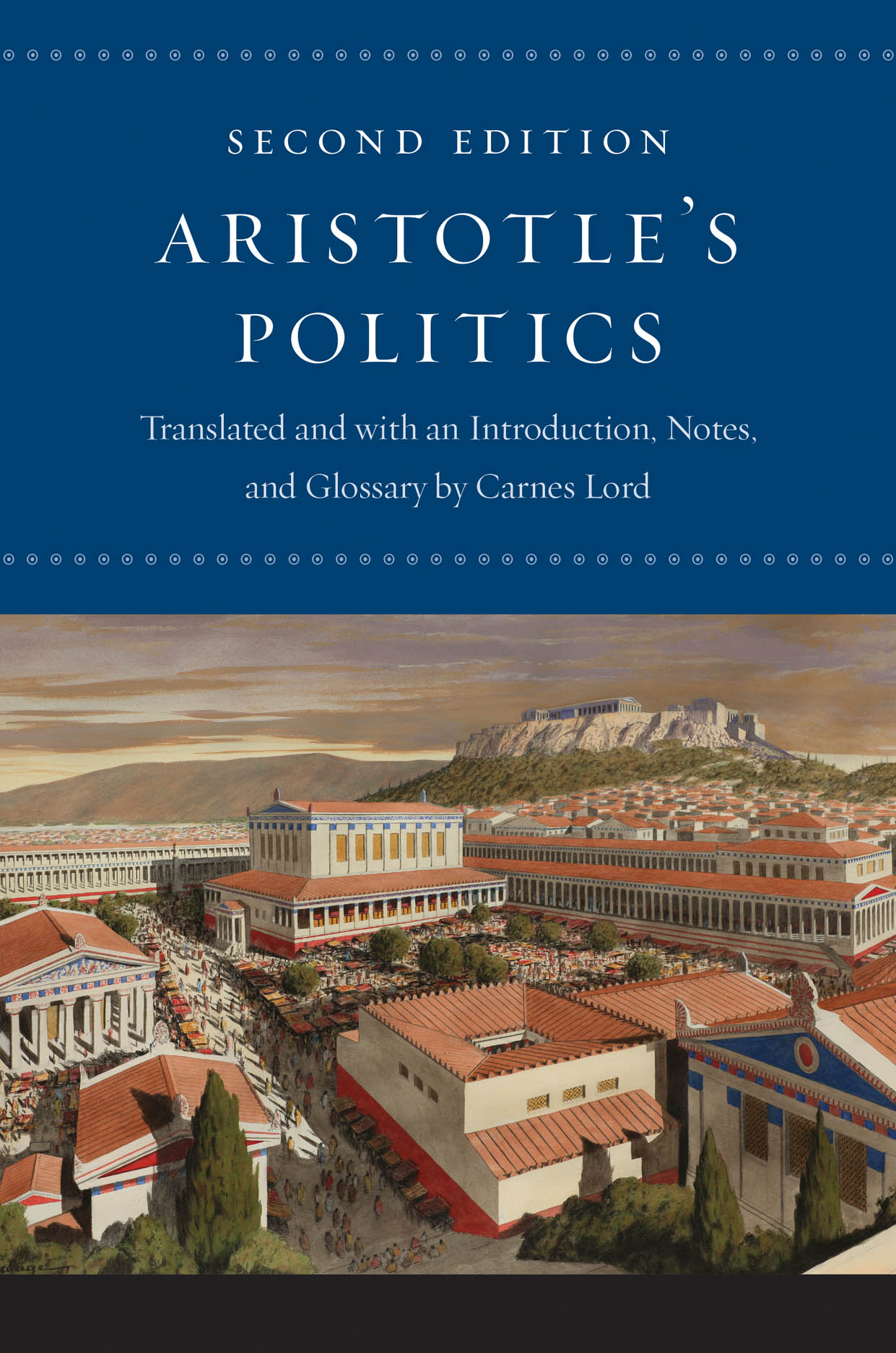
Related BookInLight Reading Guides
This article was researched and written by the BookInLight Department of Philosophy and Intellectual History. The editorial process included bibliographical review, consultation of primary-text resources, source and edition verification, interpretive comparison, and factual checking. Readers are invited to submit factual corrections, overlooked scholarly sources, interpretive objections, and constructive suggestions for future revision.
Editorial art direction, visual composition, image selection, and presentation were developed by the BookInLight Art Department. Contextual images are credited according to their stated public-domain or Creative Commons terms. Third-party book covers remain the property of their publishers, artists, designers, and other rights holders and are reproduced here for editorial identification. Complete republication, reproduction, translation, or reuse of this article requires prior written authorization from BookInLight.
Sources and Further Reading
Primary Text and Editions
Aristotle. Aristotle’s Nicomachean Ethics. Translated by Robert C. Bartlett and Susan D. Collins. University of Chicago Press, 2011. Publisher record. Used for the recommended edition, translation method, notes, glossary, and bibliographical details.
Aristotle. Nicomachean Ethics. Translated by W. D. Ross. Internet Classics Archive. Full text. Consulted for the public-domain English text and the work’s ten-book structure.
Aristotle. Nicomachean Ethics. Greek and English resources, Perseus/Scaife. Digital text collection. Consulted for Greek terminology and textual comparison.
Aristotle. Ethica Nicomachea. Edited by I. Bywater. Clarendon Press, 1894. Catalogue record. Used to confirm the standard Greek editorial tradition.
Aristotle. Nicomachean Ethics. Second edition. Translated and edited by Roger Crisp. Cambridge University Press, 2014. Publisher record. Consulted as an accessible modern translation and introduction.
Historical and Intellectual Context
Richard Kraut. “Aristotle’s Ethics.” Stanford Encyclopedia of Philosophy. Reference article. Used for the architecture of Aristotle’s ethical inquiry, virtue, friendship, and contemplation.
Joe Sachs. “Aristotle: Ethics.” Internet Encyclopedia of Philosophy. Reference article. Consulted for terminology, habituation, practical wisdom, and the mean.
Edward Clayton. “Aristotle: Politics.” Internet Encyclopedia of Philosophy. Reference article. Used for the relation between ethics, citizenship, education, and the polis.
Ronald Polansky, editor. The Cambridge Companion to Aristotle’s Nicomachean Ethics. Cambridge University Press, 2014. Bibliographical record. Used as the principal map of recent specialist debates.
Major Interpretations
C. D. C. Reeve. “Beginning and Ending with Eudaimonia.” In The Cambridge Companion to Aristotle’s Nicomachean Ethics. Chapter record. Used for the relation between the opening and closing accounts of happiness.
T. D. Roche. “Happiness and the External Goods.” In The Cambridge Companion to Aristotle’s Nicomachean Ethics. Chapter record. Used for fortune, vulnerability, and the enabling role of external goods.
Carlo Natali. “The Book on Wisdom.” In The Cambridge Companion to Aristotle’s Nicomachean Ethics. Chapter record. Used for practical and theoretical intellectual excellence.
Jessica Moss. “Was Aristotle a Humean? A Partisan Guide to the Debate.” In The Cambridge Companion to Aristotle’s Nicomachean Ethics. Chapter record. Used for the relation between desire, reason, habituation, and virtuous motivation.
Christine M. Korsgaard. “Aristotle’s Function Argument.” In The Constitution of Agency: Essays on Practical Reason and Moral Psychology. Oxford University Press, 2008. Chapter record. Used for the premises and interpretive difficulties of the function argument.
A. A. Long. “Aristotle on Eudaimonia, Nous, and Divinity.” In Selfhood and Rationality in Ancient Greek Philosophy: From Heraclitus to Plotinus. Oxford University Press, 2022. Chapter record. Used for the relation between practical life, contemplation, intellect, and divine activity.
Thornton C. Lockwood. “Competing Ways of Life and Ring Composition: NE X 6–8.” In The Cambridge Companion to Aristotle’s Nicomachean Ethics. Chapter record. Used for the debate over contemplative and political lives.
Reception and Afterlife
Anna Akasoy. “The Arabic and Islamic Reception of the Nicomachean Ethics.” In The Reception of Aristotle’s Ethics, edited by Jon Miller. Cambridge University Press, 2012. Chapter record. Used to distinguish transmission, translation, and later philosophical appropriation.
Alasdair MacIntyre. After Virtue: A Study in Moral Theory. Third edition. University of Notre Dame Press, 2007. Publisher record. Used for the modern reconstruction of Aristotelian virtue through practices, traditions, and social institutions.
Image Credits
1. Aristotle’s Nicomachean Ethics, Robert C. Bartlett and Susan D. Collins translation, University of Chicago Press, 2011. Publisher cover used for editorial identification; all cover rights remain with the publisher, designer, artist, and rights holders. Source page.
2. “Aristotle’s Lyceum (Lykeion), Athens,” photograph by Carole Raddato, 16 March 2017. Wikimedia Commons, CC BY-SA 2.0; externally delivered from Wikimedia’s stable image service. Source page.
3. Beginning of Book VI of Aristotle’s Nicomachean Ethics, Vienna, Österreichische Nationalbibliothek, Cod. phil. gr. 4, fol. 45v; Southern Italy, late fifteenth century, produced for Andrea Matteo Acquaviva. Public-domain faithful reproduction via Wikimedia Commons. Source page.
4. Raphael, The School of Athens, 1511. Public-domain work and faithful reproduction via Wikimedia Commons; externally delivered from Wikimedia’s stable image service. Source page.
5. Plato, Republic, translated by G. M. A. Grube and revised by C. D. C. Reeve, second edition, Hackett Publishing, 1992. Exact-edition cover delivered from the verified Amazon product image; cover rights remain with Hackett Publishing and associated rights holders. Publisher source page.
6. Aristotle, Aristotle’s Politics, translated by Carnes Lord, second edition, University of Chicago Press, 2013. Publisher cover used for editorial identification; all cover rights remain with the publisher and associated rights holders. Source page.
7. Alasdair MacIntyre, After Virtue: A Study in Moral Theory, third edition, University of Notre Dame Press, 2007. Publisher cover used for editorial identification; all cover rights remain with the publisher and associated rights holders. Source page.