

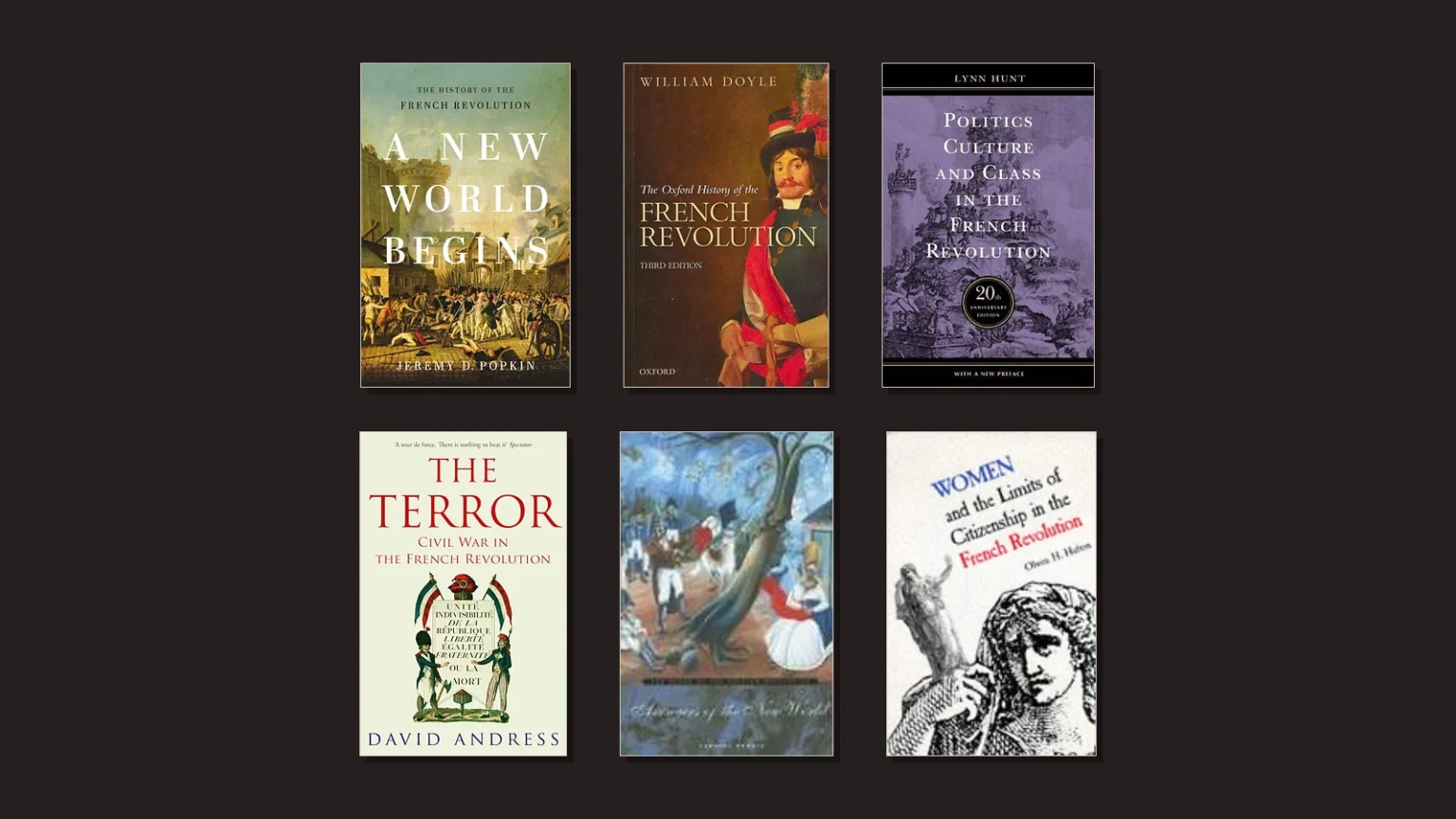
French Revolution reading becomes confusing when a beginner meets famous names, shifting factions, constitutional experiments, civil war, slavery, and the Terror all at once. Begin with Jeremy D. Popkin’s broad narrative, then move through institutional history, contingency, political culture, violence, Atlantic emancipation, and the limits of citizenship. The order matters more than any claim that these are simply the seven “best” books.
Introduction
The French Revolution remains one of the decisive laboratories of modern political life. Between the crisis of the monarchy and Napoleon’s seizure of power, revolutionaries recast sovereignty, citizenship, law, property, religion, warfare, and the language of rights. They also produced new exclusions and new forms of coercion. The subject therefore resists a single moral: it is simultaneously an emancipation from privilege, a struggle over state capacity, a civil conflict, an imperial crisis, and a warning about political violence.
Beginners often encounter the period as a procession of dates—1789, Varennes, the Republic, the Terror, Thermidor—or as a cast list of estates, clubs, assemblies, and factions. A concise chronological outline such as the Encyclopaedia Britannica overview of the Revolution can steady the sequence, but chronology alone does not explain why institutions collapsed, why symbols mattered, or why the language of universal rights coexisted with colonial slavery. Nor does the familiar Paris-centered story show how events in Saint-Domingue transformed the meaning of the revolutionary age.
This guide is a reading path rather than a ranking. It begins with a modern synthesis that keeps narrative momentum without treating outcomes as inevitable. It then supplies a more compressed institutional history, an event-centered study of contingency, a classic account of political culture, a contextual history of the Terror, and two books that widen the frame through Haiti and women’s citizenship. Readers who want to test interpretations against primary material can use the Stanford French Revolution Digital Archive, but the primary sources become far more intelligible after the first two books.
The shortest honest answer
Start with Jeremy D. Popkin’s A New World Begins. Then read William Doyle for a tighter institutional chronology, Timothy Tackett for contingency, Lynn Hunt for political culture, David Andress for the Terror, Laurent Dubois for the Haitian Revolution, and Olwen H. Hufton for the gendered limits of citizenship.
That sequence gives a beginner a narrative spine before introducing historiographical disagreement. It also prevents two common distortions: reducing the entire Revolution to the Terror, and treating metropolitan France as though its colonial world were incidental. You do not need to complete a preparatory shelf on the Enlightenment, absolutism, or eighteenth-century economics before beginning. Learn those contexts as the questions arise.
Before you start: how to approach the French Revolution
Begin with a light chronology and a small working vocabulary, not with an attempt to master the whole eighteenth century. Know what the Estates-General, National Assembly, Legislative Assembly, Convention, Directory, Jacobins, Girondins, sans-culottes, Thermidor, and assignats were. That is enough scaffolding. The books themselves will teach the fiscal crisis of the monarchy, seigneurial burdens, political clubs, dechristianization, military mobilization, and constitutional change in context.
Chronology is useful because institutional names changed quickly, but it becomes misleading when it turns into teleology—the assumption that 1789 necessarily led to 1793, or that the guillotine was already latent in the Declaration of Rights. Read the Declaration of the Rights of Man and of the Citizen early, but treat it as a contested political instrument rather than a self-executing charter. Its universal grammar mattered; so did the disputes over who counted as an active citizen, a free person, a property holder, a woman, or a colonial subject.
A second precaution concerns labels. “The bourgeois revolution,” “the liberal revolution,” and “the Revolution of the people” each illuminate part of the story while concealing another. Social interests mattered, but political identities were formed through speeches, ceremonies, newspapers, petitions, rumors, elections, warfare, and fear. The immense digitized Archives parlementaires collection shows how rapidly meanings changed inside debate. A deputy could defend the nation, the king, property, and liberty in combinations that later categories make difficult to see.
Finally, do not let Paris swallow the map. Paris was indispensable, but the Revolution was also made in villages, ports, borderlands, the Vendée, the army, and the Caribbean. The sequence below deliberately postpones specialized work until a basic narrative is secure, then breaks open the metropolitan frame. That order lets a beginner recognize both the coherence of the French political crisis and the limits of any story that stops at France’s European shoreline.
The best first book on the French Revolution
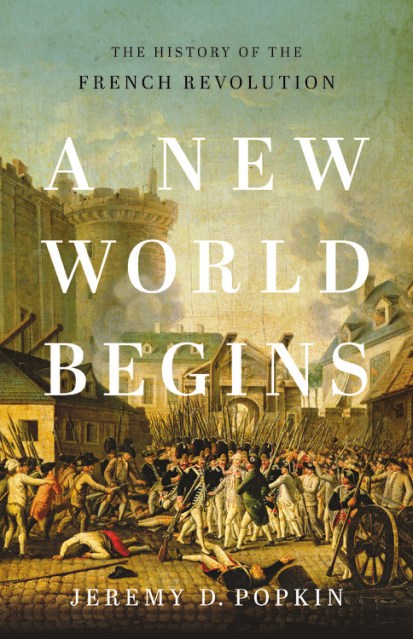
Start with: A New World Begins: The History of the French Revolution by Jeremy D. Popkin
Popkin is the best first book because he writes at the scale a beginner needs. The narrative is broad enough to connect the monarchy’s fiscal breakdown, popular mobilization, constitutional politics, war, republican government, the Terror, colonial rebellion, and the Directory, yet it repeatedly returns to individual actors whose decisions were made without knowledge of the outcome. That combination prevents the Revolution from becoming either an abstract debate about causes or a breathless succession of crises.
The book also reflects a later historiographical landscape than many still-standard surveys. It incorporates political culture, emotion, race, slavery, gender, and empire without treating them as detachable “special topics.” For a beginner, this matters more than having the shortest possible volume. Popkin gives enough context to make later disagreements intelligible: Doyle’s sharper institutional compression, Hunt’s interpretation of representation and symbolic practice, and Dubois’s reconstruction of Saint-Domingue all become arguments within a known chronology rather than isolated corrections.
Its limitation is the reverse of its strength. At more than six hundred pages, it can blur the difference between narrative synthesis and historiographical intervention. Read it steadily rather than quickly, keeping a one-page chronology and noting moments when political trust breaks: the king’s acceptance of constitutional change, the flight to Varennes, war, the fall of the monarchy, federalist revolt, and Thermidor. The 2019 Basic Books hardcover shown below is the exact edition used here. After finishing it, move directly to Doyle. The second book will compress the same terrain and make the institutional architecture easier to retain.
The core reading sequence
Book 1
A New World Begins: The History of the French Revolution by Jeremy D. Popkin
Edition shown: Basic Books / hardcover / 2019 / ISBN 9780465096664
Place in the sequence: Narrative orientation and a broad modern synthesis
Difficulty: Beginner
“This is a book that has been needed for a long time: a lucid, engaging, authoritative, accurate, and up-to-date history.”
— David A. Bell • Basic Books

Book 2
The Oxford History of the French Revolution by William Doyle
Edition shown: Oxford University Press / third edition / paperback / 2018 / ISBN 9780198804932
Place in the sequence: Institutional chronology and a revisionist synthesis
Doyle covers much of the same ground as Popkin, but the repetition is productive. A first reading supplies familiarity; this second one gives shape. Doyle is particularly strong on the monarchy’s administrative and fiscal predicament, the constitutional experiments of successive assemblies, the transformation of the Church, and the recurrent gap between legal design and political authority. His chronology is tighter, his judgments more compressed, and his account less dependent on extended personal testimony. The result is a book that helps the reader retain the Revolution’s institutional skeleton.
The history also occupies an important place in the late twentieth-century reassessment of older Marxist interpretations. Doyle does not deny social conflict, class interest, or the destruction of privilege. He resists making a rising bourgeoisie the single explanatory motor and emphasizes political breakdown, contingency, and the diversity of interests within revolutionary coalitions. A beginner need not choose a historiographical camp. The immediate lesson is methodological: large social categories do not automatically explain why particular constitutions were attempted, why alliances fractured, or why emergencies changed the acceptable limits of government.
Read for transitions. How does a reforming monarchy become a sovereign National Assembly? How does constitutional monarchy lose credibility? Why does a republic at war centralize power? Why does Thermidor end one form of emergency politics without restoring the old regime? Doyle’s precise treatment of these passages makes later specialized works easier to locate. When Tackett slows the story around Varennes, or Andress reconstructs the Terror, the reader will know which institutional alternatives were still available.
The third edition is preferable because it incorporates subsequent scholarship and carries Doyle’s mature revisions. Read it from beginning to end, though the opening analysis of the old regime and the chapters covering 1789–94 deserve close notes. Its limitation is perspective: the metropolitan political narrative remains more central than empire, race, and gender. Do not treat that as a defect to be silently corrected. Treat it as a reason the sequence must continue beyond a powerful national synthesis.
Difficulty: Moderate
“Provides a comprehensive and authoritative history of the French Revolution.”
— Oxford University Press • Oxford University Press

Book 3
When the King Took Flight by Timothy Tackett
Edition shown: Belknap Press of Harvard University Press / paperback / 2004 / ISBN 9780674016422
Place in the sequence: Event-centered history of contingency, trust, and political rupture
After two surveys, Tackett changes the scale. The attempted royal flight of June 1791 occupies only a small portion of most general histories, yet it transformed the credibility of constitutional monarchy. Louis XVI and his family left Paris, were recognized and stopped at Varennes, and returned under guard. Tackett reconstructs the episode not merely as a failed escape but as a nationwide crisis of interpretation. What had the king intended? Could his previous oaths still be trusted? Was the monarchy compatible with the sovereignty claimed in 1789?
This is the right third book because it teaches historical contingency. The later Republic can make the constitutional monarchy look like a brief waiting room. Tackett restores the uncertainty of 1791, when many citizens still wanted a king bounded by law. The flight did not mechanically cause republicanism or the Terror. It changed the evidence with which political actors judged royal sincerity, strengthened suspicions of conspiracy, and made compromise harder. The book therefore demonstrates how a single event becomes consequential through communication, rumor, public ceremony, local response, and institutional debate.
Pay attention to geography. News travels through municipalities, military units, roads, newspapers, and political clubs. Reactions outside Paris do not simply echo the capital. They reveal a political nation learning to make judgments about loyalty and treason. Tackett’s use of correspondence and local evidence also provides a practical lesson in method: political history can be reconstructed from emotional language and patterns of trust without reducing decisions to private psychology.
Read the book completely; its compact form is part of its value. The limitation is built into the microhistorical design. Varennes cannot by itself explain the Revolution’s social conflicts, colonial crises, or later emergency government. It should not replace the surveys. It teaches the reader how to question their smoothness. Once that habit is established, Hunt’s more theoretical account of political culture becomes easier to grasp: symbols and representations will no longer seem like ornaments placed on top of “real” events.
Difficulty: Beginner
“Exciting, provocative, instructive: popular history at its finest.”
— Kirkus Reviews • Kirkus Reviews

Book 4
Politics, Culture, and Class in the French Revolution by Lynn Hunt
Edition shown: University of California Press / twentieth-anniversary edition with a new preface / paperback / 2004 / ISBN 9780520241565
Place in the sequence: Political culture, symbolic practice, and the making of revolutionary identities
Hunt’s book marks the point at which this reading path becomes explicitly historiographical. Earlier accounts had often organized explanation around social structure and class conflict. Hunt did not argue that material interests vanished. She asked how political identities were produced through language, symbols, rituals, images, institutional practices, and new conceptions of legitimacy. Revolutionary politics, on this account, was not simply the public expression of interests formed elsewhere. It helped create the categories through which people understood themselves and their opponents.
The book belongs fourth because its conceptual claims need a known chronology. Without that foundation, discussions of political culture can seem detached from bread prices, elections, war, and administrative conflict. With Popkin, Doyle, and Tackett behind you, Hunt’s examples become concrete interventions. The reader can see why seals, festivals, clothing, allegorical figures, fraternal language, and representations of authority were political technologies. A new regime had to make sovereignty visible after the sacred and dynastic supports of monarchy were challenged.
Look closely at Hunt’s treatment of class. The title does not announce a simple rejection of class analysis. It asks how class and political language interacted, and why revolutionary alignments cannot be read directly from occupation or wealth. This is a useful corrective to any beginner’s temptation to assign every actor to a stable social bloc. It also prepares the ground for questions of gender: the political family, fraternity, and republican virtue were not neutral metaphors. They helped define who could represent the nation.
The twentieth-anniversary edition is the appropriate choice because its new preface allows Hunt to situate the book’s intervention after two decades of debate. On a first pass, read the preface, introduction, the central analytical chapters, and conclusion; then return to the complete work after Hufton. Its main difficulty is density rather than length. Some claims are inseparable from the historiography they challenged. Read them as arguments about what counts as political causation, not as a demand to replace economic or institutional history with symbolism.
Difficulty: Demanding
“When this book was published in 1984, it reframed the debate on the French Revolution.”
— University of California Press • University of California Press
Book 5
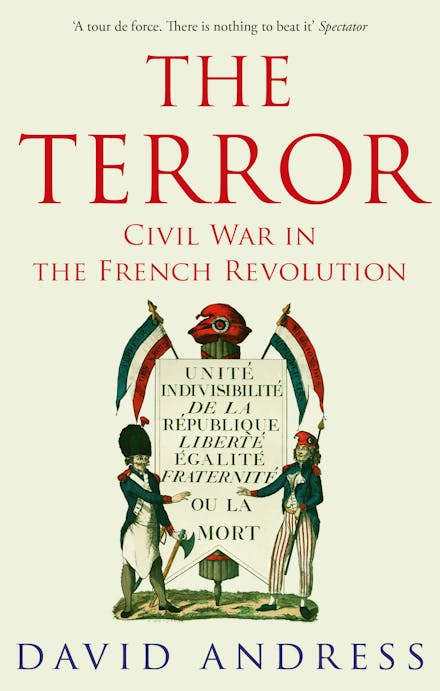
The Terror: Civil War in the French Revolution by David Andress
Edition shown: Abacus / new-edition paperback / 2006 / ISBN 9780349115887
Place in the sequence: The Terror situated within invasion, civil war, insurrection, and state emergency
The Terror is the episode most likely to distort a beginner’s reading. It can absorb the entire Revolution into an image of ideological purity, mass execution, and the guillotine. Andress restores scale and sequence. He places revolutionary repression within a republic facing foreign invasion, internal rebellion, political assassination, economic crisis, factional struggle, and the immense demands of mobilization. Context here is explanatory, not exculpatory. State violence remains violence, and emergency does not settle the moral or political questions it raises.
This book belongs after Hunt because the reader can now connect coercion to competing languages of virtue, treason, sovereignty, and popular legitimacy. It also follows Tackett’s study of distrust. The suspicions intensified after Varennes did not remain private attitudes; under war and civil conflict, they entered legal categories, surveillance, denunciation, and revolutionary justice. Andress shows that “the Terror” was neither a perfectly unified system nor merely a collection of local excesses. Its operation depended on the interaction of central legislation, representatives on mission, local institutions, military conditions, and political pressures from below.
Read for distinctions. Separate the September Massacres from the later machinery of the Revolutionary Government; separate repression in Paris from violence in the Vendée and federalist cities; separate the Committee of Public Safety’s coordination from the diverse motives of local actors. These distinctions prevent the vague use of “terror” as an explanation for itself. They also reveal a larger problem of revolutionary government: how could a regime founded on popular sovereignty defend itself when the boundaries between opposition, rebellion, and treason were unstable?
The Abacus paperback shown here is a complete, obtainable edition. Read it completely, ideally with Doyle’s chronology nearby. Its limitation is concentration: a history organized around civil war and repression necessarily gives less space to the Revolution’s constructive legal and social transformations. Do not use it as a verdict on 1789. Use it to understand how the Republic’s survival became entangled with exceptional power, and why historians disagree over the relative weight of ideology, circumstance, institutions, and war.
Difficulty: Moderate
“The most authoritative treatment we are likely to have for many years”
— William Doyle • Hachette Australia

Book 6
Avengers of the New World: The Story of the Haitian Revolution by Laurent Dubois
Edition shown: Belknap Press of Harvard University Press / paperback / 2005 / ISBN 9780674018266
Place in the sequence: Slavery, emancipation, empire, and the Revolution’s Atlantic transformation
Dubois changes the geographical and conceptual center of the reading path. Saint-Domingue was France’s most profitable colony and a society structured by racial slavery. The uprising that began in 1791, the abolition of slavery by the French Republic, the struggle against foreign invasion and attempted restoration, and Haitian independence in 1804 were not echoes of events in Paris. They transformed the practical meaning of liberty and equality and forced metropolitan revolutionaries to confront claims their own political language had made possible.
The book comes sixth because a reader first needs the metropolitan chronology to understand the changing legal and military environment in which colonial actors operated. Once that foundation exists, Dubois exposes the inadequacy of a France-only narrative. Enslaved people, free people of color, white colonists, commissioners, soldiers, and political leaders pursued distinct projects. Their alliances shifted as decrees, wars, and local struggles altered what could be demanded. Emancipation emerges neither as a gift from Paris nor as an isolated slave revolt untouched by revolutionary politics.
Read closely for the relationship between universal language and organized power. Rights claims mattered, but armies, plantation labor, racial hierarchy, imperial rivalry, and local leadership determined whether claims could survive. Toussaint Louverture is central, yet Dubois avoids turning the Haitian Revolution into a biography of one exceptional man. The book’s larger achievement is to make formerly enslaved people political agents within the history of the revolutionary Atlantic.
Read the whole volume. Its narrative is accessible, but the shifting names, military fronts, and statuses require attention. A small timeline helps. The limitation for this sequence is not the book’s scope but the risk that readers will still treat Haiti as an “addition” after the French story. Resist that arrangement. Return mentally to the Declaration of Rights, the Republic’s wars, and the meaning of citizenship. Dubois shows that the French Revolution’s universal claims were tested most radically where the economic order depended on human bondage.
Difficulty: Moderate
“There are hundreds, perhaps thousands of books about the Haitian Revolution, but only a handful are indispensable.”
— Robin Blackburn • Harvard University Press

Book 7
Women and the Limits of Citizenship in the French Revolution by Olwen H. Hufton
Edition shown: University of Toronto Press / paperback / 1992 / ISBN 9780802068378
Place in the sequence: Gender, subsistence, religion, political action, and exclusion from formal citizenship
Hufton closes the core sequence by testing the Revolution’s political vocabulary against women’s lived participation and formal exclusion. Women marched, petitioned, organized, argued about prices and subsistence, defended religious practices, attended political gatherings, and appeared in revolutionary iconography. Yet the new political order did not translate this activity into equal citizenship. The book asks readers to distinguish political agency from the possession of recognized political rights.
Placed after Hunt, Hufton sharpens the gendered implications of fraternity, republican virtue, and the political family. Placed after Dubois, it also encourages comparison without collapsing different exclusions into one model. The categories produced by universal declarations—citizen, dependent, active, passive, free, enslaved—were contested and enforced through distinct institutions. A serious history of rights must therefore examine not only what texts proclaimed but how labor, household authority, property, race, and sex shaped access to public power.
Hufton is particularly valuable on the material and religious dimensions of women’s politics. Bread, provisioning, family survival, church practice, and community discipline were not “private” concerns waiting outside political history. They were sites where revolutionary policy was encountered and judged. This perspective prevents a narrow focus on a few celebrated figures from substituting for the social range of women’s experience. It also complicates the assumption that participation always followed a single progressive line from tradition toward secular republican emancipation.
Read the book in full; it is concise, though its arguments presuppose familiarity with the chronology. The 1992 University of Toronto Press paperback remains a useful exact edition. Its limitation is historical position: later scholarship has expanded the archive and further complicated categories of race, sexuality, family, and colonial status. That does not make Hufton merely superseded. It makes the book an effective culmination to a beginner path, because it teaches the reader to ask who disappears when “the citizen” is treated as a neutral subject. After finishing, return to Popkin’s opening chapters and notice how differently the Revolution’s constituency now appears.
Difficulty: Demanding
“Women were denied citizenship in the new state, but they were not apolitical.”
— University of Toronto Press • University of Toronto Press
How these books fit together
The architecture moves from orientation to complication. Popkin supplies the populated narrative world; Doyle condenses it into institutions and phases. Tackett then interrupts the apparent smoothness of both surveys by showing how one event altered trust and political possibility. Hunt asks what makes such changes politically intelligible: language, symbols, ritual, and representation become part of causation rather than decorative evidence.
Andress follows because the Terror should be approached after the reader understands both emergency institutions and revolutionary political culture. Dubois and Hufton then test the limits of a national, formally male conception of citizenship. They do not function as corrective appendices. They change the unit of analysis. The Revolution becomes Atlantic as well as French, and citizenship becomes a field of exclusion as well as a declaration of equality.
Material objects can help fix these shifts in memory. The Musée Carnavalet’s permanent chronological pathway places revolutionary artifacts within the longer history of Paris, while its exhibition on Paris in 1793–1794 concentrates attention on government, daily life, and violence during the revolutionary emergency. Used after the books, museum collections become evidence to interpret rather than illustrations to admire.
Common beginner mistakes
Beginning with polemic or primary sources alone
Memoirs, speeches, pamphlets, and declarations are indispensable, but they assume contexts that beginners do not yet possess. A famous hostile or celebratory narrative can also make one interpretation feel like the event itself. Begin with a synthesis, then use primary texts to test its choices.
Treating the Terror as the inevitable destination
The Terror matters enormously, but reading backward from 1793 makes constitutional monarchy, republican pluralism, and alternative settlements look unreal. Preserve contingency. Ask what actors knew at each stage and which options still appeared plausible.
Letting Paris stand for the entire Revolution
Paris drove national politics, but provincial administration, peasant action, civil war, armies, ports, and colonies changed the Revolution’s course. A metropolitan-only account misunderstands both resistance and emancipation.
Using “the people” and “citizens” as neutral categories
These terms were claims, not transparent descriptions. Property, sex, race, legal status, household position, labor, and geography affected who could speak or act in the nation’s name. Dubois and Hufton should therefore alter how earlier books are reread, not simply add two excluded groups to an unchanged framework.
Optional paths depending on your interest
If you are interested in narrative chronology, prioritize Popkin and Doyle. Read Popkin first for texture and people, then Doyle for a more compact institutional map. Together they are stronger than either used as a solitary master account.
If you are interested in political language, symbols, and representation, prioritize Hunt. Pair selected chapters with visual and printed materials from the digital archives, but keep the chronology nearby so political culture remains connected to institutions and conflict.
If you are interested in violence and the Terror, prioritize Tackett and Andress. Tackett shows how trust and suspicion changed before the Republic; Andress follows the interaction of emergency government, war, and civil conflict.
For a more advanced path, continue with Dubois and Hufton. Read them not as supplementary social histories but as works that revise the geographical and conceptual boundaries of citizenship, revolution, and universal rights.
FAQ
How much eighteenth-century background is necessary?
Enough to understand the monarchy’s fiscal crisis, corporate privilege, the social orders, Enlightenment political vocabulary, and the colonial economy. Do not postpone reading until you have mastered each subject. A good synthesis introduces them at the point where they become causally important.
Should primary sources come before these French Revolution books?
Read the Declaration of Rights early, but save extended pamphlets, parliamentary debates, and memoirs until after Popkin or Doyle. Primary texts are not unmediated access to events; they are interventions written for particular audiences under changing political pressures.
Do the exact editions matter?
They matter most when an edition adds a revised preface, updated scholarship, or reliable bibliographical apparatus. Doyle’s third edition and Hunt’s twentieth-anniversary edition are preferable for that reason. For narrative histories, a matching complete edition matters more than minor differences between printings.
Can abridgments or audiobooks replace the printed books?
Audiobooks can work well for Popkin, Tackett, Andress, and Dubois if the listener keeps a chronology and checks unfamiliar names. Avoid abridgments for Doyle, Hunt, and Hufton: their arguments depend on distinctions that summary tends to flatten. Print or searchable digital editions are better for analytical rereading.
Related BookInLight Reading Guides
Seven Essential Books on the History of Taxation — useful for readers tracing the fiscal institutions and legitimacy crises that preceded revolutionary rupture.
Une histoire populaire de la France: Why Gérard Noiriel’s History Needs an English Translation — a complementary reflection on writing French history from below and on the politics of translation.
Six Best Books on the Algerian War of Independence — extends questions of French sovereignty, empire, violence, and contested citizenship into the twentieth century.
This article was researched and written by the BookInLight Department of History and Historiography. The editorial process included bibliographical review, source verification, quotation verification, link verification, and historical fact-checking. Readers are invited to submit factual corrections, overlooked sources, edition suggestions, interpretive observations, and constructive ideas that could improve a future revision.
The BookInLight Art Department provided editorial art direction, visual composition, cover selection, and image presentation. Rights in third-party book covers remain with the respective publishers, artists, designers, and other rights holders. Complete republication, reproduction, translation, or reuse of this article requires prior written authorization from BookInLight.
Sources and Further Reading
Primary texts, archives, and material culture
French Presidency, “The Declaration of the Rights of Man and of the Citizen” — authoritative English presentation of the 1789 declaration used to frame rights and citizenship.
Stanford University Libraries and Bibliothèque nationale de France, French Revolution Digital Archive — digitized images and parliamentary materials for primary-source consultation.
Persée, Archives parlementaires — institutional description and access point for the revolutionary parliamentary record.
Musée Carnavalet, permanent collection pathway — supports the article’s use of objects and urban material culture within a longer Paris chronology.
Musée Carnavalet, “Paris 1793–1794” — contextual resource for government, daily life, and violence during the revolutionary emergency.
Core editions and bibliographical records
Basic Books, Jeremy D. Popkin, A New World Begins — exact 2019 edition, bibliographical data, cover, and critical notice.
Oxford University Press, William Doyle, The Oxford History of the French Revolution — exact third-edition record and publisher description.
Harvard University Press, Timothy Tackett, When the King Took Flight — exact paperback edition and scholarly reception.
University of California Press, Lynn Hunt, Politics, Culture, and Class in the French Revolution — twentieth-anniversary edition and account of its historiographical intervention.
Hachette Australia, David Andress, The Terror: Civil War in the French Revolution — exact Abacus paperback, cover, bibliographical data, and critical notice.
Harvard University Press, Laurent Dubois, Avengers of the New World — exact paperback edition and critical assessment.
University of Toronto Press, Olwen H. Hufton, Women and the Limits of Citizenship in the French Revolution — exact edition record and statement of scope.
Open Library, 1992 Hufton edition record — corroborates edition identity and cover correspondence.
Open Library, 2005 Dubois edition record — corroborates paperback edition identity and cover correspondence.
Open Library, 2004 Hunt edition record — corroborates the twentieth-anniversary edition and displayed cover.
Reference and critical reception
Encyclopaedia Britannica, “French Revolution” — checked for concise chronology, periodization, and general reference points.
Kirkus Reviews, “When the King Took Flight” — verified the quotation and reception of Tackett’s event-centered narrative.
Paul R. Hanson, review of David Andress’s The Terror, H-France Review — consulted for scholarly assessment of the book’s treatment of violence, war, and revolutionary government.
Image Credits
A New World Begins: The History of the French Revolution, Basic Books hardcover, 2019. Cover image supplied through Hachette Book Group’s official image server; edition record: Basic Books.
The Oxford History of the French Revolution, Oxford University Press third-edition paperback, 2018. Cover image delivered through the MyStudyBooks Google Cloud CDN and matched to ISBN 9780198804932; authoritative edition record: Oxford University Press.
When the King Took Flight, Belknap Press of Harvard University Press paperback, 2004. Cover image supplied through Open Library and matched to ISBN 9780674016422; authoritative edition record: Harvard University Press.
Politics, Culture, and Class in the French Revolution, University of California Press twentieth-anniversary paperback, 2004. Cover image supplied through Open Library and matched to ISBN 9780520241565; authoritative edition record: University of California Press.
The Terror: Civil War in the French Revolution, Abacus paperback, 2006. Cover image supplied through Hachette Australia’s official CDN and matched to ISBN 9780349115887; authoritative edition record: Hachette Australia.
Avengers of the New World: The Story of the Haitian Revolution, Belknap Press of Harvard University Press paperback, 2005. Cover image supplied through Open Library and matched to ISBN 9780674018266; authoritative edition record: Harvard University Press.
Women and the Limits of Citizenship in the French Revolution, University of Toronto Press paperback, 1992. Cover image supplied through Open Library and matched to ISBN 9780802068378; authoritative edition record: University of Toronto Press.




Popkin’s history should be read as the map on which the remaining six books will draw sharper boundaries. He begins before the famous summer of 1789, giving the monarchy’s financial predicament and the politics of representation enough weight to explain why calling the Estates-General became revolutionary. From there, he maintains a firm chronology while refusing the comfort of hindsight. Political actors repeatedly improvise: royal ministers seek solvency, deputies redefine authority, crowds intervene, provincial communities defend local interests, and soldiers confront loyalties that no constitution has settled.
The reader should watch less for a single cause than for changes in political possibility. In 1789 a constitutional monarchy seems attainable; after Varennes, that settlement becomes harder to believe; after war and the overthrow of the monarchy, emergency government acquires another logic. Popkin is especially good at moving between famous decision-makers and people whose testimony survives in letters, petitions, memoirs, or judicial records. This human scale does not sentimentalize the Revolution. It shows how expectation, rumor, resentment, and fear entered institutions that are sometimes described too impersonally.
The book contributes more than narrative breadth. It integrates Saint-Domingue, racial politics, women’s participation, religious division, and provincial conflict into the central story. Those elements are not explored with the depth supplied later by Dubois or Hufton, but their presence from the beginning changes what counts as the Revolution. A reader is less likely to imagine that universal rights were completed in Paris and merely exported elsewhere.
Read the book completely, but do not attempt to memorize every committee or faction. Keep a short list of constitutional turning points and note when the meaning of “the people” changes. Popkin’s principal limitation is that the inclusiveness of the synthesis can make historiographical disputes appear smoother than they are. That is precisely why Doyle comes next: the second book redraws the chronology with greater compression and a more visible argument about the Revolution’s institutional trajectory.