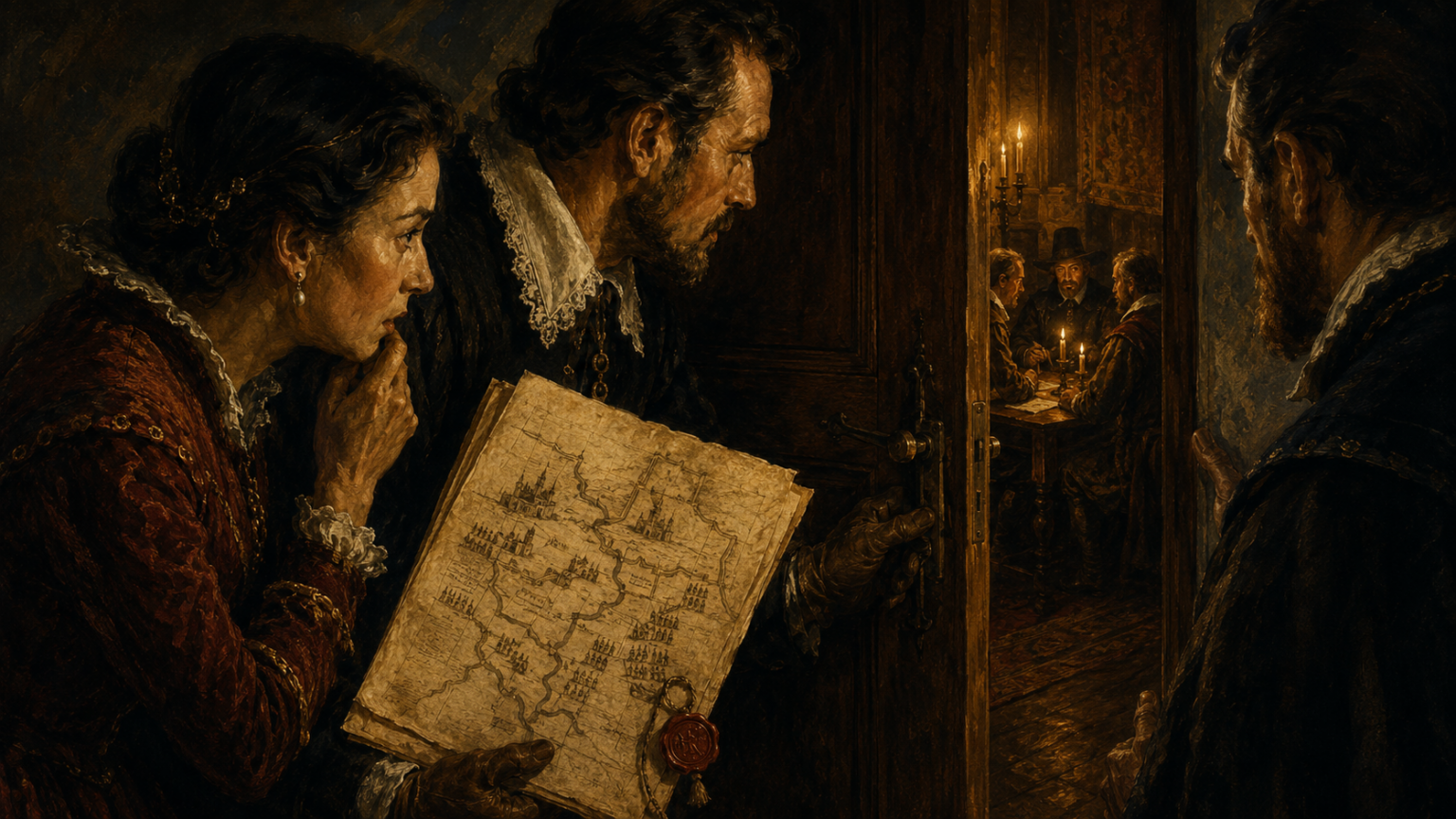
Illustration by Bookinlight Art Desk
Early Modern History
Eight Books on the Thirty Years’ War
A serious reader’s guide to the war that turned confession, empire, finance, military enterprise, and diplomacy into one of early modern Europe’s defining crises.
By Bookinlight
The Thirty Years War: Europe’s Tragedy
Peter H. Wilson
Not the original published cover
The Thirty Years War
C. V. Wedgwood
Not the original published cover
The Thirty Years’ War
Geoffrey Parker
Not the original published cover
The Thirty Years War: A Documentary History
Tryntje Helfferich
Not the original published cover
Battles of the Thirty Years War
William P. Guthrie
Not the original published cover
The Business of War
David Parrott
Not the original published cover
Westphalia: The Last Christian Peace
Derek Croxton
Not the original published cover
The Thirty Years War: The Holy Roman Empire and Europe, 1618-48
Ronald G. Asch
Not the original published cover
War as a System, Not a Single Cause
The Thirty Years’ War is often introduced as a religious war, then quickly corrected into a dynastic, constitutional, fiscal, imperial, or geopolitical war. The better approach is not to choose one cause. The conflict matters because it shows how those causes became inseparable. The best books on the Thirty Years War do not merely recount campaigns from Prague to Westphalia; they reconstruct a fractured political world in which confessional fear, imperial law, private military contracting, local survival, and diplomatic calculation fed one another. Read together, these eight books turn a familiar catastrophe into a laboratory of early modern state formation and political disorder.
Why the Best Books on the Thirty Years War Disagree
The intellectual value of this reading list lies in its disagreements. Peter H. Wilson restores the Holy Roman Empire to the center of the story. C. V. Wedgwood gives the war narrative force and human atmosphere. Geoffrey Parker’s collaborative volume opens the conflict to European comparison. Tryntje Helfferich lets the actors speak through documents. William P. Guthrie narrows the view to operational violence. David Parrott explains the military market that sustained war. Derek Croxton rethinks the settlement. Ronald G. Asch shows why constitutional and confessional instability inside the Empire cannot be treated as background. Together they show that the war was not one event but a pressure system.
The Reading Lens
The War That Made Europe Legible by Breaking It Apart
These books reshape the Thirty Years’ War by refusing to let it become either a morality tale of religious fanaticism or a tidy preface to the modern state. Their shared lesson is sharper: early modern Europe was held together by institutions that were strong enough to mobilize loyalty but too divided to contain escalation. The war’s tragedy came from that contradiction. It was fought through armies, treaties, sermons, taxes, offices, estates, mercenaries, and memories; its history must therefore be read across military, political, social, and diplomatic registers at once.
Central Question
How does a political order survive when every mechanism of compromise becomes another instrument of conflict?
Historical Pressure
The war exposed the strain between confessional pluralism, imperial law, dynastic ambition, and the expanding capacity to finance organized violence.
Why These Books
They belong together because each reveals a different layer of the same crisis: narrative, structure, evidence, battle, military economy, settlement, and imperial constitution.
Eight Books for Reading the War in Depth
The Thirty Years War: Europe’s Tragedy
Peter H. Wilson
Not the original published cover
The Thirty Years War: Europe’s Tragedy
Peter H. Wilson
Best for: Readers who want the most comprehensive modern synthesis.
Difficulty: Advanced
Intellectual role: The structural anchor of the list.
Bookinlight Rating: ★★★★★
Wilson’s great achievement is to restore scale without flattening complexity. The book resists the habit of treating the Holy Roman Empire as a mere battlefield for stronger monarchies. Instead, it explains the Empire as a political order with legal traditions, institutional mechanisms, confessional settlements, and internal weaknesses. This is the book to read when one wants the war’s European dimensions without losing the dense imperial core that made the conflict so difficult to end.
Bookinlight Note: Read Wilson with a notebook of institutions rather than personalities: elector, estate, emperor, league, diet, city, army, and treaty.
The Thirty Years War
C. V. Wedgwood
Not the original published cover
The Thirty Years War
C. V. Wedgwood
Best for: Readers who want narrative force and historical atmosphere.
Difficulty: General to Intermediate
Intellectual role: The literary narrative gateway.
Bookinlight Rating: ★★★★★★
Wedgwood remains valuable because she gives the war dramatic intelligibility. Her prose foregrounds decision, contingency, ambition, fear, and exhaustion. Later scholarship has revised many emphases, but her book still performs an essential service: it helps readers feel the war as an unfolding human catastrophe rather than a diagram of structures. For first-time readers, it can make the chronology memorable before more specialized works complicate it.
Bookinlight Note: Pair Wedgwood with Wilson: one gives momentum and character, the other gives institutional depth and corrective scale.
The Thirty Years’ War
Geoffrey Parker
Not the original published cover
The Thirty Years’ War
Geoffrey Parker
Best for: Readers seeking a concise multi-author scholarly frame.
Difficulty: Intermediate
Intellectual role: The comparative European bridge.
Bookinlight Rating: ★★★★★★
Parker’s volume is especially useful because it refuses a single-author tunnel. Its collaborative form matters: the war becomes a European field of linked problems, from diplomacy and dynastic strategy to regional devastation and military change. It is not as expansive as Wilson, nor as atmospheric as Wedgwood, but it is a strong bridge between narrative history and thematic analysis.
Bookinlight Note: Use this book as a seminar text: each chapter can become a separate question about causation, scale, and interpretation.
The Thirty Years War: A Documentary History
Tryntje Helfferich
Not the original published cover
The Thirty Years War: A Documentary History
Tryntje Helfferich
Best for: Readers who want primary sources and classroom-ready evidence.
Difficulty: Intermediate
Intellectual role: The evidentiary core.
Bookinlight Rating: ★★★★★★
Helfferich’s collection changes the reader’s posture. Instead of receiving the war as a finished historical argument, we encounter manifestos, treaties, letters, reports, and political justifications. The result is bracing: actors do not speak in the neat categories historians later apply to them. They combine law, faith, property, honor, fear, and necessity. This sourcebook is indispensable for anyone writing, teaching, or arguing about the war’s meanings.
Bookinlight Note: Ask one question while reading: which words do contemporaries use when they are trying to make violence appear legitimate?
Battles of the Thirty Years War
William P. Guthrie
Not the original published cover
Battles of the Thirty Years War
William P. Guthrie
Best for: Readers focused on campaigns, tactics, and operational chronology.
Difficulty: Advanced
Intellectual role: The battlefield corrective.
Bookinlight Rating: ★★★★★
Guthrie narrows the scale and, in doing so, clarifies what broad narratives can obscure. Battles were not interruptions in political history; they were mechanisms through which bargaining power, territorial control, supply systems, and reputations changed. The book is specialized, but it matters because the Thirty Years’ War cannot be understood only through treaties and manifestos. Operational realities shaped what statesmen could imagine.
Bookinlight Note: Best read alongside maps: notice how logistics, not just ideology, determines the rhythm of violence.
The Business of War
David Parrott
Not the original published cover
The Business of War
David Parrott
Best for: Readers interested in military entrepreneurship and state capacity.
Difficulty: Advanced
Intellectual role: The material and fiscal explanation.
Bookinlight Rating: ★★★★★★
Parrott’s book is not only about the Thirty Years’ War, but it is crucial for understanding how such wars could be sustained. It challenges simple stories in which modern states steadily monopolized violence. Military enterprise, contracting, private initiative, credit, and noble ambition all remained central. This matters because the war’s violence was not produced by ideology alone; it was organized through markets and institutions capable of feeding conflict long after its original causes had mutated.
Bookinlight Note: This is the book that makes Wallenstein look less like an exception and more like a symptom of an entire military economy.
Westphalia: The Last Christian Peace
Derek Croxton
Not the original published cover
Westphalia: The Last Christian Peace
Derek Croxton
Best for: Readers interested in diplomacy, settlement, and political myth.
Difficulty: Intermediate
Intellectual role: The peace settlement reconsidered.
Bookinlight Rating: ★★★★★★
Croxton’s study is valuable because it approaches Westphalia not as a slogan but as a diplomatic achievement produced by delay, exhaustion, bargaining, and conceptual adjustment. The book helps readers move beyond the overused idea that Westphalia simply invented modern sovereignty. Instead, it shows a settlement deeply embedded in Christian, imperial, dynastic, and legal assumptions. It ended a war, but it did not create a clean secular modernity overnight.
Bookinlight Note: Read Croxton whenever someone uses “Westphalian order” too quickly; the historical settlement is stranger and more negotiated than the formula suggests.
The Thirty Years War: The Holy Roman Empire and Europe, 1618-48
Ronald G. Asch
Not the original published cover
The Thirty Years War: The Holy Roman Empire and Europe, 1618-48
Ronald G. Asch
Best for: Readers who want the imperial and constitutional center of the war.
Difficulty: Intermediate
Intellectual role: The imperial-context guide.
Bookinlight Rating: ★★★★★
Asch is especially helpful for readers who want a focused account that keeps the Holy Roman Empire and Europe in the same frame. The book’s strength lies in its insistence that the conflict cannot be explained by importing later ideas of statehood into the seventeenth century. Imperial law, princely rights, confessional guarantees, and European intervention formed one unstable arena. This makes the war less simple, but far more historically intelligible.
Bookinlight Note: Use Asch as a corrective to maps that make the Empire look like emptiness; politically, it was dense terrain.
How These Books Speak to One Another
The strongest sequence begins with Wedgwood’s narrative, moves to Wilson’s synthesis, then turns to Parker and Asch for interpretive framing. Helfferich should be opened throughout, not saved for the end, because documents prevent the reader from accepting any retrospective explanation too easily. Guthrie and Parrott then expose the material machinery of war: battles, supply, command, credit, and enterprise. Croxton completes the arc by showing that peace was not merely the absence of battle but a painstaking reconstruction of political language. Read together, the books turn the Thirty Years’ War into a study of how institutions fail, adapt, and survive.
The Reading Map
| Book | Difficulty | Rating | Why It Matters |
|---|---|---|---|
| The Thirty Years War: Europe’s Tragedy | Advanced | ★★★★★ | The fullest modern synthesis. |
| The Thirty Years War | General to Intermediate | ★★★★★★ | The clearest narrative gateway. |
| The Thirty Years’ War | Intermediate | ★★★★★★ | Connects regional and European frames. |
| The Thirty Years War: A Documentary History | Intermediate | ★★★★★★ | Lets the evidence speak directly. |
| Battles of the Thirty Years War | Advanced | ★★★★★ | Restores battle and logistics. |
| The Business of War | Advanced | ★★★★★★ | Explains military enterprise. |
| Westphalia: The Last Christian Peace | Intermediate | ★★★★★★ | Demystifies the peace settlement. |
| The Thirty Years War: The Holy Roman Empire and Europe, 1618-48 | Intermediate | ★★★★★ | Keeps the Empire central. |
Where to Begin
- Entry point: Begin with C. V. Wedgwood if you need narrative momentum and human drama.
- Historical background: Move to Ronald G. Asch to understand the Holy Roman Empire as a political order.
- Conceptual foundation: Read Peter H. Wilson for the fullest integrated interpretation.
- Critical perspective: Use Tryntje Helfferich to test every argument against contemporary voices.
- Contemporary relevance: Read Derek Croxton before using Westphalia as a shortcut for sovereignty.
- Advanced reflection: Add David Parrott and William P. Guthrie to see how war was financed, contracted, supplied, and fought.
External Sources for Further Reading
NYRB page for C. V. Wedgwood · Routledge page for Geoffrey Parker · Hackett page for Tryntje Helfferich
Cambridge page for David Parrott · Springer page for Derek Croxton · Springer page for Ronald G. Asch
The Last Margin
The best books on the Thirty Years War matter because they discipline the imagination. They prevent the conflict from becoming a single lesson about fanaticism, sovereignty, or modernity. They show instead a Europe where overlapping loyalties could become fatal, where law could coexist with devastation, where war could be both principled and entrepreneurial, and where peace required more than victory. The Thirty Years’ War remains so compelling because it is not only a story of breakdown. It is also a story of interpretation: how historians, diplomats, soldiers, subjects, and later readers try to make sense of a political world that almost consumed itself.