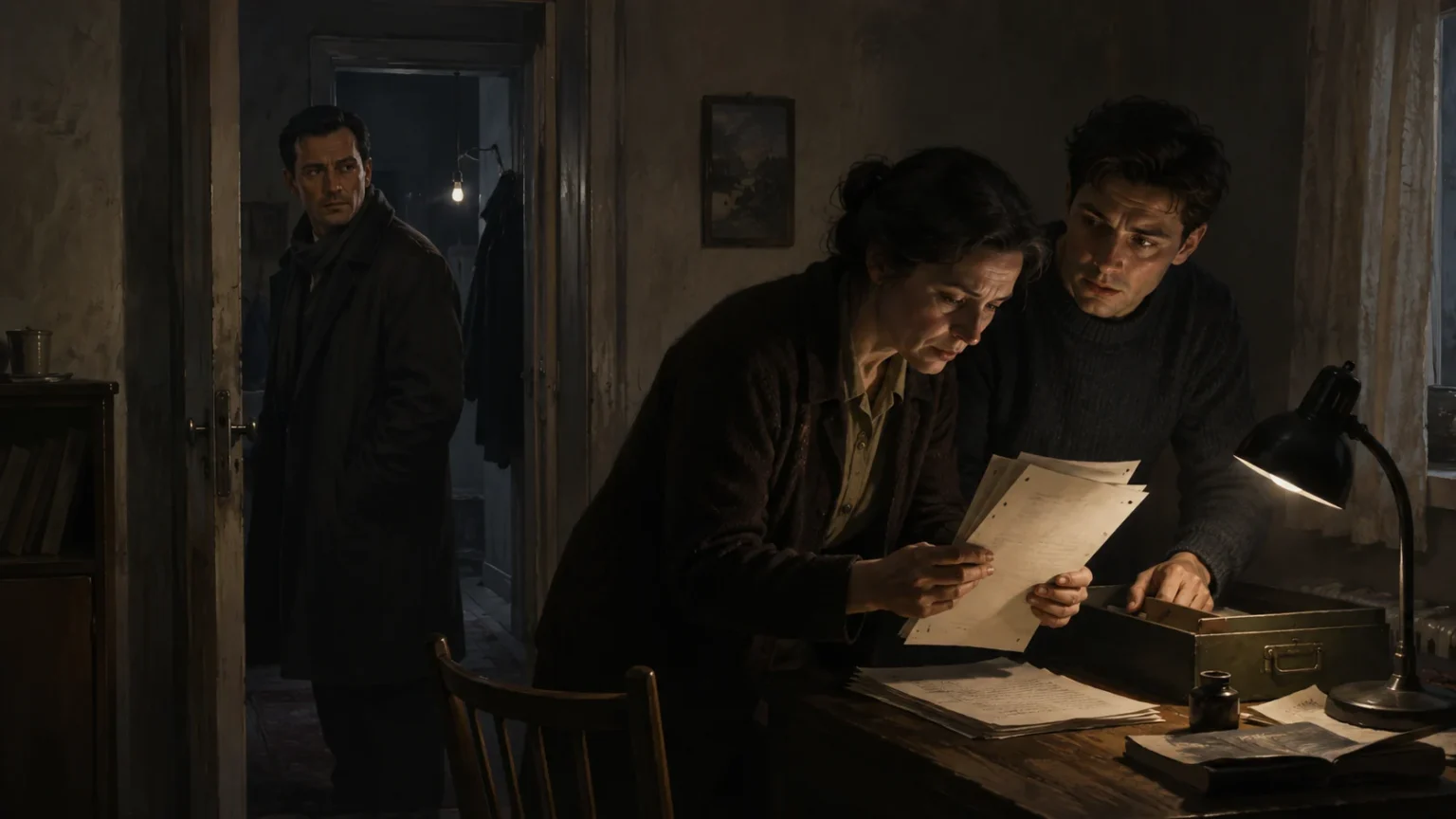
Illustration by Bookinlight Art Desk
The best books on Soviet dissident literature do not form a simple shelf of anti-communist protest. They form a record of how writing survives when public language is captured by the state, memory is criminalized, and ordinary moral perception becomes dangerous. The books gathered here move between fiction, memoir, documentary witness, and philosophical prison prose. Together they show dissent not only as political opposition, but as a literary struggle over reality itself.
In Soviet literary history, dissent often begins before a writer publicly declares it. It may appear as a hidden manuscript, a remembered poem, a story smuggled abroad, a courtroom statement, a forbidden archive, or a fictional scene that refuses official optimism. These seven works belong together because each exposes a different pressure point in the Soviet system: the Great Purge, the Gulag, censorship, ideological language, the policing of memory, and the moral solitude of the individual before power.
By Bookinlight
Dissent as the Defense of Reality
Soviet dissident literature is not unified by genre. It is unified by a moral procedure: the recovery of truthful description from a political system that tried to monopolize truth. These books ask how a person can remember, narrate, judge, and remain inwardly alive when law, language, and literary publication are subordinated to ideology.
The Reading Map
| Book | Difficulty | Rating | Why It Matters |
|---|---|---|---|
| Sofia Petrovna | General | ★★★ ★★ | Shows terror entering ordinary Soviet life through language, queues, and denial. |
| Journey into the Whirlwind | General to Intermediate | ★★★★ ½ | Turns arrest, interrogation, and deportation into disciplined moral testimony. |
| Kolyma Stories | Advanced | ★★★ ★★ | Redefines camp writing through austerity, fragmentation, and anti-sentimental witness. |
| Hope Against Hope | Intermediate | ★★★ ★★ | Makes memory itself a form of literary resistance. |
| The Gulag Archipelago | Advanced | ★★★ ★★ | Transforms scattered testimony into a moral anatomy of the camp system. |
| Life and Fate | Advanced | ★★★ ★★ | Places Soviet power within a vast moral comparison of twentieth-century totalitarianism. |
| A Voice from the Chorus | Intermediate to Advanced | ★★★★ ½ | Shows dissent as spiritual, literary, comic, and polyphonic consciousness. |
Seven Books on Soviet Dissident Literature
Lydia Chukovskaya’s Sofia Petrovna is one of the clearest fictional accounts of how Stalinist terror entered the everyday moral imagination. Its power lies in restraint. The novella follows a loyal Soviet widow whose son is swallowed by the machinery of accusation; what matters is not only the arrest, but the gradual collapse of all interpretive categories available to her. Official language tells her one thing, maternal knowledge another, and the social world around her teaches silence as a form of survival. The result is a study of terror as cognitive disorientation.
The book belongs here because Soviet dissident literature is often born before the vocabulary of dissidence becomes public. Chukovskaya wrote from within a historical catastrophe that could not yet be openly named. The novella’s spare realism refuses the heroic pose; instead, it shows how ordinary people are trained to mistrust their own perception. Readers new to Soviet literature will find it accessible, brief, and devastating. More advanced readers will recognize its technical precision: the bureaucratic queue, the rumor, the carefully phrased letter, and the missing explanation become literary forms.
After reading Sofia Petrovna, dissent appears less as open rebellion than as a fragile fidelity to what one has seen. The novella changes the theme by shifting attention from prison camps to the social atmosphere that makes prison possible.
Eugenia Ginzburg’s Journey into the Whirlwind is indispensable because it records the passage from ideological belonging into state abandonment. Ginzburg was not an outsider to Soviet life; she was a committed intellectual, a teacher, and a party member. The memoir’s central drama is therefore not simply that an innocent person is arrested, but that an entire moral and political universe turns against one of its own. Her account of interrogation, accusation, transport, and imprisonment reveals the system’s logic from the inside: confession is demanded before guilt is intelligible, and biography is rewritten by police procedure.
The book belongs in an article on Soviet dissident literature because it shows how witness becomes a new intellectual identity. Ginzburg’s prose is not merely a survivor’s report; it is a reconstruction of conscience under pressure. She retains a striking capacity for observation: voices, faces, cells, rumors, gestures of kindness, and humiliations all become evidence. Readers who want narrative momentum will find the memoir gripping. Readers interested in political theory will find a concrete study of how totalitarian systems manufacture consent, isolation, and self-betrayal.
Ginzburg alters the reader’s understanding of dissent by making it inseparable from retrospection. To dissent, in this book, is to return to the moment when language was corrupted and describe it without revenge, exaggeration, or amnesia.
Varlam Shalamov’s Kolyma Stories stands apart from nearly every other work of camp literature because it distrusts moral elevation. Where some prison writing discovers spiritual endurance, Shalamov often shows a world in which hunger, cold, exhaustion, and fear reduce human beings below familiar ethical narratives. His stories are brief, hard, and deliberately anti-rhetorical. They do not ask the reader to admire suffering; they ask the reader to understand what extreme coercion does to memory, friendship, language, and the body.
This book belongs at the center of Soviet dissident literature because it refuses both official Soviet lies and comforting anti-Soviet simplifications. Shalamov is not interested in turning the camp into a stage for redemption. His literary contribution is colder and more radical: he makes form answer to historical damage. The fragment, the anecdote, the sudden reversal, and the flat ending become ways of refusing false coherence. For readers of modernism, testimony, trauma studies, or political violence, Kolyma Stories is a necessary text.
The book changes the reader’s understanding of dissent by making style itself an ethical decision. Shalamov’s spareness is not minimalism as taste; it is minimalism as witness. After reading him, the question is no longer only what happened in the camps, but what kind of literary form can speak after such damage without falsifying it.
Nadezhda Mandelstam’s Hope Against Hope is one of the great books about the preservation of literature under terror. Its immediate subject is Osip Mandelstam’s persecution, arrest, exile, and death, but its deeper subject is the fragile afterlife of poetry in a society designed to erase inconvenient voices. Nadezhda Mandelstam remembers not only events, but tones of fear, habits of concealment, networks of friendship, literary judgments, and the terrifying importance of memorization when manuscripts can be confiscated.
The book belongs here because Soviet dissident literature depends on memory as much as publication. Mandelstam shows that when print becomes dangerous, the human mind can become an archive. Her memoir is not neutral. It is sharp, severe, sometimes unforgiving, and deeply concerned with literary value. She insists that poetry is not an ornament to political history; it is one of the things political violence wants to destroy because it forms an independent order of meaning.
Readers interested in Russian poetry, Stalinist cultural policy, or the ethics of remembrance will find the book inexhaustible. It changes the theme by moving dissent from courtroom or camp into the intimate space of memory. In Mandelstam’s hands, remembering a line accurately becomes a moral act. The dissident writer is not only the one who speaks; it is also the one who keeps another voice from disappearing.
Aleksandr Solzhenitsyn’s The Gulag Archipelago is not merely a book about Soviet forced labor camps; it is a literary investigation into how a civilization of arrest, interrogation, denunciation, and administrative violence becomes normalized. Its scale is monumental, but its method is built from fragments: personal memory, survivor testimony, legal detail, irony, moral commentary, and historical reconstruction. Solzhenitsyn turns the camp system into an archipelago because it is both dispersed and connected, both hidden and structurally central to Soviet power.
The book belongs in any serious account of Soviet dissident literature because it changed the global vocabulary of Soviet repression. It did not simply report; it accused. It named mechanisms, habits, evasions, compromises, and spiritual dangers. Its literary force comes from the fusion of witness and judgment. Solzhenitsyn’s voice can be polemical, prophetic, sarcastic, and theological, but the book’s central contribution remains unmistakable: it refuses to let state violence remain abstract.
This is demanding reading, especially in its unabridged form, but it rewards readers who want to understand dissidence as an act of historical counter-archive. The book changes the theme by making the writer a collector of forbidden evidence. Here literature becomes tribunal, memory becomes indictment, and private suffering becomes a public record capable of outliving the regime that tried to bury it.
Vasily Grossman’s Life and Fate expands Soviet dissident literature beyond memoir and prison testimony into the form of the epic novel. Set around the Battle of Stalingrad, it moves through families, laboratories, military command, the Gulag, German camps, Jewish catastrophe, and intimate private life. Its central intellectual contribution is the moral comparison it draws between systems that subordinate the person to historical necessity. Grossman does not flatten differences between Nazi and Soviet violence, but he insists that ideological power becomes monstrous when it treats human beings as material for historical design.
The novel belongs here because it was suppressed not for a single slogan but for its entire moral architecture. Grossman had been a Soviet war correspondent and a witness to the Holocaust in the East; his fiction carries that burden into a vast meditation on freedom, kindness, fear, and compromised loyalty. Readers who admire Tolstoyan scale will find a twentieth-century counterpart: many lives, many fronts, and a recurring question about whether goodness can survive political absolutism.
The book changes the reader’s understanding of dissent by showing that resistance can be embedded in narrative structure. Grossman’s dissent lies in his refusal to grant history the last word over the person. Against systems of classification, he gives the reader irreducible human particularity. That is why the novel feels both historical and philosophical.
Andrei Sinyavsky’s A Voice from the Chorus, written under the pen name Abram Tertz, gives Soviet dissident literature one of its strangest and most original forms. Based on letters and reflections from imprisonment after the Sinyavsky-Daniel trial, the book is not a conventional memoir. It moves through anecdotes, dreams, theological speculation, literary criticism, folklore, jokes, memories, fragments of conversation, and sudden meditations on freedom. Its “chorus” is not decorative; it is the form of a mind refusing to be reduced to the identity of prisoner.
This work belongs here because Sinyavsky represents a crucial late Soviet transition: the writer prosecuted not for an act of violence, but for the act of writing and publishing outside official norms. His dissidence is inseparable from aesthetics. He challenged Socialist Realist expectations not only politically, but imaginatively, by defending the fantastic, the grotesque, and the spiritually unruly against ideological seriousness.
Readers who want linear camp narrative should begin elsewhere. Readers who want to understand the interior freedom of the dissident writer will find this book extraordinary. It changes the theme by showing that dissent can be comic, mystical, digressive, and formally disobedient. Sinyavsky does not merely testify against prison; he writes in a manner that prison cannot organize. His prose keeps open a zone of play, memory, and metaphysical speculation where the state’s categories lose authority.
How to Read This Shelf
A useful path is to begin with Sofia Petrovna or Journey into the Whirlwind, then move to Hope Against Hope and Kolyma Stories. The Gulag Archipelago and Life and Fate should be read slowly, with attention to their architecture. A Voice from the Chorus works best after the reader has already encountered more direct forms of witness, because Sinyavsky’s originality depends on his refusal to remain inside those forms.
Together, these books show that Soviet dissident literature is not only a literature of exposure. It is a literature of form under pressure. The hidden novella, the camp story, the preserved poem, the documentary indictment, the suppressed epic, and the prison notebook all ask how writing can remain answerable to reality when public reality has been coerced.
FAQ
It is writing that challenged, evaded, documented, or outlived Soviet ideological control. It includes banned fiction, memoir, camp testimony, samizdat, exile literature, and works suppressed by censorship.
Sofia Petrovna is the most accessible starting point. Journey into the Whirlwind is the best first memoir. The Gulag Archipelago is essential, but it is better approached after shorter works.
They are both. Their historical value lies in testimony and suppressed memory; their literary value lies in how they transform fear, censorship, and moral pressure into form.
Because Soviet dissent was not limited to factual exposure. Fiction could reveal the inner structure of ideological life, the corruption of language, and the moral cost of obedience.
The Last Margin
The best books on Soviet dissident literature leave the reader with a demanding idea: truth is not preserved by institutions alone. It is preserved by memory, style, courage, stubborn accuracy, and the refusal to let official language replace lived reality. These works remain necessary because they show literature doing one of its most serious tasks: keeping human experience legible when power tries to make it disappear.